
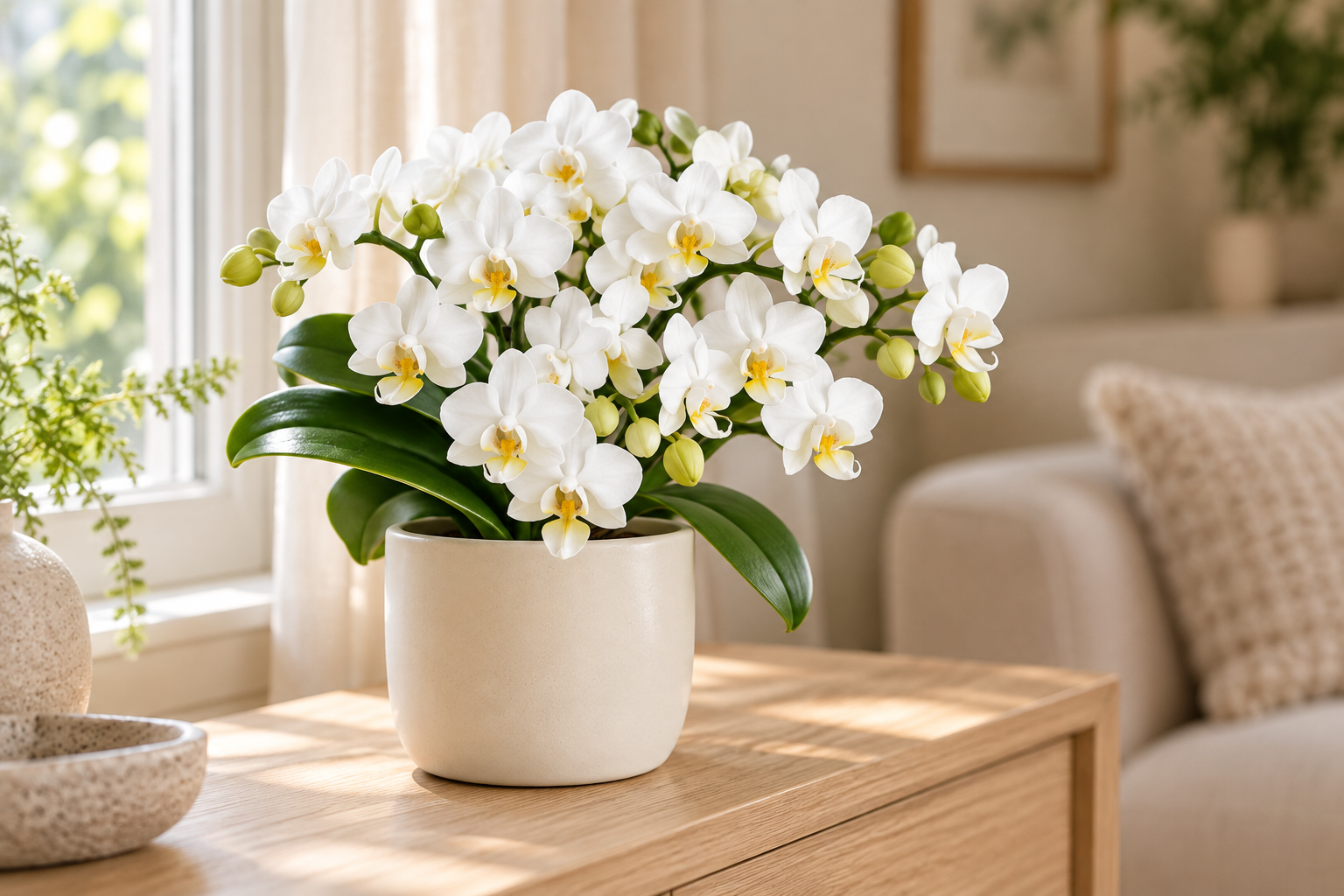
This plant at Exotenherz
Check the shop offer for current availability, price and what is included.
Product and delivery details are given in the individual offer.
Your care table
| Topic | What to do | Why it helps |
|---|---|---|
| Position | Keep bright with filtered daylight and distance from hot window glass. | Many flowers can be visible; green leaves also need sufficient light afterwards. |
| Watering | Check compost and pot weight; water thoroughly when bark has largely dried. | Roots need air between waterings without completely drying out for days. |
| Water quality | Use room-temperature, preferably low-lime water and let the inner pot drain afterwards. | Cold water and a remaining water level stress the warm root zone. |
| Leaf centre | Carefully absorb water from the crown and leaf axils. | Moisture may persist between close leaves and encourage rot. |
| Room climate | Keep consistently warm, preferably above 16 °C, without cold draughts or direct heating warmth. | Sudden temperature changes may cause drop particularly during bud development. |
| Feeding | Feed weakly during active growth according to the orchid fertiliser label; occasionally water without fertiliser. | New roots and leaves need nutrients, while concentrated salt residues can harm them. |
| Repotting | Replace broken-down bark with airy orchid compost; leave space for firm healthy aerial roots. | Dense old bark stays wet longer, and an unnecessarily large pot prolongs this wetness. |
| Flower stems | Remove fully dry stems; assess healthy green stems according to plant condition. | A side shoot is possible, but a weakened plant first needs strong roots and foliage. |
Check the compost and pot weight. The care table explains how far the compost may dry.
Water only when needed. The water should reach the root ball without spilling over the rim.
Remove surplus water from the saucer or cachepot. Then return the plant to a suitable position.
A small bouquet with yellow flower centres
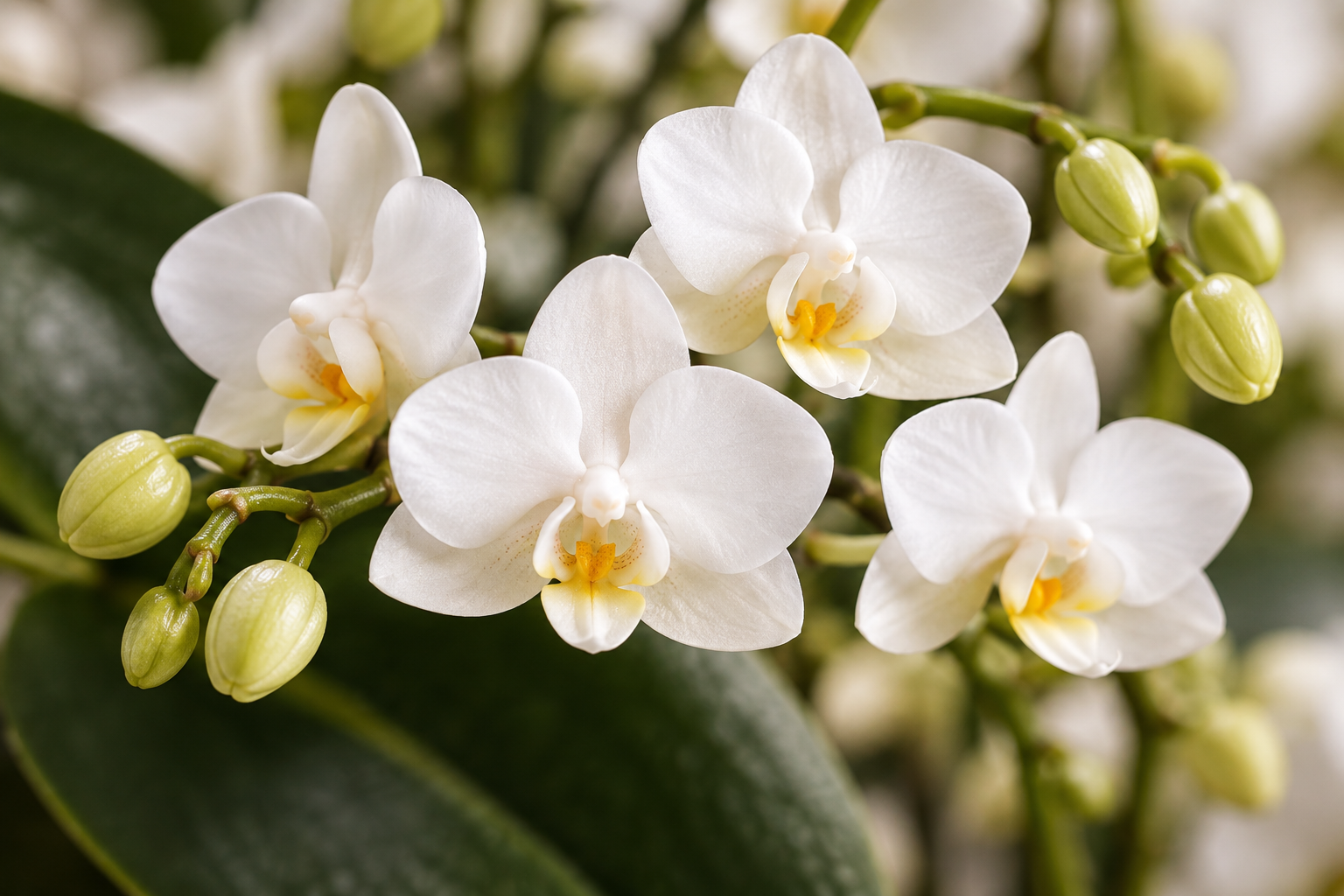
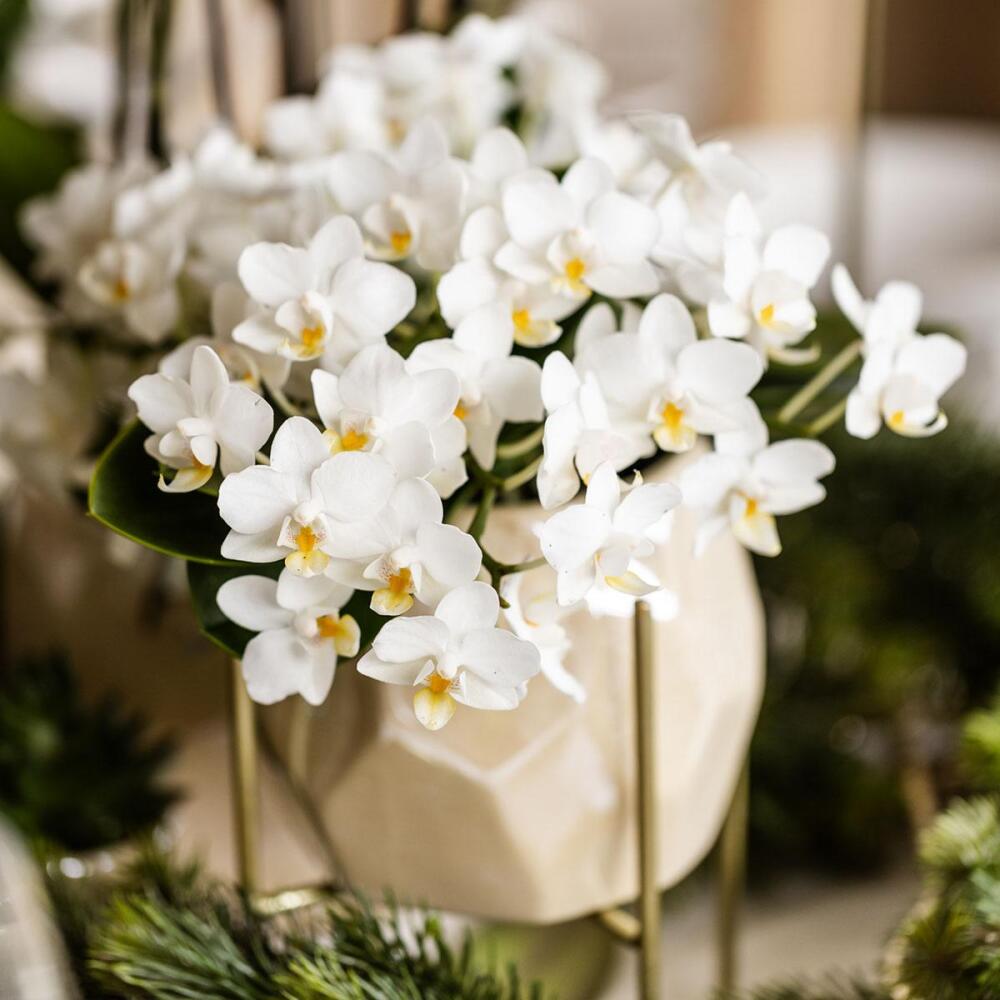
Nazaré shows its flowers in many small groups spread above a strong green leaf base. White to pale-ivory surfaces catch soft daylight while yellowish lips mark the centre of each flower. Closed oval buds sit between them. The checked original shows a compact branched shape whose individual flowers are as appealing close up as the full bouquet. On a low table or window console it leaves the view into the room clear. Keep sufficient distance from the table edge: a passing sleeve should neither strip flowers nor catch a support stick.
Nazaré and its orchid roots
Nazaré is a named Phalaenopsis selection from Kolibri’s Blossom family. It belongs to the orchid family and is cultivated as a hybrid. Many roots of its wild relatives sit on branches rather than growing in heavy garden soil. Root space is therefore decisive for care at home too. Firm fleshy roots cling to airy bark and may grow beyond the pot edge. Thicker green leaves sit on a short plant base, from which new flower stems later arise. A faded bouquet is thus not a used-up cut-flower arrangement. The orchid remains a living plant whose next development may be new roots or a fresh leaf.
Unpack the flower bouquet gently
The specific offer gives a nine-centimetre growing pot. No fixed total height is specified. While unpacking, one hand supports the pot and the other gently releases packaging from buds and stems. Do not pull the plant out by its floral crown. Existing supports initially remain; carefully free trapped leaves. Then check whether water stands in the outer container and how moist the compost already is. The distribution of open flowers and buds shown in photographs changes continuously. A decorative outer pot in the interior scene describes styling; it does not enlarge delivery contents. For later care the inner pot must remain easy to remove.
A bright table needs a bright permanent position
Nazaré is particularly easy to appreciate at a table centre when daylight falls sideways onto the flowers. Check leaves too: a position far behind the window may look attractive yet receive too little light for further growth. A bright position with filtered sun combines display with cultivation. Screen hot direct summer sun behind glass. During ventilation the orchid does not stand in cold airflow; above a radiator flowers and roots often dry faster. Consistent warmth helps transition from transport to living room. An unopened bud may react to the change. Frequent movement makes light and temperature harder to assess as possible causes.
Assess moisture with your hands
Remove the inner pot before watering and compare its weight with its last freshly watered state. Also look into the bark and, in a transparent pot, at firm roots. These often look more silvery when dry and greener after watering; together with the compost this is a useful indication. With largely dried bark, supply thoroughly using room-temperature water and drain completely. Constant wetness is as unfavourable as prolonged complete drying. The leaf centre stays dry. Carefully absorb any water collected there. A weekly checking day is practical, but watering follows actual demand in the particular room.
Airy bark and moderate feeding
After some time old bark loses its coarse structure. Small decomposed pieces may make root space denser and persistently moister. Then changing to suitable airy orchid compost is useful, preferably during active roots and after flowering. Loosen the old root ball gently, protecting firm healthy roots. Soft dead parts can be removed with clean tools. A suitable pot with drainage holes suffices; a large reserve of unused wet compost does not help. During visible growth weakly dosed orchid fertiliser supports supply according to the label. Water with plain water between applications so salts do not constantly accumulate. Pale flowers need no special colour care.
Nazaré remains after the white flowers
When the final flower falls, first assess the whole plant. You can remove a fully dry stem. A firm green stem can be shortened above a suitable node and later develop a side shoot. This does not work on every plant; weak foliage makes recovery the priority. Meanwhile Nazaré keeps its bright warm position. Occasionally look under leaves and around root bases to notice pests or soft areas early. With limp leaves, check roots before giving more water. Later new flowering may again form a white bouquet. Shape, extent and timing nevertheless follow this orchid’s development.
One plant, several views
Good to know
What does the name Nazaré mean ?
It denotes breeder Kolibri’s separately named Phalaenopsis selection within its Blossom family.
How large is the current delivery ?
The specific shop gives a 9 cm growing pot; no fixed total height is specified.
Are all flowers pure white ?
Flower surfaces look white to pale ivory, with yellowish lips at the centre. Light and developmental condition alter the impression.
Can it stay permanently on the table ?
Yes, if sufficient filtered daylight reaches it and the plant receives neither cold draughts nor hot direct sun.
When is watering due again ?
When compost has largely dried. Check weight, bark and firm visible roots together, then drain completely.
Should I stuff aerial roots into the pot ?
Firm healthy aerial roots may remain outside. They are neither shortened for appearance nor forced into dense soil.
What helps with bud loss ?
First check transport changes, cold draughts, warmth and moisture. Bud loss alone is no reason for more fertiliser.
Will it bloom again after flowering ?
Further flowering is possible with suitable cultivation. Keep supplying roots and leaves meanwhile; no date or flower count is promised.
Sources and editorial note
- Exotenherz: offer and original photographs (03.10.2026)
- Kolibri: Nazaré, named Blossom selection (03.10.2026)
- Kolibri: separately named orchid selections (03.10.2026)
- RHS: Phalaenopsis culture (03.10.2026)
- AOS: light, water and compost (03.10.2026)
- NC State: Phalaenopsis, roots and flower structure (03.10.2026)
Shop offer, article number, GTIN, availability and original photographs checked directly on 03.10.2026. Specialist sources read directly. Named breeder selection directly documented; no unconfirmed pure species, ancestry, patent number or fixed delivery height added. Clean unchanged gallery3 original selected; branded originals internal evidence only. Reader checked against Amabilis/Gibraltar and the Hoya reference.