
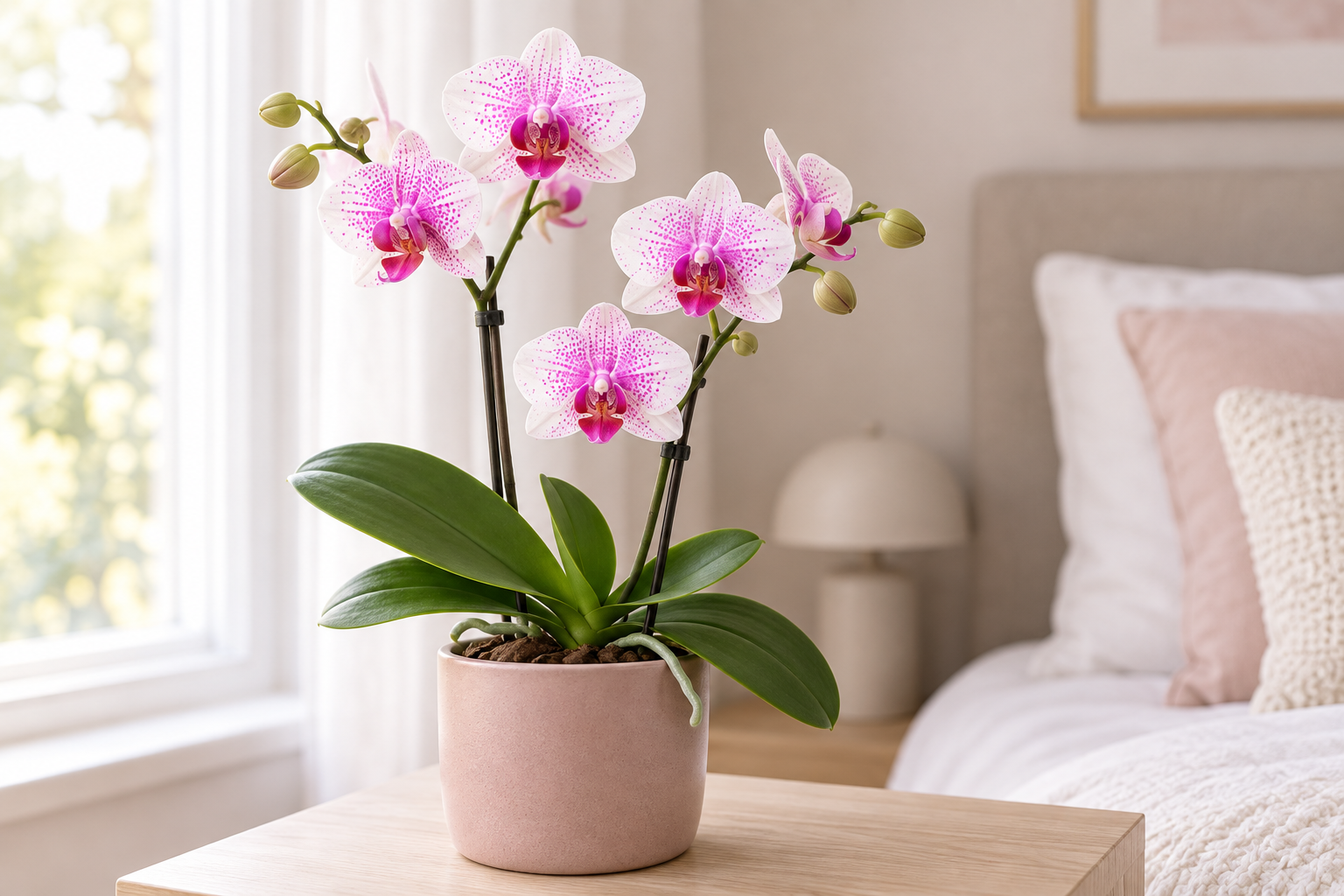
This plant at Exotenherz
Check the shop offer for current availability, price and what is included.
Product and delivery details are given in the individual offer.
Your care table
| Topic | What to do | Why it helps |
|---|---|---|
| Position | Choose a bright place with soft daylight; screen hot direct summer sun. | Flower pattern and foliage are clearly visible while leaves remain protected against scorching. |
| Watering | Lift the inner pot and water thoroughly only when compost has largely dried. | Bark and pot weight indicate demand more reliably than an unchanging weekly rhythm. |
| Drainage | Drain completely after watering and empty the outer pot. | Fleshy orchid roots need air and cannot tolerate a persistent water level. |
| Water quality | Use preferably low-lime room-temperature water and keep the leaf centre dry. | Cold and standing crown moisture stress the sensitive plant base. |
| Room climate | Keep warm with gentle air movement, without cold draughts or hot heating proximity. | Sudden changes can cause bud loss; dry warmth increases water use. |
| Feeding | During fresh growth give weakly dosed orchid fertiliser according to its label. | Firm new roots and foliage need nutrients, but strong concentrations damage the root ball. |
| Repotting | With broken-down bark or crowded roots, use suitable airy orchid compost. | Structure maintains drainage and oxygen; an oversized pot stays unnecessarily wet for longer. |
| Stem care | Remove dry stems and carefully support green flower stems where needed. | Healthy green stems can form side shoots; tight clips must not crush growing parts. |
Check the compost and pot weight. The care table explains how far the compost may dry.
Water only when needed. The water should reach the root ball without spilling over the rim.
Remove surplus water from the saucer or cachepot. Then return the plant to a suitable position.
Many dots on a single flower surface
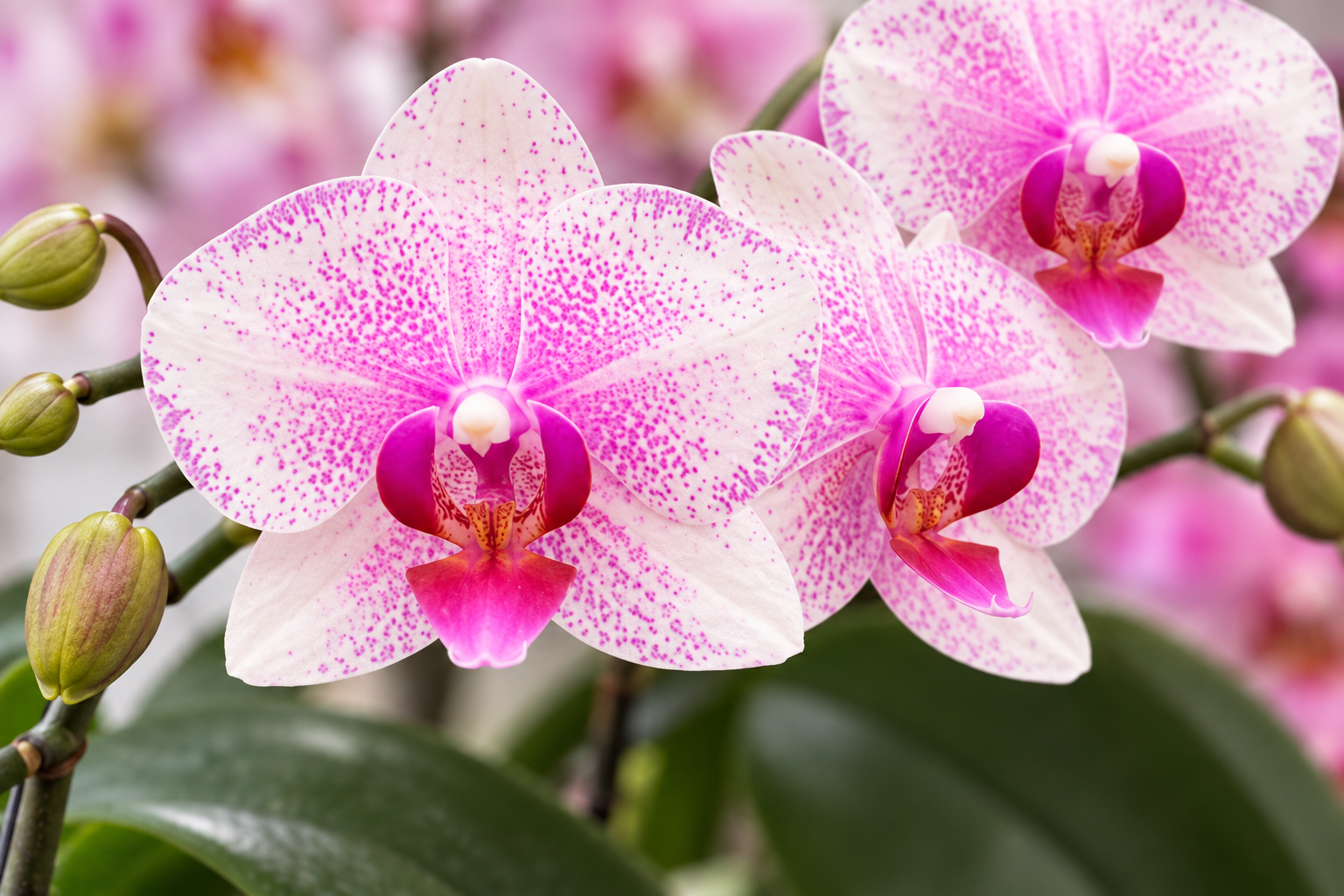
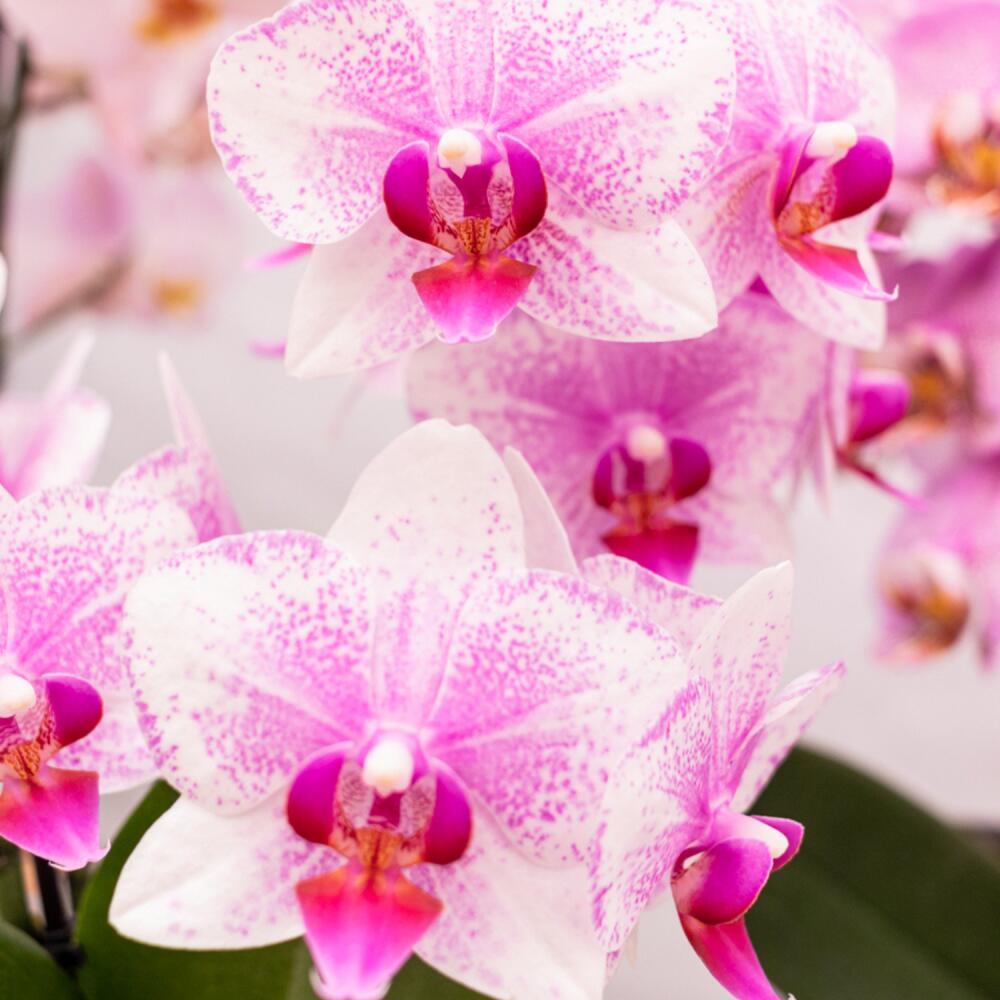
Rotterdam’s pink comes from many small details. Pale flower surfaces, almost white in places, carry a fine magenta dotted pattern. Towards the centre the strong purplish-pink lip stands out. The clean close-up shows how these colours come together without obscuring an individual orchid flower’s shape. Green buds stand beside open flowers. From farther away the impression is softly pink; approaching reveals dots and folds. A calm bright background therefore works particularly well. The plant needs free space around its slender stems so they do not catch when a curtain opens.
A named selection with the Mineral addition
Kolibri lists Rotterdam as its own pink orchid selection. This offer calls it Mineral Rotterdam and places it as a Phalaenopsis hybrid. The name belongs to the cultivated selection; the botanical genus is Phalaenopsis in the orchid family. Its firm leaves grow from a short base, while roots may be visible both in and above the growing pot. Wild relatives often live as epiphytes on branches. Air around roots therefore remains an important part of indoor cultivation. Later new flowering grows from the same plant kept in care. The coloured flower arch may finish while green leaves and firm roots keep working.
Keep it accessible with a nine-centimetre pot
The current individual offer gives a nine-centimetre growing pot and approximately 35 to 40 centimetres total height. This height includes the offered flowering plant and its pot. It describes neither an unchanging later flower stem nor a fixed flower count. The breeder also notes possible differences in stems and flowers. When unpacking hold the pot rather than supports. Slowly release packaging from buds and check that leaves are free. A decorative outer pot should allow the inner pot to be lifted back out. On a narrow console also ensure the container stands securely and stems are protected from passing movement.
Light for leaves beneath the pink
A place near the window helps reveal the orchid’s complete structure: flowers above, firm green leaves below. Filtered daylight suits it, while hot direct summer sun behind glass is screened. An east window can provide a suitable starting point; other windows work with appropriate shading too. Check the place at the strongest sunny time. Leaves must touch neither hot nor winter-cold glass. Even warmth and distance from radiators help buds continue developing. Avoid cold draughts while ventilating. A bedside table suits a permanent position only if sufficient daylight reaches it and care remains accessible.
Look at roots before watering the pot
Regularly lift out the inner pot and check compost condition. Airy bark may largely dry; its interior may still be moist even though the surface looks pale. Healthy firm roots often look more silvery when dry and greener after watering. Together with pot weight this makes demand easier to assess. Supply thoroughly with preferably low-lime room-temperature water, then drain. Empty the outer pot before replacing the plant. Carefully absorb water in leaf axils or the crown. If leaves turn limp first look for firm or damaged roots. Already wet soft roots do not benefit from an extra water bath.
New roots need an open structure
Firm aerial roots may visibly extend beyond the rim. They are not cut off simply because they interrupt the clean leaf silhouette. When old bark breaks down into small dense fragments, root space receives less air and stays wet longer. Suitable fresh orchid compost then makes sense. During repotting after flowering or active root growth, loosen gently and remove only dead soft parts. The new pot must fit remaining roots; excess unused compost holds water unnecessarily long. Weakly dosed orchid fertiliser according to its label accompanies fresh growth. Occasionally water without fertiliser to wash out salt residues. Moderate supply maintains the plant beyond current flowering.
Calmly accompany the next flower arch
After flowering remove a fully dry stem at its base. A healthy green stem can be shortened above a suitable node and form a side shoot. With a weakened orchid, foliage and roots take priority. Light, warmth and moisture checks continue. Guide new flower stems carefully early instead of later bending an already firm arch backwards. Clips should hold without crushing the stem. While tending leaves with a soft damp cloth, inspect undersides and bases too. Later flowering can show the fine dots again. Timing, number and position of flowers remain dependent on cultivation and plant development.
One plant, several views
Good to know
Is Mineral Rotterdam a separate orchid species?
Rotterdam is a named Phalaenopsis hybrid selection from Kolibri. Mineral is the addition in this specific shop offer.
What do the flowers look like?
Pale pink-white surfaces have fine magenta dots and a strongly purplish-pink lip.
Which delivery measurements are given?
The current individual offer gives a 9 cm growing pot and approx. 35–40 cm total height. Living plants may differ.
Are the pictured flower counts promised?
No. Buds open and flowers later fall; number and position differ between living plants.
Can it stand at a window?
Yes, with bright filtered daylight. Avoid hot direct summer sun, cold glass and draughts.
When is compost ready for water again?
When bark has largely dried. Also consider the interior, pot weight and firm visible root condition.
Must a faded green stem go immediately?
Not necessarily. A healthy green stem can branch; remove dry stems and build up weak plants first.
Which compost suits repotting?
Suitable airy bark-structured orchid compost and a fitting pot with free drainage; heavy ordinary potting compost is unsuitable.
Sources and editorial note
- Exotenherz: offer and original photographs (03.10.2026)
- Kolibri: Rotterdam, named pink selection (03.10.2026)
- Kolibri: separately named orchid selections (03.10.2026)
- RHS: Phalaenopsis culture (03.10.2026)
- AOS: water, compost and nutrition (03.10.2026)
- NC State: Phalaenopsis and root care (03.10.2026)
Shop offer, article number, GTIN, availability and originals checked directly on 03.10.2026. Specialist sources read directly. Named breeder selection directly documented. Mineral offer addition made clear; no unconfirmed species, ancestry or patent number added. Clean gallery2 original published unchanged; other branded images internal. Text and product information checked against directly read sources.