
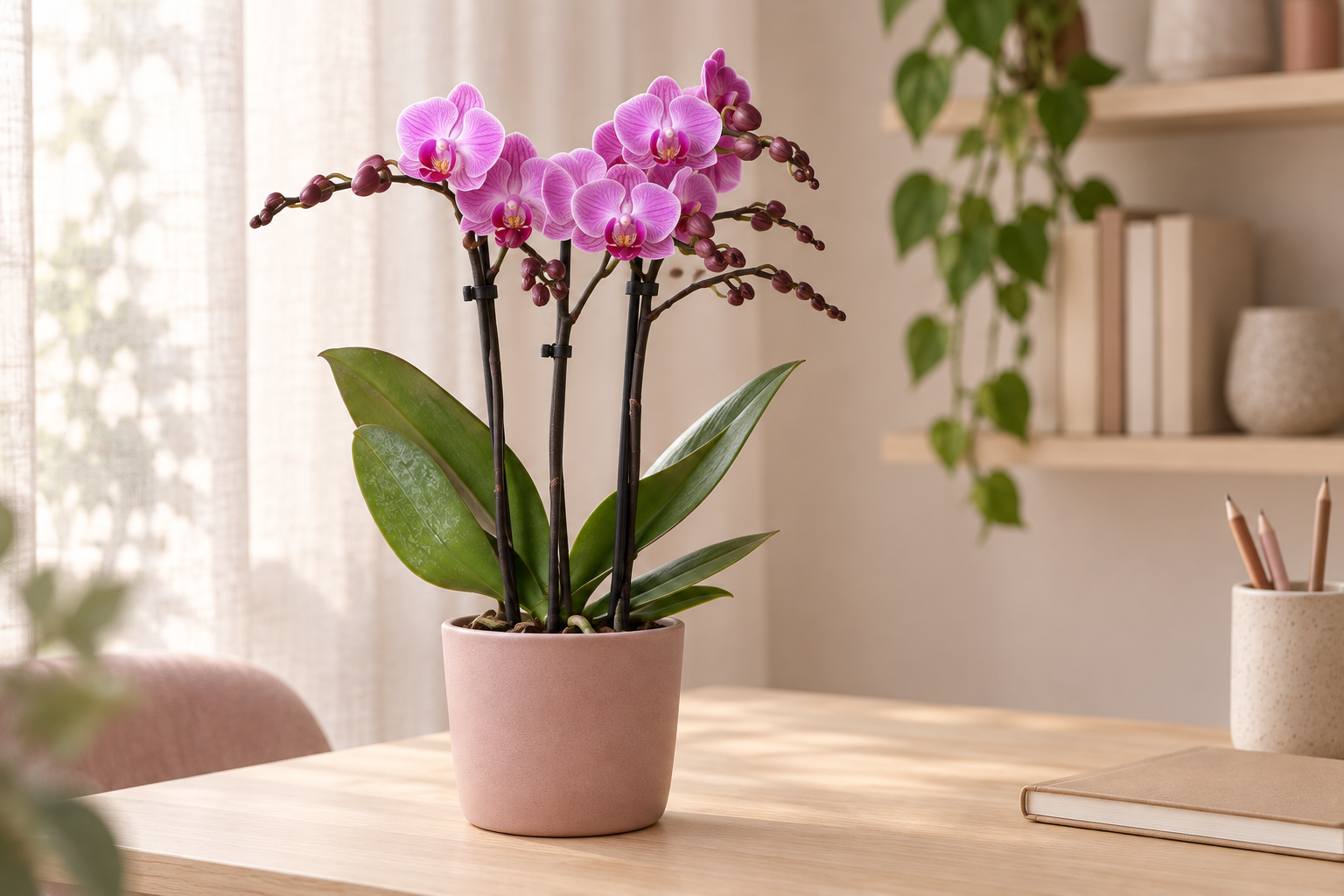
This plant at Exotenherz
Check the shop offer for current availability, price and what is included.
Product and delivery details are given in the individual offer.
Your care table
| Topic | What to do | Why it helps |
|---|---|---|
| Light | Filter hot direct sun at a bright workplace. | A welcoming bright room impression is not enough if leaves actually receive little daylight. |
| Water | Supply the nearly dry root ball with room-temperature water. | Roots need regular moisture without remaining constantly wet enclosed. |
| Drainage | Drain the inner pot well and remove residual outer-pot water. | A filled outer pot does not provide roots with air. |
| Compost | Use loose bark-based orchid compost. | Spaces support epiphytic root cultivation. |
| Warmth | Keep warm without cold ventilation draughts or hot heating proximity. | Buds react sensitively to sudden changes. |
| Feeding | Feed moderately during active growth according to orchid fertiliser label. | Weak roots first need appropriate cultivation, not an extra portion. |
| Repotting | With breaking-down mixture wait for active root tips and a suitable time. | Renewal follows compost condition rather than flower colour. |
| Repeat flowering | Remove dry stems; assess green stems according to plant strength. | New branching is possible, but no fixed flowering is promised. |
Check the compost and pot weight. The care table explains how far the compost may dry.
Water only when needed. The water should reach the root ball without spilling over the rim.
Remove surplus water from the saucer or cachepot. Then return the plant to a suitable position.
A flower pattern for close viewing
Vienna combines a pale pink-lilac base with darker lines. Veins run outwards from the centre and remain visible where two broad petals overlap. A narrow pale edge softly frames flowers. Strong pink areas in the centre lie beside a pale yellow-marked throat. Darker buds complement flowering. On a bright desk the small orchid can show this pattern without elaborate staging. Plan its place so paper piles and the lamp do not push into flower stems. Beyond visual effect, the plant needs room for everyday work and its light.
The name comes from the original producer
The selected offer states Phalaenopsis hybrid, variety Vienna. The 9 cm pot and approximately 35–40 cm height belong to this specific version. Kolibri names Vienna in its own product offer; different decorative containers do not change the selection name. The portrait therefore covers a traceably named hybrid selection without adding a registered grex or parental combination. Fine-veined pink-lilac flowers match the original photograph. They differ from separately named Morelia with richer violet flowers, although both need the same basic Phalaenopsis care. Pot diameter and current height are offer measurements, not promised unchanging final dimensions of the perennial plant.
A workplace can be bright yet protected
Choose a warm place with filtered daylight. If the desk stands in a south- or west-sunny room, check whether foliage gets hot behind glass at midday. A light curtain can soften direct rays. Good light remains important in winter while short cold ventilation draughts are avoided. Do not keep the orchid directly above operating heating. Choose the decorative outer pot so the inner pot can always be removed. Even during a busy working week this accessibility helps more than a deep container hiding moisture and root condition.
Check roots before every watering
Look between bark pieces and check the small pot’s weight. Greenish firm roots in still-moist compost normally do not immediately need another supply. When visible roots become silvery and the ball nearly dry, give room-temperature water. Read root colour together with moisture and weight, not as the sole switch. After watering or brief dipping everything drains freely. Leaves and crown stay above the waterline. Check more often on warm days; with low light the ball may remain moist longer. Neither small daily sips nor a rigid weekly plan reliably suit every room and compost situation.
Aerial roots remain a normal part of its structure
Vienna belongs to Phalaenopsis, whose roots need airy cultivation. Healthy firm aerial roots at the rim are no reason to immediately sink it into a large soil pot. Ordinary potting compost does not replace loose orchid bark. In time a bark mix breaks down and can remain moist progressively longer; renew it during active roots, preferably after flowering. Damaged soft or hollow roots can be removed with clean tools. Preserve healthy parts. The new pot should fit rather than be generously oversized. Do not bury the leaf base in moist compost when planting.
Leaves and roots accompany the next flowering
Moderate orchid feeding follows visible growth and label instructions. Strong new roots and leaves matter more for development than trying to force extra flowers immediately with more fertiliser. After flowering the perennial orchid remains in a suitable place. Remove a fully dry stem. On a strong plant a green stem can be shortened above a healthy bud and form new side growth. Shape and number of later flowers may differ from the sale view. Bright warm consistent cultivation does not guarantee a specific flowering date.
Carefully distinguish small changes
An old lower leaf can gradually age while new leaves and roots continue growing. Several rapidly limp leaves with a wet root ball instead call for root inspection before additional watering. Keep the leaf centre dry; carefully remove accidental water. Also check leaf undersides and branched stem bases for sticky areas or new cotton-like nests. Do not answer bud loss after a temperature change with random moving. First check the actual position. The clean original flower-detail photograph makes Vienna’s fine pattern visible. Both new scenes stay with the same pink-lilac selection and show its current flowering phase without promising a fixed flower count.
One plant, several views
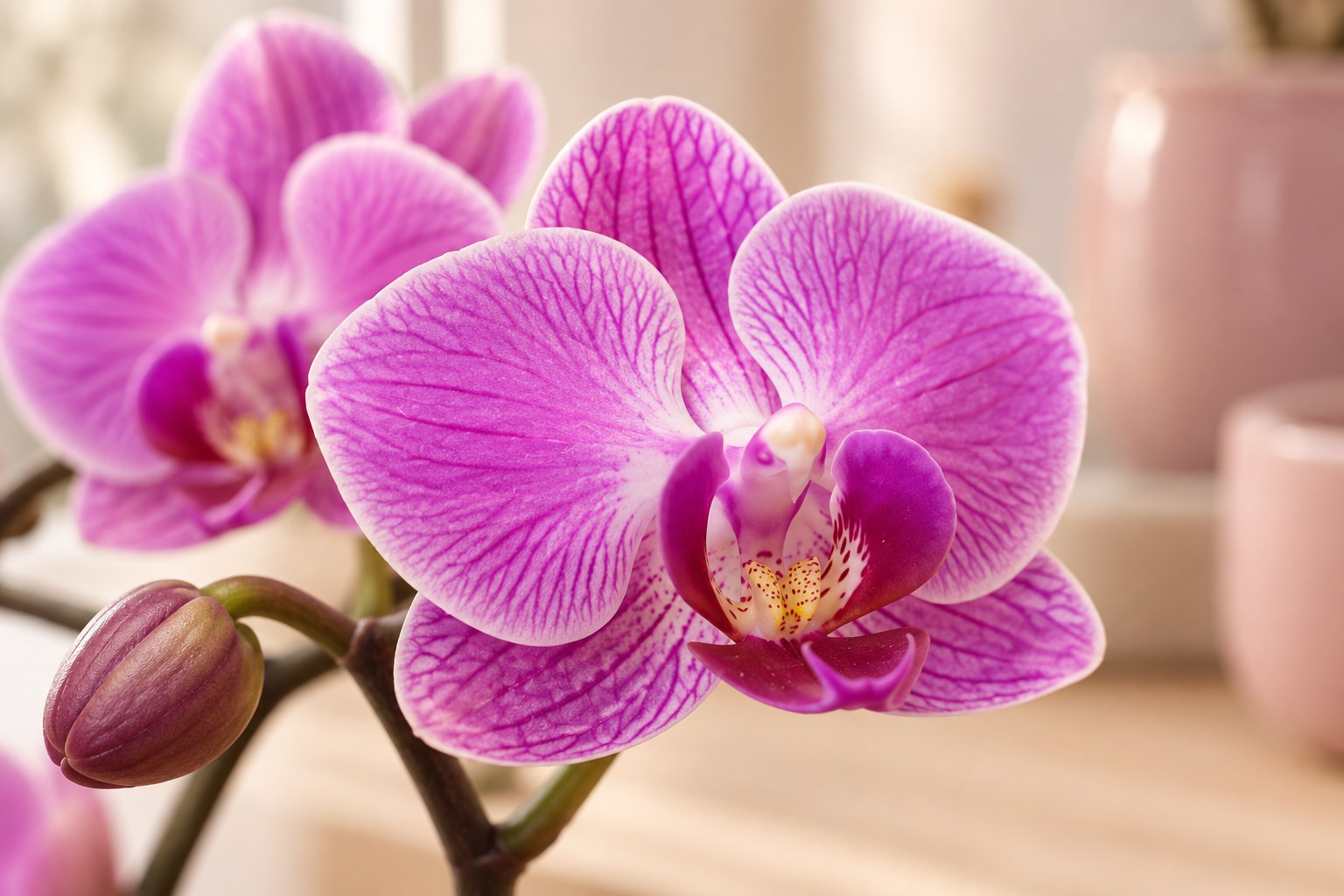
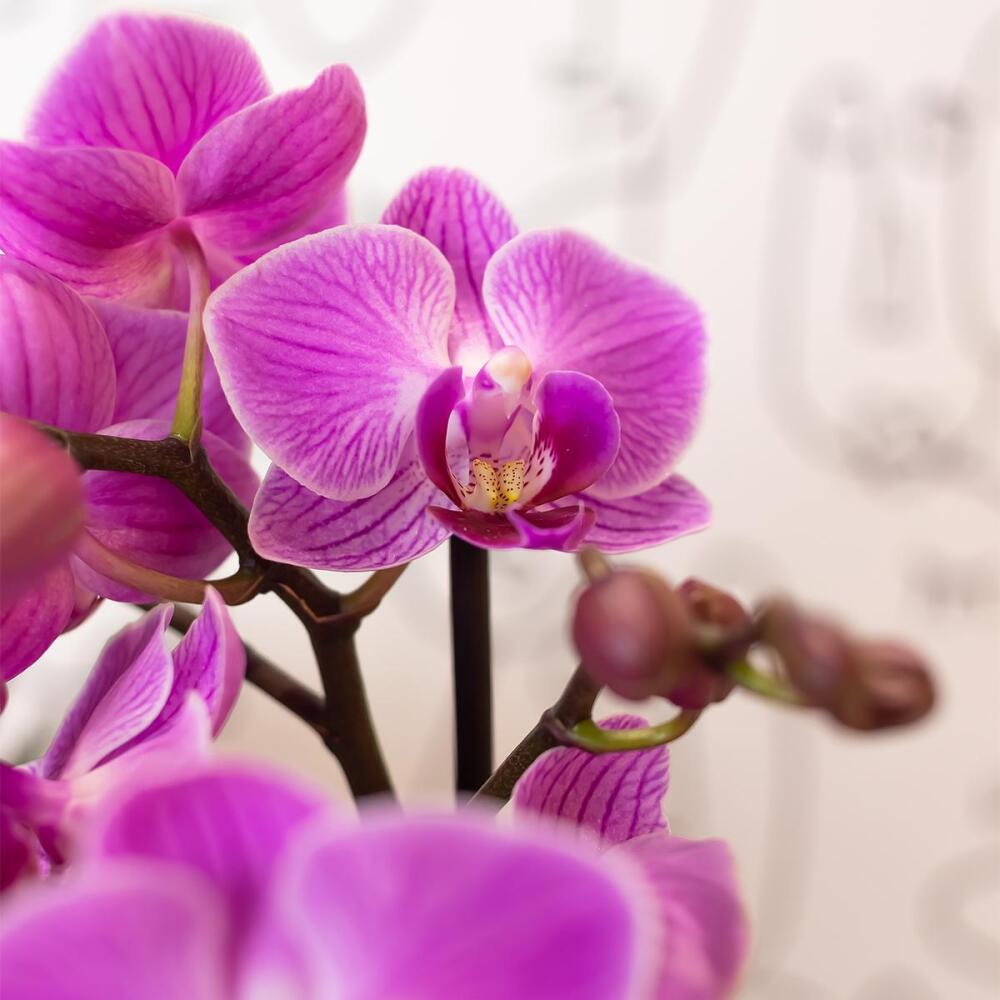
Good to know
What distinguishes Vienna from Morelia?
Vienna’s original shows fine-veined pink-lilac flowers with a pale edge. Both names are separately documented selections from the original producer.
Is a registered grex documented?
Only the traceably named Kolibri selection is reproduced; no grex registration or parental combination is claimed.
How large is this version?
9 cm pot diameter and approximately 35–40 cm height according to the selected offer.
Must aerial roots go under bark?
Healthy firm outer roots are preserved rather than deeply buried for appearance.
What happens to green stems after flowering?
New branching is possible on a strong plant. Root strength is considered too; no flowering date is promised.
Why must an outer pot not hold residual water?
Persistent wetness displaces air from roots and can encourage damage.
Sources and editorial note
- Exotenherz: specific variant, measurements, identifiers and availability (accessed 03.10.2026)
- Kolibri Company: original selection profile read directly (accessed 03.10.2026)
- RHS: Phalaenopsis, roots, water and repeat flowering (accessed 03.10.2026)
- American Orchid Society: Phalaenopsis culture (accessed 03.10.2026)
- Kolibri Company: care of its own orchids (accessed 03.10.2026)
Shop offer and directly read specialist sources compared on 03.10.2026. Identity, synonyms and SKU checked against Canon642, central new and isolated parallel portraits. Original Kolibri selection name and specific original compared. No registered grex, parental combination or guaranteed stem count inferred. Different quantities and outer pots count together. Delivery size solely from selected Exotenherz offer. Original producer separately names Vienna in its own selection/product list; exact offer light purple-pink flowers have fine darker vein pattern unlike Morelia. Cultivar registration and parentage not inferred; decorative pot variations all one identity.