
This plant at Exotenherz
Check the shop offer for current availability, price and what is included.
Link to the offer in German. Check the shop for the current price, availability and delivery contents.
Your care table
| Topic | What to do | Why it helps |
|---|---|---|
| Light | Provide bright indirect light and avoid intense midday sun. | Good brightness supports balanced, compact growth. |
| Watering | After the upper compost dries somewhat, check the root ball and water according to need. | Constantly damp roots and prolonged complete dryness are unfavourable. |
| Drainage | Use a nursery pot with holes and remove leftover water. | An attractive decorative pot must not hide drainage. |
| Turning | Occasionally turn the pot slightly if growth is one-sided. | Leaves and shoots orient towards light. |
| Fertiliser | Feed moderately during active growth according to instructions. | Additional fertiliser does not help with low light or damaged roots. |
| Repotting | Move a cramped root ball to a slightly larger pot with loose compost. | A suitable volume of soil makes even moisture easier. |
| Offsets | Separate side shoots with enough development of their own and preferably roots. | Well-prepared young plants start more reliably than tiny freshly separated beginnings. |
| Winter | Keep bright and frost-free, avoid cold draughts and reassess water needs. | With less growth, root balls often stay moist longer. |
Check the compost and pot weight. The care table explains how far the compost may dry.
Water only when needed. The water should reach the root ball without spilling over the rim.
Remove surplus water from the saucer or cachepot. Then return the plant to a suitable position.
The stalk meets the middle of the coin
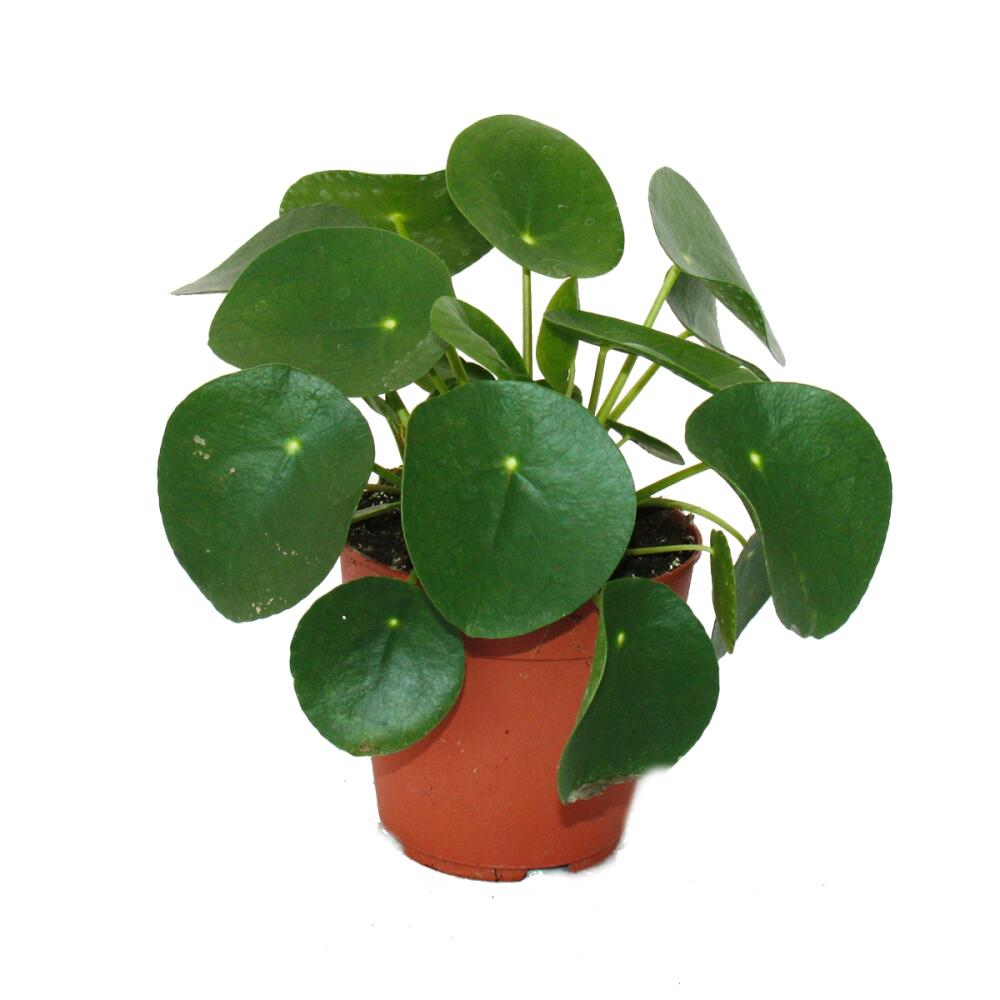
In Pilea peperomioides, the leaf stalk does not simply join the outer edge but the underside of the rounded leaf surface. This shield-shaped form explains names such as UFO plant, belly-button plant and lucky coin plant. Leaves sit on long stalks and can point differently towards the light. The species comes from China and belongs to the nettle family. Its appeal lies in its foliage; small flowers play more of a supporting role indoors. Even without flowers, there is much development to observe on a Pilea.
A small beginning with its own silhouette
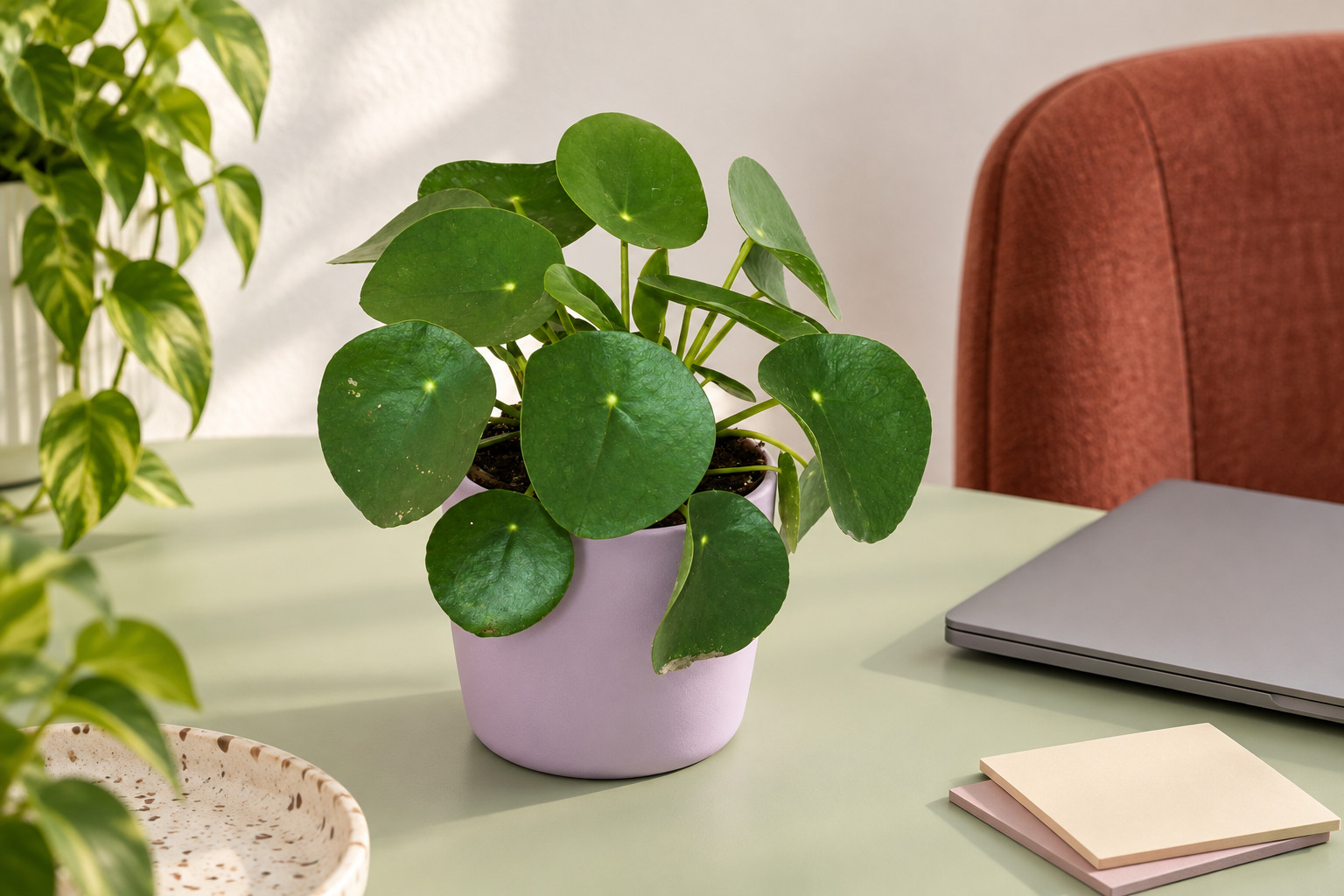
The offered plant has an 11 cm pot and approximately 15 to 25 cm overall height including the pot. It is a small companion for a bright table or suitable shelf. An older Pilea can grow taller and show a more distinct stem; that is not the delivery condition of the young plant pictured here. Every plant arranges its leaves a little differently. The home scene follows the original shop image but does not promise a particular leaf pattern or number. Other Pilea species and variegated varieties are considered separately.
Light guides the shape
Choose a bright position without harsh midday sun. Round leaf surfaces turn towards light; a one-sided crown is therefore initially an observation about position. To encourage more even growth, you can occasionally turn the pot a little. Frequent moves between very different light conditions are less helpful. Check new growth too: long gaps and unusually thin shoots may indicate insufficient light. A bright desk is suitable as long as the plant can be safely separated from electronics and delicate surfaces for watering.
The root ball and season matter when watering
Let the upper compost dry somewhat, then check how much moisture remains deeper in the pot. Water slowly when needed and remove leftovers. Slightly fleshy leaves do not make Pilea a plant for weeks of complete drying out. Conversely, it does not need constantly wet soil. An enclosed decorative pot in particular can hide moisture. Take out the nursery pot to check. Lifting it after watering gives a good sense of the difference between a freshly watered root ball and one that has dried somewhat.
Consider yellow leaves in context
An individual older leaf low on the stem may yellow and fall over time. If several leaves are affected quickly, however, check care conditions. Was the compost wet for a prolonged period? Has the plant been very dry or exposed to cold air? Light and nutrient supply also belong in the assessment. Leaf colour alone is not a reliable diagnosis. Carefully remove completely dead leaves and watch new growth. Photos from similar angles help compare progress without becoming worried about every single mark.
A good pot is neither cramped nor overly generous
A change of pot becomes useful when the root ball is densely rooted. Spring is a favourable time. Use loose, well-drained houseplant compost and a pot with clear holes. A slightly larger size usually suits better than a large decorative container full of soil. Support the root ball when lifting it out and do not pull on long leaf stalks. Replant at a similar depth. A leaning older stem cannot be corrected at will by burying it deeply. After moving it, provide a stable bright position.
There is no need to hurry offsets
Pilea can produce young side shoots that develop over time into small plants of their own. Initially leave very small beginnings with the mother plant. Once an offset is stronger, carefully check at a suitable repotting time whether it has roots of its own. A rooted shoot can be released from its connection with clean tools and planted in a small pot. Afterwards, provide gentle brightness and suitable moisture. An individual leaf without a suitable shoot portion is not a reliable substitute for such an offset. The joy of sharing begins with a well-established small plant.
Leaf care with a light touch
Round leaves are easy to inspect, but their stalks are more sensitive than their sturdy appearance suggests. Support the leaf surface when wiping and use a soft damp cloth. Rubbing, bending and leaf-shine spray are unnecessary. Check undersides and the area near the compost for unusual deposits or insects too. Keep the desk dry while watering and move the plant to a resistant surface if needed. Do not bend a healthy leaf stalk to achieve a perfectly even crown.
Winter care and the fresh start in spring
In winter, Pilea stays bright and frost-free, away from cold draughts. Depending on position, it grows more slowly and uses less water. Keep checking the root ball while watering and feeding intervals often lengthen. A warm place can nevertheless dry out faster than expected. With longer days, watch whether new leaves appear faster. Adjust care to growth again then. A plant book can keep the basics available; add the particular position and the experiences your Pilea has had there.
One plant, several views

Good to know
Why does my Pilea lean towards the window?
It turns towards light. Occasional turning can support more even growth, but does not compensate for very low light.
Is Pilea the same as jade plant?
No. Similar names such as money plant can easily cause confusion. Pilea peperomioides and Crassula ovata are different plants with their own care.
When can I remove an offset?
When it is sufficiently developed and preferably has its own roots. Initially let very small beginnings grow on.
Why does it lose lower leaves?
Individual old leaves may naturally fall. With rapid loss of several leaves, check the root ball, light and temperature.
Does the plant always have to be round and symmetrical?
No. Leaf arrangement and growth are living and position-dependent. A healthy Pilea may have its own silhouette.
Sources and editorial note
- Product and delivery size: Exotenherz
- NC State Extension: Pilea peperomioides
- RHS: Pilea peperomioides
- RHS: care for the genus Pilea
Sources checked: 14 September 2026. The specific version is described from the shop offer and care assessed using the linked specialist sources. Plant condition, position and season remain decisive for every action.