
This plant at Exotenherz
Check the shop offer for current availability, price and what is included.
Check the selected shop offer for price, availability and delivery contents.
Your care table
| Topic | What to do | Why it helps |
|---|---|---|
| Light | Choose a sunny to lightly partly shaded position. | Heavier shade can reduce flowers; the bright flowering planting needs enough light. |
| Soil | Prepare humus-rich soil holding moisture with good drainage. | During growth, the plant should not continually dry out, but tolerates no lasting wetness. |
| Planting | Set the moistened root ball at its previous height and water in. | The small delivery root ball first needs to connect to the larger soil space. |
| Spacing | Use 30–40 cm as shop guidance and allow for later clump width. | Air between plants makes care easier and prevents very densely packed foliage. |
| Water | Supply the root zone thoroughly during prolonged drought. | An older planting is more resilient than new set plants, but is not for continually parched soil. |
| Nutrition | Supply moderately in spring; follow the fertiliser label for containers. | A sensible soil start is more helpful than many subsequent heavy fertiliser doses. |
| Flower care | Remove spent heads during the season if desired. | This keeps the planting tidy and may support further flowers. |
| Winter and division | Leave healthy dry heads if desired; divide old clumps in spring or autumn. | Winter stems provide structure, while division can renew overcrowded plantings. |
For young plants, feel the soil directly at the root ball. The surface and deeper soil may have different moisture levels.
Water thoroughly after planting; later, water according to the soil, weather and establishment rather than a fixed calendar.
Avoid standing water. For plants in containers, also check that water runs out of the drainage hole.
The dark eye makes yellow warmer
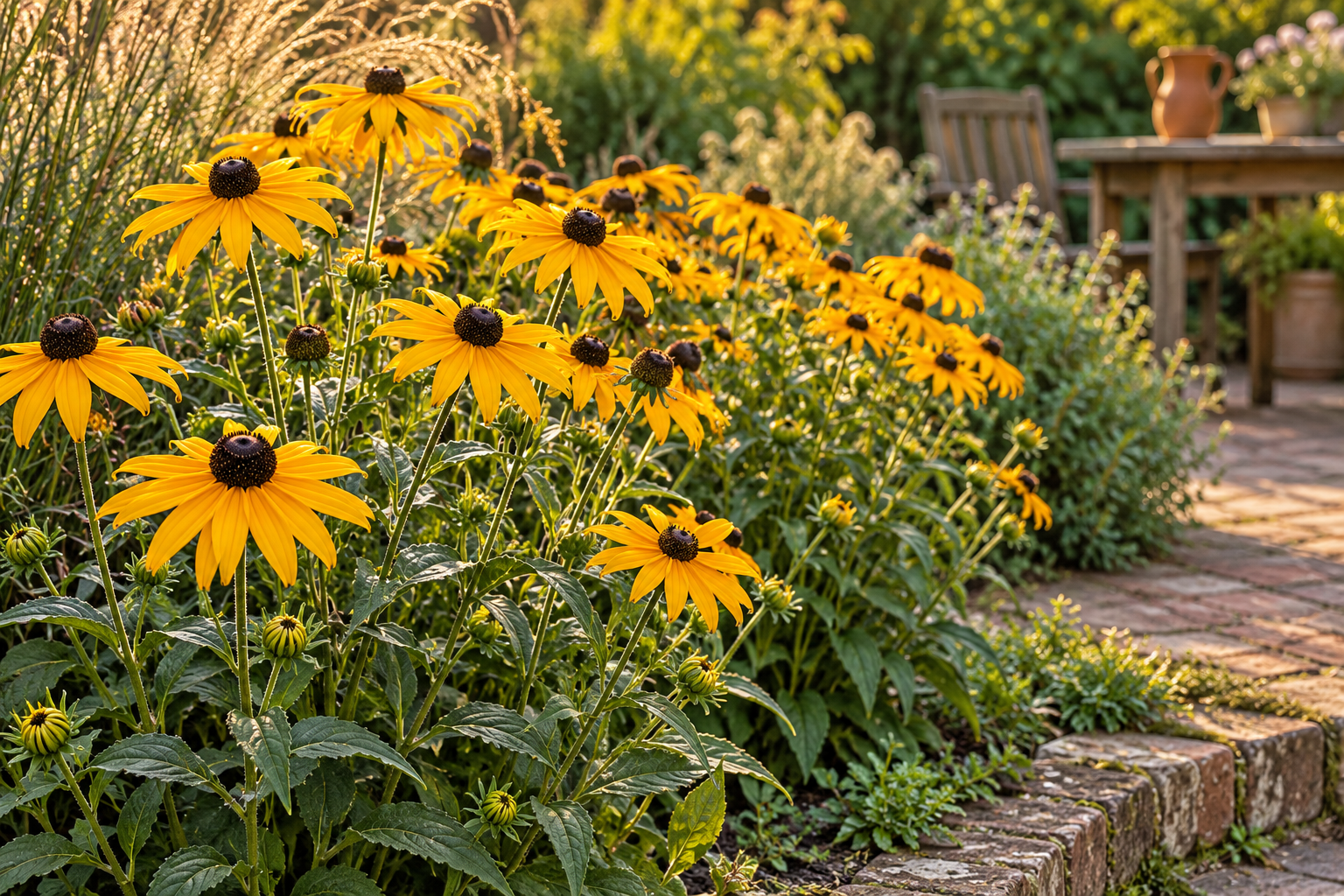
I like Goldsturm’s simple flower structure. Golden-yellow rays sit outside a dark slightly raised head. When soft evening light falls through the bed, this contrast looks especially attractive. Flowers stand on upright green stems above darker foliage and combine well with finer grass or other later perennials. The garden clump often reaches about 60 cm with flowers; the shop gives 50–70 cm as guidance. For me, Goldsturm is therefore a visible bed companion, not a tiny plant directly between paving joints.
A rudbeckia that returns next year
Goldsturm is perennial. Above-ground parts die back in winter and the clump later shoots again. Other plants with a different yearly cycle also appear under the shared German name Sonnenhut. I therefore look at Rudbeckia fulgida Goldsturm rather than simply transferring characteristics from short-lived Rudbeckia hirta or Echinacea. Goldsturm carries its characteristic yellow heads in summer and autumn. Approximately July to October is the shop guidance; a cool spring, drought and early frosts can change the course. The small delivery plant need not yet be in full flower.
Hold moisture but still release water
When preparing the bed, I seek neither a bone-dry gravel position nor a permanently wet hollow. Humus-rich soil that holds moisture and releases excess water makes everyday care easier. Light matters too: sun is a good starting point, light partial shade is possible. If it becomes too dark, flowers may remain weaker. Drainage can be checked particularly well in a pot or container. Its reserves, however, run short faster than in the garden. Roots should find usable soil rather than constantly alternating between a completely dry root ball and standing water.
A manageable start for small set plants
Offered sets consist of young plants in 9 cm pots with roughly 10–25 cm delivery height. For a new group I first put the pots on the soil and check distances. The shop specifies 30–40 cm, about six to nine plants per square metre. Later it is useful to watch clump development and neighbours. The moistened root ball is set at its previous height and watered in well. Spring often gives a pleasant start. Planting is also possible at other frost-free times if soil is not waterlogged and water is sufficiently supplied in summer heat.
Looking into soil stays important in summer
During warm dry spells I check the root zone. Fresh plantings need particular attention because roots do not yet reach far into the bed. Established Goldsturm handles drought better but should not spend all summer in completely dry soil. Water thoroughly at the base when needed rather than repeatedly giving the surface a brief wetting. I check containers more often and let excess water drain. If leaves develop unusual spots, I also look at dense growth and air movement. More water is not the right answer for every leaf change; the actual plant condition decides.
Spent heads mean different things in summer and winter
During flowering I can remove wilted heads to tidy the planting. This may support more flowers but does not replace appropriate nutrition and water. Later in autumn healthy dry heads may stay. I like their dark shapes among grasses even without yellow rays. Old stems are removed gently in spring so new shoots have room. Clearly diseased leaves or soft rotting parts are handled differently from firm dry winter stems. The garden need not be cleared immediately, but visibly diseased growth should not remain unchanged solely for design reasons either.
Make a clear group from a dense clump again
Over the years a rudbeckia planting can widen. If plants grow tightly together or old clumps need a new arrangement, Goldsturm can be divided in spring or autumn. I use healthy rooted pieces and supply them after planting like new specimens. They still need time to establish afterwards. Additional fertiliser does not improve overcrowding. I like a group where individual flowers remain recognisable and care access stays clear. Goldsturm then accompanies the garden for years instead of having to represent one perfect photograph moment.
One plant, several views

Good to know
Is Goldsturm annual?
No. This Rudbeckia fulgida is a perennial deciduous plant. Not all plants called Sonnenhut in German have the same yearly cycle.
When does it flower?
In summer into autumn, roughly July–October in the offer. Weather, position and development affect actual flowering.
How tall does it grow?
About 50–70 cm with flowers, often around 60 cm. The young delivery plant at roughly 10–25 cm is still much smaller.
Can I leave the flower heads over winter?
Healthy dry heads can provide winter structure. Diseased or rotting parts are handled differently and removed if needed.
How much spacing do the sets need?
The shop specifies 30–40 cm and about six to nine plants per square metre. Consider later clump width and neighbouring plants.
Why is my rudbeckia flowering weakly?
Check light, soil moisture and development first. An overly dark position or repeatedly dry root ball can impair flowers.
Does an older planting still need water?
Yes during prolonged drought. Established plants are more resilient, but evenly slightly moist soil helps during growth.
Sources and editorial note
- Exotenherz: five sets, delivery size, spacing and flowering guidance (01.10.2026)
- RHS: exact cultivar Goldsturm, growth, soil and winter structure (01.10.2026)
- RHS: planting, watering and caring for rudbeckias (01.10.2026)
- NC State Extension: Goldsturm, flowering and planting development (01.10.2026)
Parent 1443619032025, five sets confirmed separately. 6/12/60 available, 20/40 inactive. Exact RHS Goldsturm and NC State read; garden clump about 60 cm, shop range 50–70 cm. Shop July–October used as weather-dependent flowering guidance. Not equated with short-lived Rudbeckia hirta. Winter structure from healthy dry heads; remove diseased parts. Only unchanged advertising-free original photo 2 public. Scene accepted: later garden scene, dark raised flower centre, golden rays and rough foliage checked against original; warm natural evening light accepted.