
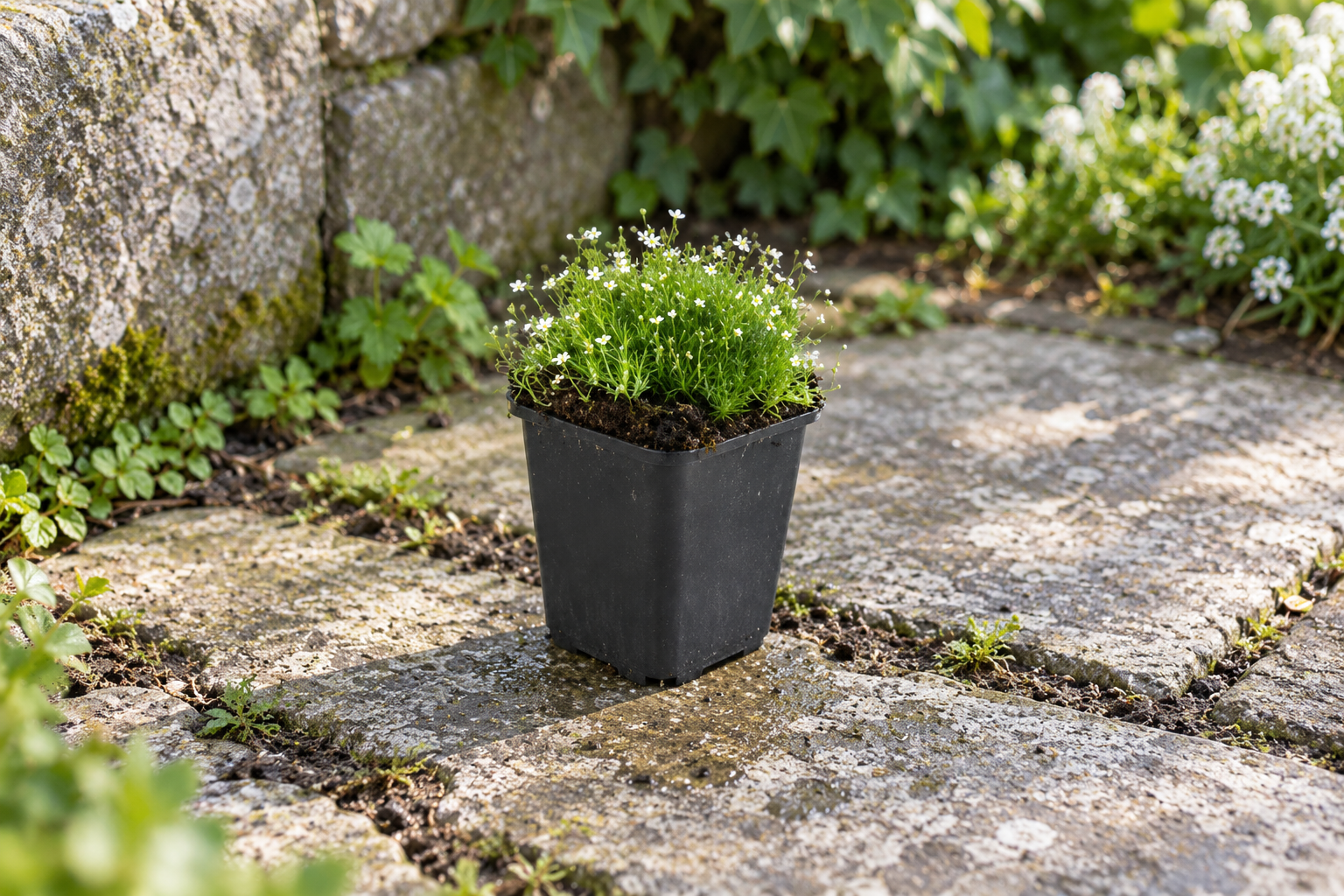
This plant at Exotenherz
Check the shop offer for current availability, price and what is included.
Check the selected shop offer for price, availability and delivery contents.
Your care table
| Topic | What to do | Why it helps |
|---|---|---|
| Light | Choose sun with midday relief or bright partial shade. | Very deep shade can encourage loose elongated growth. |
| Water | Supply the root zone evenly without standing water. | Drought and waterlogged soil are both unfavourable. |
| Heat | Avoid overheated stone edges and hot dry joints. | The fine cushion dislikes permanently hot root space. |
| Soil | Provide well-drained moderately nourished, slightly acid to neutral soil. | A purely dry sandy joint is not an adequately supplied planting site. |
| Planting | Set a moistened rootball at its previous depth and water slowly. | New roots need good contact with surrounding soil. |
| Edge | If needed shorten individual overreaching cushion edges. | Regular whole-area cutback is unnecessary. |
| Division | Divide older vigorous cushions in spring when needed. | Divisions must re-establish moistly with good soil contact. |
| Foot traffic | Treat as a garden cushion; occasional light stepping is no lawn promise. | Constant heavy wear and good plant development are not equivalent. |
For young plants, feel the soil directly at the root ball. The surface and deeper soil may have different moisture levels.
Water thoroughly after planting; later, water according to the soil, weather and establishment rather than a fixed calendar.
Avoid standing water. For plants in containers, also check that water runs out of the drainage hole.
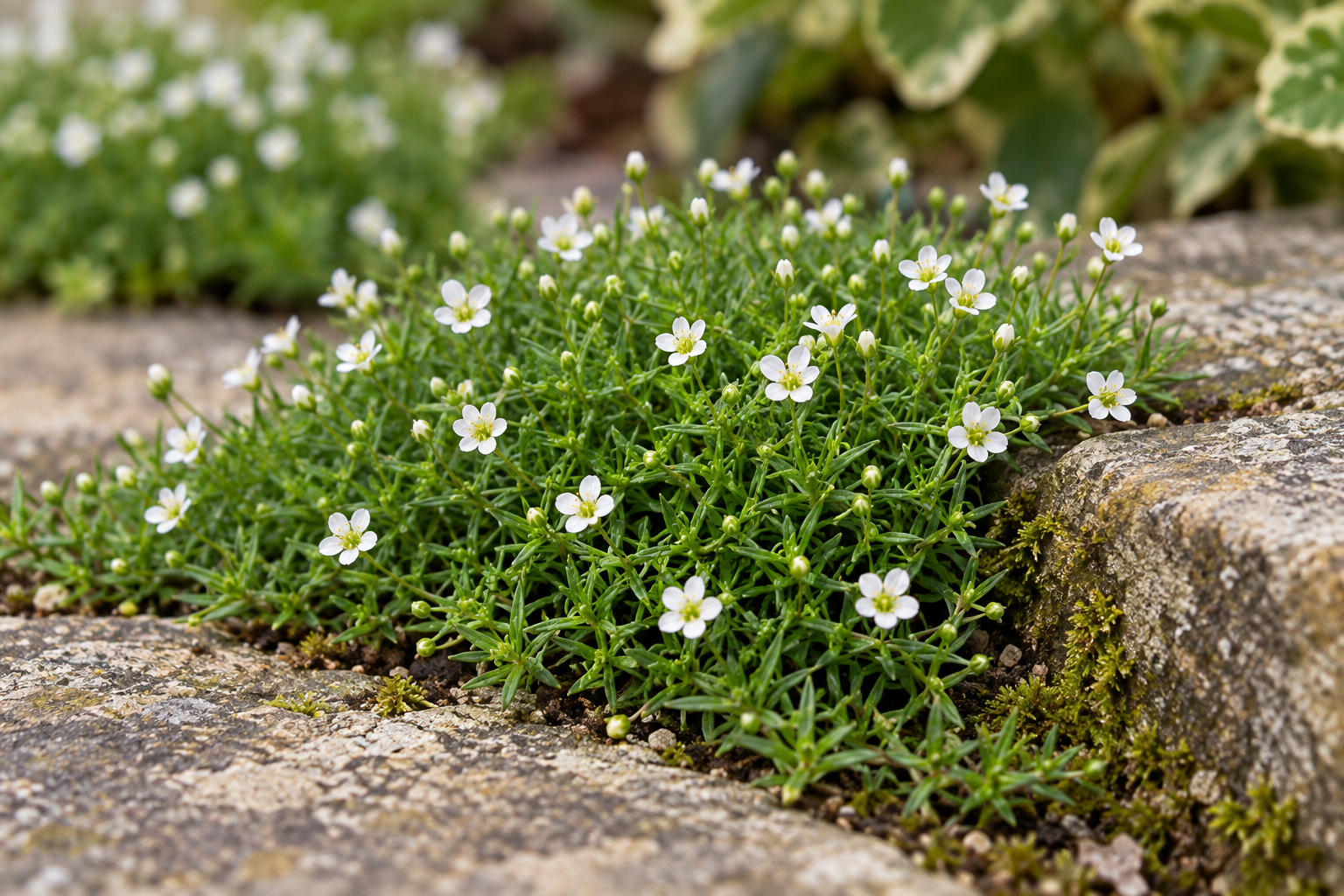
White stars on a small scale
Irish moss shows its finest detail up close. In summer tiny white five-petalled flowers stand above fine green leaves. Short stalks lift them slightly above the cushion. From a distance the plant looks like a quiet green surface; up close it becomes a little flower picture. A young plant may bear just a few flowers or none currently. That does not contradict the offer. Look at the very narrow paired leaves and low branching too. They determine its appearance independently of present flowers and help distinguish Irish moss from any arbitrary green garden cushion.
A name that can mislead botanically
Sagina subulata belongs to the carnation family and is a flowering perennial. The German name Sternmoos does not make it a true moss. Its narrow green leaves and tiny white flowers suit the species offered here. No golden-yellow cultivar is added; the offer names Sagina subulata without such a cultivar designation. The low plant can form a fine carpet in suitable places but remains dependent on soil and water. An image of greenery among stones should not make those conditions invisible. Botanical identity and position needs explain care better than assuming every moss-like cushion manages in a dry joint.
Between stepping stones only with supplied soil
A quiet garden edge or suitable space between stepping stones can show the fine texture well. Enough moisture-retaining, well-drained soil must lie beneath visible greenery. A hot dry sandy joint does not automatically offer a good place. Watch how strongly nearby stones heat at midday and whether water reaches roots at all. Sun with protection from the hot midday period or bright partial shade often suits better than all-day heat. Very deep shade may instead encourage loose elongated growth. Occasional light stepping is possible; a durable lawn for regular heavy foot traffic is expressly not promised here.
Release the low plant from its delivery container
Sets contain young plants in individual 9 cm pots with about 10 to 15 cm total height including pot. Later the cushion remains low, up to approximately 10 cm above ground. Delivery height does not contradict this garden height because the pot is included in the first measure. The shop gives 20 to 25 cm planting distance as a guide. Set pots out first and do not let growth reach immediately into the smallest neighbours. Creeping shoots can root at nodes and enlarge the planting. A little container thus shows the start of an area, not a fully closed carpet over unlimited stones.
Balance moisture and drainage
Spring or early autumn often suit planting as long as soil is frost-free and not waterlogged. Fully moisten the rootball before removing the pot, set at its previous depth and ensure good soil contact. Water slowly and then check directly at the young root zone. It should not repeatedly dry out completely, but water must not stagnate either. In hot weather particularly watch areas alongside heated stones. If the cushion develops brown gaps, first check soil and drainage. Such a picture automatically proves neither dryness nor feeding need. Adding more and more water to an already wet rootball may be the wrong response.
A green cushion needs no constant pruning
Irish moss is not regularly mown like lawn. Gently trim overreaching edges when needed and keep smaller neighbours clear. Older vigorous cushions can be divided in spring; pieces must then reconnect with suitable soil and be kept moist. Do not put every thin edge piece in a hot place and leave it alone there. Moderate soil nutrition is a starting point; add extra nutrients only for actual need. More fertiliser solves no heat or wetness problems. Tiny flowers cannot be forced by heavy feeding alone either. A maintained appearance comes more from even root supply and a manageable healthy edge.
Read small changes attentively
The evergreen cushion may look differently dense through the year. Check individual gaps, foreign seedlings and overreaching edges rather than just overall colour. In a container provide enough soil and free drainage holes, observing the little rootball outside hot weather too. Check moisture on frost-free days; do not routinely water frozen soil. In combinations choose neighbours with similar moisture needs and enough spacing. A vigorously spreading perennial may otherwise quickly cover the fine cushion. With cooler roots and careful observation its little white stars become an understandable garden moment rather than an impossible care promise.
One plant, several views
Good to know
Is Irish moss a true moss?
No. Sagina subulata is a flowering perennial in the carnation family.
Does it suit every paving joint?
No. It needs enough moisture-retaining well-drained soil. Hot dry sandy joints are unfavourable.
Does it tolerate full sun?
Sun is possible with secured moisture and protection from intense midday heat. Bright partial shade may ease care.
Does it replace heavily walked lawn?
No. Specialist sources mention only light occasional wear; regular heavy foot traffic is not promised.
Why 10–15 cm delivery height for a low cushion?
Delivery height includes the 9 cm pot. Later plant height is measured above garden ground.
Must I prune it regularly?
No routine whole-area pruning. If needed trim overreaching edges and divide older vigorous cushions in spring.
Sources and editorial note
- Exotenherz: offer and original images (03.10.2026)
- RHS: Sagina subulata – species profile read directly (03.10.2026)
- NC State Extension: Sagina subulata – culture and light foot traffic (03.10.2026)
- Exotenherz: checked 6-plant child offer (03.10.2026)
- Exotenherz: checked 12-plant child offer (03.10.2026)
- Exotenherz: checked 20-plant child offer (03.10.2026)
- Exotenherz: checked 48-plant child offer (03.10.2026)
- Exotenherz: checked 60-plant child offer (03.10.2026)
Shop offer, article number, availability and original images checked directly on 03.10.2026. Specialist sources read directly. RHS cultivation information read directly, NC State for moisture and light foot traffic. Contradictory NC State origin and synonym information not included. No lawn promise; shop has a 48- rather than 40-plant variant. All five child offers individually checked; available quantities: 6, 12, 60. Clean original view retained unchanged; young scene and later flowering detail separately captioned.