

This plant at Exotenherz
Check the shop offer for current availability, price and what is included.
Product details, availability and delivery information are provided in the shop offer.
Your care table
| Topic | What to do | Why it helps |
|---|---|---|
| Light | Sunny after slow acclimatisation | Strong pitchers and markings need energy |
| Water | Low-mineral rainwater or suitable reverse-osmosis water | Dissolved salts should not accumulate |
| Tray water | Shallow standing water during growth; always keep the root ball moist | The plant is not a succulent for dry cultivation |
| Compost | An acidic nutrient-poor carnivorous-plant mix | Garden compost and pre-fertilised potting compost do not suit it |
| Hoods | Do not open, fill or stuff with food | The natural trap shape remains undamaged |
| Winter | Cool, bright and protected in severe frost | Small pots need adapted winter care |
| Cleaning | Gently remove completely dead leaves | The dense centre should remain airy and healthy |
| Repotting | As needed in spring, protecting growing points | A dense sale plant does not need immediate division |
The root ball stays moist. Check more often in warm or windy conditions and do not let it dry out completely.
A small, controlled water reserve can help during growth. The centre of the plant does not need to be deeply submerged.
In cool winter conditions, reduce the reserve while keeping the root ball moist. Keep the saucer clean and follow the frost protection in the care table.
A low form with small curved hoods
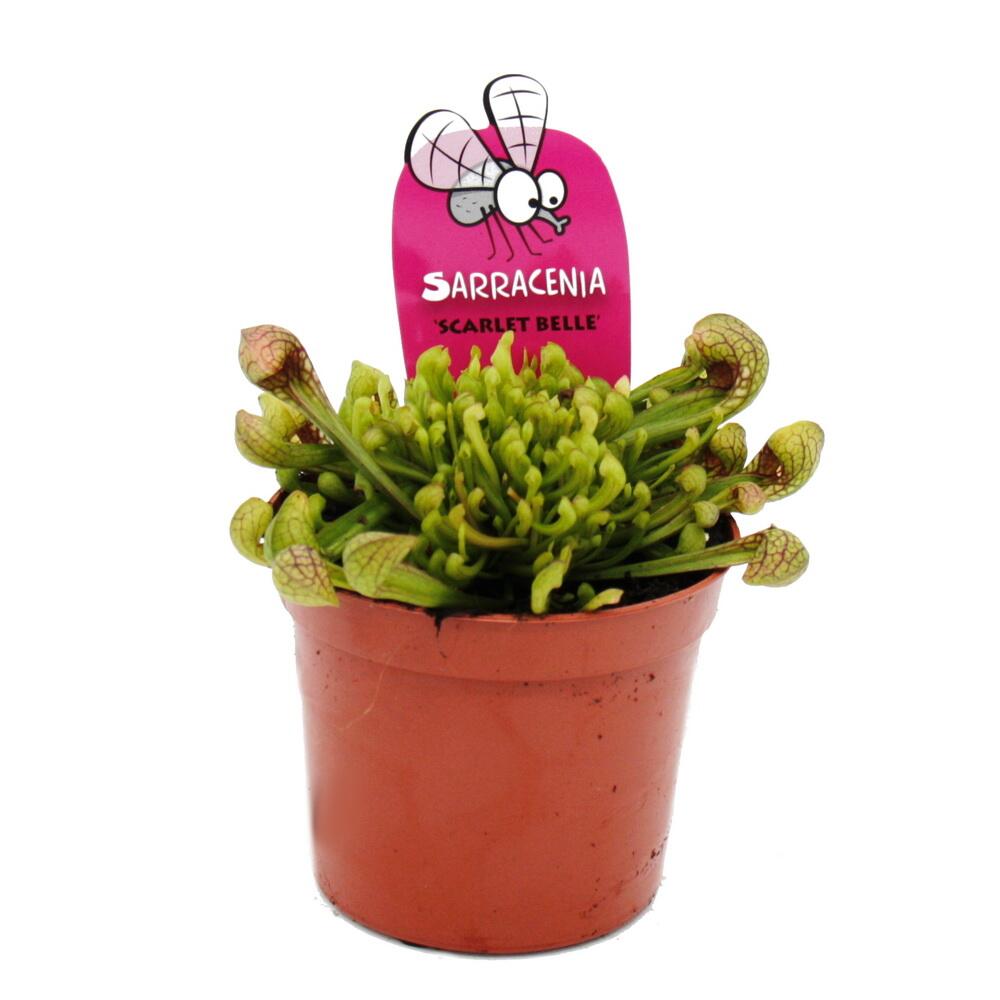
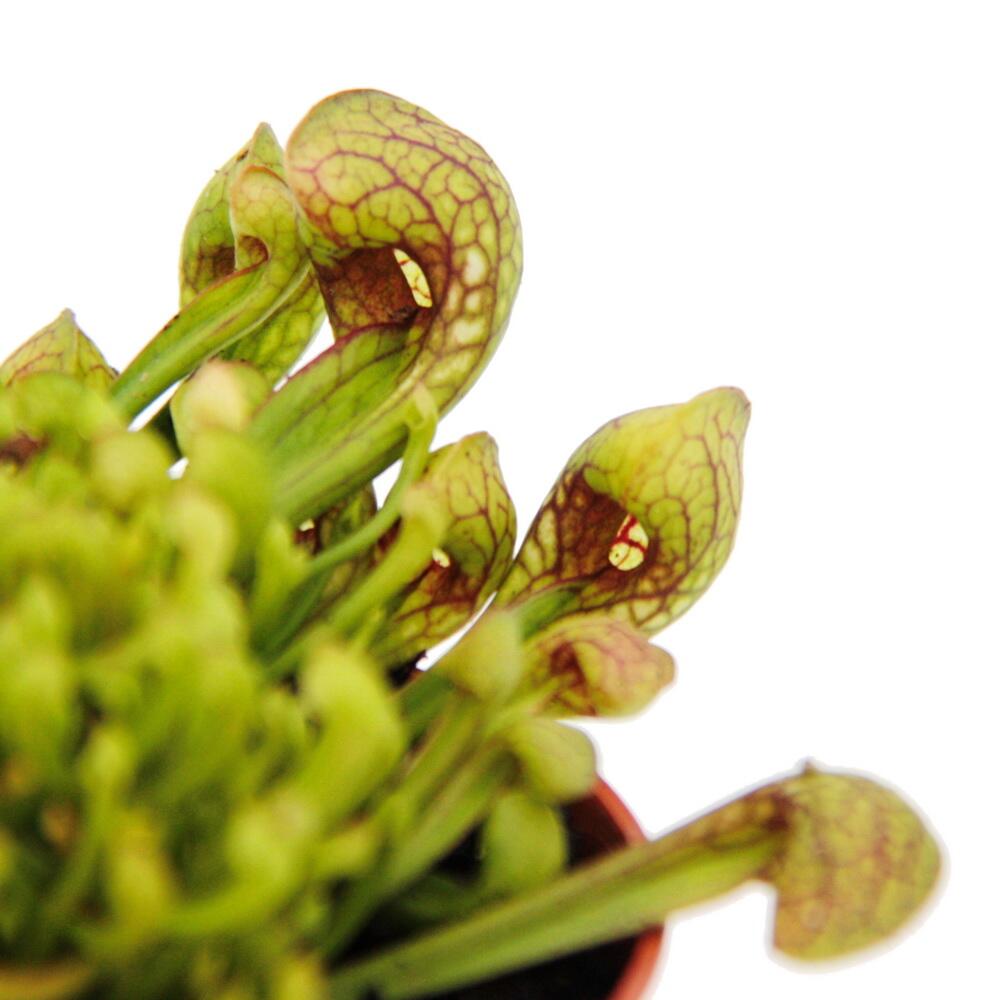
The shop photograph shows a young dense rosette. Its green pitchers are not all vertical but also extend sideways. Pale rounded hoods with red veins sit at their ends. The offer comes in a 9 cm pot; no delivery height is stated. A young plant therefore initially looks compact and close to the ground. The AI scene explicitly shows a small example in this pot format. The strength of red markings, pitcher count and seasonal condition may vary in the living specimen.
Two parents explain the distinctive trap shape
Scarlett Belle is described as a cultivated form from Sarracenia leucophylla and S. psittacina. The trade also uses the spelling Scarlet Belle and the hybrid attribution S. × wrigleyana. It is therefore not a pure Sarracenia psittacina. Pale network-marked areas and curved shape give it its individual appeal. Traps are specialised leaves, not flowers. Their openings lie around the hoods and should not be unfolded by hand. Light supplies the plant with energy, while trapped prey supplements nutrients.
Sunshine shows the form to better effect
A sunny outdoor position suits strong compact growth. A plant freshly from sheltered cultivation should first acclimatise to direct sunshine. The low habit is attractive to observe in an easily reached pot. In a deep decorative outer pot, outside pitchers must not be squeezed. In very hot conditions, check the water reserve and root-zone temperature. A dark living room is not an equivalent permanent position. Colour development is not improved by deliberate drying.
Keep nutrient-poor compost moist
Use suitable acidic nutrient-poor carnivorous-plant compost and low-mineral water. A shallow reserve of clean rainwater is practical during growth. The root ball should stay evenly moist, not dry completely between applications. Do not permanently flood the plant centre deeply. Use neither ordinary potting compost, garden compost nor routine fertiliser. Even a natural-looking pond edge may be too nutrient-rich. A separate pot offers a good way to control water level and compost for this small plant.
Repot and keep the dense rosette clean
When space becomes tight or compost is spent, gently repot at an appropriate spring date. Carefully free curved pitchers beforehand so they do not break at the rim. Do not bury the rhizome with its growing points deeply. Remove completely dead leaves and keep healthy green traps. Division may be possible with older vigorous plants, but a dense small sale specimen does not need pulling apart immediately. Neither stuff traps nor feed meat scraps. Clean cultivation is more helpful than extra experiments at the plant centre.
Plan winter rest and adapt summer care
Scarlett Belle needs seasonal change and a cool resting period. No general frost-hardiness promise is made for the small pot. Overwinter bright, cool and protected in severe frost; keep compost moist without thoughtlessly continuing the summer water level. Old pitchers may decline while the plant waits for its next growth. A warm windowsill above a radiator is unsuitable. With soft dark areas in the centre or an unusual smell, check whether rot has developed. Individual old dry traps alone do not mean the entire plant is lost.
One plant, several views
Good to know
Why do the pitchers stay so low?
The curved compact form belongs to this cultivated selection, particularly in young specimens. It need not resemble a tall trumpet pitcher plant.
Is Scarlett Belle the same as Sarracenia psittacina?
No. It is a hybrid with S. psittacina and S. leucophylla as parents.
Must I unfold the hoods?
No. The natural opening is enough. Forceful bending damages traps.
Can I keep it warm indoors all year?
That does not suit its seasonal rhythm. A cool winter period with suitable moisture and protection of the small pot belongs to care.
Sources and editorial note
- Product and delivery contents: Exotenherz
- Missouri Botanical Garden: plant profile
- International Carnivorous Plant Society: care knowledge
- Royal Horticultural Society: plant and care information
Sources checked: 15 September 2026. Product information and the contents of delivery follow the linked shop offer. Care advice was checked against the cited specialist sources and should still be adapted to the plant’s condition, position and season.