
This plant at Exotenherz
Check the shop offer for current availability, price and what is included.
The linked shop is in German. Product details, availability and delivery information are provided in that shop.
Your care table
| Topic | What to do | Why it helps |
|---|---|---|
| Light | Bright with indirect daylight, without hot midday sun. | Leaf markings need light; strong sun can cause damage. |
| Water | Allow surface compost to dry before watering and check deeper down. | Moisture remains in the root ball longer than at the surface. |
| Drainage | Allow all excess water to drain. | Roots must not remain permanently in water. |
| Compost | Use airy houseplant compost with a stable structure. | The climber needs an aerated root zone. |
| Feeding | Feed moderately during active growth according to the label. | Demand often falls in the darker winter. |
| Climbing support | Tie shoots loosely or let them trail freely. | A support keeps longer stems organised. |
| Propagation | Take cuttings with at least one suitable stem node. | New roots and shoots form on the stem section. |
| Safety | Do not eat; avoid contact with plant sap. | Aroids may irritate skin and mucous membranes. |
Check the compost and pot weight. The care table explains how far the compost may dry.
Water only when needed. The water should reach the root ball without spilling over the rim.
Remove surplus water from the saucer or cachepot. Then return the plant to a suitable position.
Silver on a living surface
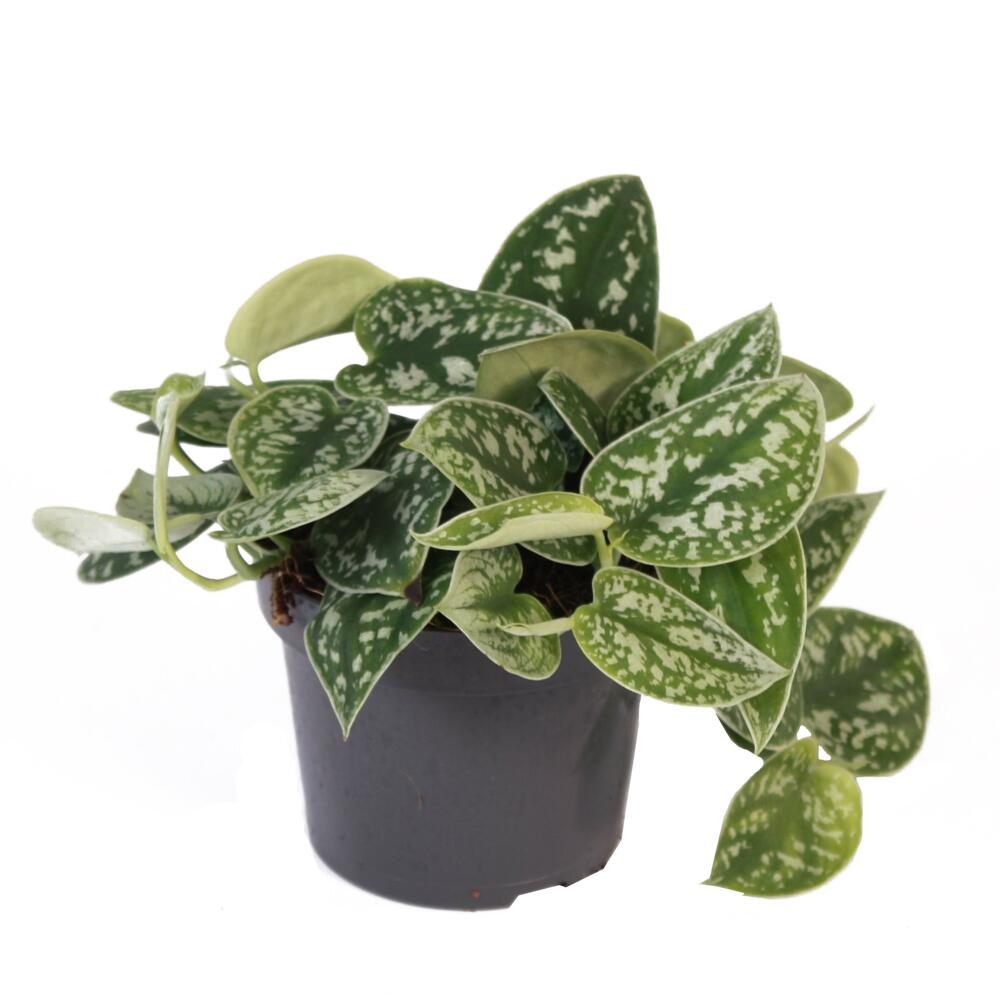
Scindapsus pictus belongs to the aroid family. The Argyraeus form offered here carries silver-marked leaves whose sheen changes with the light. The patches are part of the leaf and cannot be wiped away. Although the English name satin pothos suggests a relationship to pothos, it is a different genus. The small specimen shows the juvenile form. As shoots lengthen, the choice between a trailing form and a climbing support follows.
Begin with a small specimen
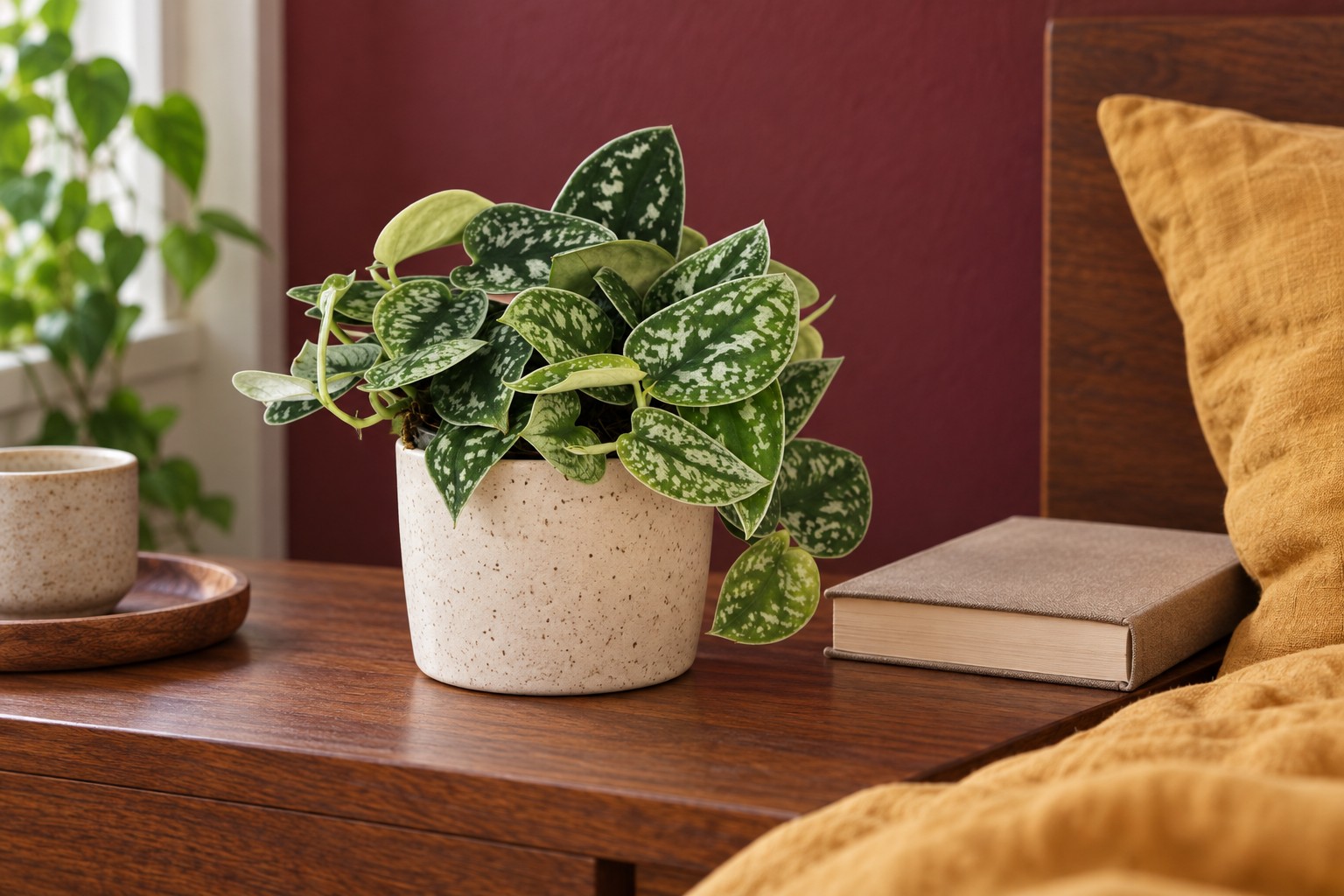
The listing in a 12 cm pot is about 15 cm tall. Initially, the plant is therefore a small foliage feature for a bright surface. Plan a clear edge or stable support now for when shoots become longer. A large cachepot does not make the plant grow faster. What matters is a nursery pot you can lift out for checking. The original shop photograph remains the basis for delivery form and leaf markings; the indoor scene shows a possible arrangement with additional decoration.
The right position for matt leaves
Plenty of indirect daylight suits it better than hot midday sun. In a deep room corner, gaps between leaves often become longer and growth weaker. Keep away from cold panes and draughty doors. The pot should stand in a consistently warm room without dry heating air passing directly over the leaves. Clean dusty foliage gently with a soft, damp cloth. Leaf-shine spray is unnecessary for the matt surface.
Examine curled leaves first
Scindapsus can curl its leaves when short of water. Nevertheless, do not water automatically: check compost beneath the dry surface and lift the pot. If the root ball is still heavy and wet, damaged roots may be the cause. Once the upper compost has genuinely dried, water evenly and allow all excess to drain. A permanently full cachepot is unsuitable. Repeated complete drying costs the plant strength just as constant wetness does.
Airy compost and moderate feeding
Use a houseplant mix with a stable structure that holds water briefly and lets air reach the roots. Coarse components can improve the structure but do not replace drainage holes. Densely rooted plants are moved into a slightly larger pot as growth begins. A generous volume of unrooted compost stays wet unnecessarily long. Feed during growth according to the product instructions and account for existing nutrients. In a low-light winter, adjust water and fertiliser to the genuinely slower growth.
Guide, prune and observe shoots
Longer trailing shoots can be tied loosely to a support. Do not squeeze the stem. A cutting needs a piece of shoot with a node; a single leaf without a suitable stem section is not a reliable new plant. Cut with clean tools and protect skin from sap. Check leaf axils for mealybugs and undersides for thrips or mites. This aroid is not suitable for eating and is placed out of reach of children and nibbling pets.
One plant, several views
Good to know
Why do the leaves curl?
Water is often lacking, but root problems are also possible. Check the root ball before watering.
Can I wipe away the silver patches?
No. They are part of the natural leaf markings. Remove only dust with a soft cloth.
Is the plant an ordinary pothos?
Scindapsus and Epipremnum are different genera within the same plant family.
Does it need a moss pole?
Not necessarily. It can also trail. A suitable support helps with upright growth.
Sources and editorial note
Sources checked: 15 September 2026. Product details and delivery contents follow the linked shop listing. Care has been checked against the specialist sources cited and must be adapted to the plant’s condition, position and season.