
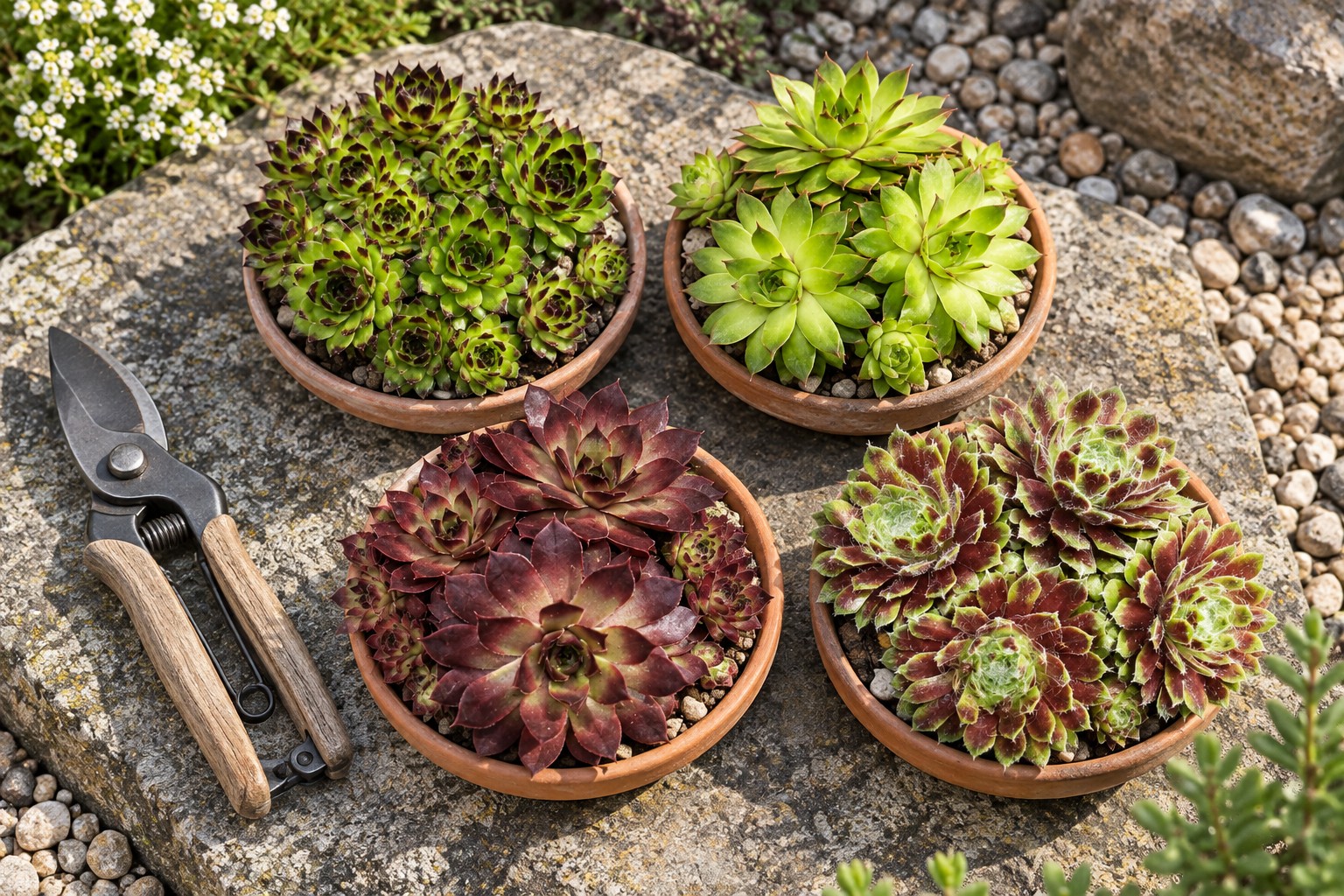
This plant at Exotenherz
Check the shop offer for current availability, price and what is included.
Link to the offer in German. Check the shop for the current price, availability and delivery contents.
Your care table
| Topic | What to do | Why it helps |
|---|---|---|
| Light | Open sunny outdoor position. | Neighbours must not overgrow the low rosettes. |
| Water | After establishment, sparingly and according to weather. | Fleshy leaves store water; avoid persistent wetness. |
| Compost | Lean, mineral-structured and very well-drained. | Water must drain even below a gravel layer. |
| Container | Provide drainage holes and enough root room. | Closed decorative bowls easily become waterlogged. |
| Fertiliser | Usually unnecessary in borders, only sparingly in containers. | Heavy feeding does not suit compact growth. |
| Winter | Leave outdoors; protect sensitive hairy forms from constant wetness. | Hardiness does not mean tolerance of standing water. |
| Flowering | Gently remove the dead mother rosette later. | Daughter rosettes maintain the group. |
| Propagation | Plant well-developed daughter rosettes in spring. | Let them root first after detaching. |
Check the compost and pot weight. The care table explains how far the compost may dry.
Water only when needed. The water should reach the root ball without spilling over the rim.
Remove surplus water from the saucer or cachepot. Then return the plant to a suitable position.
Every rosette has its own small centre
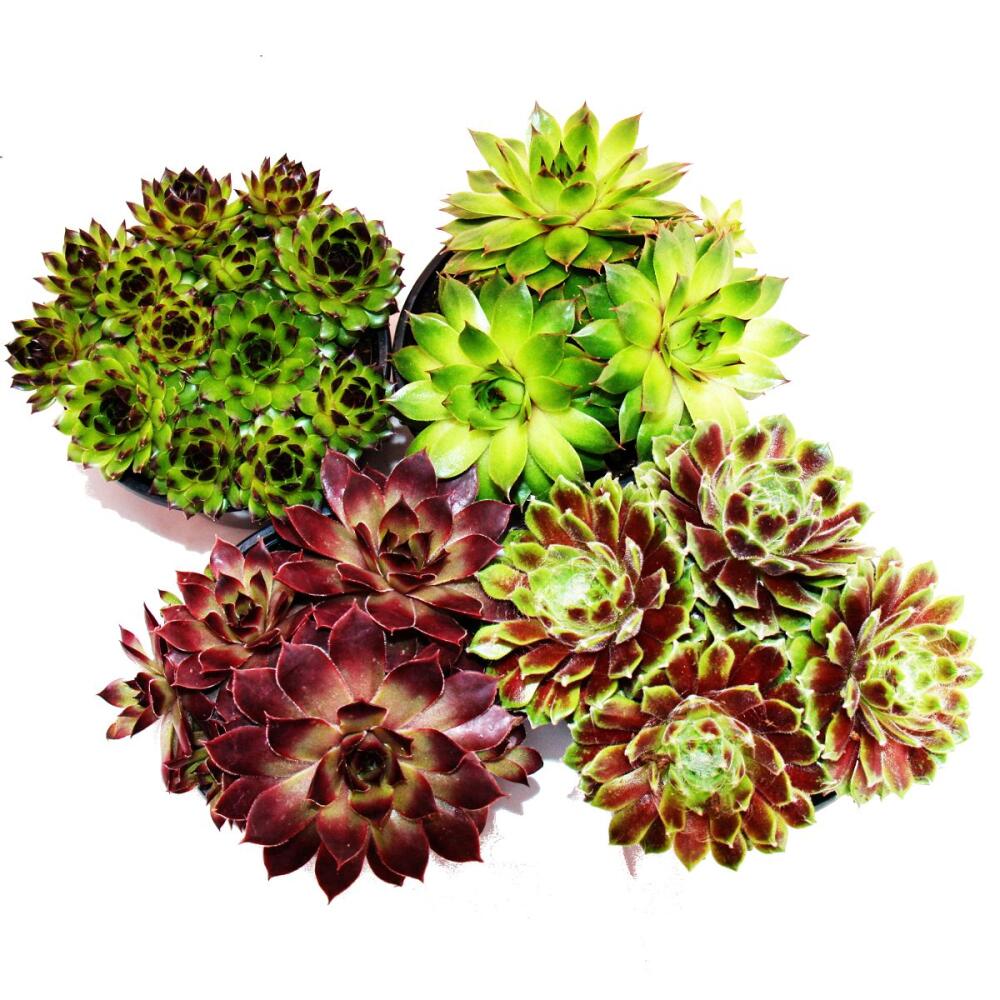
Sempervivum belongs to the stonecrop family. Fleshy leaves sit closely around a centre, forming flat to domed rosettes. Daughter plants arise at the sides on short or longer connections and gradually develop into small groups. Depending on form, leaves are green, flushed red or finely hairy. Such features make houseleeks interesting even without flowers. Varieties in the offer change, so individual cultivar names are not inferred from a photo here. A particular plant can only be assigned reliably through appropriate labelling.
Four small pots as a starting point
The shop set comprises four different houseleeks, each in a 9 cm pot. Particular varieties cannot be selected. Images show examples from the range, not a guaranteed identical combination. Small stones create attractive transitions in a shallow bowl; several separate containers display differences in leaf structure clearly. Enough root space beneath the decorative surface matters. A stone without compost or a closed bowl without drainage is not an equivalent planting position. Delivery height and exact rosette diameters are not specified in the offer.
Outside with sun and free drainage
An open sunny outdoor position suits them well. Houseleeks are unsuitable for a permanently dark indoor shelf or a closed damp glass vessel. Use a well-drained, rather lean mix with a mineral structure. In borders deeper layers must drain water too; surface gravel over compacted soil is insufficient. Plant rosettes with their centres clear. Cut back dense-growing neighbours regularly before they shade the small plants. The offered hardy garden forms do not need a warm living room as winter quarters.
Little water still means observing
Water carefully after planting and support establishment. Later the leaves store water and permit longer dry phases. In a small container, targeted watering may nevertheless be useful during prolonged summer drought. The essential point is that soil dries again afterwards. With normal winter rain, additional watering is generally unnecessary. Very wet positions are more problematic than temporary dryness. Borders usually need no special feeding; supply long-standing container plantings only sparingly during the growing period when needed.
After flowering, the group lives on
A flower stem may rise from a mature rosette. After flowering that individual rosette dies; this is part of its natural life cycle, not evidence of incorrect watering. Neighbouring daughter rosettes remain and can take over its place. Gently remove dead material. In spring, well-developed small rosettes can be detached and planted in suitable compost. Give them time to root. This allows a planting to renew itself even though no individual rosette lasts indefinitely.
Distinguish winter moisture from natural colours
Reddish tones may strengthen or weaken with temperature, light and season. A colour change alone therefore calls for no countermeasure. Soft translucent or rotting rosettes need a different assessment; first check moisture and drainage. Especially finely hairy forms may benefit from airy rain protection in a very wet winter. Do not wrap them airtight. Occasionally divide older dense groups and fill gaps with healthy daughter plants. The calm geometric effect comes from good conditions, not constantly adding more care.
One plant, several views

Good to know
Can houseleeks grow in a living room?
For lasting cultivation, a sunny outdoor position is much better. A dark warm interior does not suit the garden forms.
Why does a rosette die after flowering?
A rosette flowers only once and then dies. Healthy daughter rosettes continue the planting.
Will I receive particular varieties?
The set of four is assembled from the range. Images show examples, and exact variety selection is not possible.
Do I need to water in winter?
Usually not with normal outdoor rainfall. Above all, ensure good drainage and avoid excessive winter wetness.
Sources and editorial note
- Product and delivery contents: Exotenherz
- NC State Extension: plant profile
- Royal Horticultural Society: plant and care knowledge
- Royal Horticultural Society: plant and care knowledge
Sources checked: 15 September 2026. Product information and delivery contents follow the linked shop offer. Care has been checked against the stated specialist sources and remains subject to plant condition, position and season.