
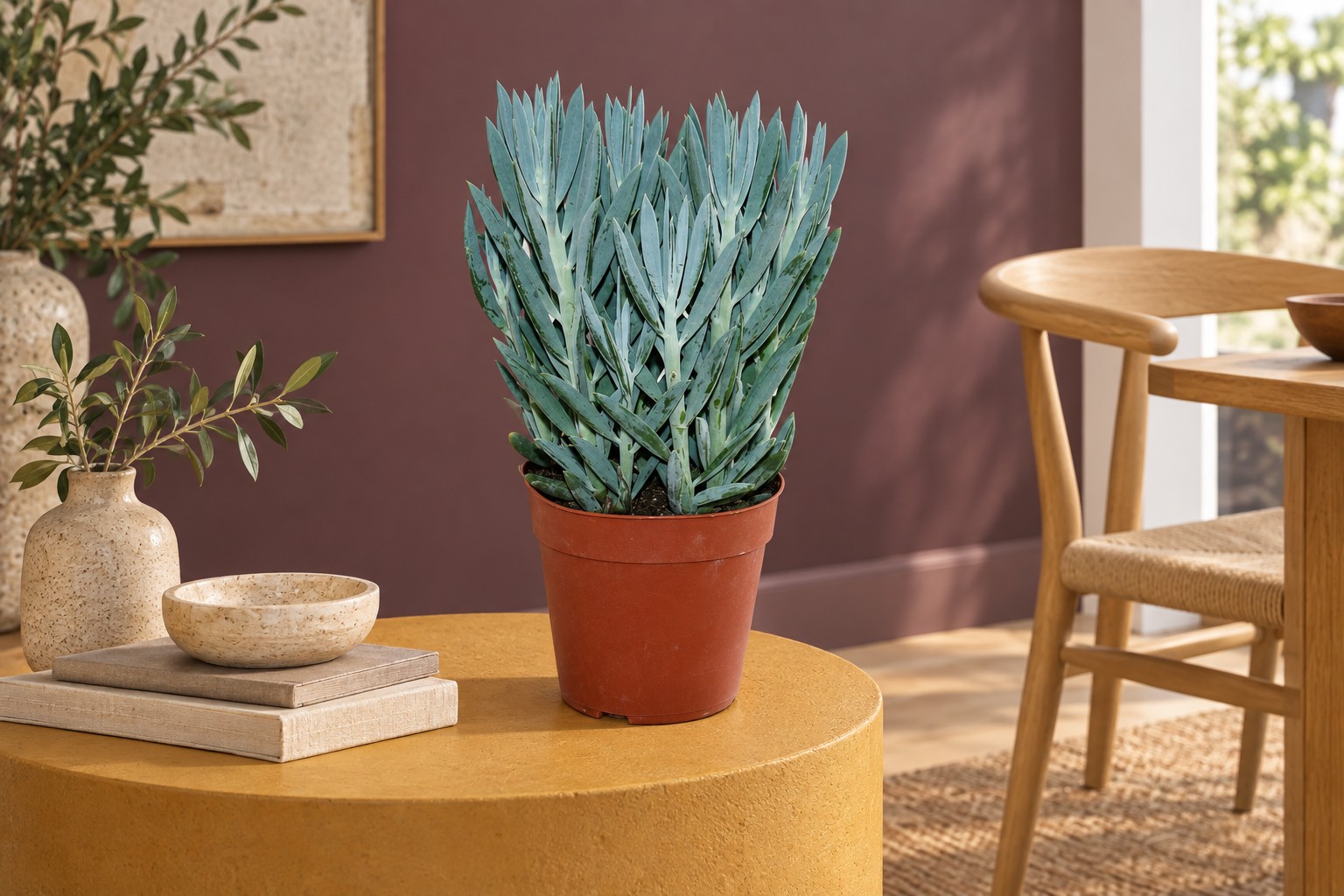
This plant at Exotenherz
Check the shop offer for current availability, price and what is included.
Product details, availability and delivery information in the shop.
Your care table
| Topic | What to do | Why it helps |
|---|---|---|
| Light | Very bright; acclimatise to sun slowly. | This keeps growth more compact. |
| Water | After the root ball dries noticeably. | Fixed cupfuls do not suit changing conditions. |
| Drainage | Remove residual water. | Roots need an airy environment. |
| Surface | Do not wipe away the wax coating. | Rubbed marks remain visible. |
| Compost | Free-draining succulent mix. | Compacted compost dries slowly. |
| Pruning | Selectively shorten individual long healthy shoots. | The remaining plant supplies new growth. |
| Fertiliser | Sparingly during growth, following the label. | Overfeeding does not replace light. |
| Winter | Bright and frost-free; water less. | Light and temperature determine water use. |
Check the compost and pot weight. The care table explains how far the compost may dry.
Water only when needed. The water should reach the root ball without spilling over the rim.
Remove surplus water from the saucer or cachepot. Then return the plant to a suitable position.
A cool leaf colour in an upright form
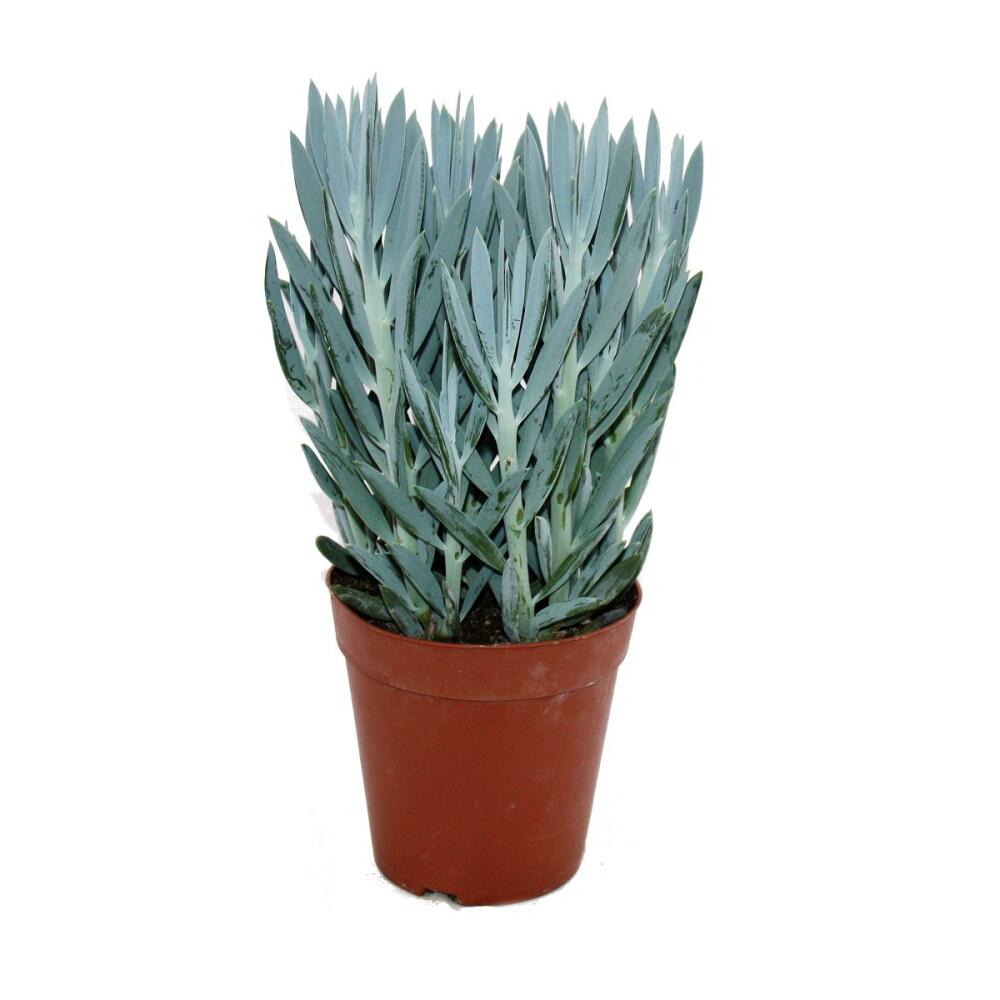
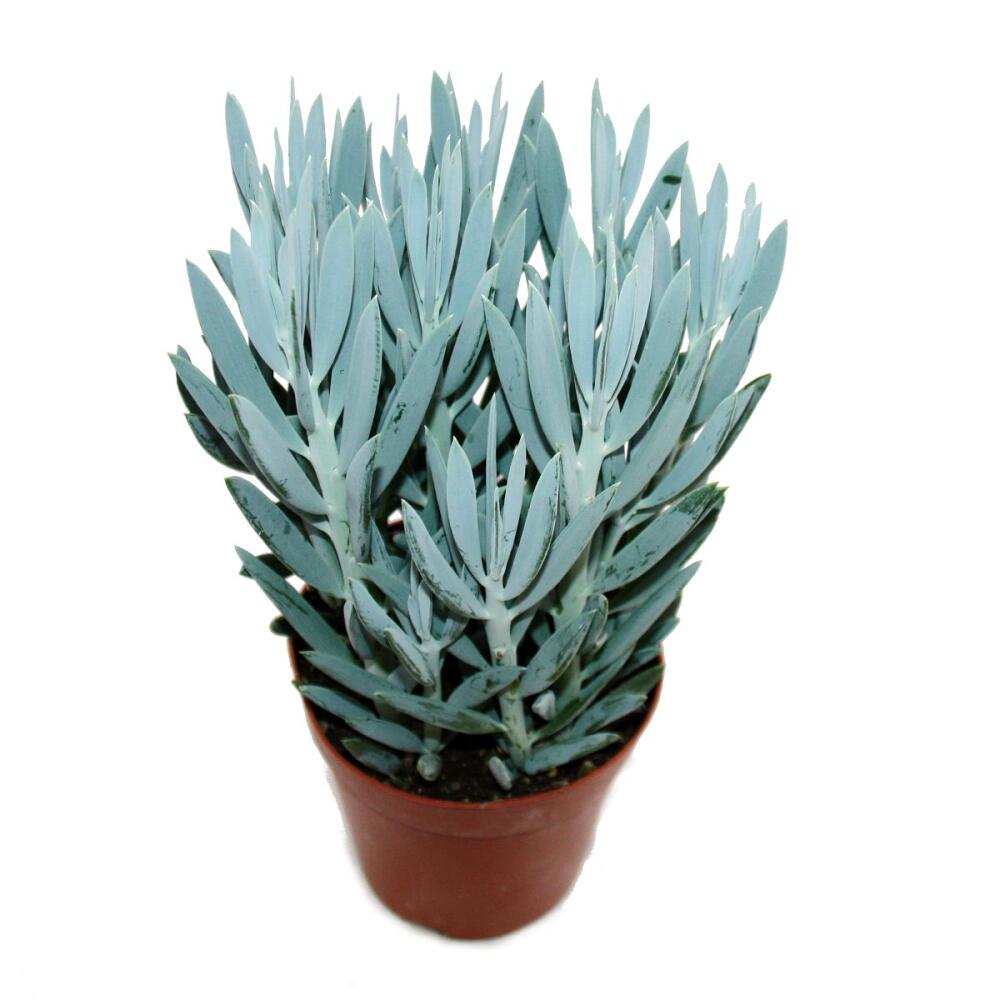
The narrow elongated leaves stand densely on branching shoots. Their matt blue-grey coating is particularly clear beside warm wall colours. The shop lists a 15 cm pot and approximately 40–45 cm total height. The scene stays with this young bushy size. It does not describe an old woody shrub or a ground-cover carpet. Leaves may appear differently light in sunshine without every shade meaning a separate variety.
Keep Aquarine understandable as a trade name
Aquarine is documented as a trade name in succulent Senecio offers. Nursery lists also show a connection with Mount Everest. However, a clearly confirmed species classification or clone identity cannot automatically be inferred for this specific shop offer. The name Senecio or Curio Aquarine therefore remains visible without invented parentage. The plant belongs within the Asteraceae family. Blue coating, water-storing leaves and branching shoots are its defining visible features.
Brightness maintains the dense shape
A very bright position is favourable. Acclimatise slowly to direct sun, particularly after transport or prolonged winter conditions. Too little light often produces longer gaps and a loose structure. An indoor position can look attractive, but must actually receive sufficient daylight. A warm outdoor position sheltered from rain is suitable in summer. Bring it back into frost-free conditions before cool nights. Supposed blanket heat resistance replaces neither acclimatisation nor monitoring water needs.
No care by coffee cup
A particular number of cups a week does not suit every pot, position and weather. Let the root ball dry noticeably, then water evenly and remove excess. Pot weight and moisture below the surface help with the decision. Water use increases during active growth and decreases in low light. Thin new shoots do not automatically mean more water is needed. With soft leaves and wet compost, check root condition before adding water.
Care for coating, compost and branching
Leave the blue-grey wax coating untouched wherever possible. Do not polish it, apply shine products or brush it vigorously. Carry by the pot when moving. Free-draining succulent compost and a drainage hole help prevent constantly wet compost. Repot when the root ball is rooted through or the compost exhausted. Overlong shoots on a strong plant can be shortened selectively; do not remove the entire structure at once. Moderate feeding according to the label is sufficient during growth.
Winter rest and typical changes
Overwinter in bright, frost-free conditions and water less when cooler. Permanently warm, dark winter conditions are unsuitable. Individual older lower leaves may be lost over time. Extensive leaf drop, dark soft shoot bases or a constantly wet root ball instead require closer inspection. Mealybugs can appear at leaf bases; the even matt coating itself is not a pest infestation. Flowers are not guaranteed year-round or within a particular temperature range. The clear foliage colour remains the main ornament.
One plant, several views
Good to know
Is the blue coating sprayed on?
The leaf appearance shown has a naturally matt coating. It should not be rubbed off.
Are two cups a week correct?
Not as a general rule. Root-ball moisture and position determine when and how much to water.
Is Aquarine definitely the Mount Everest variety?
Such a definite clone classification is not confirmed for this specific offer.
Does Aquarine flower all year?
Year-round flowering is not promised. This is presented as a foliage succulent.
Sources and editorial note
- Product and delivery contents: Exotenherz
- Tropica Nursery: trade forms
- Royal Horticultural Society: plant and care information
Sources checked: 16 September 2026. Product information and the contents of delivery follow the linked shop offer. Care advice was checked against the cited specialist sources and should still be adapted to the plant’s condition, position and season.