This plant at Exotenherz
Check the shop offer for current availability, price and what is included.
Product and delivery details are given in the individual offer.
Your care table
| Topic | What to do | Why it helps |
|---|---|---|
| Summer position | Choose sunny and sheltered with free climbing space. | The young support is not a permanent final size. |
| Framework | Check stability, guide shoots loosely. | Ties must not cut in during growth. |
| Bringing in | Bring into bright frost-free conditions before frost. | Mild species profiles are no container winter guarantee. |
| Water | Supply the root ball reliably during growth. | Abundant foliage changes consumption. |
| Drainage | Remove excess and keep holes clear. | Moist roots still need air. |
| Soil | Use humus-rich draining container compost. | Combine support and drainage. |
| Nutrients | Dose according to label during active growth. | Adapt supplies to cultivation and substrate. |
| Pruning | Organise selectively after flowering if needed. | Do not immediately cut every new climbing shoot. |
Check the compost and pot weight. The care table explains how far the compost may dry.
Water only when needed. The water should reach the root ball without spilling over the rim.
Remove surplus water from the saucer or cachepot. Then return the plant to a suitable position.
Star flowers rather than jasmine trumpets
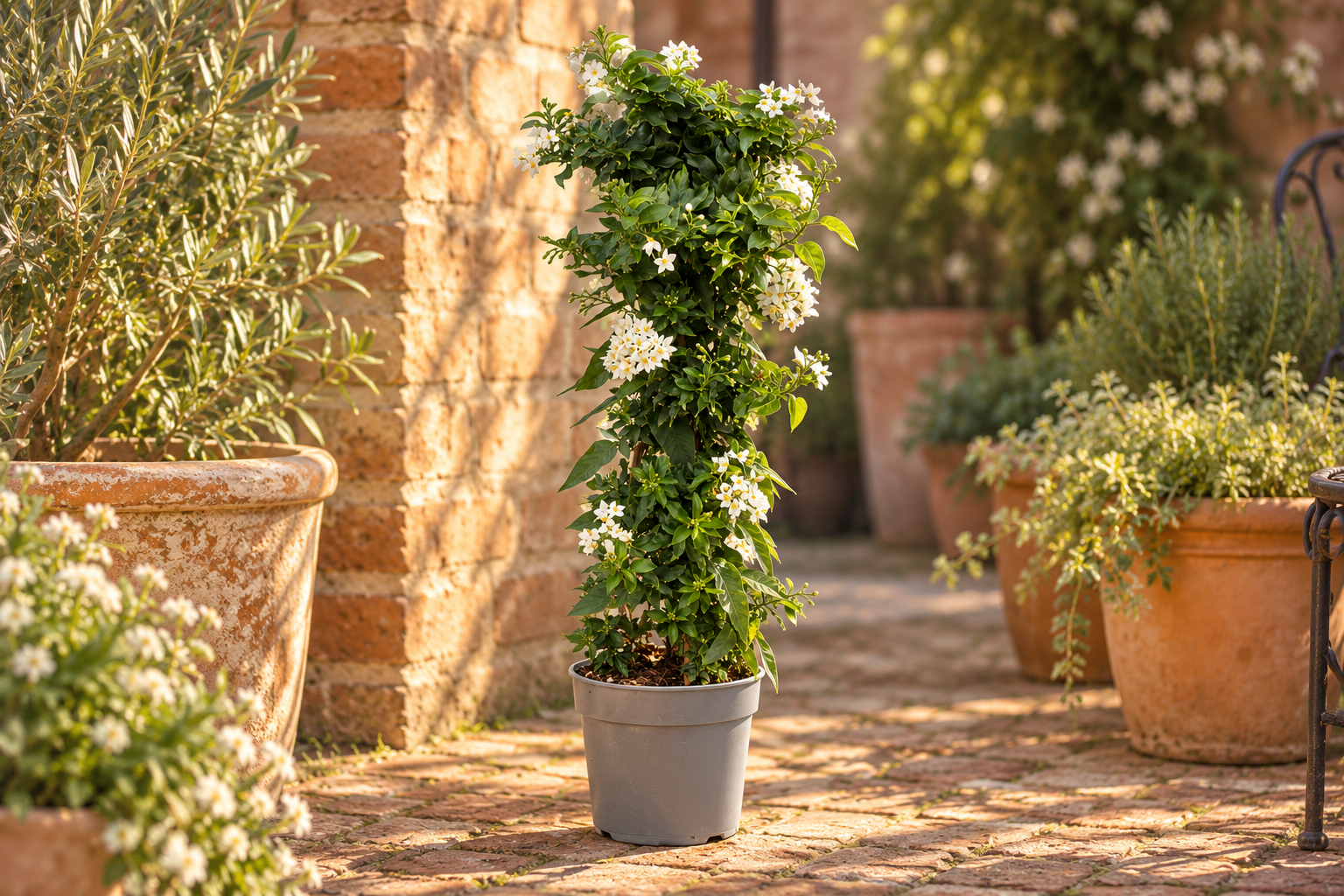
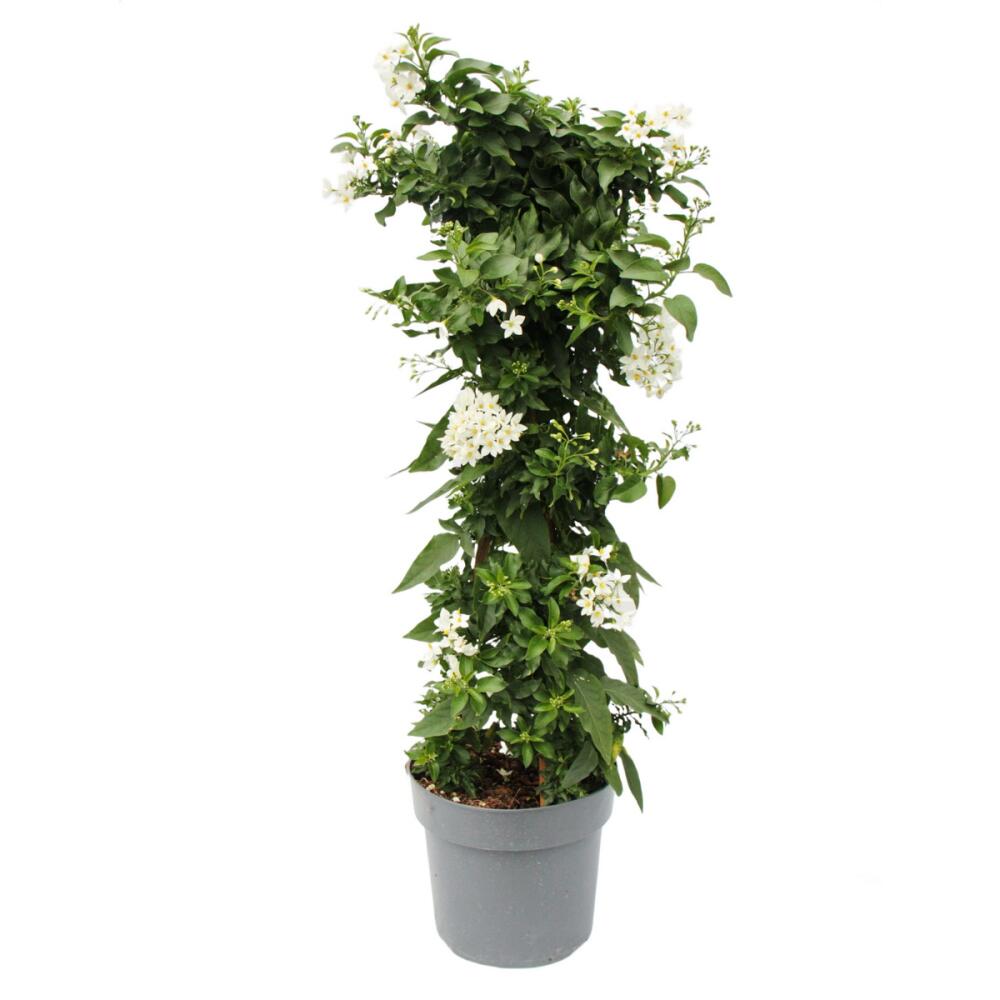
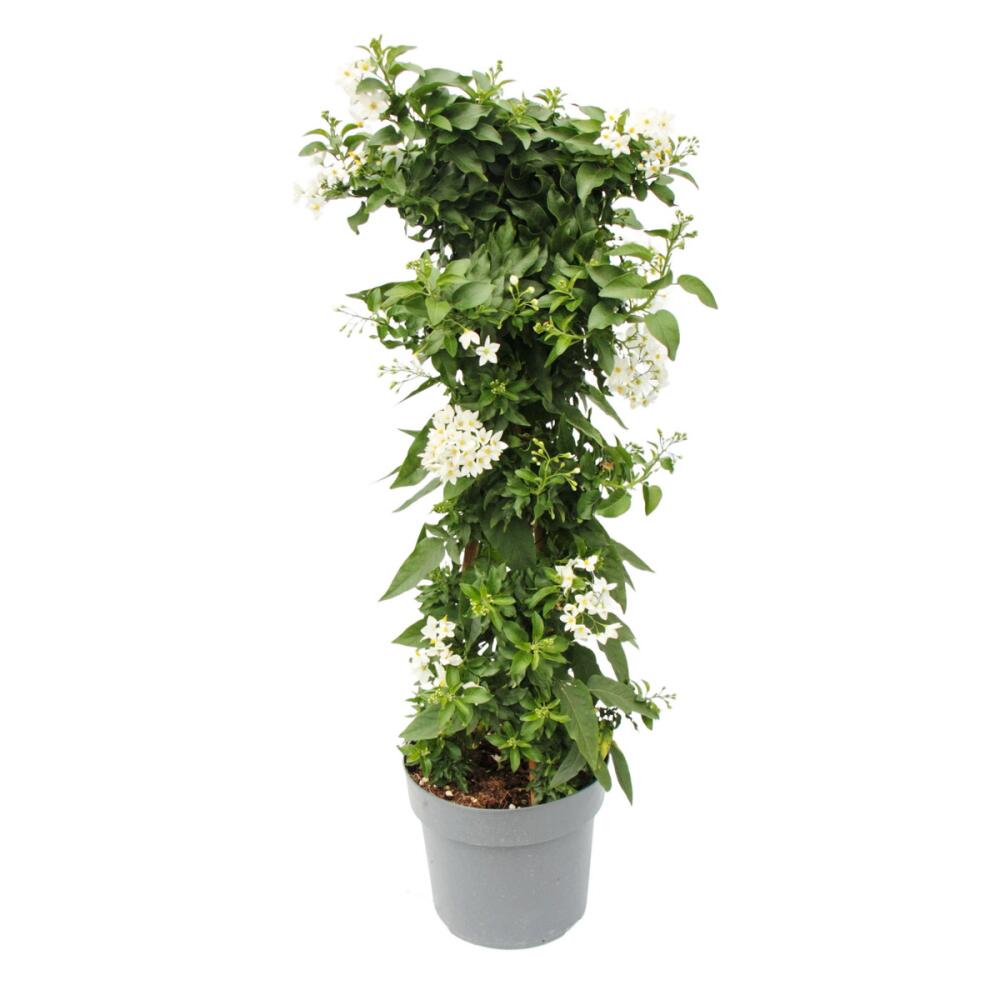
Small white five-pointed flowers stand among green oval leaves. Yellow anthers in their centres give them clear markings. Summer jasmine thus looks light even though its shoots can become a larger climber. Its trade name does not mean it is a true jasmine. The shop says Solanum jasminoides; botanical sources list Solanum laxum with this synonym. No particular scented jasmine species or unnamed white cultivar is additionally assigned to the offer. We stay with the associated white-flowering plant.
The little column can develop further
The young plant is described in a 19-cm pot with roughly 75 cm total height including support. This column shape helps it start but is not a later final size. The species can reach several metres on suitable climbing surfaces. In a container, root space and selective pruning influence development. When unpacking, check that the framework is secure and release shoots gently. A later position needs lateral and overhead freedom. A small transport support cannot permanently replace planning for an increasingly vigorous climber.
A bright summer position with shelter and support
A sunny sheltered position suits outdoor cultivation. Under glass, strong heat and radiation may need moderation. After sheltered cultivation, move outdoors gradually and only after frost risk. Against a wall, check that light reaches lower leaves too. Fastening must hold without crushing a shoot. Guide young climbing shoots loosely and inspect their ties again later. This lets the plant show its star flowers without constantly rubbing against too-tight cord or sharp-edged wire.
The leafy climber needs a supplied root ball
Keep soil reliably moist during active growth but not permanently wet. Check the pot and water slowly so water reaches the root ball. Remove excess from outer covers. A large leaf area in warmth may increase consumption; a cool day changes it again. Neither flower count nor a dry support surface is a reliable watering signal. For wilting foliage, therefore check soil, drainage and shoot bases together. The pot rim must remain accessible for this check even after new growth.
Connect flowers and pruning through the year
Humus-rich draining container compost and moderate nutrients according to the label form the foundation. Selective cutting back after flowering can keep the climber manageable; inspect existing flowers and new shoots before every cut. Do not remove every tip at once merely because it overtops the little frame. Dead or obstructive growth can be worked on with clean tools. For abnormalities, look under leaves and at nodes, especially during sheltered overwintering. Changed leaf colour is not answered solely with stronger fertiliser solution.
Winter position remains part of container planning
A young potted offer gets a bright frost-free winter place. General species descriptions for mild garden sites do not become a secure winter promise for every German terrace. With less light and growth, consumption falls; keep checking the root ball. Record the whole plant, framework and star-flower centre in the plant book. A note of bringing-in time and the actual winter position helps next season. The plant remains an ornamental climber, not a kitchen plant, even if Solanum recalls other familiar nightshade relatives.
One plant, several views

Good to know
Is summer jasmine true jasmine?
No. Here the name means Solanum jasminoides or Solanum laxum.
What are the yellow dots in the centre?
They are the conspicuous yellow anthers of the star flowers.
Does the plant stay 75 cm tall?
No. That is its young total height including support.
Can the transport framework always remain?
The growing climber needs suitably planned support and space later.
May the container stand in frost?
Overwinter the young pot plant bright and frost-free.
Sources and editorial note
- Exotenherz: offer and original photographs (03.10.2026)
- RHS – Solanum laxum, synonyms and climbing cultivation (03.10.2026)
Shop offer, article number, GTIN, availability and original photographs checked directly on 02.10.2026; specialist acceptance 03.10.2026. Specialist sources read directly. Specific SKU, measurements, original photographs and orderability checked directly in the shop on 03.10.2026. Specialist sources read in full; shop name and botanical synonyms remain distinguishable. Currently not orderable: knowledge portrait without a purchase link, social drafts without sending approval. No Wawi, server or tool changes. Currently not orderable: knowledge portrait without a purchase link; social drafts not released for sending.