This plant at Exotenherz
Check the shop offer for current availability, price and what is included.
Check the shop for the current price, availability and offer contents.
Your care table
| Topic | What to do | Why it helps |
|---|---|---|
| Light | Place in brightness and filter strong midday sun. | Pale leaf surfaces do not tolerate a hot sunny position. |
| Watering | Water evenly when the surface has dried slightly. | The inner root ball should not become completely dry. |
| Drainage | Remove remaining water after watering. | Moist soil and waterlogging are different states. |
| Water quality | Use low-lime water at room temperature. | Sensitive foliage reacts to unsuitable growing conditions. |
| Growing medium | Choose loose, humus-rich and freely draining compost. | Roots need moisture and air together. |
| Air | Do not place directly above a heater. | Dry warm air stresses the leaf margins. |
| Feeding | Feed sparingly during growth. | Oversupply does not replace suitable light conditions. |
| Winter | Check root ball and leaf undersides regularly. | Less light changes water needs. |
Check the compost and pot weight. The care table explains how far the compost may dry.
Water only when needed. The water should reach the root ball without spilling over the rim.
Remove surplus water from the saucer or cachepot. Then return the plant to a suitable position.
One leaf, three colours, many small differences
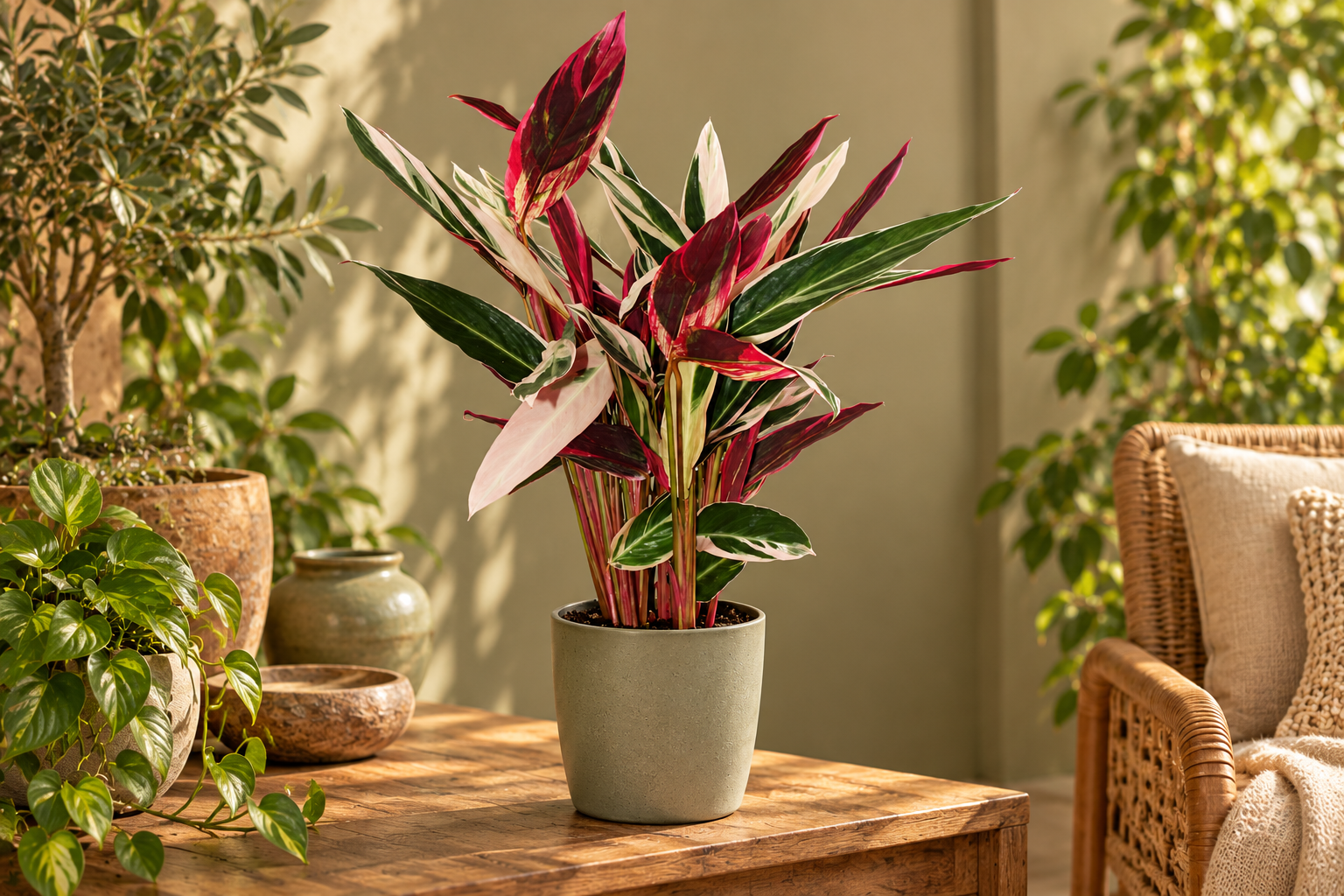
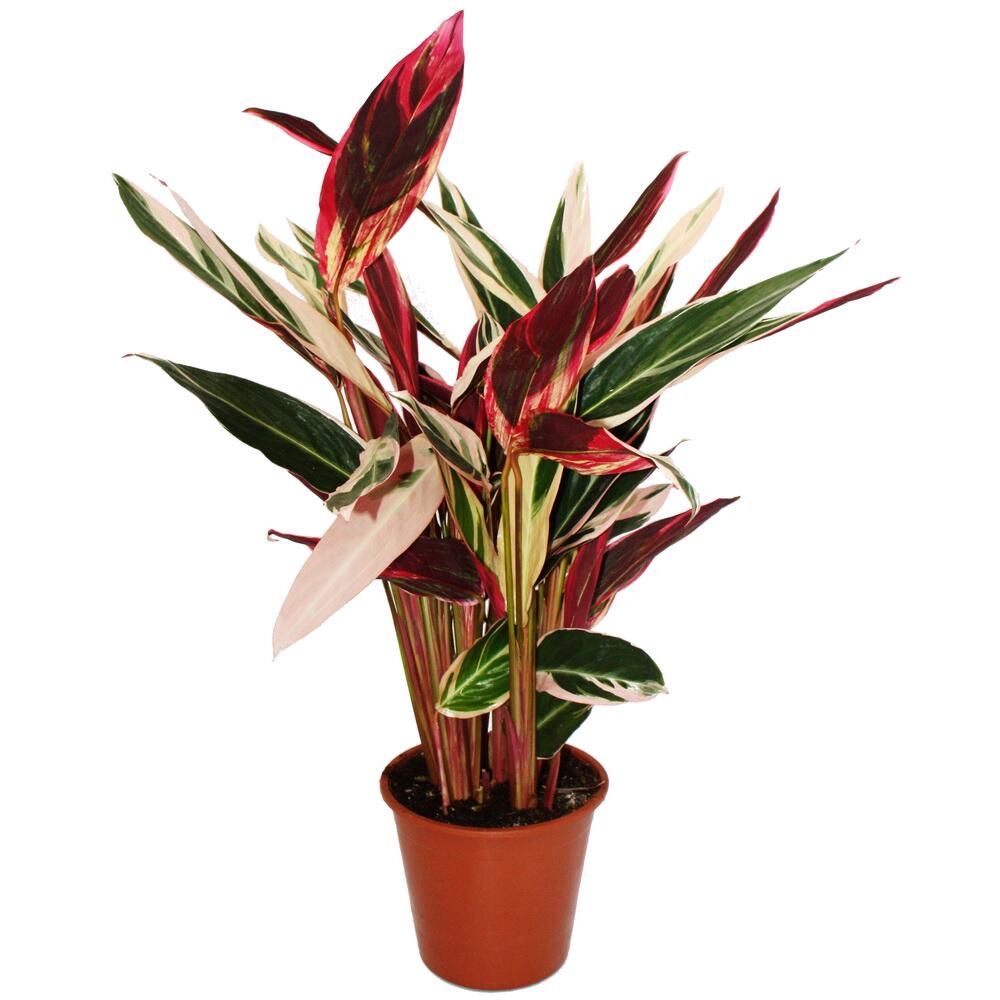
Triostar carries long leaf surfaces with green islands, cream-white stripes and pink transitions. When a leaf turns slightly to one side, its reddish underside appears. This movement makes the plant lively even when little else changes in the room. I like it on a clear low piece of furniture where the whole leaf group can be viewed. With a delivery height of about seventy to eighty centimetres and a nineteen-centimetre pot, it is already easy to see. The pattern nevertheless remains individual: no leaf must repeat its neighbour’s markings, and a particular colour distribution cannot be ordered.
Stromanthe rather than another Calathea
The shop offer uses the trade designation Calathea insigne Triostar and also names Stromanthe. This placement is helpful for care: botanically the plant belongs to Stromanthe sanguinea, a relative of calatheas. The same colourful leaf world also appears in trade under the designation Tricolour. I treat it as a warmth-loving foliage plant, not a robust garden plant. Its leaves emerge from the lower plant area; it needs no climbing support. The striking markings take centre stage. Flowers may appear under suitable conditions, but are neither necessary for a beautiful plant nor a reliable promise for indoor cultivation.
Brightness without hot leaf surfaces
A bright room position with diffuse daylight gives Triostar a good starting point. The white and pink areas need enough light but do not automatically tolerate full midday sun behind glass. I therefore also look at the temperature in the intended position. A sunny strip can become very hot a few hours later. A light curtain or some distance from the glass eases this situation. A permanently dark shelf, on the other hand, is no good solution for the whole plant. While airing the room, it stands outside the cold air stream. It stays warm in winter; its leaf appearance is no indication of frost tolerance.
Understand moisture into the middle of the pot
The compost should stay slightly moist without a water reservoir forming below. Before every watering, I check the upper layer and pot weight. If only the surface is dry while the centre still seems very wet, I wait. If it has dried slightly and the whole root ball is somewhat lighter, I water evenly through and let excess water drain. A deep decorative pot is then checked. Complete drying is as unsuitable for this foliage plant as constant topping up. Curled leaves therefore first call for a look at actual moisture, not a reflexive extra can of water.
Airy soil and suitable nourishment
A humus-rich, loose growing medium that can absorb water and release the excess suits the roots. Heavily compacted soil makes this balance harder. Repotting is sensible when the root ball is clearly rooted or the existing compost has lost its structure. I then choose a pot only moderately larger with drainage holes. Low-lime water at room temperature is a good choice. During vigorous growth, Triostar receives moderate food according to the dosage of the fertiliser used. A damaged leaf edge does not turn green again with more fertiliser; the cause must be sought in water, light or room climate.
Air is part of care too
Even a regularly watered Triostar quickly loses its pleasant position directly above a heater. Dry air and a hot rising air stream can stress the margins. I therefore place it in a bright area with even warmth and a little free air around the leaves. A group of other plants may fit there but must not become so dense that the root ball and undersides are inaccessible. Occasional misting does not replace a persistently favourable room climate. I remove dust carefully. Yellow old leaves are removed cleanly at their base without injuring healthy young shoots.
Attentively through the darker season
In winter, I check slower-drying compost particularly carefully. Heating can dry the air while the roots use less water at the same time; both processes must be considered together. Small pale dots, webbing or sticky patches are reasons to look more closely at leaf undersides and temporarily move the plant away from neighbours. Individual dry tips, however, do not immediately mean a pest infestation. With a consistent position and calm observation, care remains manageable. Triostar does not thank you with perfect symmetry but with new, differently marked leaves bringing their own green, pale and pink balance.
One plant, several views
Good to know
Is Triostar a Calathea?
The shop uses this trade name. Botanically we list the plant as Stromanthe sanguinea Triostar, a related foliage plant.
Why do the leaves look different?
The three-coloured pattern is irregular. Young and older leaves may also look different.
How moist should the soil be?
Slightly moist in the centre; the surface may dry a little. Remaining water must not stay in the decorative pot.
Why do the leaves curl?
Check moisture, strong sun, dry air and cold. Leaf position alone does not reveal the cause.
Does it need direct sunlight?
Bright filtered daylight is sufficient. Hot midday sun may particularly damage the pale leaf surfaces.
Does more fertiliser help brown tips?
No. First check water quality, root-ball moisture and heating air; old damage does not grow back.
Can it stay outdoors in winter?
No. Triostar is a warmth-loving houseplant and must stand frost-free and sheltered from draughts.
Sources and editorial note
Shop offer, SKU, GTIN and availability checked live on 01.10.2026. Original photograph unchanged. Our own researched gardening texts and individually approved scene.