
This plant at Exotenherz
Check the shop offer for current availability, price and what is included.
Check the shop for the current price, availability and offer contents.
Your care table
| Topic | What to do | Why it helps |
|---|---|---|
| Identification | Record the actual plants and labels. | Succulent describes water storage, not a single species or care routine. |
| Light | Position brightly and increase strong sun gradually. | Rosettes and other leaf forms should retain their compact structure. |
| Water | Check each plant’s root space and growth phase before watering. | A living stone has a different annual rhythm from many leaf rosettes. |
| Drainage | Use containers with holes and remove excess water. | Fleshy leaves do not protect against wet damaged roots. |
| Compost | Choose suitable airy, freely draining succulent compost. | A permanently dense moist root environment makes suitable supplies harder. |
| Surfaces | Do not rub off powdery coatings or pull leaf pairs apart. | Natural surfaces and fresh growth should remain undamaged. |
| Feeding | Supply sparingly according to a suitable fertiliser label during growth. | Extra nutrients do not solve rest phases or missing light. |
| Winter | Keep frost-free and bright; judge demand by the plant actually present. | A changing combination has no safe shared cold or watering instruction. |
Check the compost and pot weight. The care table explains how far the compost may dry.
Water only when needed. The water should reach the root ball without spilling over the rim.
Remove surplus water from the saucer or cachepot. Then return the plant to a suitable position.
A small group with very different personalities
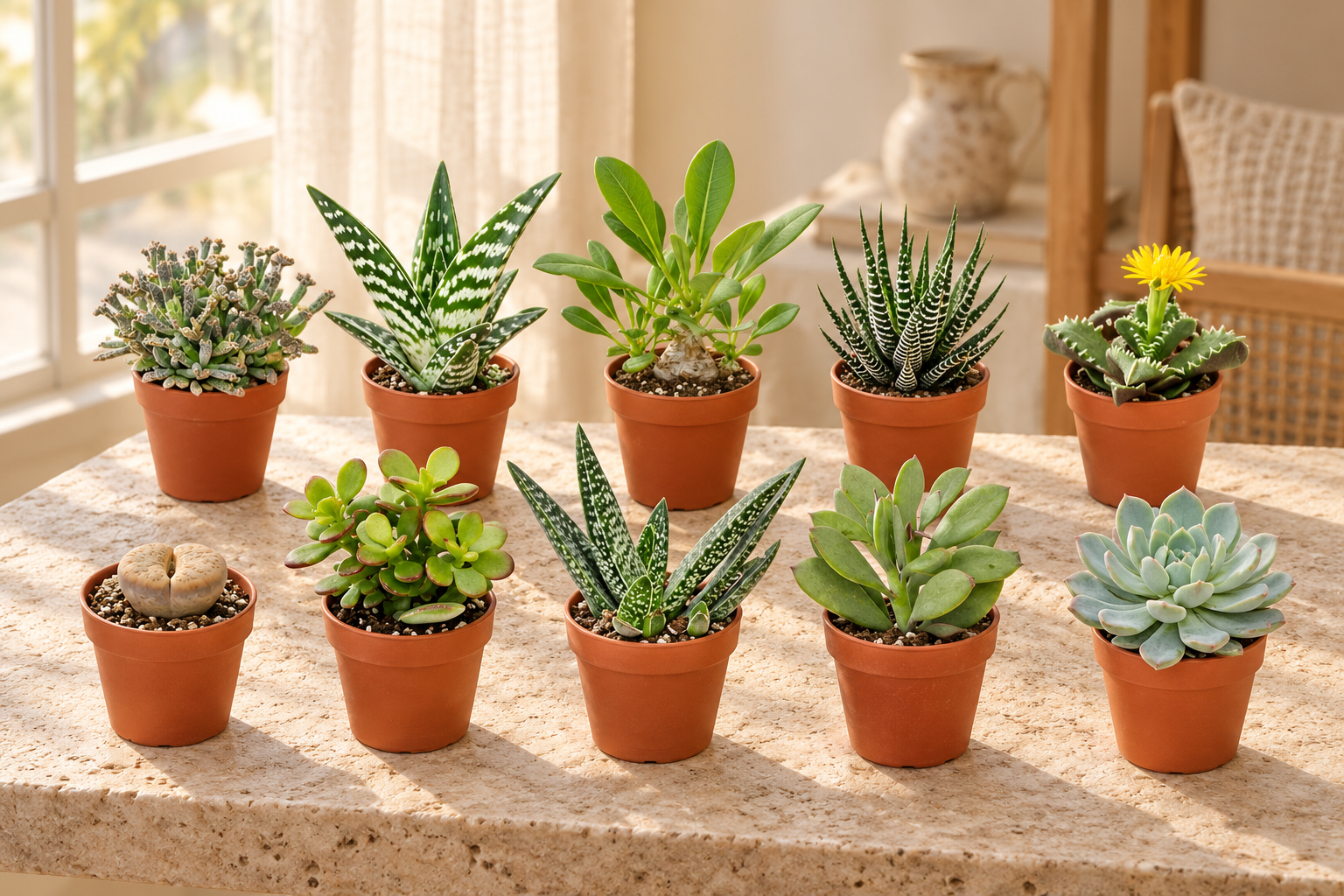
A succulent collection looks especially beautiful when you do not try to smooth away the differences. Beside a round leaf shape stands a pointed rosette, beside pale powdery green a finely patterned surface. The word succulent describes plants with water-containing tissue and is not one shared botanical species. In the ten-piece set the shop combines ten different plants from the available range. The original image shows possible examples, including rosettes, branched leafy plants and a living stone. Your delivery may look different. After unpacking, first group them loosely and take time for labels and different leaf structures.
Delivery size leaves room for individual development
Each plant arrives in a 5.5-centimetre pot at about eight to fifteen centimetres total height including the pot. The shop gives an approximate age of two years. This shared delivery size says little about how wide or tall each individual plant later becomes. A flat form needs room sideways; a branched shoot can grow upwards. Do not push pots so close that leaves rub on neighbouring plants. For the plant book you can first photograph each and add its name or a simple personal identifier. Development stays traceable even if the initial arrangement changes later.
Light makes the collection more than decoration
A bright sideboard or sunny plant bench suits it if each plant truly receives enough daylight. An attractive room view can deceive: the back shelf corner often has much less light than the front. On a rosette-forming Echeveria, long stretched-out new growth is a reason to check the position. Do not immediately place new plants behind hot glass or in the strongest midday sun. Acclimatise them gradually to more light, considering their specific identification. A sheltered outdoor spot may be possible in warm summer; in autumn we bring frost-sensitive specimens back in promptly.
A shared pot does not automatically mean shared care
The row of small pots can look like a group while keeping separate root spaces. This is particularly practical when one rosette already needs water and its neighbour is still well supplied. Check the root ball or its weight and growth phase before watering. Supply thoroughly if needed and let water drain; empty a full outer bowl. Misting an entire selection evenly does not replace this check. For later planting together, water demand, growth and required room must match. Suitable combinations arise from the actual plants, not their colours alone.
The living stone shows why differences remain important
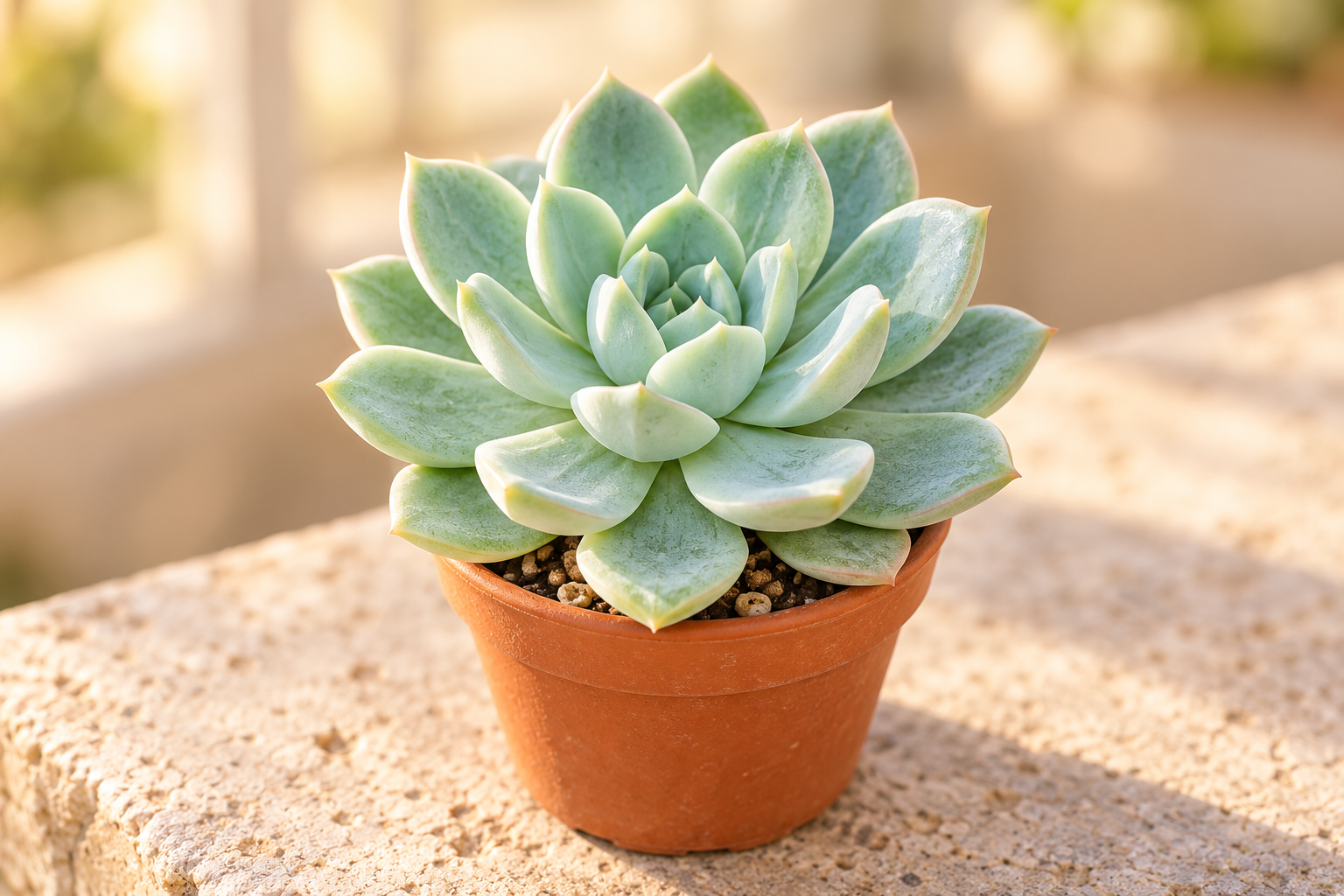
If a Lithops is included, we recognise it by a thick leaf pair with a fissure. During annual leaf replacement it uses the old leaves for the new pair; collapsing old leaves are then not automatically a call for water. Its rest and growth phases need their own assessment. It is therefore not supplied to the watering rhythm of all other pots and is initially kept separately. Other forms also reward a look at their surfaces: an Echeveria’s pale coating is not rubbed smooth. Preserving small distinctions is often more helpful than treating the entire collection with the same care motion.
Consider root space, flowers and rest together
Airy freely draining compost and containers with clear holes provide a good foundation. If a root ball becomes cramped, we consider a moderately larger pot during suitable growth. Not every small plant immediately needs a large new container. Flower colour and timing depend on the actual selection; the yellow flower in our example scene is no promise for every delivery. Feeding follows growth and label. In winter position brightly and frost-free and observe individual development. Less water does not make a dark position brighter, and strong feeding cannot replace missing light stimulation either.
Individual observations build a familiar collection
First assess new soft areas, unusual spots or deposits together with compost moisture and position. One older dry leaf differs from rapid leaf loss in wet root space. Look between leaves and under the pot rim without continually touching powdery surfaces. Note which plant is forming new leaves and which is resting. Small arrangement changes may improve care: a more sensitive specimen gets a different position while the group remains visually together. These decisions turn the succulent set into your own collection, where differences may remain and the next growth inspires curiosity.
One plant, several views
Good to know
Are all succulents cacti?
No. Succulence describes water-storing tissue and occurs in different plant families.
Is the photograph a fixed variety list?
No. Ten different plants are chosen according to availability; the combination may differ.
Can I plant all ten together?
Only with matching water, light and space requirements. Particularly assess an included Lithops separately at first.
Why do old Lithops leaves shrink?
During leaf replacement old leaf pairs are used up by new growth. This is not automatically drought stress and does not require shared watering.
Should I clean off the pale leaf coating?
Do not rub natural powdery surfaces, such as an Echeveria’s. Handle gently and work at the pot.
Are eight to fifteen centimetres the final size?
No. The measurement describes delivered plants’ total height including the pot. Later growth depends on the actual species.
Sources and editorial note
- Exotenherz: offer and original photographs (02.10.2026)
- University of Minnesota Extension: succulents and shared plantings (02.10.2026)
- NC State Extension: Lithops and leaf replacement (02.10.2026)
- NC State Extension: Echeveria, light and rosettes (02.10.2026)
- RHS: cacti and succulents in containers (02.10.2026)
Shop offer, product number, GTIN, availability and original images checked directly on 02.10.2026. Specialist sources read directly. No fixed selection promised. Lithops explained as a possible component with separate leaf replacement. No shared watering rest forced. Public gallery uses an identified AI-created detail view instead of the marked original collage. Scene and any AI-created detail view checked directly against the shop reference; count, growth forms and size relationship suitable.