
This plant at Exotenherz
Check the shop offer for current availability, price and what is included.
Check the selected shop offer for price, availability and delivery contents.
Your care table
| Topic | What to do | Why it helps |
|---|---|---|
| Sorting | Match plants and existing names before arranging. | Selection may change and does not necessarily contain 27 different species. |
| Light | Position brightly with filtered daylight. | A decorative dark niche is insufficient for lasting strong growth. |
| Water | Wet adequately with suitable low-lime water and water according to need. | Leaf scales absorb moisture; room air alone does not replace water. |
| Drying | Let water drain from rosettes and allow free air movement. | Persistent wetness in the centre can encourage rot. |
| Support | Position on an open support so plants remain accessible for care. | An easily removable arrangement simplifies watering and later checks. |
| Air | Do not use a closed permanently damp glass cabinet without exchange. | Good ventilation matters alongside brightness. |
| Feeding | During growth, cautiously use suitable tillandsia or bromeliad fertiliser according to the label. | Leaves are supplied without accumulating concentrated salt residues. |
| Winter | Keep bright and frost-free; reassess water and complete drying. | Cooler damp air can slow drying; heating air can greatly speed it up. |
Take the tillandsia off its support. Do not rub the leaves; preserve the delicate silvery scales.
Use low-lime water at room temperature. The care table explains whether thorough misting or a short soak is suitable.
Gently shake off the water. Tilt rosettes downwards, hang loose strands without bunching them together and allow them to dry with good airflow.
A collection that need not stand in a row of pots
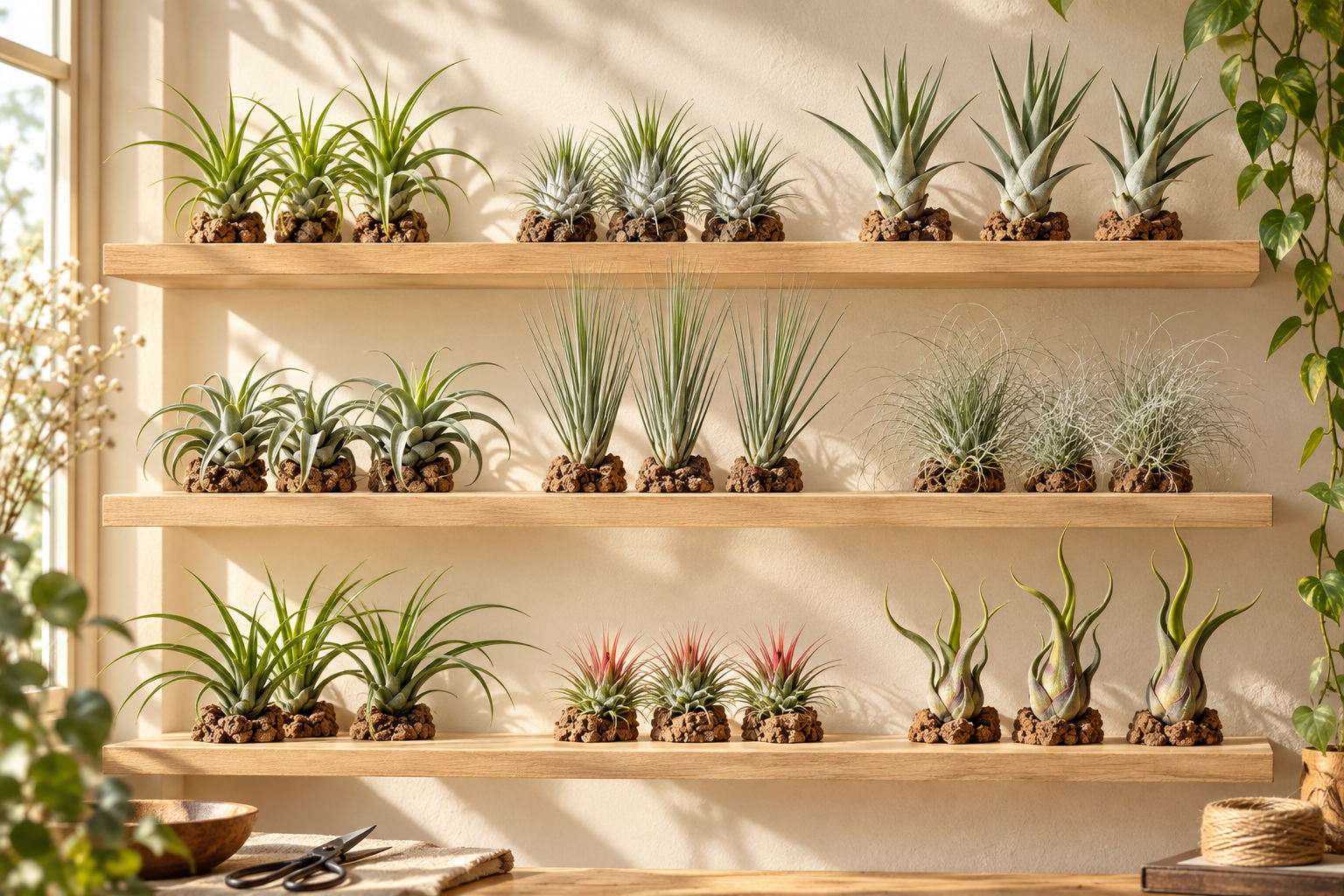
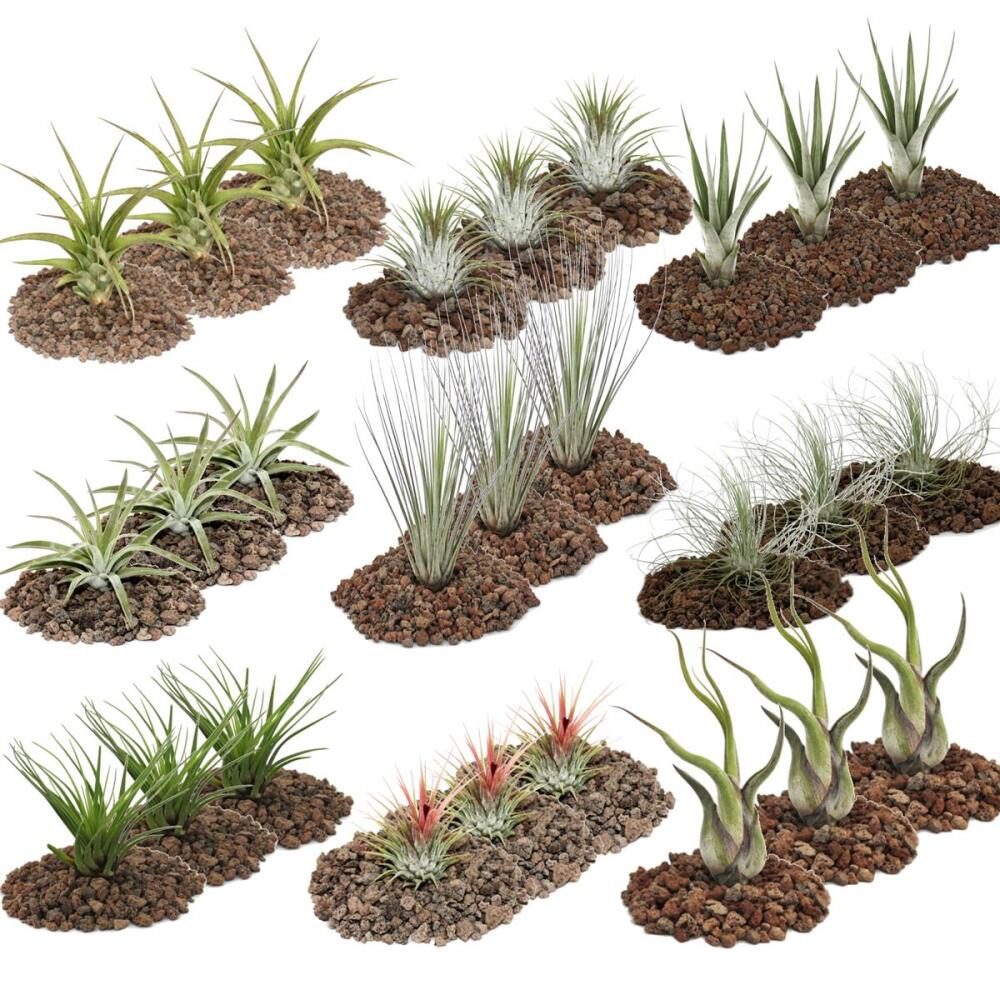
Tillandsias have a lightness about them: leaves reach from small rosettes, curve or form fine silver tufts. They can be viewed on an open support without a cachepot framing each shape. The large shop set contains 27 plants in at least nine varieties according to selection; names and distribution are not fixed guarantees. The original photograph arranges nine form groups as an example. Our scene takes up this idea but is no binding packing list. When unpacking, look at which leaves are broad, fine, stiff or curved. The special appeal comes from these actual differences, not a previously invented variety sequence.
Get acquainted first, then build the arrangement
Offered plant size is about six to twenty-five centimetres. This measures the plants, not pot height or each later rosette. Initially lay the delivery loosely on a clean open surface and keep existing labels. Only then distribute them among planned positions. A small personal marker on the support helps recognise similar forms later. With 27 plants, not every one needs a long description: a photograph of the arrangement and short group notes provide an overview without overloading the styling with signs.
The support holds the plant and leaves its base free
The air tillandsias presented here are not planted in potting soil like ordinary houseplants. Their short roots mainly provide anchorage. Open cork pieces or suitable removable supports can hold a rosette; leaves and base must not be squeezed or permanently enclosed in wetness. Plants should stay accessible for care. Try their position without final fixing first. A downward or angled rosette lets water drain more easily than a small upright funnel. The scene shows a styling possibility, not supplied boards or decorative pieces.
Light and air belong at every collection position
Choose plenty of filtered daylight and gentle air exchange. On multiple shelves, the lowest row must receive light too; a bright room alone does not guarantee a bright little niche. After shipping, do not increase hot direct sun abruptly. A bathroom may suit if daylight and ventilation are right. High humidity does not turn a windowless room into a suitable permanent position. A closed damp glass globe also looks decorative but makes drying checks harder. A sheltered outdoor position is possible in warm summer after acclimatisation; the collection returns indoors before cold or unfavourable weather.
Air plants do not live on air alone
Fine leaf scales take up water; in silver forms they make the surface particularly striking. Use suitable low-lime water and wet plants adequately. Whether thorough spraying or watering suited to the actual plant is sensible also depends on shape, warmth and air dryness. A brief mist does not automatically reach all leaves. Afterwards let water drain carefully and provide good drying, especially in dense or bulbous structures. Plants do not remain permanently in water. After care, check rear specimens in a group too, rather than judging only the visible front rosette.
Flowers and young rosettes are separate development steps
With suitable cultivation, tillandsias may form interesting flowers or coloured bracts; the set promises neither a particular colour nor simultaneous flowering of all plants. After flowering, many forms produce young rosettes at their base. Do not break them off immediately merely because they are small and still uneven. Let the group continue growing first, then consider suitable division for the actual form. During growth, use suitable fertiliser sparingly according to the label. The collection needs attention to development, not extra heavy feeding to make all specimens begin flowering on the same day.
Look at the collection afresh through the seasons
In winter, keep bright and safely frost-free. Dry heating air may increase needs, whereas a cool damp position considerably slows drying. We therefore observe both water needs and remaining moisture in rosette centres. Distinguish brown or black soft parts from older dry leaf tips. Photograph unusual changes and check neighbouring plants. An open removable arrangement is easily adjusted. Gradually you recognise which groups dry faster, where new growth sits and which form needs more free space. The large set then grows into a manageable personal collection.
One plant, several views
Good to know
Are these 27 different species?
The offer lists 27 plants in at least nine varieties according to selection. This does not establish a fixed list of 27 different botanical species.
Must I plant the air plants in soil?
The air tillandsias offered here receive an open support. They are not planted in potting soil like ordinary potted plants.
Is a windowless bathroom enough?
No. Light remains necessary; high humidity does not replace a suitable bright position.
Why must they dry after watering?
Permanently standing water in rosettes and poor air exchange can encourage rot. Let water drain and ventilate.
Do all 27 flower together?
This is not guaranteed. Species, development and cultivation differ.
Are supports in the scene included?
No. Boards, cork supports and decoration are a styling example; the offer comprises the described plants.
Sources and editorial note
- Exotenherz: offer and original images (02.10.2026)
- RHS: air tillandsias, watering and air movement (02.10.2026)
- NC State Extension: Tillandsia, leaf scales and young rosettes (02.10.2026)
Shop offer, article number, GTIN, availability and original images checked directly on 02.10.2026. Specialist sources read directly. 27 plants and at least nine varieties from the title; contradictory exaggeration “27 different” not made into 27 species. No invented fixed variety list. Water needs and drying explained, not watering potting soil. The scene and, where applicable, AI-created detail were checked directly against the shop reference; quantity, growth forms and size reference suitable.