
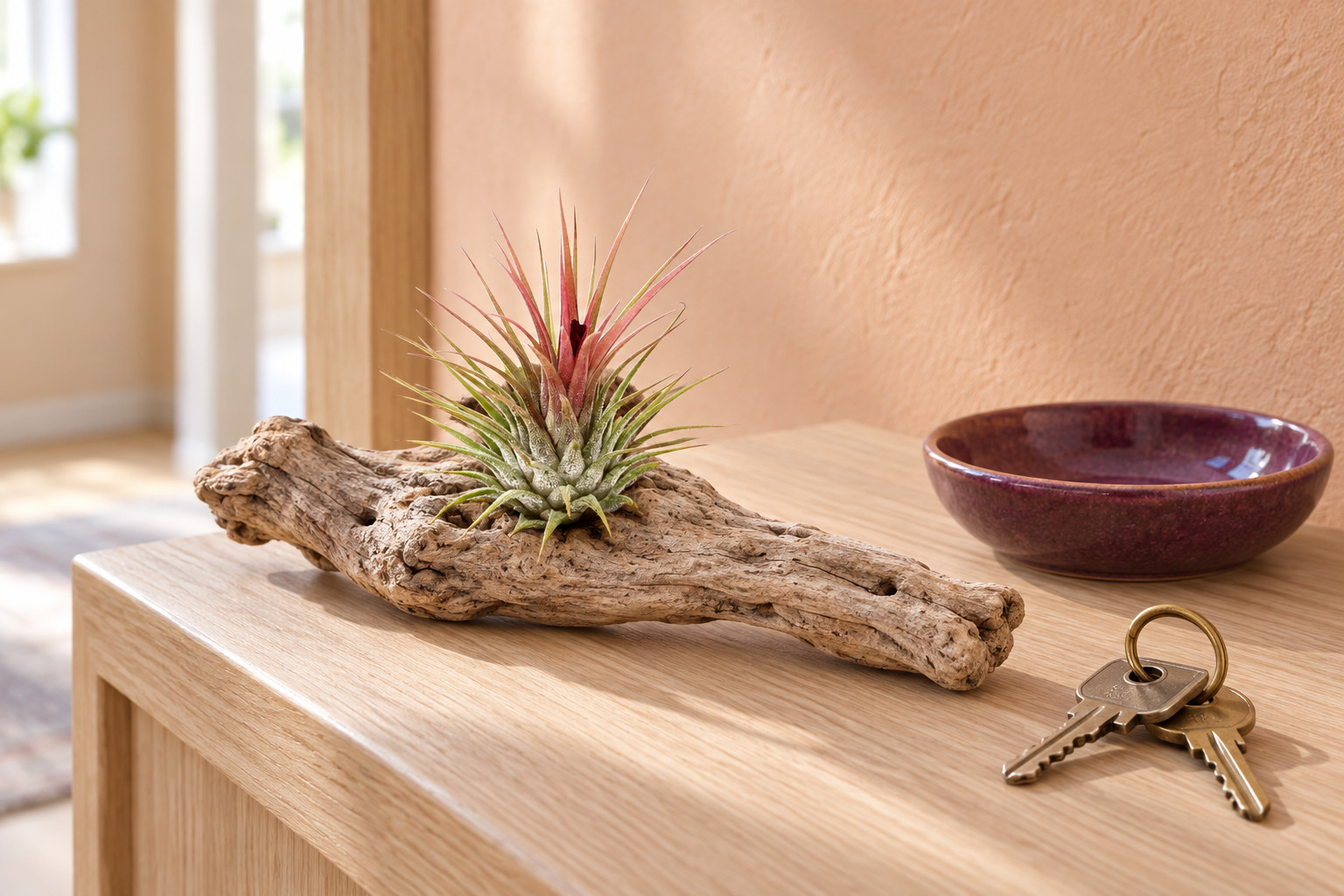
This plant at Exotenherz
Check the shop offer for current availability, price and what is included.
Link to the offer in German. Check the shop for the current price, availability and delivery contents.
Your care table
| Topic | What to do | Why it helps |
|---|---|---|
| Light | Provide bright filtered daylight and good airflow. | The small rosette needs light but cannot tolerate just any hot position behind glass. |
| Water | Regularly wet thoroughly with room-temperature, low-lime water or give a suitable bath. | Room air alone does not reliably supply enough water in ordinary homes. |
| Drying | Carefully shake water from the rosette and allow it to drain upside down. | Standing water in the plant centre can encourage rot. |
| Support | Choose an airy, preferably removable position without soil. | The base needs air; the plant must stay accessible for care. |
| Leaf scales | Do not rub them off or use leaf-shine products. | Fine scales are functional plant parts and help absorb water. |
| Fertiliser | During active growth, use suitable tillandsia or bromeliad fertiliser very sparingly according to the label. | Without soil, nutrients are absorbed through leaf surfaces; high concentrations are unnecessary. |
| Temperature | Keep warm and frost-free, without cold draughts indoors. | Wetness and cold together make quick, healthy drying harder. |
| Offsets | Let young side rosettes reach a sufficient size before separation. | Stronger offsets can take over the group’s development. |
Take the tillandsia off its support. Do not rub the leaves; preserve the delicate silvery scales.
Use low-lime water at room temperature. The care table explains whether thorough misting or a short soak is suitable.
Gently shake off the water. Tilt rosettes downwards, hang loose strands without bunching them together and allow them to dry with good airflow.
What an air plant actually is
Tillandsia ionantha belongs to the bromeliads and often grows on other plants or suitable surfaces in its home region. Roots serve mainly for attachment. Water and nutrients are absorbed through leaves, whose fine absorbing scales create the silvery impression. This makes it a lovely example of the different ways plants live. It is not a parasite draining its support. Nor does the name air plant mean that air in a heated home meets its water needs alone.
Present a small plant thoughtfully
The offer comprises a loose plant of approximately 6 to 8 cm. This compact size determines our illustration: a small piece of wood is enough as a stage, while a large floor vase would obscure the actual proportions. Reddish inner leaves can be part of flowering development; colour and condition vary in a living specimen. The support, bowl and other decoration shown are not part of the offer. A larger tillandsia group with several rosettes is a later development stage or a different product, not simply a more generously photographed individual plant.
The prettiest spot needs daylight too
Choose a bright position with filtered light and good airflow. An open console near suitable light can work. A windowless hallway or deep enclosed shelf is not a good permanent solution despite attractive decoration. Protect the plant from intense midday sun behind glass and direct dry airflow from a heater. After acclimatisation, a sheltered outdoor position is possible in warm summer weather. Check wind, drying and rain there. The plant must neither blow away nor lie permanently wet in a hollow.
Watering needs a complete finish
If possible, remove the tillandsia from its support for care. Wet it thoroughly with room-temperature, low-lime water. A time-limited bath can be practical; duration and intervals depend on warmth, airflow and condition. A rigid weekly rule does not suit every room. After watering, gently shake out excess water and let the rosette drain with its opening downwards. Return it only once it has dried sufficiently. This second part belongs to watering too. A regularly bathed plant can still rot if water always remains in its centre.
Do not polish silvery leaves
The pale, finely scaled surface is not dirt. Do not rub it away or use leaf polish. Handle the rosette only as much as necessary for care and do not bend narrow leaves apart. Strongly curled or drying tips may be a reason to check water supply and position. A dark base becoming soft points to a different problem and is not improved by more frequent bathing. Observe colour, firmness and development together. Individual old outer leaves may age over time without the whole plant being ill.
Decoration should make care easier
An airy holder, suitable branch fork or open support can work. A solution that lets you remove the plant without pulling is practical. Do not bury the base in soil or push it into constantly wet moss. A tight enclosed glass container often makes drying harder. Choose materials and fastening to keep leaves intact and prevent pulling on the rosette during watering. A small empty bowl beside the plant can serve as decoration; it need not remain filled with water.
Red centre, flowers and the next generation
Before flowering, inner leaves can turn distinctly reddish. Small tubular flowers emerge from the centre, typically violet in this species. The colouring is therefore not a fixed coat that every delivery must display permanently. An individual bromeliad rosette flowers once and gradually ages afterwards, while side rosettes can continue the group. Do not remove the mother prematurely while it is still alive and its offsets are developing. Change after flowering is part of its life cycle and cannot be stopped with strong fertiliser.
Offsets need a good start
Initially let side rosettes grow on the mother. As a guide, they should reach at least about one third of her size before considering separation. A well-developed small group can also stay together and gain character over the years. If separating, work carefully, using clean tools if the connection does not release easily. Keep the young rosette just as airy and water it carefully like the mother. Removing tiny beginnings too early brings no faster success. Patience often preserves more plants here than an ambitious propagation plan.
Winter care and small checks
In winter, keep the tillandsia bright, sufficiently warm and frost-free. Changed heated air can increase water needs while lower light and cooler positions slow drying. Check both at the actual position. With weak growth, do not add fertiliser merely because a calendar says so. Look between leaves and at the base during care: unusual deposits or individual insects are easier to identify early. Note the watering method and how long the rosette dries at its position in the plant book. This creates a dependable routine for this particular little air plant.
One plant, several views
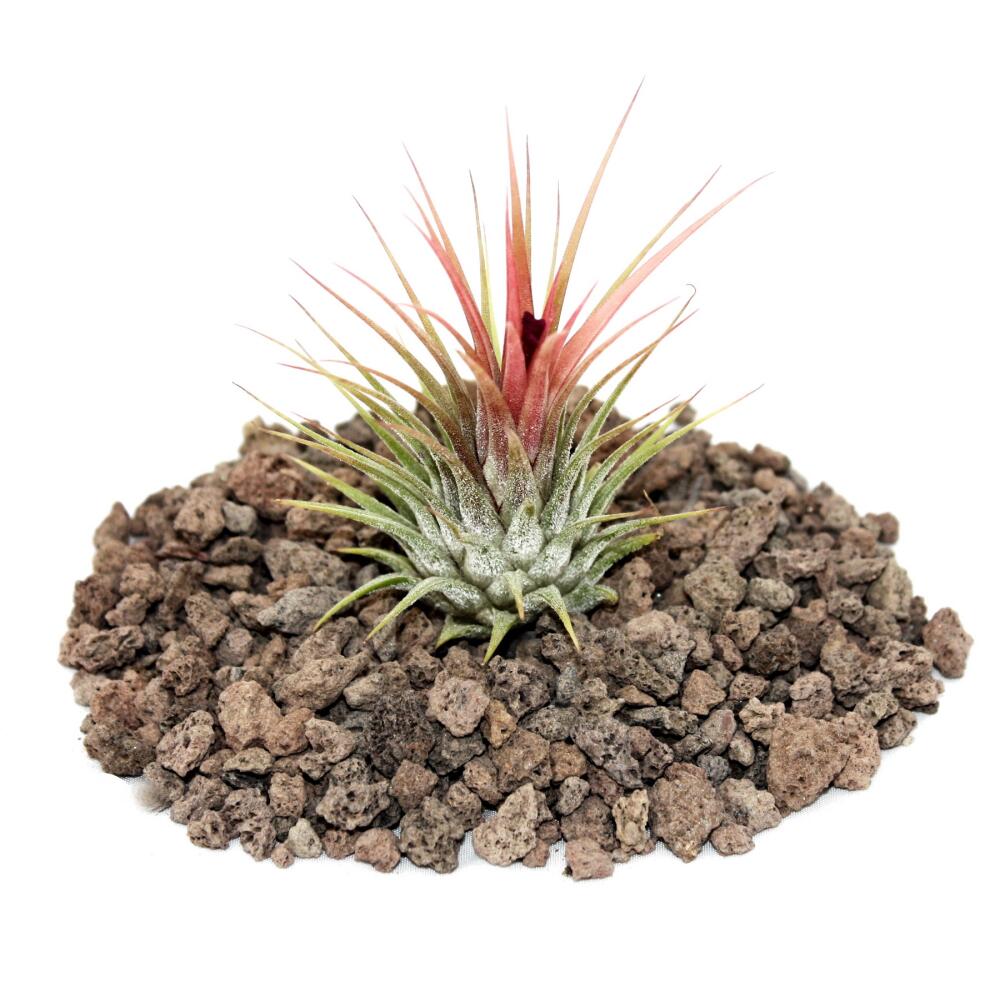
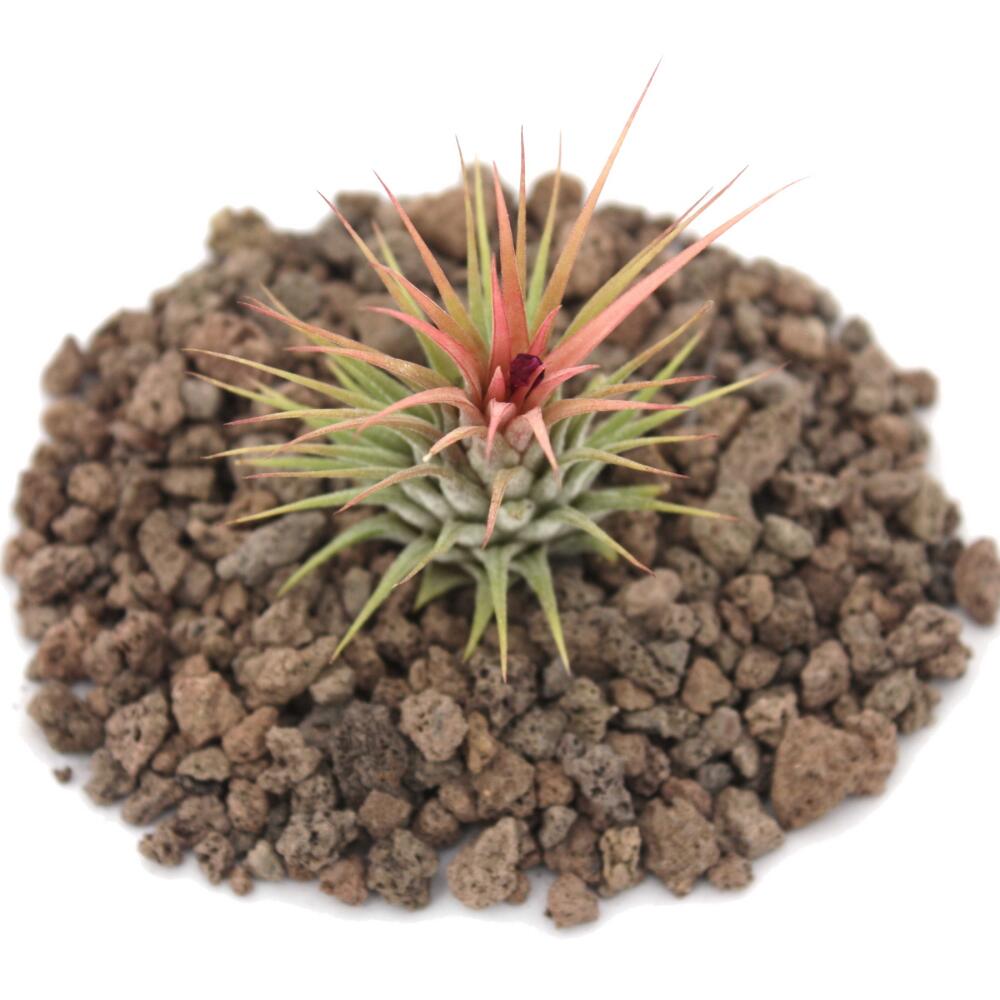
Good to know
Does Tillandsia ionantha really live only on air?
No. In homes it needs regular watering. Its leaves absorb water; after care it must be able to dry well.
Does it need planting in soil?
No. This species is cared for without potting compost on a suitable airy support.
Are silvery scales a pest infestation?
Even, fine absorbing scales belong to the plant and must not be rubbed off. Unusual localised deposits are checked separately.
Does the red centre stay permanently red?
Inner leaf colour changes with flowering development, among other things. Permanently identical colour is not a natural product characteristic.
Can I put it straight back in glass after bathing?
First remove water from the centre and let the plant dry well. An airy open place is easier to care for than a tight enclosed container.
Sources and editorial note
- Product and delivery size: Exotenherz
- NC State Extension: Tillandsia ionantha
- RHS: Tillandsia ionantha
- RHS: growing air plants
- Clemson Extension: bromeliads and tillandsias
Sources checked: 14 September 2026. Product and delivery size are described from the shop offer; care takes account of the linked botanical specialist sources. Guidance applies to this species and should be adjusted to plant condition, position and season.