

This plant at Exotenherz
Check the shop offer for current availability, price and what is included.
Check the shop for the current price, availability and offer contents.
Your care table
| Topic | What to do | Why it helps |
|---|---|---|
| Arrival | Unpack bulbs, check firmness and store organised by chosen colour. | Dry, airy material is easier to inspect than a closed damp bag. |
| Position | Choose sun, some shelter and fertile permeable soil. | Tall cups need light; constantly wet soil damages the dormant bulb. |
| Planting | Plant in autumn, tip upwards, about two to three actual bulb heights deep. | Packet instructions supplement guidance; trade circumference size is not diameter. |
| Spacing | At least two real bulb widths; about 10–15 cm in beds as guidance. | Leaves and new bulbs need sideways space. |
| Water | Check soil during emerging shoots and the leaf phase; water thoroughly when dry. | A windy pot dries faster than a rain-wet bed. |
| Nutrients | For continued cultivation, feed moderately during growth according to need and label. | The bulb builds reserves; active feeding ends with yellowing. |
| After flowering | Remove faded heads; retain green leaves until natural dieback. | Early leaf cutting limits reserve-building for next spring. |
| Dormancy | When lifting, wait for yellow leaves and store healthy bulbs dry and airy. | Summer wetness and closed damp storage make continued cultivation harder. |
For young plants, feel the soil directly at the root ball. The surface and deeper soil may have different moisture levels.
Water thoroughly after planting; later, water according to the soil, weather and establishment rather than a fixed calendar.
Avoid standing water. For plants in containers, also check that water runs out of the drainage hole.
A cup that keeps its shape
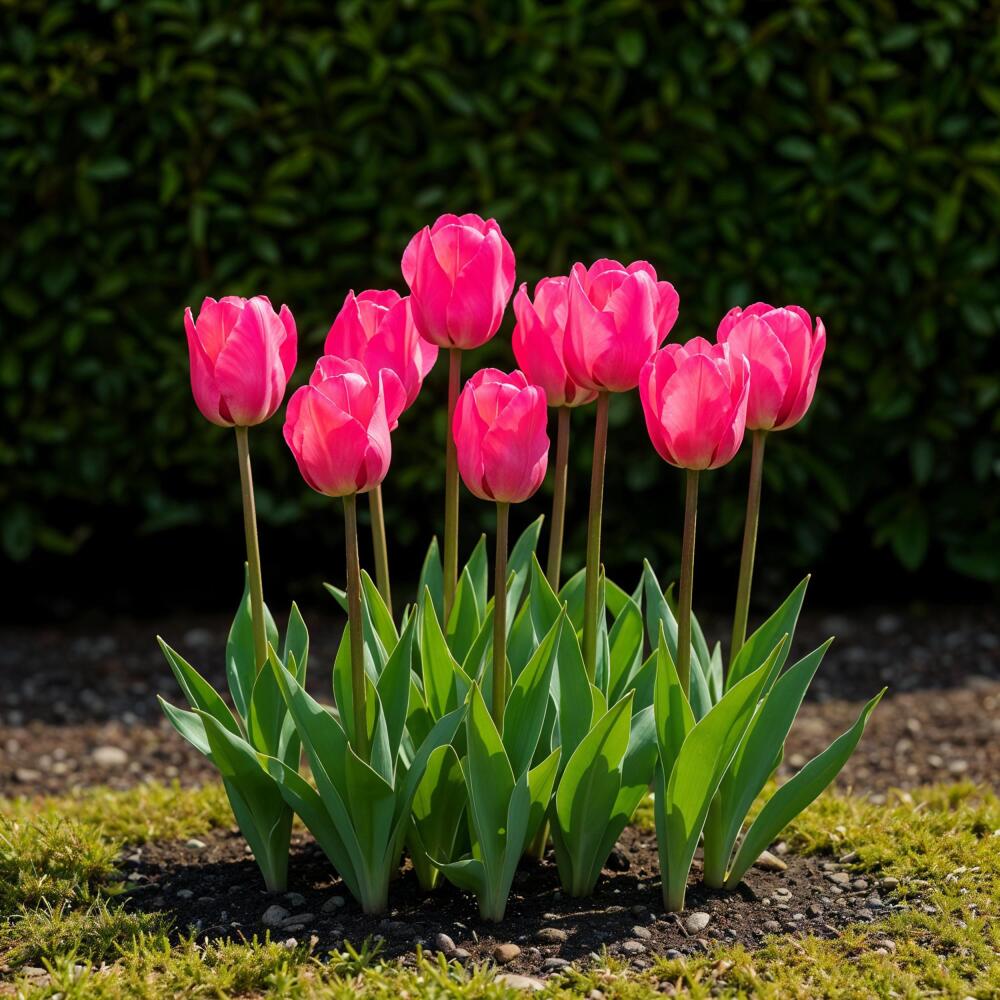
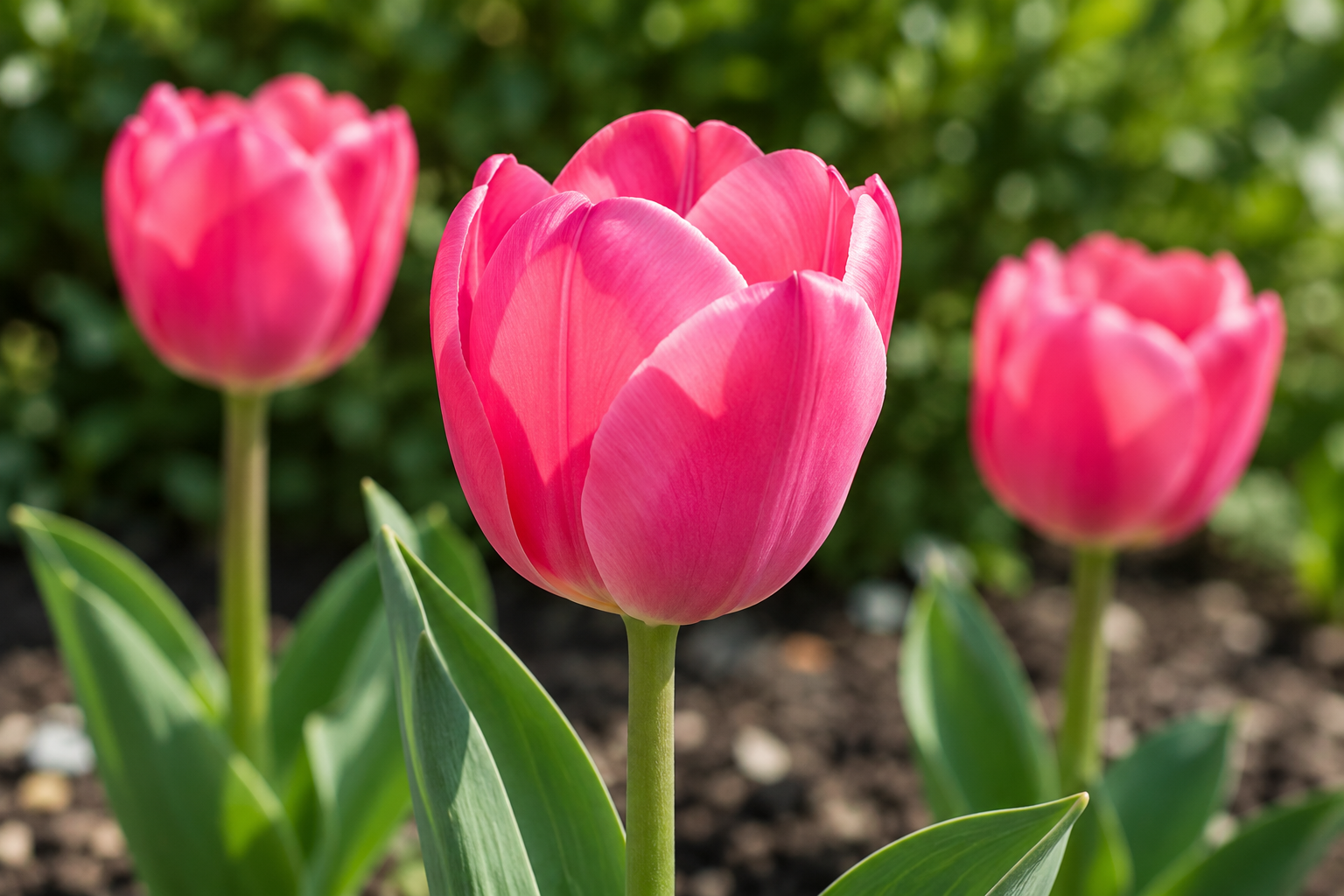
Pink flowers rise on slender green stems above broad, slightly grey-green leaves. Their smooth floral parts overlap into a simple cup; the edge stays rounded without fringes. This clear structure is easy to recognise in a small group from the garden path. Triumph denotes a horticultural tulip group within the genus Tulipa in the lily family. It includes different cultivars with simple cup-shaped flowers in mid to late spring. The pink offer bears the trade name Triumph Pink. The name tells you the colour, without identifying one particular cultivar. At a quiet bed edge, the flower may lead the eye while broad leaves create a green area of their own at ground level.
Opening the packet starts the garden plan
Delivery is bulbs for planting, fifteen in the chosen colour offer. Pink, red and white are separate offers; a selected packet is not a mixture of all three. Flowering containers and planted beds in pictures show later development. Lay bulbs out airily after opening and check firmness. Partly loose brown papery skin alone is not damage; soft areas and noticeable mould deserve attention. Keep material dry, cool and well ventilated until planting. Label the packet with its chosen colour to avoid mixing bulbs during distribution. Gloves are useful for sensitive skin; keep planting material separate from food.
Flower height helps with placement
For this selection, approximately 50–60 cm in flower is guidance for bed planning, not delivery height or a fixed limit for every bulb. April to May is the described flowering period; warmth and spring cold shift its actual start. In front of a low wall or along a sunny terrace, cups stand at eye level when you sit beside them. Keep the background quiet and leave sufficient distance from a frequently used path. A sheltered position reduces strain on stems. Plan the weeks after flowering too: broad leaves still need light when pink, red or white heads are gone. Low neighbours can accompany the area without covering tulip leaves completely too soon.
In autumn, the later shape lies underground
Plant in autumn in frost-free, workable soil. A mild unfrozen day matters more than a fixed calendar date. Choose sun and fertile, permeable soil; a hollow remaining wet long after rain is unsuitable. The bulb tip points upwards. About two to three actual bulb heights provide depth guidance, supplemented by the packet instructions. Bulb circumference differs from height or width: trade size 11/12 must not be used as an eleven- or twelve-centimetre-wide bulb body to calculate planting depth. At least two real bulb widths apart, and roughly 10–15 cm in beds as horticultural guidance, leave room for later leaves. A small marker keeps the site recognisable during other garden work.
A container needs more than a pretty rim
Deep, stable containers with open drainage holes suit balconies and terraces. Before filling, check that water really can escape. Soil must accommodate bulbs and later roots; a cramped small bowl is no good long-term plan for fifteen bulbs. Split the packet into suitable groups instead. After planting, water a little if soil is dry. During shoot and leaf growth, check moisture regularly in a sunny or windy pot. Rain often reaches the root zone in beds more reliably than in a sheltered balcony corner. Water thoroughly when needed instead of adding precautionary water to an already wet pot. Water must not remain in a decorative outer pot either.
Leaves stay busy after flowering
During its green leaf phase the plant builds reserves for the bulb. If continued cultivation is planned, suitable nutrients may help during growth; existing soil reserves and fertiliser instructions determine amounts. More fertiliser does not force longer flowering. Remove faded heads if you do not want seed formation and keep green leaves until they yellow naturally. Do not tie them into a tight decorative knot. A flowering photograph and a note of later dieback help plan next year’s space. Grazed shoots, unusual brown spots or deformed flowers require separate attention. Check affected plants and their site before attributing every problem solely to missing nutrients.
Summer dormancy also shapes next spring
Triumph tulips are perennial bulb plants, but vigorous garden tulips do not flower equally well in later years at every site. Sun, an undisturbed leaf phase and soil that dries well in summer support continued cultivation. Where soil stays wet in summer, lifting healthy bulbs after leaf yellowing may be useful. Gently remove soil, let material dry and store airily, dark and dry until autumn. Discard soft or mouldy bulbs. Small daughter bulbs need time before they can flower themselves. Protect a container in winter from prolonged wet periods and hard freezing throughout the soil, while allowing free drainage. The plant book records which group returns and which site would better suit a new autumn planting.
One plant, several views
Good to know
What does Triumph mean in a tulip?
Triumph is a horticultural group with simple cup-shaped flowers in mid to late spring. It includes different cultivars; Triumph Pink here names the pink offer.
Are the fifteen bulbs a colour mixture?
No. Pink, red and white offers are separate. Your chosen colour offer is what counts; pictures show later flowers.
How large is the delivered plant?
You receive dormant bulbs for planting, not flowering potted plants. About 50–60 cm is guidance for later flower stems, not delivery height.
How do I calculate planting depth?
Start with approximately two to three actual bulb heights and follow the packet. Trade size 11/12 describes a size class and is not used as bulb width.
May I remove leaves straight after flowering?
Leave green leaves until natural yellowing. Faded heads may be removed sooner if seed formation is not wanted.
Must I dig up bulbs in summer?
A site that dries well may allow continued cultivation in the ground. In summer-wet soil, lifting after the leaf phase may help; then store healthy material dry, dark and airy.
Do Triumph tulips flower equally strongly every year?
This cannot be assured. Large garden tulips may weaken in later years; light, leaf maturity and conditions during summer dormancy affect development.
Sources and editorial note
- Exotenherz: directly read pink offer, bulb quantity and originals (shop evidence03.10.2026, checked04.10.2026)
- Exotenherz: directly read red offer, bulb quantity and originals (shop evidence03.10.2026, checked04.10.2026)
- Exotenherz: directly read white offer, bulb quantity and originals (shop evidence03.10.2026, checked04.10.2026)
- RHS: independent Triumph Group classification; Don Quichotte not assigned as the shop cultivar (directly read04.10.2026)
- RHS: planting, feeding and caring for tulips after flowering (directly read04.10.2026)
- NC State Extension: Tulipa, growth, leaves, post-flowering and bulb cultivation (directly read04.10.2026)
- The Bulb Farmers: trade size and bulb circumference (directly read04.10.2026)
Root assignment14300: one evidenced Triumph Group portrait, three coherent active colour offers, no private cultivar assumed. Purple1514030102025 remains internally excluded because its own long text says red while the title says purple. Actual morphology/Canon comparison and directly read RHS classification support the garden-group assignment. Adult native50/shopmaximum60 presented as 50–60 cm guidance, not delivery dimensions; spacing as practical guidance. Shared build and publication only by Root.