
This plant at Exotenherz
Check the shop offer for current availability, price and what is included.
Check the selected shop offer for price, availability and delivery contents.
Your care table
| Topic | What to do | Why it helps |
|---|---|---|
| Light | Choose bright partial shade as a good starting point. | The pale leaf pattern is visible even without especially abundant flowers. |
| Soil | Prepare humus-rich soil with suitable moisture and drainage. | The root zone should not dry completely while establishing. |
| Planting | Pre-moisten the root ball, plant at its previous height and water well. | The young plant initially starts with a small root zone. |
| Spacing | Leave about 30–35 cm centre to centre as offer guidance. | Long stems connect individual planting positions over time. |
| Water | Check root-ball moisture particularly after planting and in containers. | An older garden planting and a small nursery pot have different water buffers. |
| Stems | Limit overreaching and rooted stems at the bed edge. | Variegata can grow well beyond its original position. |
| Foliage | Remove vigorous completely green reverted shoots at the base if they appear. | They should not displace the cultivar’s cream-edged pattern. |
| Division | Divide healthy larger plantings in spring or autumn as needed. | Rooted pieces can renew the planting or start one elsewhere. |
For young plants, feel the soil directly at the root ball. The surface and deeper soil may have different moisture levels.
Water thoroughly after planting; later, water according to the soil, weather and establishment rather than a fixed calendar.
Avoid standing water. For plants in containers, also check that water runs out of the drainage hole.
A pale edge on every leaf
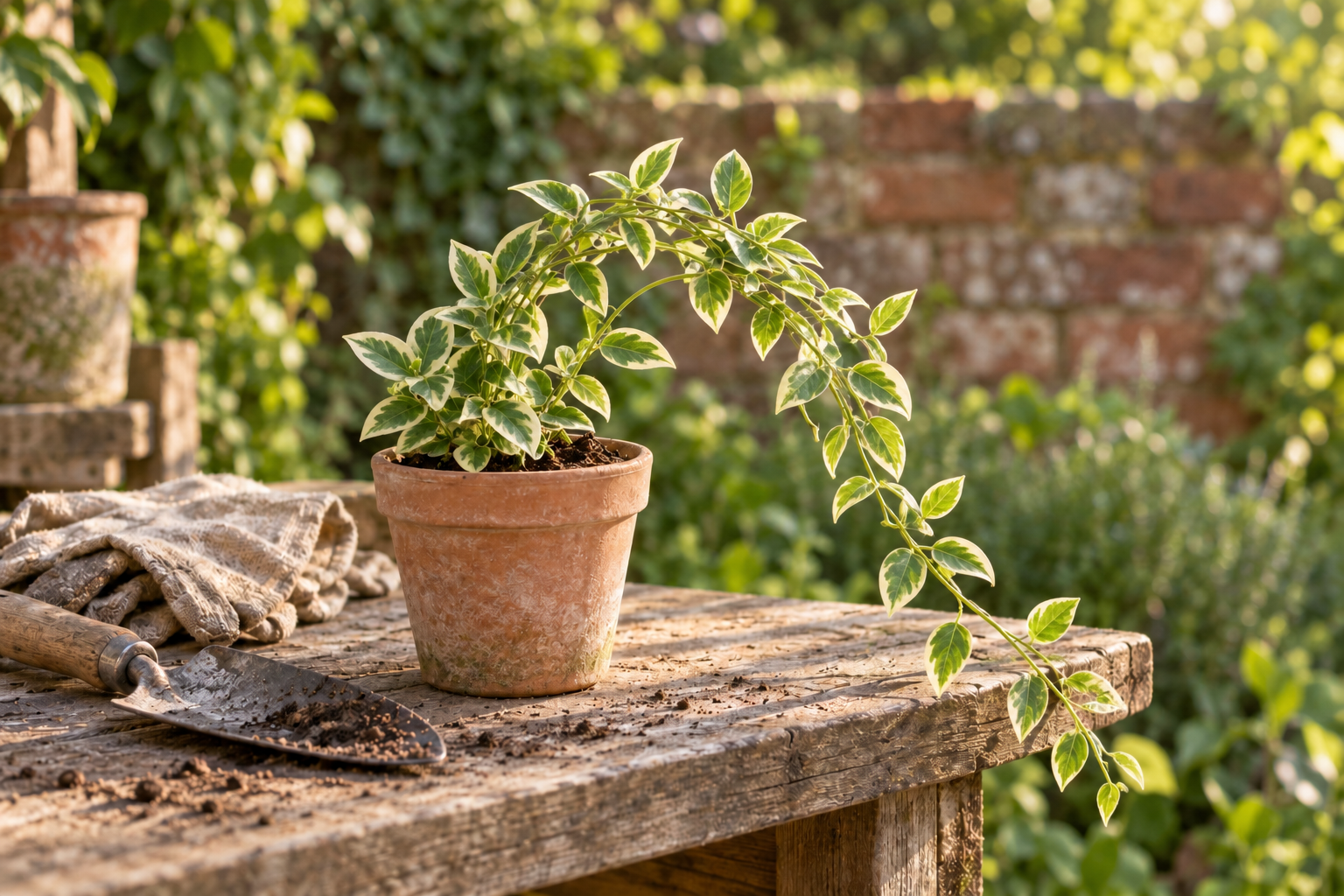
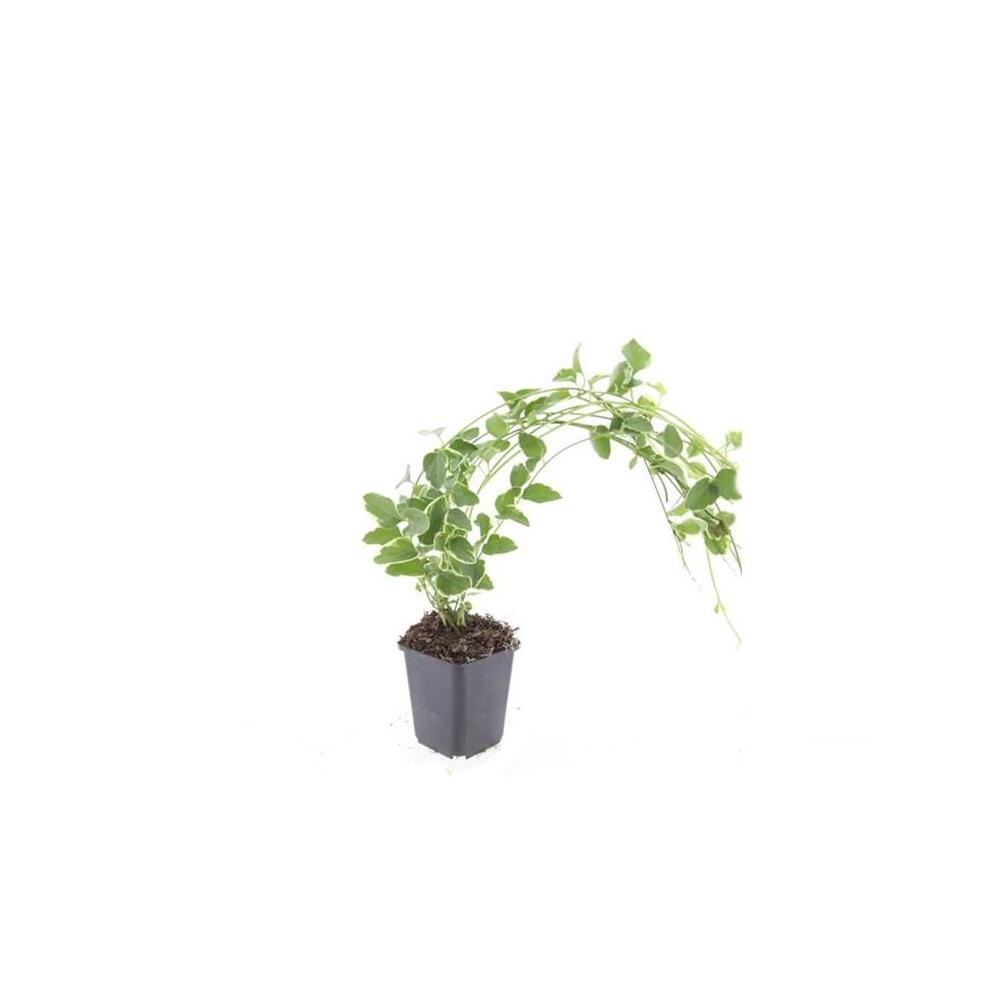
With Variegata, the effect does not begin with flowering. Green leaves are surrounded by a cream edge, sometimes narrower and sometimes broader. Light catches these pale parts and traces the long stems. A garden workbench shows a young plant’s growth particularly well: some stems initially stand upright while others already bend sideways. Leaves remain simple and oval-pointed; they are not lobed ivy leaves. The specific offer contains young plants in 9 cm pots, approximately 10–25 cm tall. The cachepot in the scene is only part of the presentation.
The plant becomes wider than its nursery pot
Alongside upright flowering stems, greater periwinkle forms long trailing stems. Where these rest on soil, they can form new roots. Variegata may reach about 45 cm high; outward spread is often more important in the garden. I would therefore not plan its space solely from the small delivery root ball. A larger group can look pleasant beneath a loosely leafed tree. Between fine small perennials, however, it needs a controlled edge. An initially delicate young plant will not automatically stay in the same small spot for years.
Pale leaves do not suit just any planting position
The leaf pattern makes Variegata interesting for shaded garden areas. Bright partial shade is a good start; shade and sunnier places are also possible. Light matters for more abundant flowers, while in deep shade the foliage carries more of the design. Beneath trees, I mainly check the soil. Dense roots and dry patches may meet there even though the surroundings look shaded. A new set plant still needs water. Sun is also not simply equivalent to dry soil. Only when light, soil and provision fit together can you see how the plant grows in its actual position.
Set size makes sense when laid out on the area
The offer gives approximately 30–35 cm spacing and eight to eleven plants per square metre as guidance. Before planting, I put the small pots on the prepared area. This shows where the group should connect a shrub planting and where a path or neighbouring perennial must remain clear. A suitable frost-free planting time helps the start. The root ball is moistened, set at its previous height and watered well. Soil must contact the pot root ball. Small plants in particular should not be buried deeply just to obtain an apparently flatter planting on the first day.
Violet-blue flowers suit the cream foliage
When the plant flowers, violet-blue complements the pale leaf edges. Individual flowers have five pinwheel-like lobes and sit among the leaves. Flowering is possible from spring to autumn, but is not guaranteed for every day or every young delivery plant. For me, the foliage therefore remains the more reliable starting point for the design. Ordering Variegata only as a particularly densely flowering carpet can easily create expectations different from its real garden growth. The planting may also spend a period without many flowers. Long stems and pale markings still show why this cultivar was chosen.
Care for the edge and recognise green reversions
I look regularly at the long stems along bed edges. What is wanted in an open area may grow into the next small perennial. Overreaching stems can be cut back appropriately; pieces already rooted need targeted removal. Occasionally a variegated plant may form completely green reverted shoots. In Variegata, these would change the pale cultivar pattern within a group. I remove such distinctly green vigorous stems at the base rather than shortening only their tips. The aim is not to fight every small natural variation in leaf margins, but to recognise clearly different vigorous growth.
Care in a pot is more confined than in a bed
A young plant can be displayed in a container before planting or grown on there temporarily. Its small root ball then needs especially attentive water checks. Water must not remain permanently in the cachepot, and the root ball should not dry out unnoticed. In winter, evergreen foliage stays visible but may bear marks of weather and position. A whole weak plant therefore needs a different assessment from a few older leaves. In spring, troublesome stems can be organised and healthy larger plantings divided as needed. Rooted pieces then begin their own establishment watering again, even if they came from an older garden planting.
One plant, several views
Good to know
Is Variegata ivy?
No. It is Vinca major with simple oval-pointed leaves, not Hedera with typically lobed leaves.
What colour are the flowers?
Violet-blue. The conspicuous cream colour belongs to the leaf edge.
Is the plant perennial?
Yes, greater periwinkle is a perennial evergreen ground cover.
How tall does the cultivar grow?
Up to about 45 cm; trailing stems can spread much further.
How much spacing do the sets need?
The offer specifies about 30–35 cm, or roughly eight to eleven plants per square metre.
What should I do with completely green stems?
Remove a clearly vigorous green reversion at the base so it does not displace the patterned cultivar.
Is the terracotta pot included?
No. Cachepot and workbench are part of the AI-created scene. The chosen quantity set in the shop is what matters.
Sources and editorial note
- Exotenherz: cultivar, delivery data and directly checked quantity sets (01.10.2026)
- RHS: exact Variegata cultivar, growth, flowering and cultivation (01.10.2026)
- NC State Extension: Vinca major, leaves and spread (01.10.2026)
- Trees and Shrubs Online: variegated greater periwinkle (01.10.2026)
- RHS: green reverted shoots in variegated plants (01.10.2026)
Cultivar identity, cream-edged unlobed leaves and violet-blue flowers precisely supported by RHS. All set identifiers confirmed, 6/12/60 available; 20/40 inactive. Original 6 advertising-free; originals 1/2 with environmental label internal, not public. First scene rejected for ivy lobes; corrected version with smooth oval leaves accepted, juvenile proportions and light appropriate.