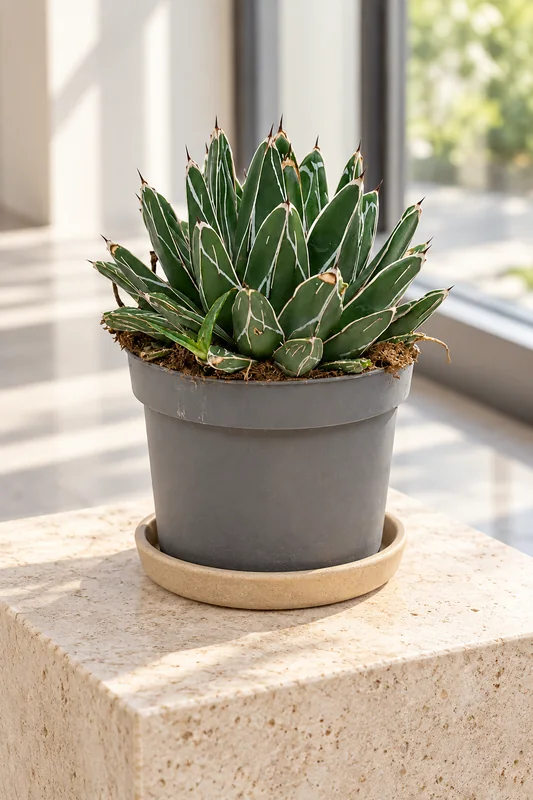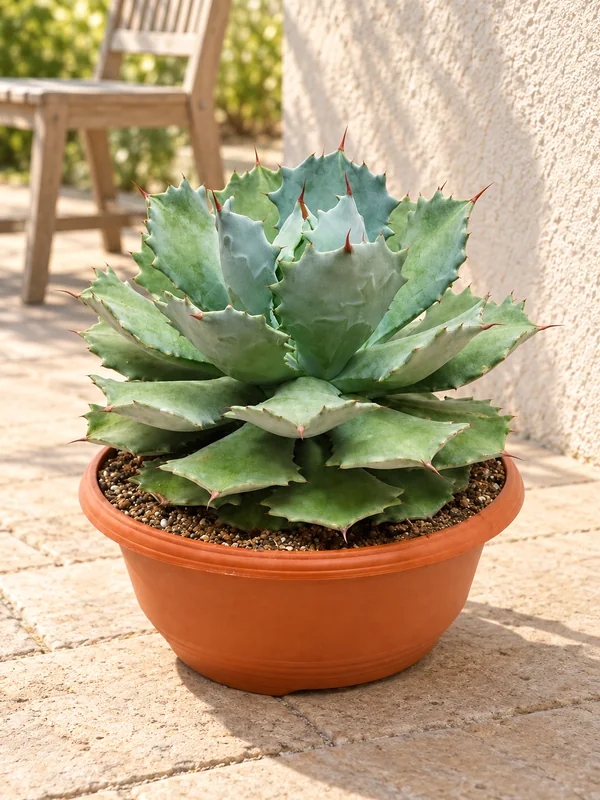
This plant at Exotenherz
Check the shop offer for current availability, price and what is included.
Product and delivery details are given in the individual offer.
Your care table
| Topic | What to do | Why it helps |
|---|---|---|
| Position | Sunny and sheltered; slowly acclimatise to light. | Pale edges do not invite an abrupt sunlight change. |
| Space | Plan room around leaves and route to winter quarters. | The larger bowl needs safe standing and transport. |
| Water | Check the ball; water thoroughly after drying. | Large and small containers dry differently. |
| Drainage | Check outflow and saucer after rain too. | Hidden residual wetness must not stay at the base. |
| Compost | Gritty soil; maintain base height when repotting. | Overlapping leaf bases are not buried. |
| Feed | Occasionally use low-nitrogen feed during growth. | Moderate supply supports firm structure. |
| Handling | Carry the container and use suitable protection. | Mind toothed edges, terminal spines and sap. |
| Winter | Very bright and frost-free; nearly dry at rest. | A large bowl holds residual moisture longer. |
Check the compost and pot weight. The care table explains how far the compost may dry.
Water only when needed. The water should reach the root ball without spilling over the rim.
Remove surplus water from the saucer or cachepot. Then return the plant to a suitable position.
Pale edges trace the grey-green rosette
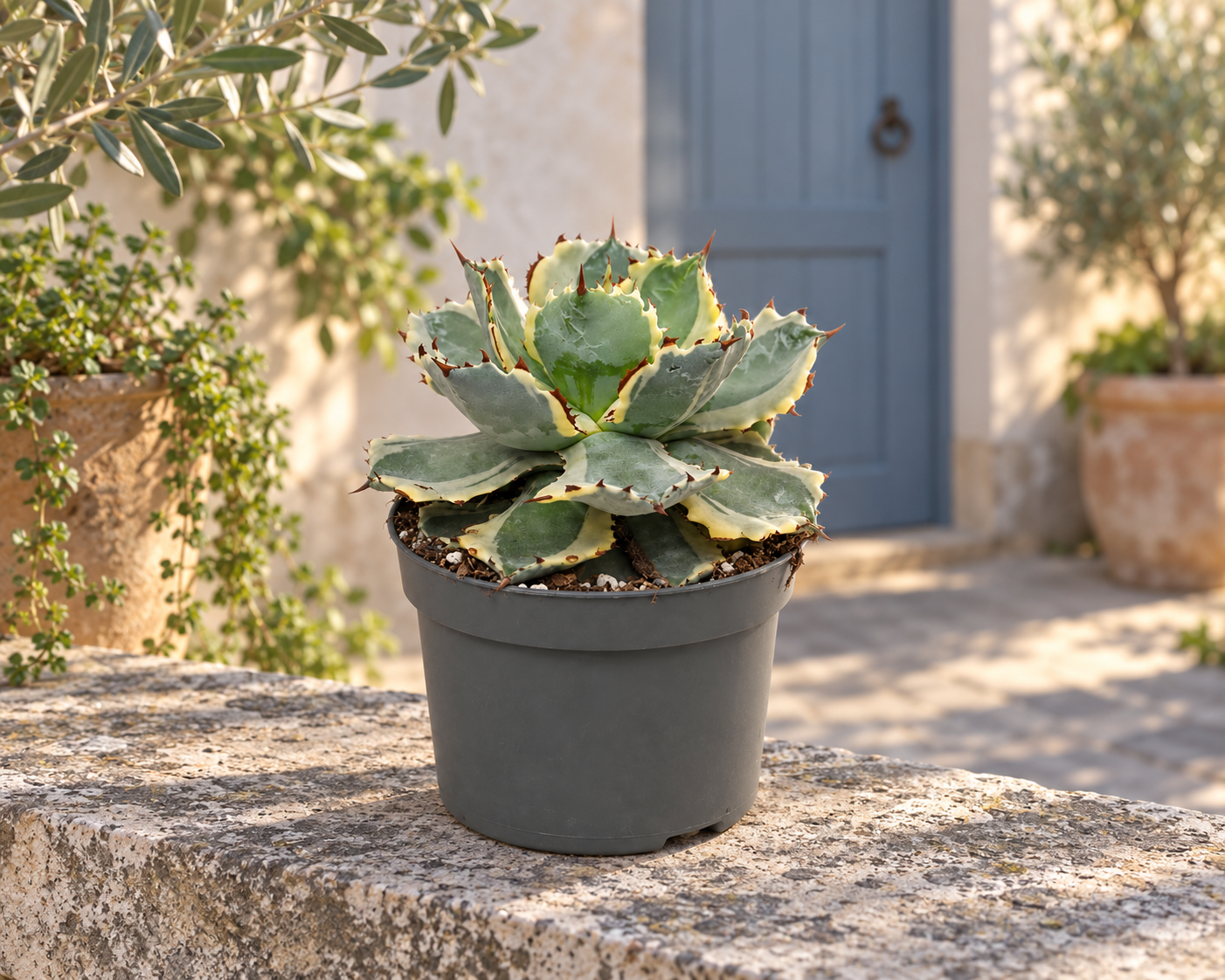
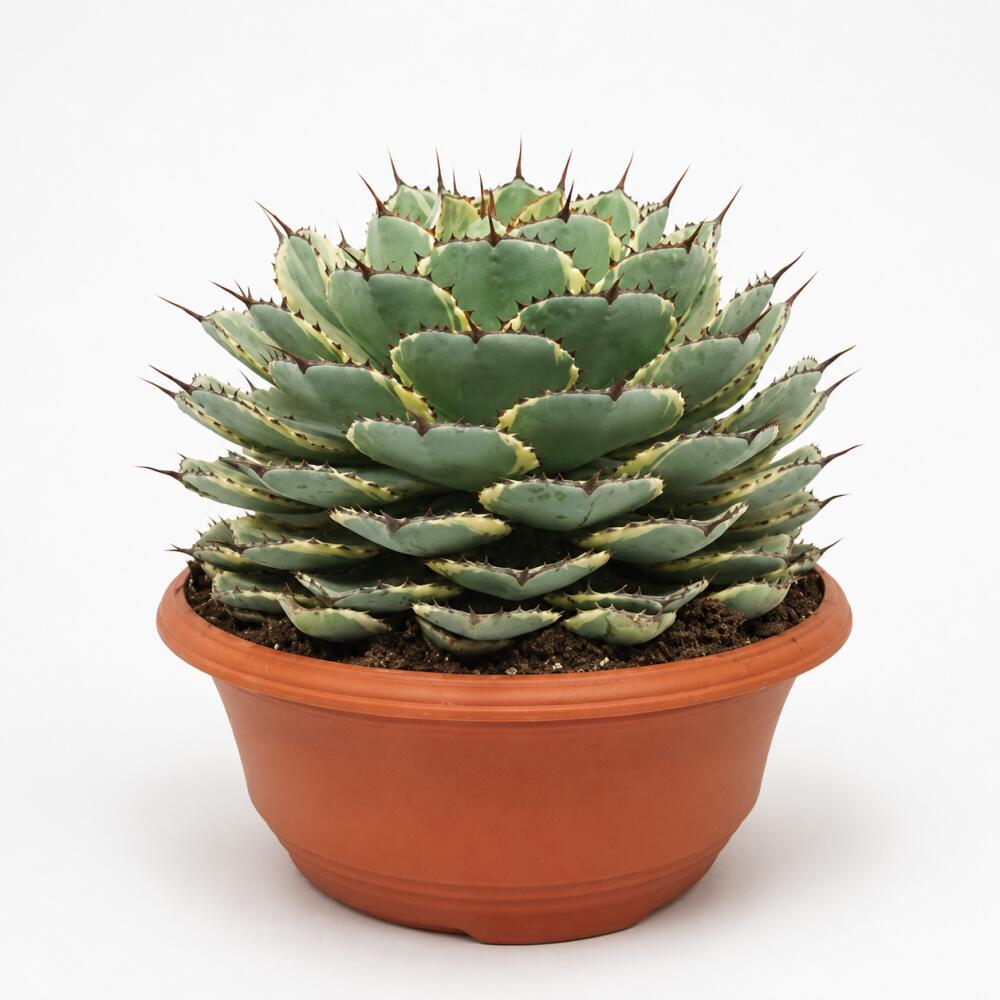
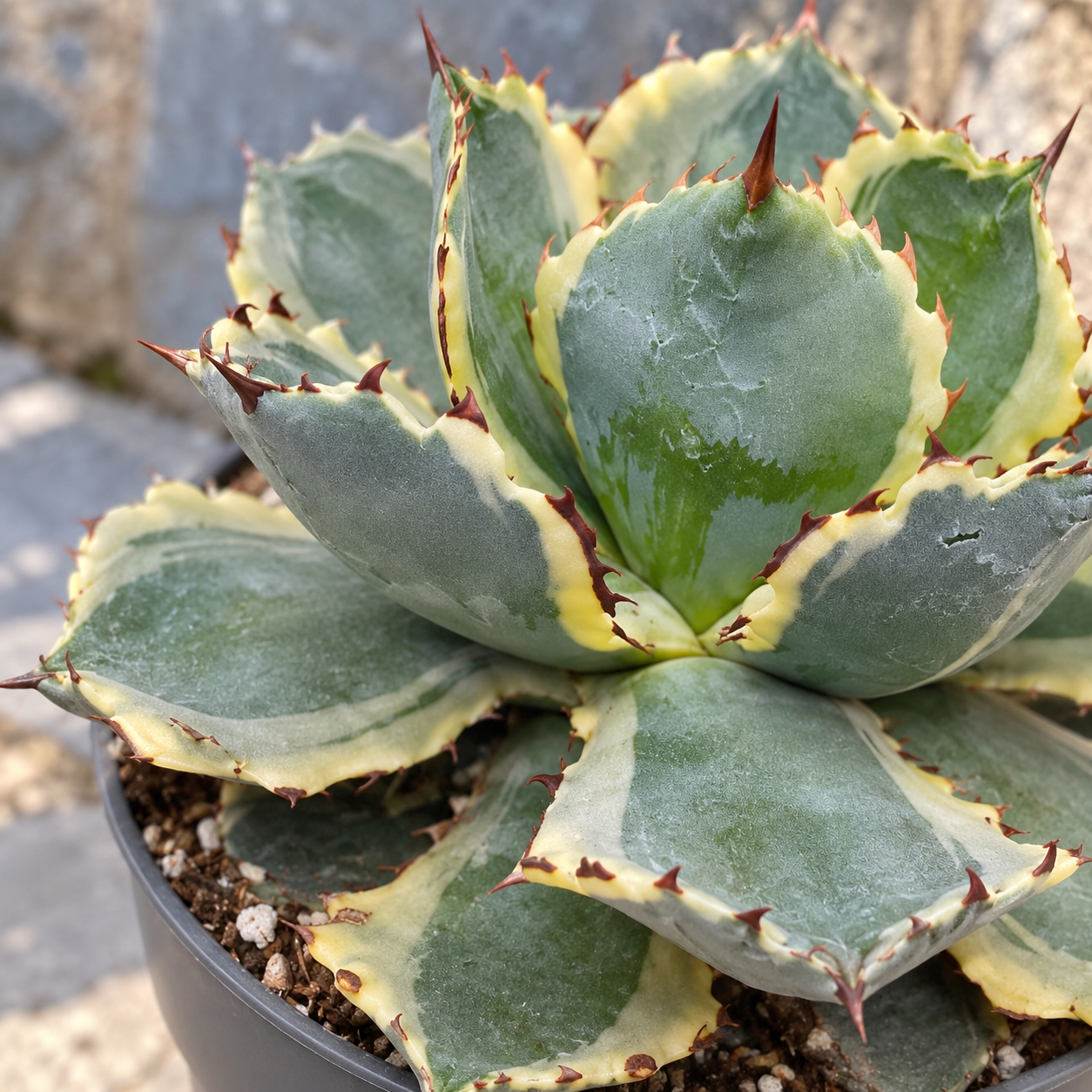
Leaves are broad and firm with matte grey-green centres. Cream-yellow stripes run along wavy edges. Brown to reddish teeth sit there; a strong terminal spine ends every leaf. This pale-edged variegated horticultural form is offered as Agave potatorum Variegata. The small original plant stands in a dark 13-cm nursery pot and opens outer leaves sideways. The larger original shows a more densely layered rosette in a shallow bowl. Pale edges are not the white imprint lines of a queen agave, but broad distinctly coloured leaf areas. Their actual distribution may vary in living plants.
Two delivery sizes change practical planning
For the smaller offer, the shop gives 13 cm pot diameter and around 18 cm total height. The larger version is offered in a 35-cm bowl at around 50 cm total height. Both include the container. Sideways rosette spread also matters for its position. Measure available room and keep space from paths, hands and other sensitive leaves. A larger bowl needs a safe transport route to winter quarters and stable standing. The young plant does not immediately need this large space. Nor should it be put preventively into a broad heavy bowl. Suitable root space and the actual rosette determine the next growing decision.
A sunny terrace starts with acclimatisation
Agave potatorum is grown bright to sunny. After shipment or winter quarters, stronger direct sunshine should be added in stages. A sheltered bright outdoor position in frost-free weather suits this. Avoid abruptly moving from a moderately lit interior to hot midday sun. Such harshness does not improve pale margins. Distinguish new dry surface damage from normal cream-yellow areas and matte leaf imprints. A small pot moves easily; a large bowl is much harder. Plan summer and winter positions together for both. A roof or other rain protection helps check drainage and ball condition even in changing weather.
A bowl needs checking below the rosette
Broad lower leaves hide part of the soil. Do not feel only a visible dry corner of its surface. Check the ball and its weight if the container can be handled. During growth water thoroughly after drying; excess flows freely away. In a larger bowl, damp soil may remain beneath dry grit. The young 13-cm pot’s watering rhythm is not simply transferred to it. After rain, outflow and saucer belong in the check. Water-storing leaves do not replace observation. If soil stays wet for a long time, assess container, compost and position before another dose. Frequent small sips do not resolve blocked drainage.
Gritty soil keeps air at leaf bases
Choose structurally stable very well-drained succulent compost and open drainage. When repotting, keep the base at its previous height instead of piling new soil between lower leaves. Spring with increasing activity suits necessary enlargement. First check whether roots and plant span need that step. Much excess soil volume stays moist longer after watering, especially in a broad bowl. Variegation justifies neither constant hunger nor heavy feeding. During growth, occasional moderate low-nitrogen supply by product instructions suffices. Do not feed at rest. Suitable assurance of exact final size for this trade form is missing; observed growth remains the basis for further space planning.
Toothed edges remain freely accessible
Place the rosette so tips do not extend into frequently used hand space. Carry by the container; gloves and further suitable protection help against spines and species skin-irritating sap. Pets should not nibble leaves. Regular shaping cuts are unnecessary. Healthy leaves and marginal teeth stay part of the plant. Do not polish the matte surface; gently remove loose soil without rubbing leaf skin. Check bases for scale and new soft dark spots. Distinguish these from older firm edge scars or regular pale stripes. Precise observation first shows whether a care problem exists.
Bright and frost-free until the next growth
Before the first cold spell, move the agave to a very bright frost-free growing place. With little growth keep it cool and almost dry. A large bowl may hold residual moisture much longer than a small pot; actually check winter condition. Dark storage and continuing summer supplies do not suit it. With new spring activity, cautiously increase water and nutrients if needed; later start outdoor sun acclimatisation again. After long maturity an agave may develop a tall inflorescence and the flowering rosette end its life stage. Metre figures for that stem describe neither the current leaf rosette nor delivery height. Until then, leaf space, light and a ball that can be checked stay central.
One plant, several views

Good to know
Where is the variegation?
The specific originals show cream-yellow edges around grey-green centres, with toothed margins and brown-red spines.
Which sizes are assigned?
13 cm pot at approx. 18 cm total height and 35 cm bowl at approx. 50 cm total height; each including container.
Does the larger bowl need the same watering intervals?
Its ball may dry more slowly. Each dose follows actual checked moisture, light and season.
Can it overwinter outdoors?
This portrait plans very bright frost-free overwintering and gives no blanket frost-hardiness promise.
Should the matte leaf surface shine?
No. The matte grey-green surface belongs to leaf appearance; no leaf shine or polishing needed.
Does the rosette become several metres tall?
Tall later figures concern a mature plant’s inflorescence, not young delivery or ordinary leaf size.
What matters when repotting?
Free drainage, gritty soil, previous base height and a suitably sized new root space. Mind spines and irritating sap with appropriate protection.
Sources and editorial note
- Exotenherz: directly read offer, measurements and originals (03.10.2026)
- Exotenherz: directly read offer, measurements and originals (03.10.2026)
- RHS: Agave potatorum, culture, habit and handling (read directly 03.10.2026)
- RHS: succulents in containers (read directly 03.10.2026)
- NParks: pale-edged variegated Agave potatorum (read directly 03.10.2026)
Directly read shop/specialist evidence and originals separately stored with hashes. Both leaf patterns actually compared: Gold centrally variegated trade form; Variegata pale-edged horticultural form. No confirmed additional species/subspecies/clone designation. Shop flower-colour advertising for Gold not adopted. One canonical non-variegated species portrait fully read; source form comparison without invented cultivar equivalence. Shared page checking and publication remain Root’s responsibility.