This plant at Exotenherz
Check the shop offer for current availability, price and what is included.
Product and delivery details are given in the individual offer.
Your care table
| Topic | What to do | Why it helps |
|---|---|---|
| Location | Keep warm with bright indirect light and protection from hot sun. | The small patterned leaf area needs light without sudden stress behind glass. |
| Watering | Water evenly when the surface begins to dry. | The small root ball should neither dry out completely nor remain constantly wet. |
| Drainage | Empty leftover water and check that pot holes are clear. | Moisture must not make the entire root zone short of air. |
| Temperature | Choose consistently warm indoor conditions without cold draughts. | This tropical Aglaonema is sensitive to cold. |
| Air humidity | Avoid direct heating air and allow a suitably more humid environment. | Very dry air can stress leaf edges; spraying alone does not replace suitable surroundings. |
| Soil | Use loose humus-rich peat-free houseplant compost. | The root ball needs both water retention and air. |
| Feeding | Feed sparingly according to a suitable fertiliser label only during new growth. | A miniature root ball cannot tolerate concentrated feeding as a shortcut to growth. |
| Repotting | When well rooted during growth, give only a little more space. | A very large container retains water unnecessarily long for the small plant. |
Check the compost and pot weight. The care table explains how far the compost may dry.
Water only when needed. The water should reach the root ball without spilling over the rim.
Remove surplus water from the saucer or cachepot. Then return the plant to a suitable position.
A small leaf pattern in three shades of green
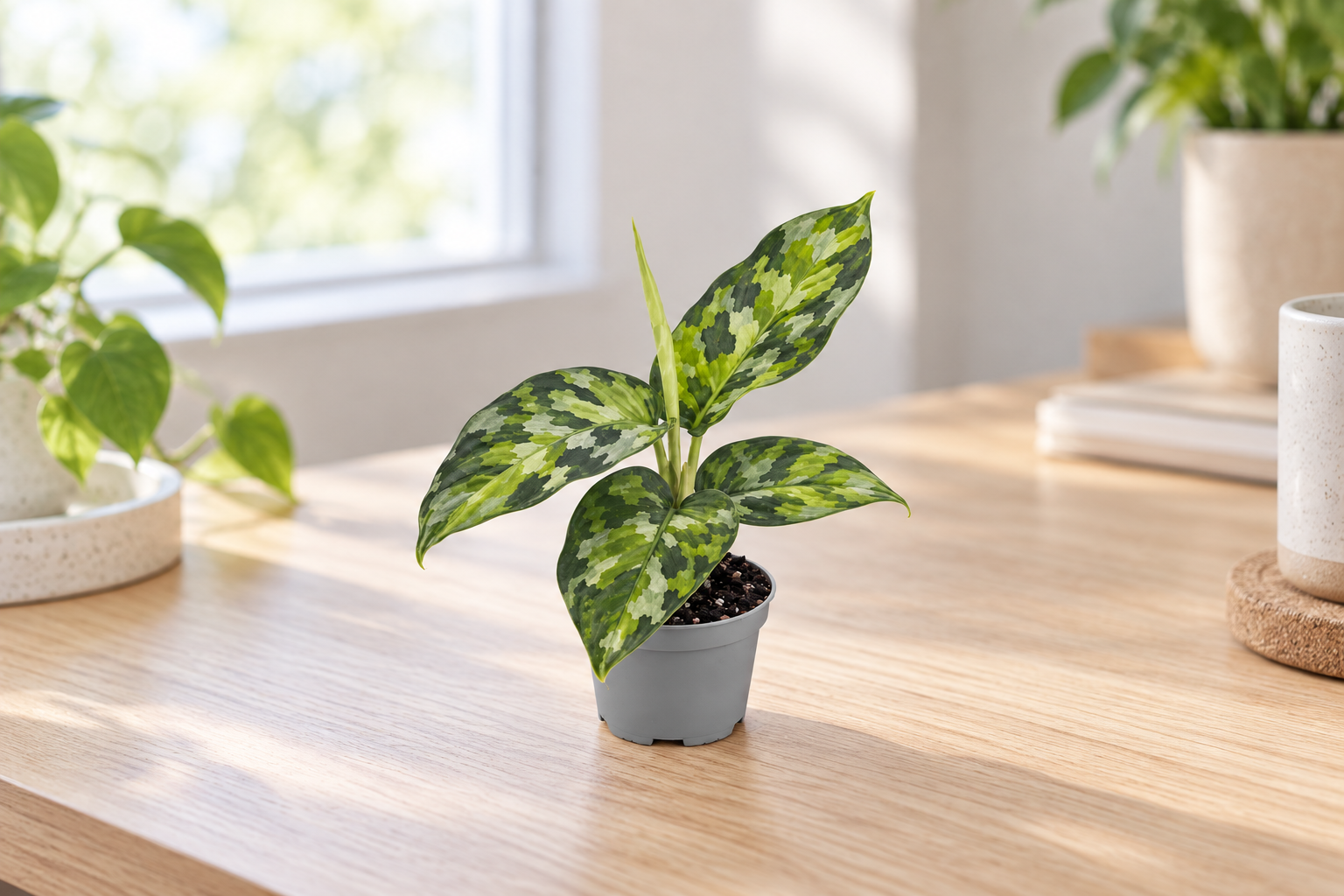
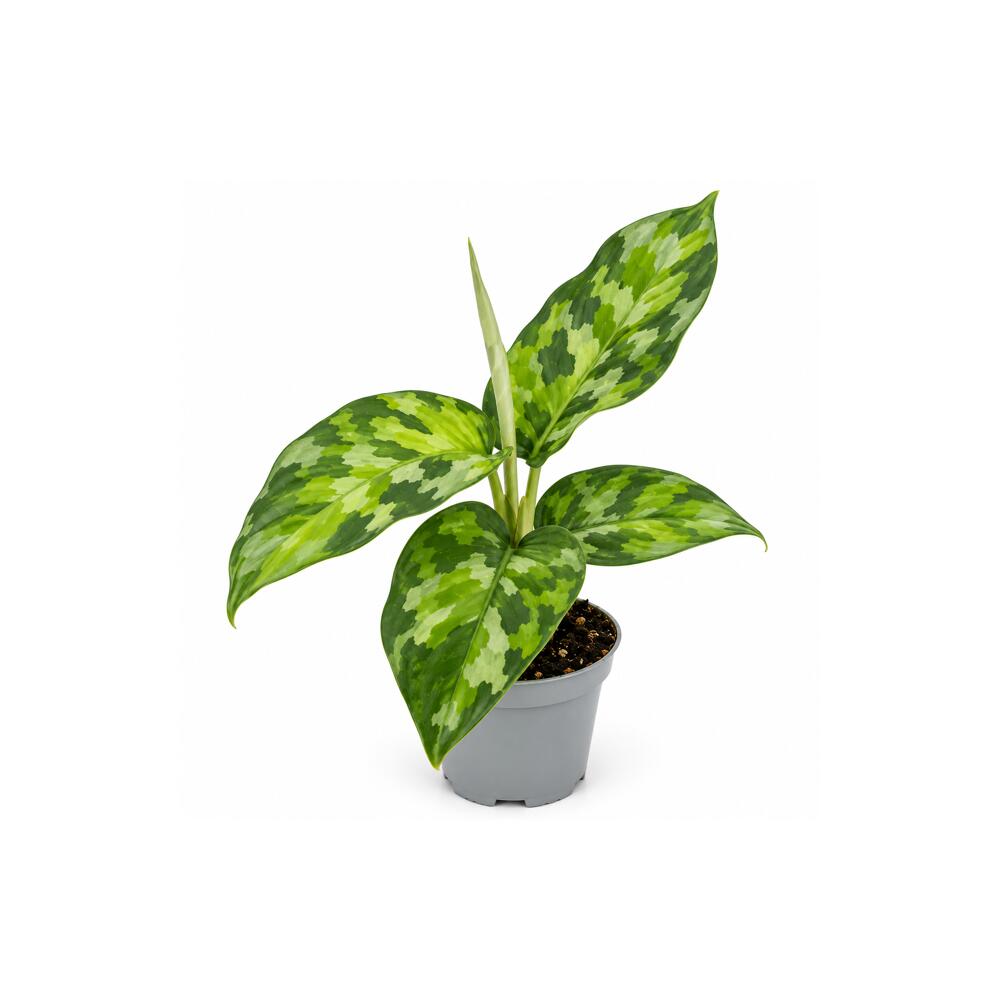
Pictum Tricolor does not have uniformly parallel stripes. Dark green, medium green and paler silvery-green areas form irregular patches on pointed elongated leaves. This resembles camouflage but remains a natural leaf pattern. Each surface develops its own distribution. In the clean original photograph, only a few leaves emerge from a very small pot, with a slender young shoot alongside them. For this miniature, an accessible spot where the pattern can be seen close up is worthwhile. A bright desk near a window or a well-lit display cabinet shows more than a high shelf. The exact patch distribution in the photograph is not guaranteed for individual delivered plants.
Pictum is the species, Tricolor the commercial form
Kew lists Aglaonema pictum as an accepted species in Araceae. Its natural range is Sumatra including Nias, where it grows in a moist tropical habitat. Dan Nicolson’s botanical revision already discusses the three-coloured patterned plants and treats them as a cultivated form. Tricolor is therefore described here as a three-coloured commercial form, not an additional accepted wild species. This offer differs in its species and leaf context from other already named Aglaonema selections. Its enjoyment lies in visible leaf development.
A miniature offer with a small root ball
The shop gives a 6-cm pot and approximately 8 to 10 cm total height. These measurements describe a young miniature plant. It is not a large bush already densely formed and initially needs suitably small root space. Nicolson’s species description gives much larger stems in developed plants; this does not establish a fixed final height or promised growth rate in a living room. When unpacking, do not use delicate young leaf stalks as handles. Hold the pot and remove packaging carefully. Then check how moist the root ball actually is. After shipping, do not combine heavy pruning with repotting into a large container. The small shoot can first unfold under suitable conditions before further changes.
Warm brightness without hot sun
For indoor care, a warm place with bright indirect daylight is suitable. Strong sun behind glass can stress the young leaves, especially just after transport. Lightly filtered window light is a good start. The general ability of some Aglaonema to tolerate somewhat less light does not automatically make a dark corner suitable for this patterned miniature. It should be able to produce new healthy leaves. Consistent warmth is equally important. Avoid cold draughts during ventilation and a cold window frame directly against the little pot. A plant display cabinet may help if light, air exchange and temperature are also appropriate. An enclosed vessel without these checks is not a self-sufficient replacement for care.
Track moisture in the miniature pot carefully
The small root ball may lose water quickly in a warm bright position. Check the upper soil and pot weight regularly. When the surface starts drying, water evenly with room-temperature water and allow the excess to drain. Slight moisture may remain inside while continual saturation is avoided. A tightly fitting decorative pot can easily conceal leftover water; lift out the nursery pot occasionally to check. Drooping leaves first call for a look at moisture and temperature. Do not give extra water as a precaution when the root ball is already wet. Nor should the little plant deliberately be dried out completely because other aroids tolerate stronger dry phases. Its own position and root ball determine demand.
Care for room air and roots together
Direct hot heating air does not suit the young foliage. A sheltered location and, if needed, a suitable improvement in room humidity help, without promising constant spraying as a permanent solution. Air in a display cabinet must not stand completely still. Loose humus-rich soil retains moisture while letting water drain. When well rooted during active growth, provide a little more space rather than putting the mini root ball into a large container that stays wet for a long time. Dose nutrients sparingly according to a suitable label and allow for pre-fertilised soil. More fertiliser does not create a prescribed camouflage pattern. The next healthy leaf grows from the living shoot; care does not repaint damaged old patterns.
New leaves give better feedback
Occasionally inspect undersides and leaf bases for mealybugs, scale insects or fine webbing. Yellow leaves, brown edges and a lack of new growth have different possible causes. Check moisture, air, light and recent changes together before taking several strong measures at once. In winter, keep the plant warm and as bright as possible; when growth slows, soil often takes longer to need another watering. Deliberately cold dormancy is not intended. Aglaonema may form inflorescences, but they are not guaranteed for this young delivery and do not define the portrait. The plant is not for eating and should stay out of reach of children or pets that chew. Its individual new leaf pattern is the loveliest response to suitable care.
One plant, several views

Good to know
Is Tricolor a second botanical species?
No. Kew accepts Aglaonema pictum; Tricolor here describes the three-coloured commercial form.
Where does the species originate?
From Sumatra including Nias in a moist tropical habitat.
What size is the miniature offered?
The shop gives a 6-cm pot and about 8–10 cm total height. This is not its final size.
Are the patches identical on every plant?
No. Distribution and appearance of the natural leaf pattern vary between living plants.
Does it definitely need a display cabinet?
A controlled bright warm cabinet position can help. Light, moisture and air exchange must still be suitable.
How dry may the root ball become?
The surface may begin drying. Do not repeatedly let the entire miniature root ball dry out completely.
Does more fertiliser strengthen the pattern?
More fertiliser is not a suitable shortcut. New healthy leaves need balanced cultivation.
Does the miniature need cold winter dormancy?
No. Continue growing it warm and as bright as possible; when growth slows, note the often lower water demand.
Sources and editorial note
- Exotenherz: offer and original photographs (03.10.2026)
- Kew: accepted species and origin (03.10.2026)
- Smithsonian: Nicolson’s revision, pages 29–30 (03.10.2026)
- NC State: Aglaonema and general indoor care (03.10.2026)
Offer, item number, GTIN, availability and original images checked directly on 03.10.2026. Specialist sources read directly. Species pictum verified directly with Kew; historical tricolor treatment distinguished as a cultivated form. Shop gallery image 2 labelled AI excluded. Species size is not a final-size guarantee for the miniature. Genus care is not confused with the origins of other Aglaonema.