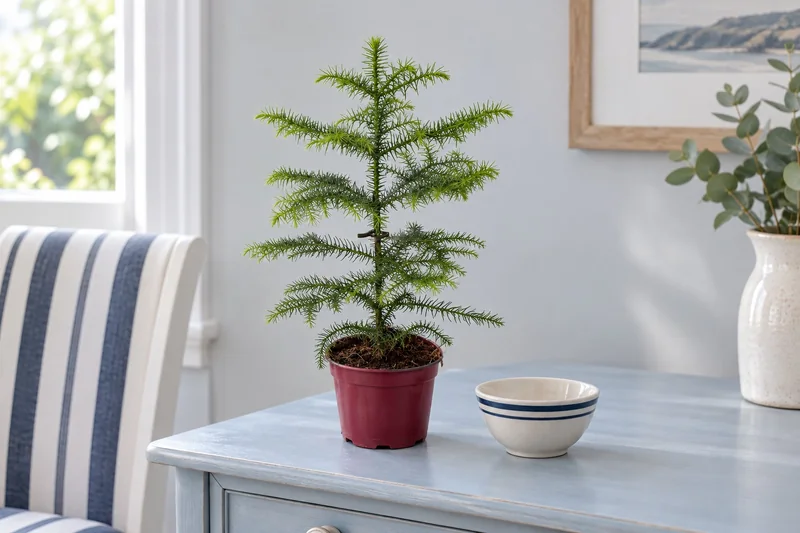
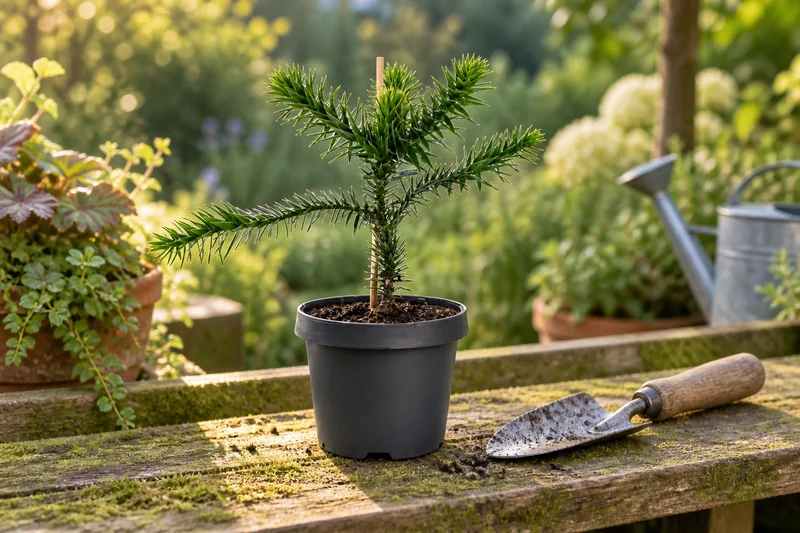
This plant at Exotenherz
Check the shop offer for current availability, price and what is included.
Link to the offer in German. Check the shop for the current price, availability and delivery contents.
Your care table
| Topic | What to do | Why it helps |
|---|---|---|
| Position | Bright with indirect light and a clear crown. | A dark room corner does not suit this conifer’s cultivation. |
| Water | Once the surface has dried, water slowly across the root ball. | The root ball should remain slightly moist without standing in water. |
| Compost | Structurally stable, loose mix with good drainage. | The compost in the shallow bowl must neither compact nor remain persistently wet. |
| Nutrients | Feed weakly during growth according to product instructions. | Limited root space calls for restrained dosing. |
| Winter | Frost-free and bright; regularly reassess consumption. | Do not confuse it with the differently cultivated monkey puzzle tree. |
| Indoor climate | Keep away from radiators and dry air currents. | Fine needles respond to unfavourable air and water conditions. |
| Shaping | Observe new shoots and plan major interventions carefully. | Decorative bonsai style does not mean constant shaping cuts. |
| Checking | Check moisture, drainage and needle tips together. | Narrow down the cause of damage first rather than simply watering more. |
Check the compost and pot weight. The care table explains how far the compost may dry.
Water only when needed. The water should reach the root ball without spilling over the rim.
Remove surplus water from the saucer or cachepot. Then return the plant to a suitable position.
A large tree in a special cultivated form
Araucaria cunninghamii comes from forests in eastern Australia and New Guinea. In its natural habitat it can develop into a very large tree. The offered specimen instead shows a shaped, compact form in bonsai style. Trunk, branching and fine needles create a living sculpture. These irregularities are precisely its appeal: nature provides no two entirely identical silhouettes, and new growth continues to change its appearance.
Choose the bowl and individual specimen carefully
The shop description states about 65 cm overall height and a 25–26 cm bowl. Several pictured forms show possible differences, not a promise of identical trunks or bowl colours. Our scene depicts one tree. Its open crown can look good on a broad, stable console; the weight of the bowl and moist root ball should also be considered. Leave room between needle tips, wall and people passing.
Bring brightness into the crown
A bright position with indirect light follows the shop recommendation. Its fine greenery should not disappear into a dark recess. At the same time, an abrupt move against very hot glass is unfavourable. Consider the planned position from the plant’s viewpoint: does light also reach the lower branches, or do furniture and curtains shade most of the crown? Do not place it directly in a heater’s dry airflow.
Keep the shallow bowl evenly moist
Regularly check the upper compost layer and the bowl’s weight. Once the surface has dried, water slowly across the root ball. Water should reach the roots and then be able to drain. A hidden reservoir without controllable drainage is not a good solution. This shallow cultivated form offers less buffering than a large deep tub; avoid both complete root-ball dryness and persistent wetness. Check the standing surface for escaping water after watering.
Shape growth without hasty intervention
The shaped form is not a reason to cut back hard with every new tip. First observe new growth and existing branching. Major pruning or root work should be targeted when condition and cultivation can be assessed reliably. Preserve a structurally stable, well-drained mix and functioning drainage when repotting. Weak fertiliser applications during growth are easier to manage than strong reserve doses in a small root space.
Read brown needles as a clue
Some older needles inside may die. If dry tips accumulate or entire branches stand out, first check root-ball moisture, light and proximity to heating. A dead area will not turn green again with more frequent watering. Also check transitions between the trunk and fine branches for pests. This araucaria stays frost-free; the monkey puzzle tree found in gardens is a different species with different requirements. This helps keep the special tree form understandable and manageable over time.
One plant, several views

Good to know
Will the araucaria always keep exactly this shape?
No. Even a shaped tree keeps growing. Trunk shape, branch arrangement and bowl colour may differ from the image.
Will I receive the three trees in the selection image?
The shop’s delivery contents are what matter. This portrait and scene describe one tree in the offered size class.
Can it overwinter outdoors?
Frost-free cultivation is intended for this offer. It is not Araucaria araucana, the monkey puzzle tree.
Should the bowl always contain water?
No. The root ball stays slightly moist, but excess water must be able to drain away.
Sources and editorial note
- Product and delivery contents: Exotenherz
- Australian National Botanic Gardens: plant profile
- Royal Botanic Gardens Sydney: botanical description
Sources checked: 15 September 2026. Product information and delivery contents follow the linked shop offer. Care has been checked against the stated specialist sources and remains subject to plant condition, position and season.