This plant at Exotenherz
Check the shop offer for current availability, price and what is included.
Check the shop for the price, current availability and what is included.
Your care table
| Topic | What to do | Why it helps |
|---|---|---|
| Light | Bright with filtered light. | Green foliage does not indicate suitability for permanently dark rooms. |
| Water | Thoroughly spray leaves with soft room-temperature water. | The whole leaf surface should be reached. |
| Base | Do not soak for prolonged periods. | Dense leaf sheaths may trap water. |
| Drying | Tilt downwards and dry in circulating air. | Avoid constant moisture at the base. |
| Holder | Open and loose without a damp moss pad. | The small epiphytic plant needs no potting compost. |
| Fertiliser | Very weakly during growth following suitable product instructions. | High salt concentrations burden leaf surfaces. |
| Winter | Bright, frost-free and without cold draughts. | Adapt watering frequency to the position. |
| Offsets | Let them strengthen sufficiently before separation. | Larger young rosettes cope better with the change. |
Take the tillandsia off its support. Do not rub the leaves; preserve the delicate silvery scales.
Use low-lime water at room temperature. The care table explains whether thorough misting or a short soak is suitable.
Gently shake off the water. Tilt rosettes downwards, hang loose strands without bunching them together and allow them to dry with good airflow.
The thickened base is not a flower bulb
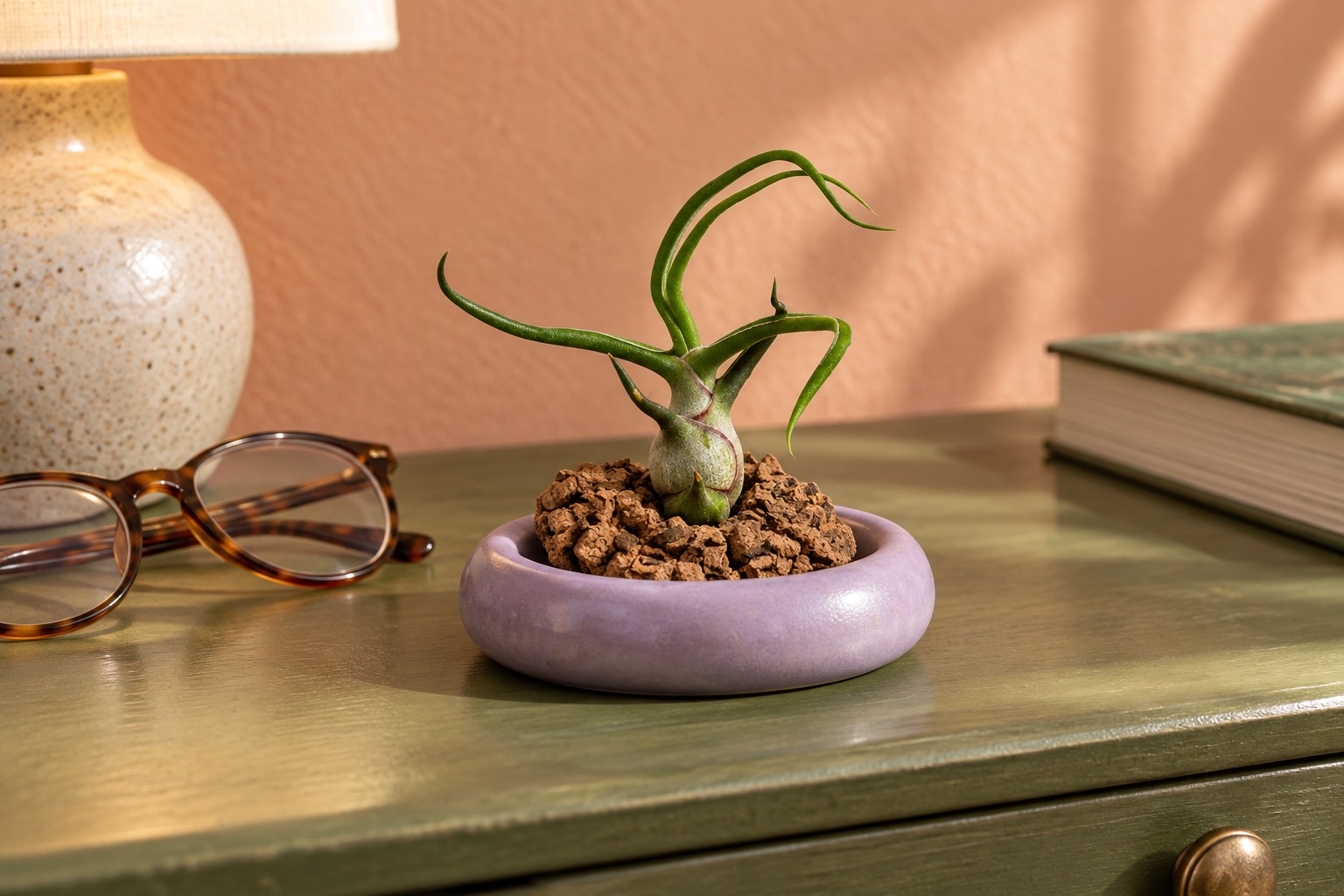
Tillandsia bulbosa belongs to the bromeliads. Overlapping leaf sheaths form a striking bulb-like base from which narrow green leaves rise and curve sideways. The plant grows epiphytically on support. It is therefore not planted deep into soil like a bulb. Compared with silvery scaled tillandsias, its foliage looks distinctly greener and smoother. This is a species-specific feature, not a reason to choose a dark place. The spelling bulbosai occurring in the shop refers here to bulbosa.
A small form for an open holder
The offer describes a loose plant approximately 8 to 12 cm in size. It is not a large spreading clump. A small open ring or suitable piece of cork already displays the form well. Decoration and holders are included only if the offer expressly states them. The base remains freely accessible without wrapping in damp moss. Loose fastening should support without crushing living leaf parts. The tillandsia should be removable for care without pulling its tips wherever possible.
Brightness and air exchange belong together
A bright position with filtered light suits well. Initially avoid hot direct sun behind glass after shipping. In a closed glass container with high humidity, the base may remain wet too long. An open position with gentle air movement instead helps drying. This can also be a bright bathroom, provided daylight is actually present. A dark windowless bathroom does not become suitable through high humidity. Cultivate frost-free all year and protect from cold draughts and directly rising dry heated air.
Wet rather than trap water in the base
For this species, NParks recommends thorough spraying rather than soaking: tightly closing leaf sheaths may hold water. Remove the plant from its support and wet leaf surfaces with suitable soft room-temperature water. Then gently tilt downwards and drain excess water. Afterwards, dry in circulating air. Two or three checks or wettings per week may be a guide in warm conditions but are no rigid schedule. Dry warm air and a cooler bright winter position require different attention.
Keep support airy and clean
Ordinary potting compost and a permanently filled saucer do not belong to this air plant’s culture. Instead, check whether the holder dries promptly after wetting and whether new leaves have enough space. During active growth, suitable tillandsia or bromeliad fertiliser may be used very weakly following product instructions. Do not apply concentrated fertiliser solutions or leaf-shine products. Water uptake through leaf surfaces must remain possible. Visible deposits prompt checking water quality and dosage, not giving fertiliser even more often.
Follow offsets and changes attentively
A strong mature rosette may develop an inflorescence; flowering and colour are not guaranteed at delivery. After flowering, the rosette slowly ages while offsets may continue growing. Let them become sufficiently strong before separating when needed. A suddenly soft dark base is not healthy gradual ageing. Remove the plant from a damp holder and check water accumulation and ventilation. Natural leaf curvature alone is no disease symptom and need not be corrected with extra watering.
One plant, several views

Good to know
Should I regularly dip Tillandsia bulbosa?
Thorough wetting is the more cautious routine for this species. No water should remain inside its closed base.
Must the thick base go into soil?
No. It consists of leaf sheaths. The plant sits openly on suitable support.
Are curved leaves a symptom of water shortage?
Curvature belongs to the typical appearance. Assess water needs using the whole plant and site conditions.
How large is the offer?
Approximately 8 to 12 cm plant size, supplied loose. Expect a pictured holder only if it expressly belongs to delivery contents.
Sources and editorial note
- Product and delivery contents: Exotenherz
- National Parks Board Singapore: plant profile
- Royal Horticultural Society: plant and care knowledge
Sources checked: 15 September 2026. Product information and delivery contents follow the linked shop offer. Care has been checked against the stated specialist sources and remains subject to plant condition, position and season.