This plant at Exotenherz
Check the shop offer for current availability, price and what is included.
Product details, availability and delivery information are provided in the shop offer.
Your care table
| Topic | What to do | Why it helps |
|---|---|---|
| Summer position | Bright outdoors, protected from extreme pot heat | Small containers warm quickly |
| Winter | Very bright, cool and frost-free at around 10 °C | Harlandii is not a winter-hardy hedge box |
| Water | Water thoroughly after slight drying | A calendar ignores weather and container conditions |
| Drainage | Remove water from the saucer | The root zone needs air too |
| Pruning | Shorten selectively and gently thin dense areas | Inner branches should receive light |
| Fertiliser | During growth, follow the label rather than automatically feeding yellow leaves | Discolouration has different causes |
| Repotting | In spring, according to root-ball and compost condition | Fresh structure supports the supply |
| Inspection | Look for caterpillars, webs, leaf spots and wire marks | Damage detected early is easier to assess |
Check the compost and pot weight. The care table explains how far the compost may dry.
Water only when needed. The water should reach the root ball without spilling over the rim.
Remove surplus water from the saucer or cachepot. Then return the plant to a suitable position.
A small tree with dense foliage
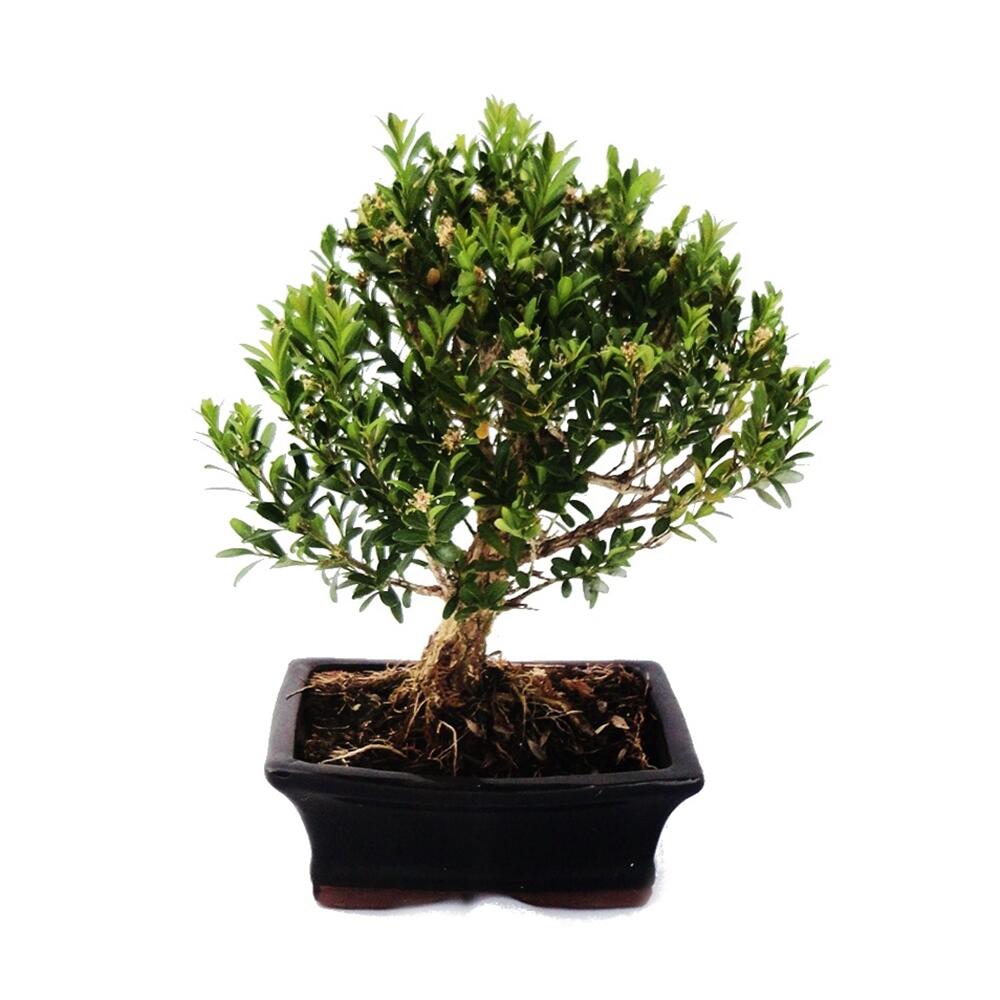
Narrow green leaves sit closely on fine branches. Beneath them, the short trunk already has its own structure, which may become more distinct over the years. The offer states approximately five years, a container around 15 × 12 × 7 cm and about 25 cm overall height. This is therefore a small bonsai whose foliage and trunk are particularly attractive up close. Each tree is individually shaped. Container shape and colour may differ from the shop photograph.
Harlandii is not ordinary garden box
The shop uses the spelling Buxus herlandii; the botanical name is Buxus harlandii. It belongs to the box family and is used as Chinese boxwood in the bonsai trade. The garden-familiar species Buxus sempervirens is not the same. Winter care differs in particular: a bright frost-free place is sensible for harlandii. General instructions for winter-hardy box hedges would be misleading here. Small yellowish flowers are a possible seasonal addition, but foliage remains the main attraction.
Plan summer light and winter quarters early
During the warm season, a bright sheltered outdoor position suits it, with sun after gradual acclimatisation. Protect the small dark container from extreme heating. Watch the root ball particularly closely in heat or wind. For winter, choose a very bright cool frost-free room around 10 °C. A dark cellar is unsuitable despite being cool. The tree also lacks good winter conditions directly above a heater. Decide on its position before the cold season to avoid short-notice emergency solutions.
Check regularly instead of following a watering calendar
The root ball should be evenly supplied without constantly standing in water. When the upper compost has dried slightly, water thoroughly and let it drain. A small bonsai can need more on one warm day than over several cool days combined. A rigid number of weekly applications is therefore unreliable. Check beneath a dense crown that water really reaches the soil. Water more cautiously in winter while still protecting roots from complete drying.
Keep the crown open through targeted pruning
Carefully shorten long new shoots, leaving enough healthy leaves. In a very dense crown, selective thinning can bring light and air to inner branches. Do not continually shear every tip. Check existing wire for constriction in good time; bark marks often stay visible for a long time. Plan repotting according to root development and compost condition, usually during a suitable spring phase. A structurally stable bonsai mix with drainage matters more than a supposed special treatment. Feed according to the label during growth and pause during cool rest.
Yellow leaves are not yet a fertiliser diagnosis
The shop instructions mention iron and magnesium for yellow foliage. Such an application should not be automatic, however: wetness, drought, unsuitable pH, cold or insufficient light can cause similar changes. Check cultivation first and seek targeted specialist advice for unclear persistent symptoms. Outdoors, regularly look for caterpillars, feeding damage and webs from box-tree moth. Leaf spots and shoot dieback deserve attention too. Clean tools, air exchange and early checks help. All plant parts are poisonous; keep the bonsai away from nibbling children or animals.
One plant, several views

Good to know
Can I overwinter it like a box hedge?
No. The bonsai offered as Buxus harlandii is overwintered bright and frost-free.
Is it called harlandii or herlandii?
The botanical name is Buxus harlandii. The shop uses the different spelling herlandii.
Do yellow leaves immediately need iron fertiliser?
Not automatically. First check water, roots, light and other possible causes. An unsuitable supplement may worsen the situation.
Can a small bonsai get box-tree moth too?
Yes. In outdoor cultivation, regularly look for caterpillars, webs and fresh feeding damage.
Sources and editorial note
- Product and delivery contents: Exotenherz
- Bonsai Empire: species-specific bonsai care
- Royal Horticultural Society: plant and care information
- Royal Horticultural Society: plant and care information
Sources checked: 15 September 2026. Product information and the contents of delivery follow the linked shop offer. Care advice was checked against the cited specialist sources and should still be adapted to the plant’s condition, position and season.