This plant at Exotenherz
Check the shop offer for current availability, price and what is included.
Check the selected shop offer for price, availability and delivery contents.
Your care table
| Topic | What to do | Why it helps |
|---|---|---|
| Light | Keep very bright and protect from hot direct midday sun. | Coloured head and green rootstock do not respond like a uniformly green desert cactus. |
| Water | Let soil dry before the next thorough watering. | The rootstock needs water but tolerates no constantly wet root ball. |
| Drainage | Let each inner pot drain and empty the pot cover. | Even a tiny pot must not stand in residual water. |
| Substrate | Use a draining cactus mixture and a pot with drainage. | Air in the root space matters more than a large reserve of wet soil. |
| Winter | Keep bright and frost-free; do not enforce a cold totally dry desert-cactus winter. | The green base needs warmth; low growth reduces water needs. |
| Nutrients | During active growth, feed sparingly according to the cactus-fertiliser label. | Strong fertilisation does not improve head colour. |
| Repotting | Only if needed, choose a suitable pot size carefully. | The graft junction and green stem must not serve as handles. |
| Checks | Look at head, junction and stem regularly. | Soft or dark areas invite checking moisture and temperature. |
Check the compost and pot weight. The care table explains how far the compost may dry.
Water only when needed. The water should reach the root ball without spilling over the rim.
Remove surplus water from the saucer or cachepot. Then return the plant to a suitable position.
Three colours, two plants in every shape
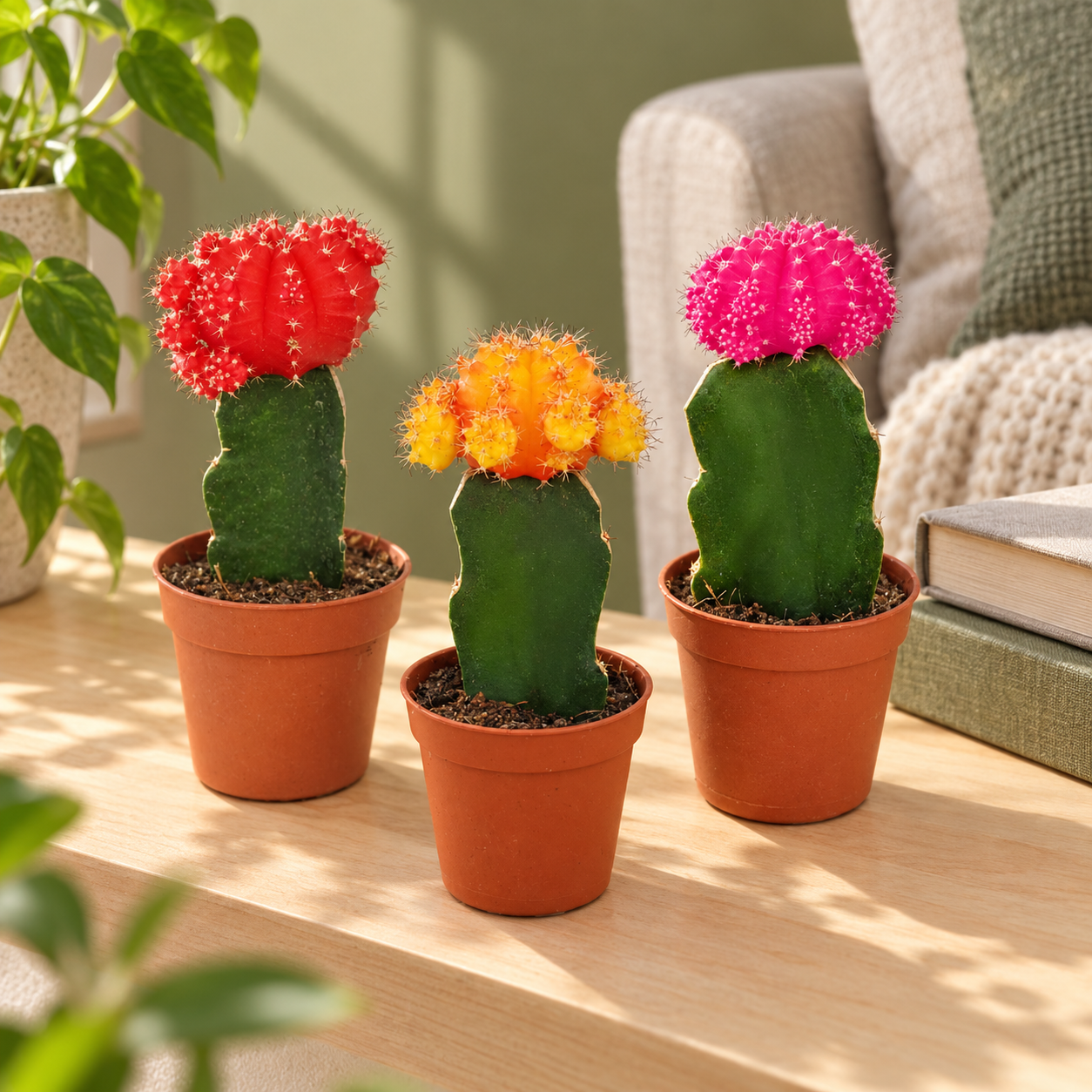
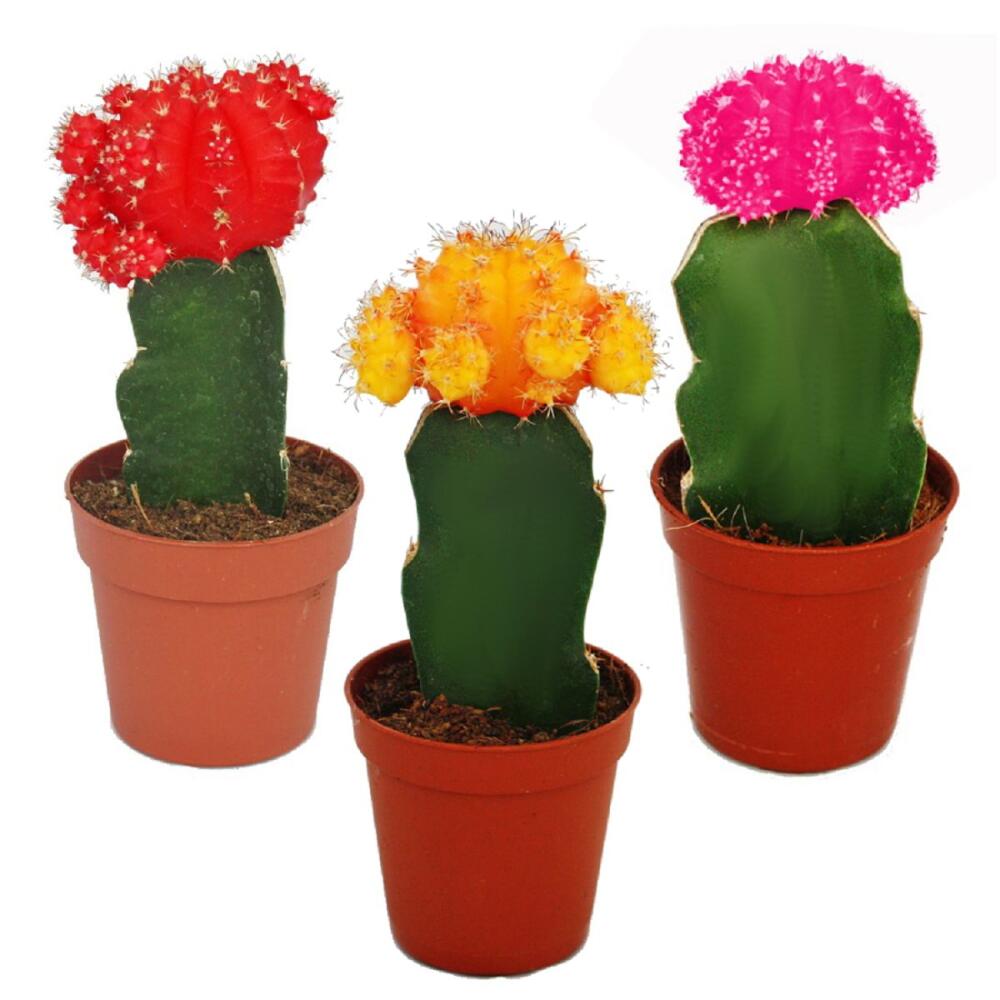
With these cacti, the striking colour sits on top. The small ribbed head looks red, orange or pink, while a green angular stem stands below. This is no attached flower. Coloured forms of Gymnocalycium mihanovichii are grafted onto a green cactus rootstock. The head with little or no chlorophyll depends on its supply. For care, therefore, we consider the entire connection. A particularly bright head is not the sole measure of a healthy plant; the green base and its roots deserve the same attentive look.
A small trio with clear delivery measurements
The offer includes three differently coloured plants, each in a five-and-a-half-centimetre pot. Around ten to twelve centimetres overall height describes their small delivery state including container. The three heads need not be exactly the same size or sit at the same height. Leave each cactus in its own inner pot initially. On a low bright shelf, their ribs and small spines can be viewed well. Decorative bowls and scene furnishings are not included. When moving them, grasp the pots; the upper coloured tissue is no practical carrying surface.
Brightness that suits the coloured head too
Filtered daylight suits better than an immediate move to the hottest midday sun behind glass. Choose a place where the trio truly stands bright while protected from extreme heating. After transport, it may settle in quietly. A lovely colour does not justify a permanently dark desk position. At first placement, also look at the three plants from the side: if heads or spines touch, move the containers slightly apart. Every shape stays visible, and no graft junction is accidentally strained during checks.
The small root ball sets the pace
Check soil and pot weight before watering. Once the root ball has dried, water thoroughly and allow excess to drain completely. Do not slide a constantly wet saucer beneath the three pots. Even brief little sips can conceal the actual root condition if only the surface is repeatedly moistened. A very light pot suggests a closer look at the root ball. A heavy pot with a soft stem instead calls first for a moisture check. Give the trio no shared calendar if one container is still wet and another already dry.
Spare the connection during repotting
Draining cactus substrate and drainage holes form the foundation. Repot only when root space is crowded or soil unsuitable, rather than immediately moving into three large containers. Hold the root ball and pot rim while leaving head and stem as unstrained as possible. Do not bury the junction deeper in soil. During active growth, restrained feeding according to the fertiliser label is enough. Strong colour comes from the plant form and cannot be intensified without limit through extra nutrients. Note which cactus receives which new pot when repotting; further checks thus remain easy to follow.
Winter follows the rootstock’s needs
A cold, practically waterless winter rest useful for some desert cacti is not assigned across the board to this trio. The green rootstock needs frost-free warmth. In a bright winter position, water consumption usually falls with reduced growth; this means smaller needs, not a permanently moist root ball. Do not place pots against cold glass or immediately above a hot radiator. Continue observing the plants separately. The seasonal change is a good time to reassess the actual position: a place bright in summer may receive considerably less daylight in winter.
Preserving colour means noticing changes
Check especially the transition between head and rootstock. Dark, soft or loosening parts are examined more closely early; more water is no automatic solution then. An old firm little surface mark is distinguished from new soft tissue. Ordinary propagation by removing a chlorophyll-free head does not work as it does for a self-sufficient green cactus. Regrafting belongs in experienced hands. For everyday care, a calm approach with light, free drainage and careful handling is enough. The visible connection itself makes these little coloured cacti interesting.
One plant, several views
Good to know
Are the coloured heads flowers?
No. They are coloured cactus forms grafted onto a green rootstock.
Can I plant a head on its own?
A chlorophyll-free head cannot supply itself without a suitable rootstock. Removal and planting are no ordinary cutting propagation.
How large is the trio?
Three plants, each in a 5.5 cm pot and about 10–12 cm overall height.
Do all three need water simultaneously?
Check each root ball. Equal pot size does not guarantee the same drying pattern.
May the trio winter in the cold?
Do not force a cold desert-cactus rest. The green rootstock needs a bright frost-free and sufficiently warm position.
Are the decorative containers included?
The scene shows a furnishing idea. The promised delivery contents are stated in the shop offer.
Sources and editorial note
- Exotenherz: offer and original images (02.10.2026)
- NC State Extension: Gymnocalycium mihanovichii and grafted cacti (02.10.2026)
- RHS: growing cacti and succulents (02.10.2026)
Shop offer, article number, GTIN, availability and original images checked directly on 02.10.2026. Specialist sources read directly. No green-rootstock species promised without specific label confirmation; winter care considers its warmth needs. Scene checked directly against the original picture on 02.10.2026: plant quantity, leaf or head shape, habit, size proportions and labelling suitable.