This plant at Exotenherz
Check the shop offer for current availability, price and what is included.
Check the selected shop offer for price, availability and delivery contents.
Your care table
| Topic | What to do | Why it helps |
|---|---|---|
| Position | Bright indirect daylight; check that it reaches the rosette. | Low foliage should not stay hidden beneath larger plants. |
| Warmth | Keep warm without hot heater airflow or cold draughts. | The flat tropical foliage needs reliable conditions. |
| Water check | Check rim moisture and weight of each small pot. | Terrarium and open shelf may dry at different speeds. |
| Watering | When needed, pour slowly onto substrate at the pot edge. | Supply roots in the ball, not an assumed leaf funnel. |
| Drainage | Let excess drain and empty the saucer. | Even moisture is not permanent wetness. |
| Substrate | Choose a loose humus-rich mix and suitable draining pot. | Air and moisture must work together in the small root space. |
| Feeding | Feed sparingly during growth according to a suitable label. | Small rosettes need no strong continuous feeding. |
| Terrarium | Check ground-level light, air exchange and standing wet. | A glass container cannot replace observing actual conditions. |
| Offsets and inspection | Separate only developed offsets gently; check bases for pests. | Healthy bases remain and problems are identified early. |
Check the compost and pot weight. The care table explains how far the compost may dry.
Water only when needed. The water should reach the root ball without spilling over the rim.
Remove surplus water from the saucer or cachepot. Then return the plant to a suitable position.
Four small stars with different lines
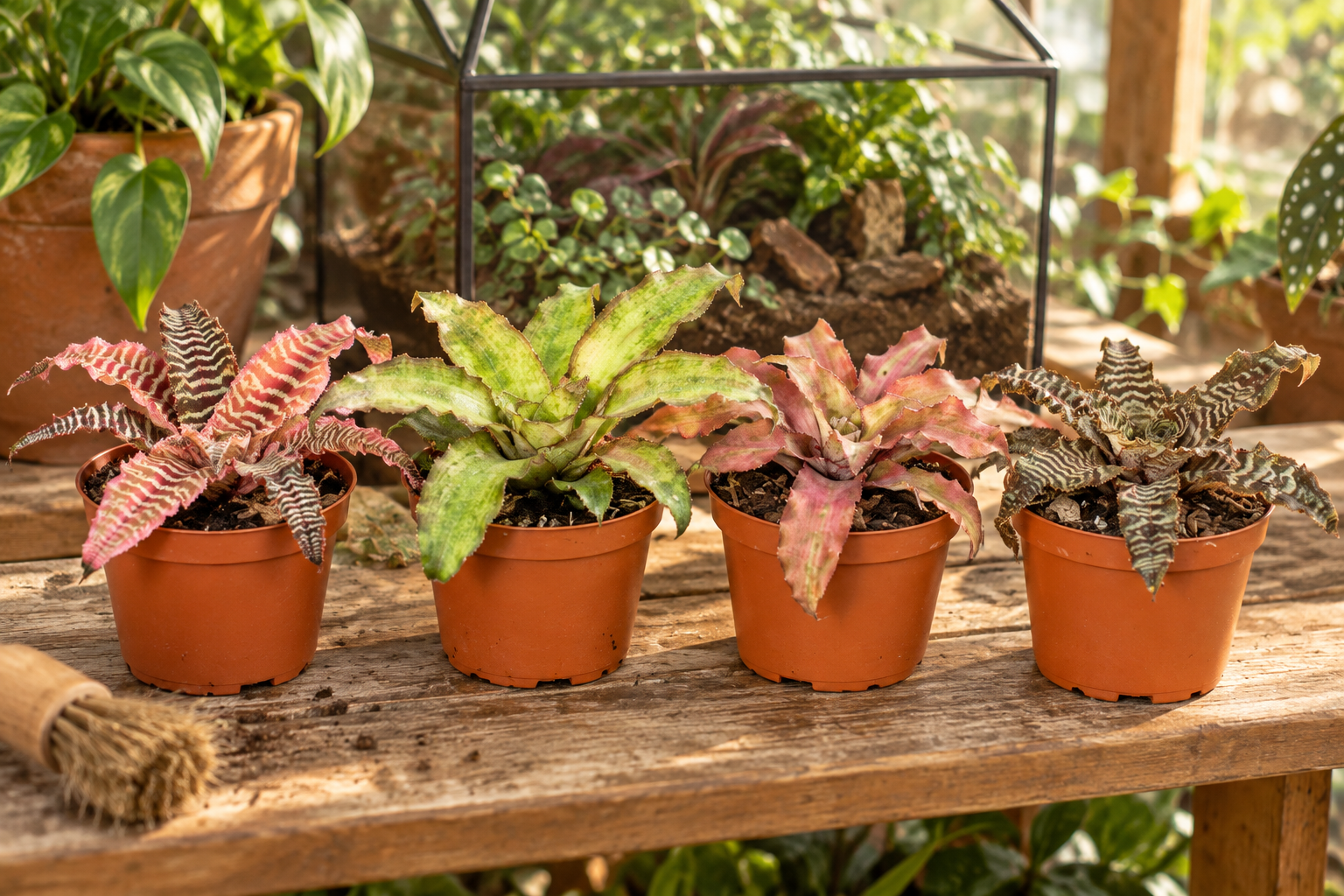
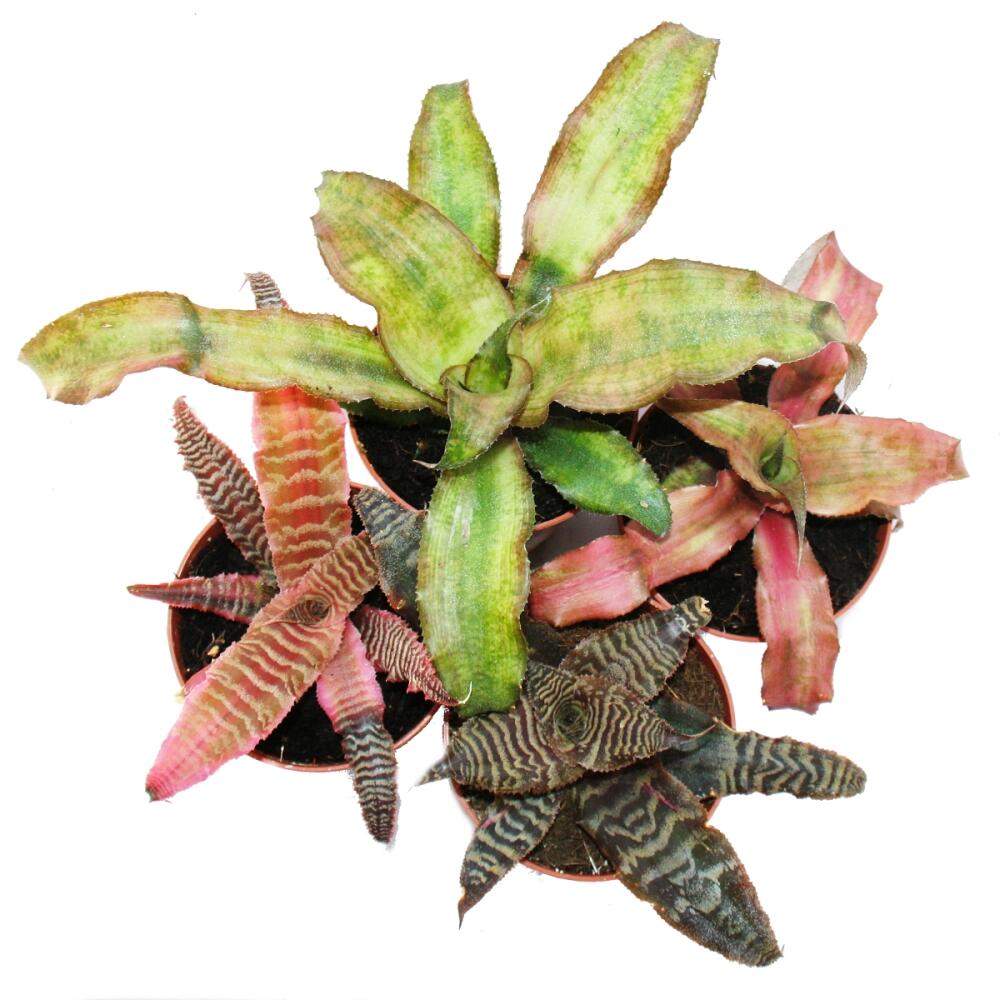
Cryptanthus spreads its leaves near the ground. The pointed leaf straps are firm with wavy finely toothed edges. In our photograph, a pale green star stands alongside pink-striped and darker cross-banded rosettes. Patterns run along a leaf surface or interrupt it in small pale transverse lines. The star-shaped structure is especially visible from above. Leave some open area beside pots on a bright plant shelf. Low leaves should not disappear behind a tall decorative container. A small earth-star display also works in a living area if individual pots remain accessible and enough daylight reaches the foliage.
A terrestrial bromeliad selection without a fixed variety list
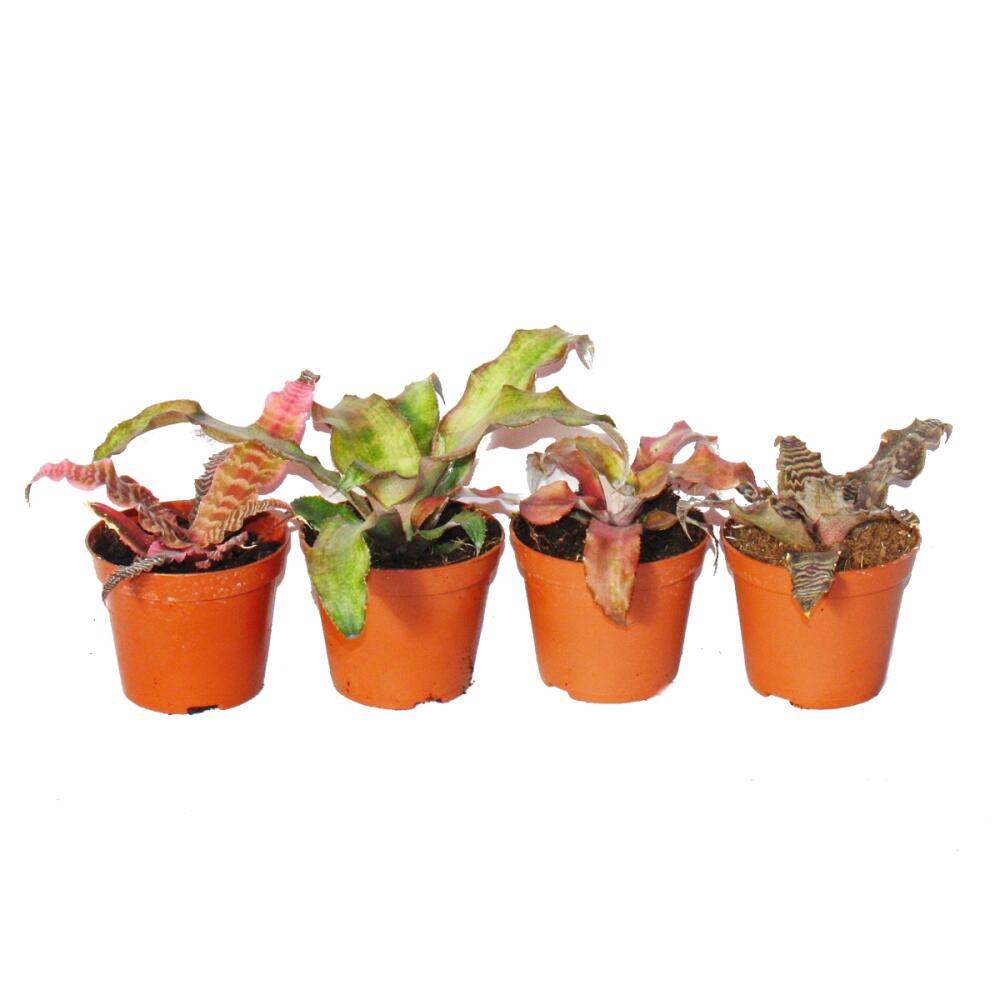
Cryptanthus belongs to the bromeliad family. Earth star suits the flat rosettes. Our offer is a variable assembly of four plants of this genus. Selection follows stock; individual varieties cannot be chosen. The photograph shows an example leaf display, not a promised unchanging sequence of four. Plants are therefore presented together as a terrestrial bromeliad trade group. No rosette is assigned to a presumed species or particular variety. Cross-banded leaves especially invite comparison, but pattern alone cannot replace a precise name. Small inconspicuous flowers may appear later in suitable plants; foliage is the focus for these young rosettes.
Small pots leave the whole rosette visible
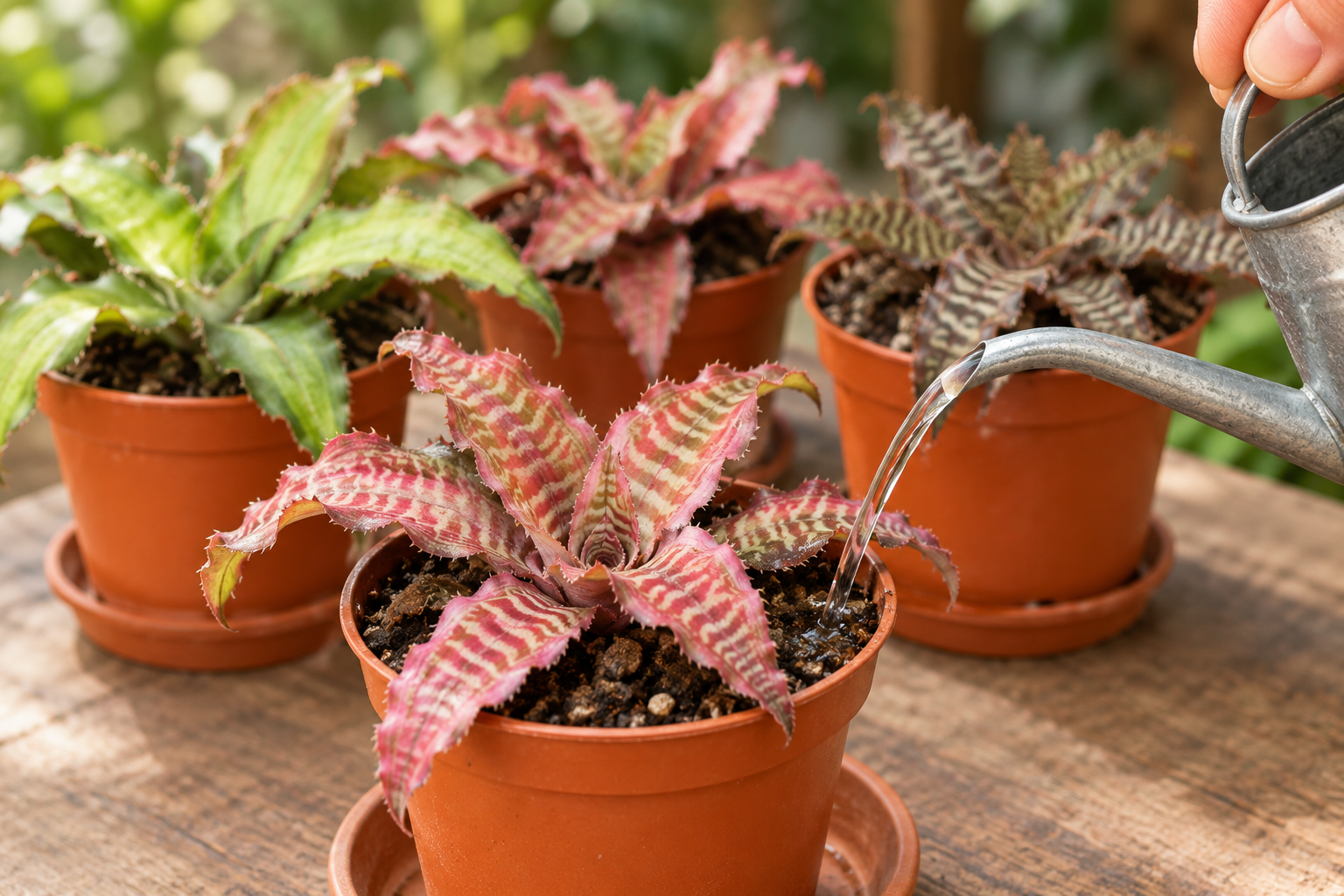
Each offered plant stands in a seven-centimetre pot. Overall height is stated as approximately eight to ten centimetres including the pot. Leaves may extend well beyond the rim sideways; allow for their spread. After unpacking, check each pot and do not press leaves flat. Fine teeth and waves belong to their form. The AI potting-table scene shows four small pots as an arrangement idea rather than a fixed promised colour combination. Glass and tools are decoration too. Pots can initially remain movable in a terrarium, allowing observation of light and root-ball moisture before a permanent planting position is chosen.
Light must reach low foliage
Bright indirect daylight reveals patterns and suits cultivation. A low rosette may still receive too little light beneath larger foliage even if the terrarium beside it looks bright. Check its actual ground-level position. Soften hot direct sun behind glass; strong rays may bleach leaf surfaces. Warmth and an environment which is not excessively dry are favourable. At the same time leaves should not remain dripping wet in motionless air. Decorative glass is no reason to surrender ventilation or access. Check such arrangements more often for accumulating moisture. For open room growing, stay away from hot heater airflow and cold draughts during ventilation.
Supply roots through the substrate
These low earth-star pots are supplied through the substrate. Check moisture at the rim and lift the small pot carefully. It should remain lightly moist without standing for long in wet soil or drying out completely. When needed, water slowly at an open spot beside the rim so water reaches soil. Let excess drain and inspect the saucer afterwards. Do not fill the flat leaf centre as a water reservoir. The care image shows precisely this substrate application. Consumption in a damp terrarium may differ from an open shelf. Both places are watered according to observation, rather than the same rigid weekly rhythm.
Handle root space and side shoots gently
A loose humus-rich draining mix eases moisture management. Do not tear the small root ball apart unnecessarily when moving it. Only choose a slightly larger draining pot when space is clearly needed, rather than placing a low rosette in a large wet soil reserve. During visible growth, supply suitable nutrients sparingly according to the label and account for existing feed. Later side offsets may expand the group. Wait to separate an offset until it is sufficiently developed to handle gently. There is no race to obtain as many rosettes as possible. Do not bury the existing base deeper, and initially check the new position regularly for suitable moisture.
Read patterns and leaf condition over time
Older outer leaves may decline as new surfaces arise inside. Carefully remove only truly dead parts without pulling healthy rosette leaves off. With dry tips, assess moisture, heat and air at the position together. A soft base and persistently wet soil instead warrant drainage and root checks. Also look for mealybugs or scale insects among tightly arranged leaf bases. Coloured bands are the normal background of this observation, not disease signs. No fixed mature size is specified for the changing selection. Allow plants to occupy space gradually and move pots farther apart once rosettes constantly overlap.
One plant, several views
Good to know
Are the four shown forms fixed?
No. The offer is assembled according to stock and individual varieties cannot be selected. It is a variable selection of four Cryptanthus plants.
Which species is the cross-banded rosette?
No precise species or variety is promised for an individual set component. The portrait conservatively assigns the selection to Cryptanthus.
Which measurements are documented?
7 cm pots each and approximately 8–10 cm overall height including pot. Lateral leaf spread may go beyond this.
Should water go into the leaf centre?
These earth stars are supplied through substrate. The flat centre is not filled as a permanent water tank.
Must Cryptanthus be in a terrarium?
No. A bright warm room position is possible if small root balls are reliably supplied and the position is not too dry or hot.
Do small plants flower immediately?
Small flowers may develop later under suitable conditions, but are not promised by the original image or offer size.
How can I propagate a larger rosette?
Well-developed side offsets can be separated gently and grown in a suitable mix. Do not pull at tiny newly formed offsets.
Sources and editorial note
- Exotenherz: own offer and originals (4 October 2026)
- RHS: Cryptanthus genus description (4 October 2026)
- NC State: Cryptanthus zonatus, features and care context (4 October 2026)
Shop offer, originals and specialist sources checked on 4 October 2026. Check current shop availability.