This plant at Exotenherz
Check the shop offer for current availability, price and what is included.
Check the shop for the current price, availability and offer contents.
Your care table
| Topic | What to do | Why it helps |
|---|---|---|
| Position | Very bright and sheltered; adapt to sun gradually after arrival. | A woody plant needs light; sudden changes can stress fine young foliage. |
| Water | Check the rootball regularly and distribute water evenly when moisture declines. | The small pot has limited reserves, unlike older plants established in the ground. |
| Drainage | Keep holes open and remove water from the outer pot. | Waterlogging can damage roots and lead to rot. |
| Substrate | Stable well-drained container soil with suitable mineral components. | Water and air should reach the root zone without a persistently wet rootball. |
| Container and feed | Move up appropriately when rootbound; feed moderately during growth by instructions. | An evergreen needs space and nutrition adapted to its pot. |
| Pruning | Keep the natural cone, with light corrections only in green growth. | Cuts into old brown wood may leave permanently bare patches. |
| Winter | Protect roots from frost and drying wind; check on frost-free days. | Evergreen foliage still uses water in the little exposed pot. |
| Checking | Assess brown branches with moisture, frost, light and pests. | Similar colours have different causes: avoid blindly adding more. |
Check the compost and pot weight. The care table explains how far the compost may dry.
Water only when needed. The water should reach the root ball without spilling over the rim.
Remove surplus water from the saucer or cachepot. Then return the plant to a suitable position.
A little cone of fine pale-green foliage
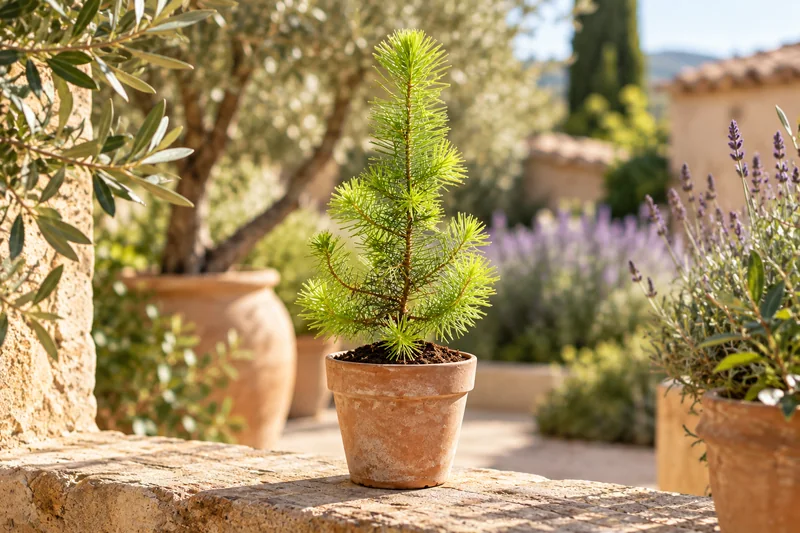
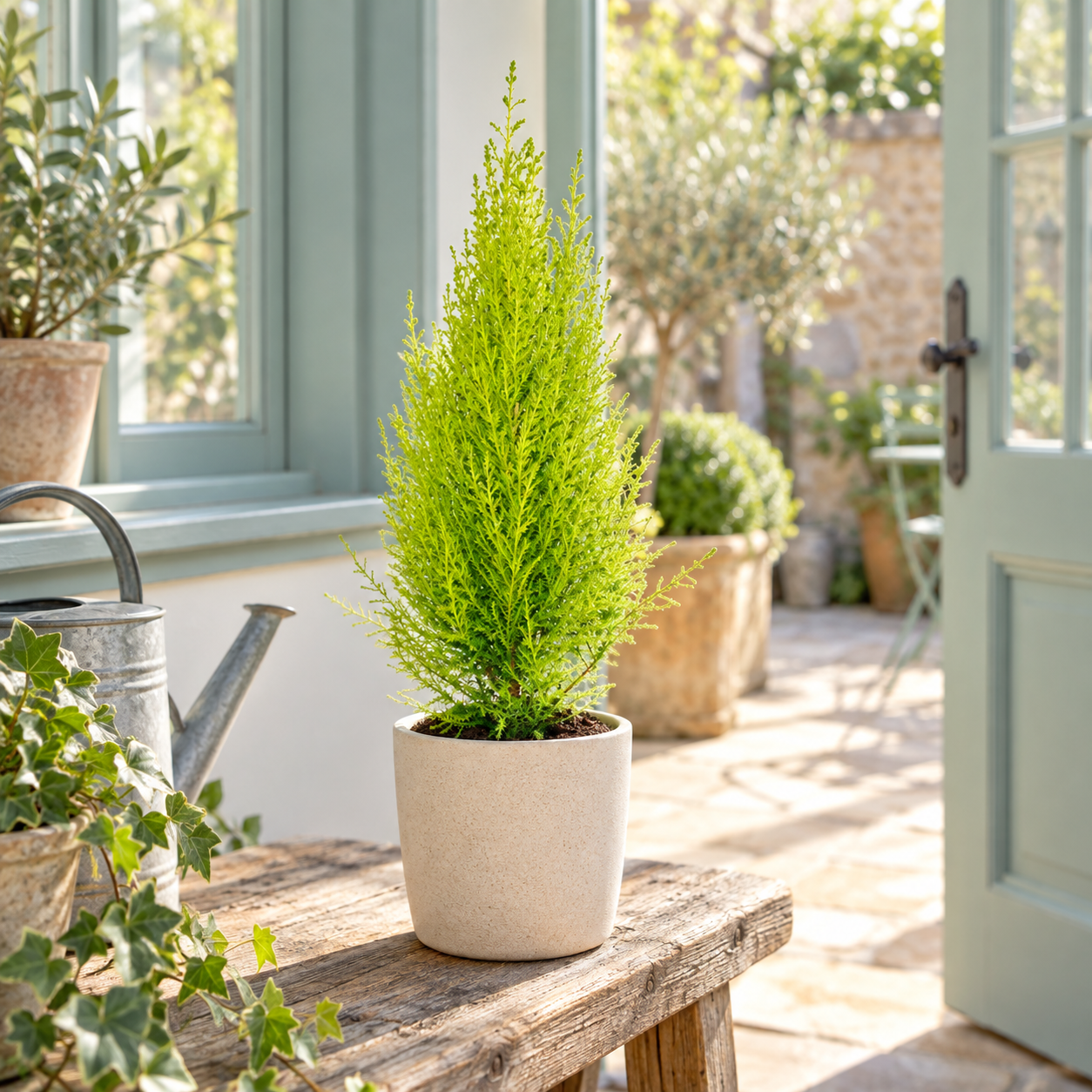
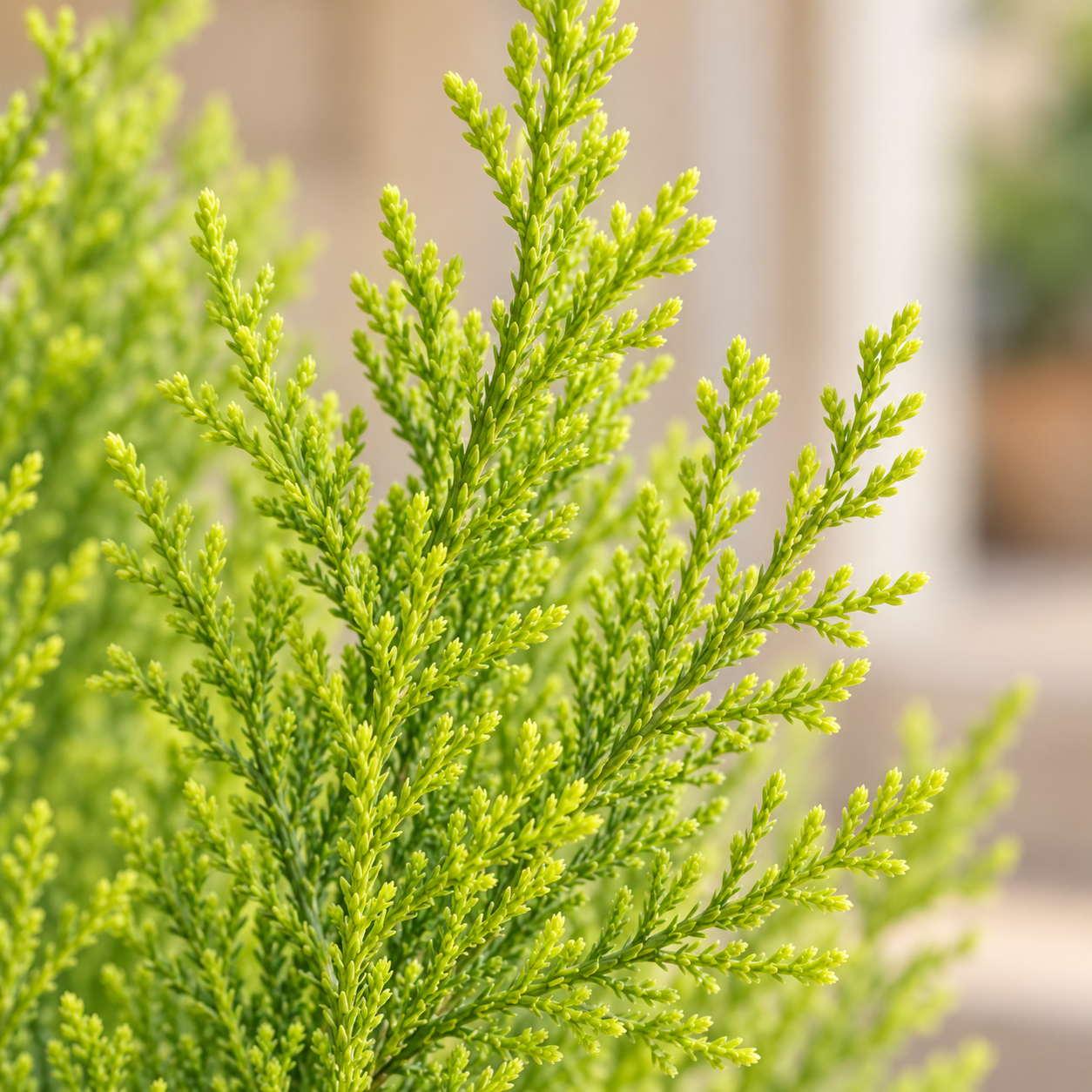
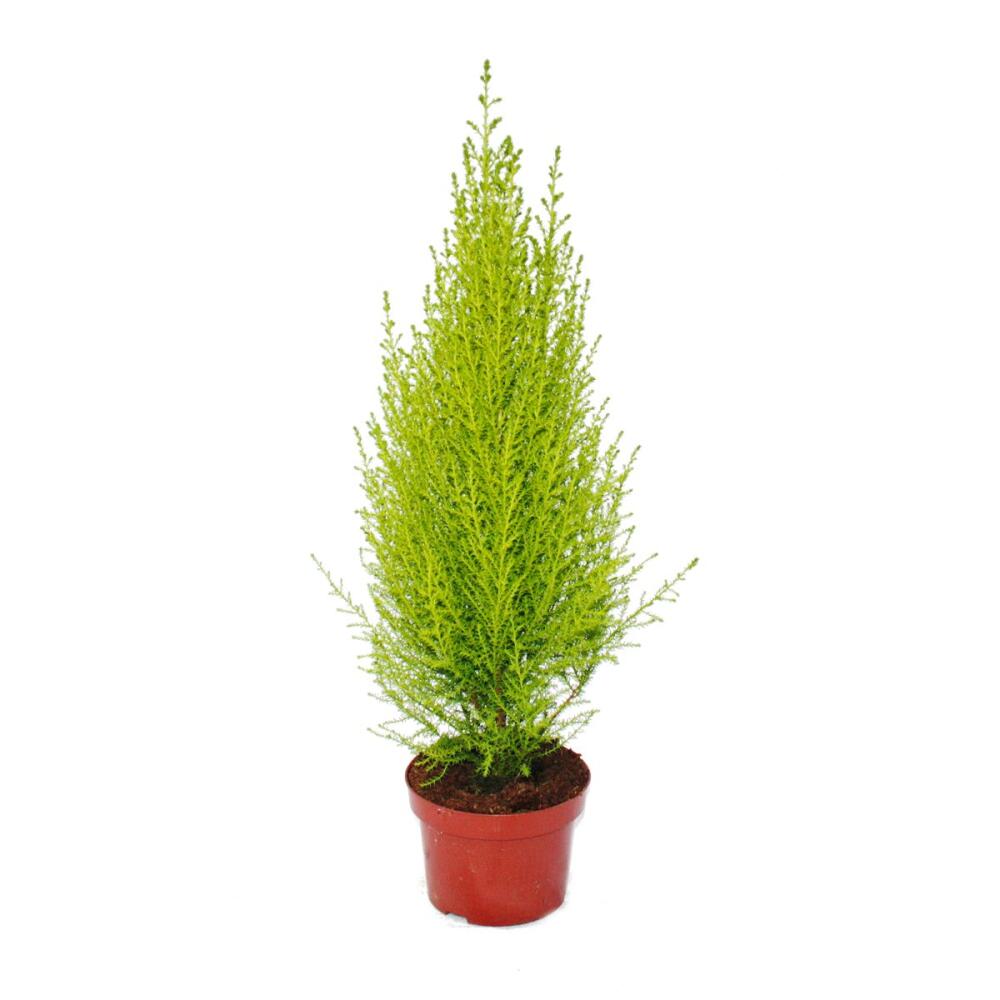
At a distance Wilma gives a calm green accent; close up there are many fine branches. Young yellow-green to pale-green foliage makes a dense cone with lively slightly irregular tips. The original shows a small nursery pot. Its upright structure fits a bright sheltered veranda or little container space near the house. Beside a low bowl it provides an appealing height difference. Lemon aroma is most noticeable when touching or crushing the foliage; there is no need to handle the branches constantly.
Wilma among Monterey cypresses
Cupressus macrocarpa is Monterey cypress from the Californian coast and belongs to Cupressaceae. Some sources place it in Hesperocyparis. Wilma is a more compact selection of golden-green Goldcrest; Goldcrest Wilma also appears in trade for this selection. Compact is comparative, not a fixed miniature size. Specialist descriptions go well beyond a metre; RHS gives 1.5–2.5 m. Later allow space both sideways and upwards. Its fine evergreen foliage offers interest beyond a short decorative season.
Delivery starts in a small pot
The selected offer is one plant in a 12 cm nursery pot, about 35–40 cm total height including the pot. Any extra outer container and the scene surroundings are examples only. Support the pot when unpacking and release branches gently without pulling the tip. Check moisture and drainage. Small pots may dry faster in bright weather than later larger containers. After travel, assess actual rootball moisture first instead of leaving preventive water in an outer pot.
The indoor-cypress trade name needs a considered position
Wilma is often sold as an indoor cypress, but a warm room is unsuitable long-term. A very bright sheltered container spot or cool veranda is more appropriate. Initially protect the new arrival from hard direct sun, then gradually adapt it to more sun. Outdoors shelter it from cold drying wind. Watch heat radiated by walls and moisture in the small pot too. For a short indoor stay choose the brightest cool position and plan suitable subsequent cultivation.
Reliable moisture in a small root space
Check the container rootball regularly. Older plants cope better with dryness once established in the ground; that does not describe a freshly delivered little pot. Assess surface, weight and deeper rootball moisture. When moisture declines, water slowly and evenly, letting it leave the holes. Keeping foliage healthy does not mean leaving roots in standing water: check the outer pot after watering. Wind and sun increase consumption. Check in winter too, especially under a roof. Water carefully if needed on a frost-free day; a frozen rootball should receive no additional water.
The container should follow the natural shape
Structured well-drained container soil supports the plant and keeps roots aerated. When roots become crowded, move to an appropriate size; increasing height also requires stability. During active development give moderate liquid feed by instructions, accounting for any feed already in the soil. Heavy reserves are unnecessary early on. The narrow cone needs no hard routine pruning. Correct lightly within green branches: many conifers regrow poorly from old brown wood. A planned long-term position avoids severely topping a plant that later becomes too large.
Evergreen foliage needs winter attention too
Winter suitability depends on climate, position and root space. A small pot faces more frost and drying wind than an established garden plant. Protect container sides, leave drainage open and provide a cool sheltered position during severe frost. A dark heated room is no good replacement. Assess brown branches alongside moisture, preceding cold and light; pests may change their appearance too. Address the cause selectively rather than adding water, feed and hard pruning together. Healthy fresh growth provides better feedback on a suitable everyday position.
One plant, several views
Good to know
What size is delivered?
A 12 cm pot and about 35–40 cm total height including the pot. Later growth can become much larger.
Are Cupressus and Hesperocyparis two plants?
No: Monterey cypress may have either name depending on classification. Here they refer to Wilma, not two deliveries.
Will Wilma always stay small?
Compact is relative to Goldcrest. Developed plants may exceed a metre; RHS lists 1.5–2.5 m.
Can it stay permanently in a heated room?
That is poor long-term cultivation. Prefer a very bright sheltered container position and suitably cool winter conditions.
Why protect it from sun on arrival?
Adapt gradually after transport. A sunny sheltered spot then suits container growth, while the small root volume still needs moisture checks.
Does it tolerate drought?
Advice for older established plants does not apply to the little pot. Check regularly without leaving stagnant water.
Can I prune into brown wood?
It is better to avoid it: regrowth is unreliable. Correct lightly within green shoots.
Does it need winter water?
Check on frost-free days, especially under cover. Water if needed, never when the rootball is frozen.
Sources and editorial note
- Exotenherz: offer and original images checked 03.10.2026
- RHS: Wilma name, position and size
- NC State: Wilma selection and container culture
- RHS: conifers, containers, water, winter and pruning
- NC State: Monterey cypress origin and name forms
Shop offer, article number, GTIN, availability and original images directly checked on 03.10.2026. Specialist sources directly read. Exact variant SKU176319112020-18, GTIN4019515914388, InStock. Pot12/total35–40 directly in long text. Indoor no-sun advice contextualised: protect on arrival, then sunny container cultivation rather than permanent heated indoor living according to NC State. Cupressus/Hesperocyparis and Goldcrest Wilma compared; plain Goldcrest not conflated with this identity. Original1 clean and byte-identical. Garden category/container group suit actual long-term culture; responsibility B agreed.