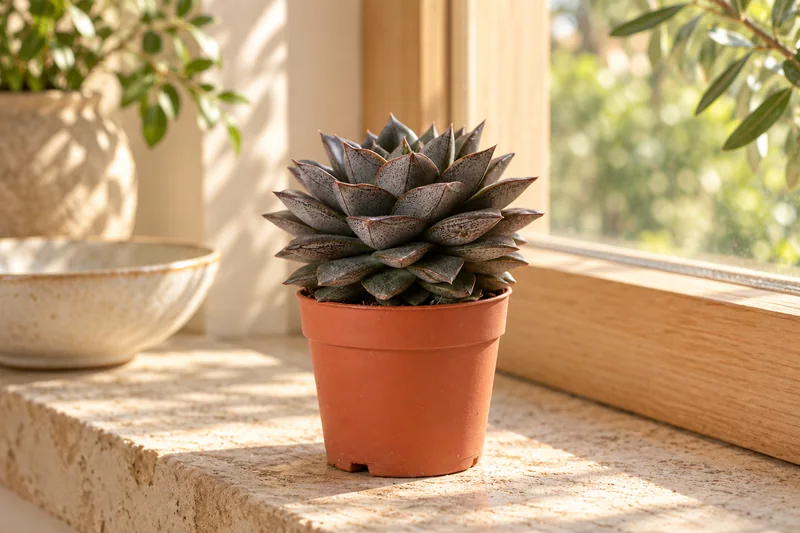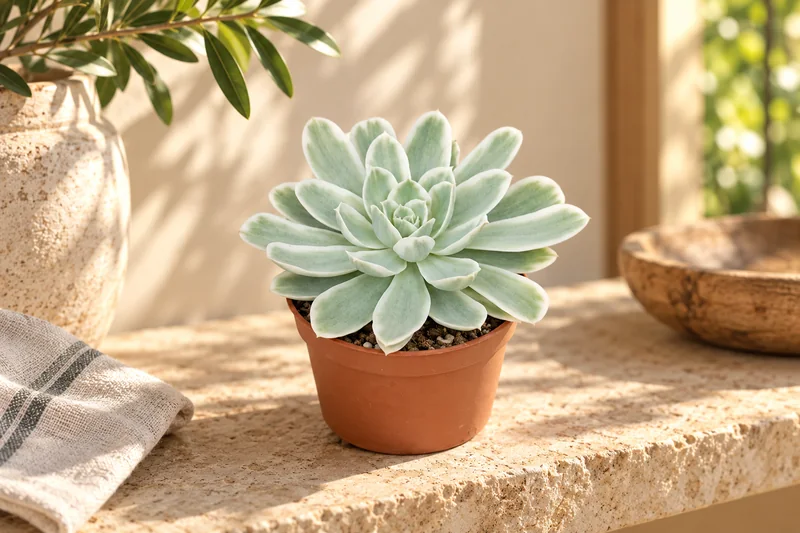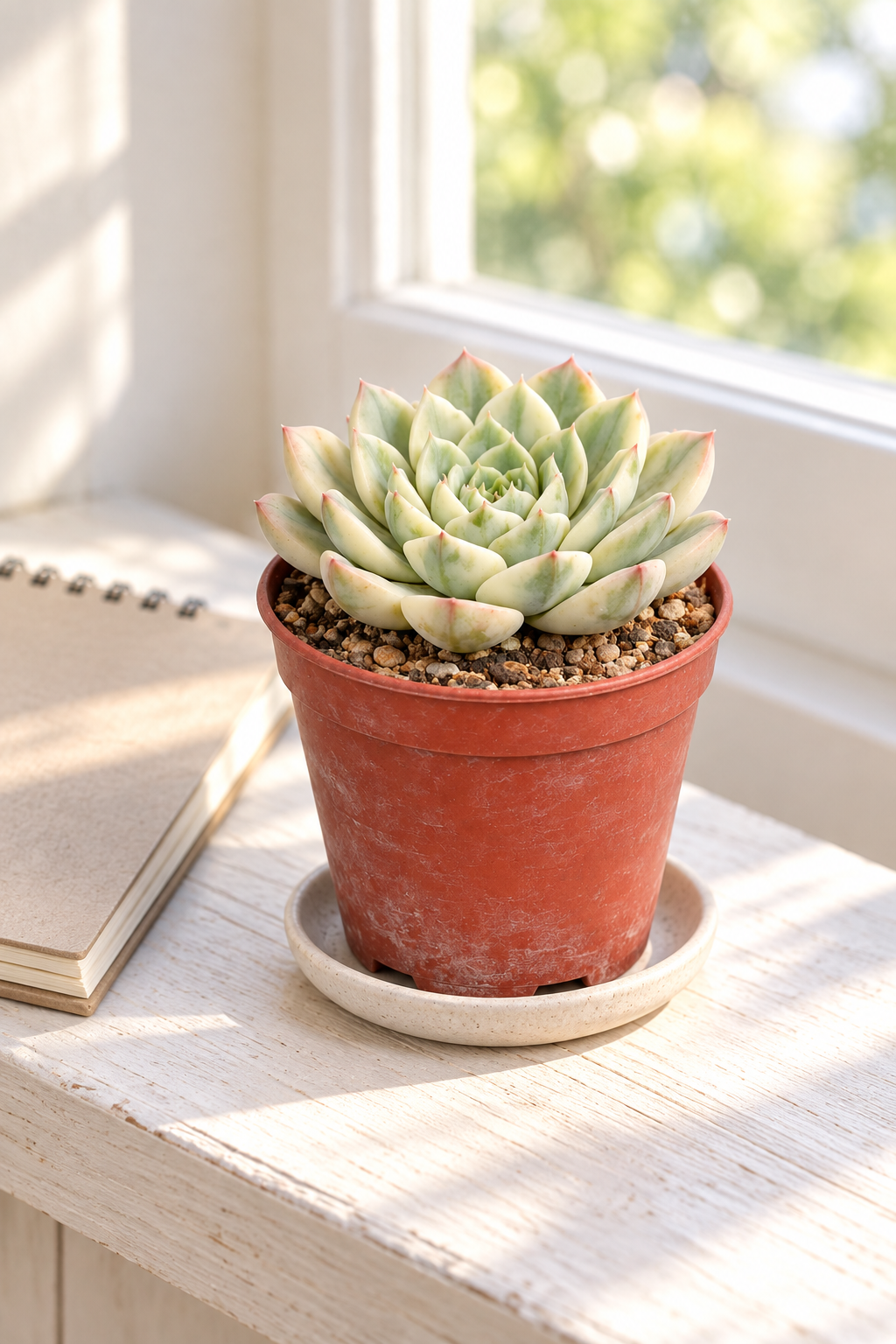
This plant at Exotenherz
Check the shop offer for current availability, price and what is included.
Check the selected shop offer for price, availability and delivery contents.
Your care table
| Topic | What to do | Why it helps |
|---|---|---|
| Light | Stand very bright with gradually introduced sun. | The compact rosette needs light; the pale selection is protected from suddenly hot sun. |
| Water | Only water soil after sufficient partial drying and let drain. | Fleshy leaves store water, but the rootball should still not remain constantly moist. |
| Markings | Treat differences between leaves as natural variation. | The original photograph is not a millimetre-precise template for every living specimen. |
| Substrate | Use gritty succulent compost and an open drainage hole. | Moisture must not linger unseen beneath a dense rosette. |
| Handling | Hold pot and rootball; protect fresh leaf surfaces. | Pressure and frequent touching leave marks on the thickish leaves. |
| Feeding | Feed sparingly only during growth according to product instructions. | More fertiliser does not reliably enhance variegation. |
| Winter | Keep very bright and slightly cooler above 10 °C; reduce watering substantially. | Weak warm winter growth may alter the compact structure. |
| Checks | Inspect tight leaf bases and rootball for soft areas and deposits. | Pale leaf colour must not conceal new damage. |
Check the compost and pot weight. The care table explains how far the compost may dry.
Water only when needed. The water should reach the root ball without spilling over the rim.
Remove surplus water from the saucer or cachepot. Then return the plant to a suitable position.
A pale rosette with green lines
Variegated Moon Fairy carries thickish leaves tapering to a point. Broad cream-pale areas alternate with irregular green stripes; individual tips may look gently pink. The young specimen in the original shows a dense low rosette. Its pale effect comes from leaf markings, not an artificially brightened setting. When unpacking look at the firm centre and leaf bases. New leaves may be patterned differently from outer ones. A living plant is not an imprint of the product photograph. The mixture of green and pale areas makes a close look interesting as long as further growth remains firm and compact.
Moon Fairy and Alfred belong to the same naming history
In the International Crassulaceae Network the originally described Echeveria Alfred is also called Moon Fairy in Korea. The origin of this selection remains open there; a possible parent combination is merely proposed. This portrait does not turn it into securely documented ancestry. The specific shop offer additionally carries the name variegata and shows variegated leaves. A specialist succulent grower also lists a corresponding variegated trade selection. The description thus remains tied to the offered plant and its documented name connection. It is not counted as a new botanical species. Reliable final measurements for this particular pale selection are unavailable; the described measurements of another Alfred trial plant do not replace them.
The little pot remains the basis for care
The selected offer gives a 6.5 cm pot diameter and approximately 15 cm total height including the pot. Such a small rootball is easily overlooked in a decorative container. Lift the nursery pot out for checks and compare its weight before and after drying. Grit at the surface is helpful but does not reliably reveal all moisture in the core. A closed cachepot can retain water below while everything looks dry above. Check and empty it after watering. The young rosette may first settle into this easily monitored little root space. An immediate move into a very large wet container is not a necessary starting step.
Plenty of light without overloading pale leaves
A very bright position supports the compact rosette form. Introduce sun slowly, particularly after shipping or shaded culture. During hot summer midday hours behind glass some protection from the strongest exposure can help. A sudden change of position differs from suitable light over weeks. New pale dry spots should therefore be considered in connection with the move. Cream areas belong to the variegation; their distribution does not reliably improve with ever stronger sun. Watch for living green areas and short firm new leaf bases. These pale colours do not turn a poorly lit shelf into a good growing position.
Water reaches soil, not the rosette centre
After sufficient partial drying, water the substrate when needed. The rootball should be able to absorb water, after which surplus drains freely. Avoid long-standing moisture between the tightly layered leaves. Gritty well-drained succulent compost helps this alternation. When roots need more space give only suitably more container room and keep the plant at its previous base height. Hold pot or rootball rather than lifting the rosette under pressure. Fleshy leaves store water but do not permit permanently wet roots. A firm little plant body and a well-drying rootball belong together as a care picture.
The leaf pattern need not be constantly optimised
The mixture of cream and green may change somewhat with new leaves. Care aims for healthy structure, not the whitest possible next set of leaves. Give nutrients at low strength during visible growth according to product instructions, not as a means to enhance markings. Handle fresh leaves little; otherwise pressure marks and scuffing remain visible. Completely dry outer leaves can be loosened carefully. Check tight leaf bases for fluffy deposits and the plant base for soft areas. A pale base colour can make changes less obvious. An occasional photograph of your own specimen helps distinguish normal development from a new problem.
Carry the compact structure through winter
Moon Fairy stays very bright and frost-free, above about 10 °C and preferably somewhat cooler than during summer growth. With fewer new shoots water needs fall. Check the rootball instead of continuing summer watering unchanged. Warm, dark and generously watered conditions may weaken and stretch the rosette. Even during drier rest observe the plant regularly so severe shrinking is not overlooked. In spring increase supply appropriately with new growth and stronger light. Later offsets may enlarge the group; they are not guaranteed delivery features. The pale little rosette remains easiest to understand when its position lets you follow its development.
One plant, several views


Good to know
Is Moon Fairy a new species?
No. The portrait follows a variegated trade selection of a named echeveria.
What is Alfred’s connection?
The directly read original description names Moon Fairy as a name used in Korea for Alfred.
Are the parents known for certain?
No. The mentioned possible combination is a proposal and is not asserted as certain here.
Must every leaf look like the shop photograph?
No, distribution of green, cream and gentle pink tones can vary in living plants.
How large does the variegated selection grow?
A binding final size is not documented. The secured offer figures are a 6.5 cm pot and approx. 15 cm total height including the pot.
Can I put the pale leaves immediately in full midday sun?
Introduce sun slowly and avoid particularly hot unfamiliar exposure.
Sources and editorial note
- Exotenherz: currently orderable single offer (accessed 03.10.2026)
- International Crassulaceae Network: original Alfred description and Moon Fairy name connection (accessed 03.10.2026)
- Giromagi: variegated Moon Fairy selection and culture (accessed 03.10.2026)
- RHS: Echeveria cultivation (accessed 03.10.2026)
Current single offer and specialist sources read directly on 03.10.2026; botanical identity/SKU checked against Canon 642 and new parallel portraits. ICN original description and actual Giromagi variegated selection directly read. Alias Alfred included in final dedupe; proposed parentage explicitly not asserted. Variegata trade selection not treated as a new species or second counted colour variant.