This plant at Exotenherz
Check the shop offer for current availability, price and what is included.
Check the shop for the current price, availability and offer contents.
Your care table
| Topic | What to do | Why it helps |
|---|---|---|
| Position | Choose a bright position for the glass container with indirect daylight, protected from direct summer sun. | The fine vein pattern needs light; in a closed container, sunshine can also produce intense heat. |
| Watering | Check the compost and glass; add small amounts of water only when moisture is declining. | Ruby Lime should not dry out completely, but water cannot escape from the container through a drainage hole. |
| Condensation | Observe light misting; if heavy droplets persist, open the lid temporarily. | Excess moisture and constantly wet foliage encourage rot. |
| Planting | Follow the supplied instructions, place the root balls carefully and keep leaves above the compost. | The delicate stems need support without being buried in wet substrate. |
| Compost | Use loose, humus-rich compost and the intended lower layers without allowing water to accumulate in them. | A layer at the bottom collects surplus water but does not replace drainage out of the container. |
| Trimming | Shorten long tips selectively and remove all cut material. | A low, branching shape leaves light for both plants and limits decaying material inside the glass. |
| Feeding | In a freshly planted small container, rely on the nutrients already present at first; later, feed sparingly and only as needed. | Heavy feeding encourages rapid growth that soon fills the limited space. |
| Winter | Keep warm and bright, away from cold draughts or direct heat from a radiator. | Lower winter light often slows growth; moisture still needs to be monitored separately. |
Check the compost and pot weight. The care table explains how far the compost may dry.
Water only when needed. The water should reach the root ball without spilling over the rim.
Remove surplus water from the saucer or cachepot. Then return the plant to a suitable position.
A rose-red network against a lime-green background
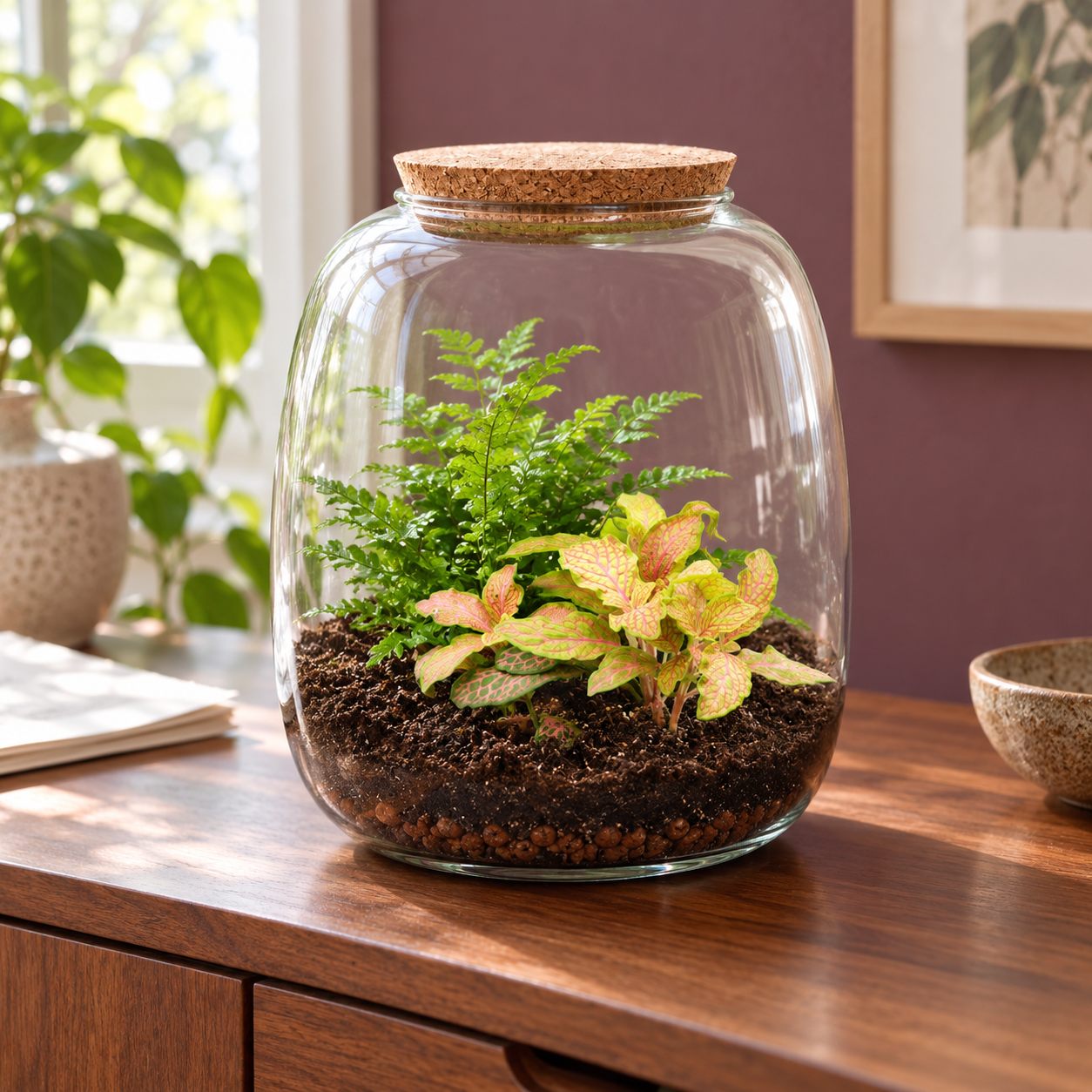
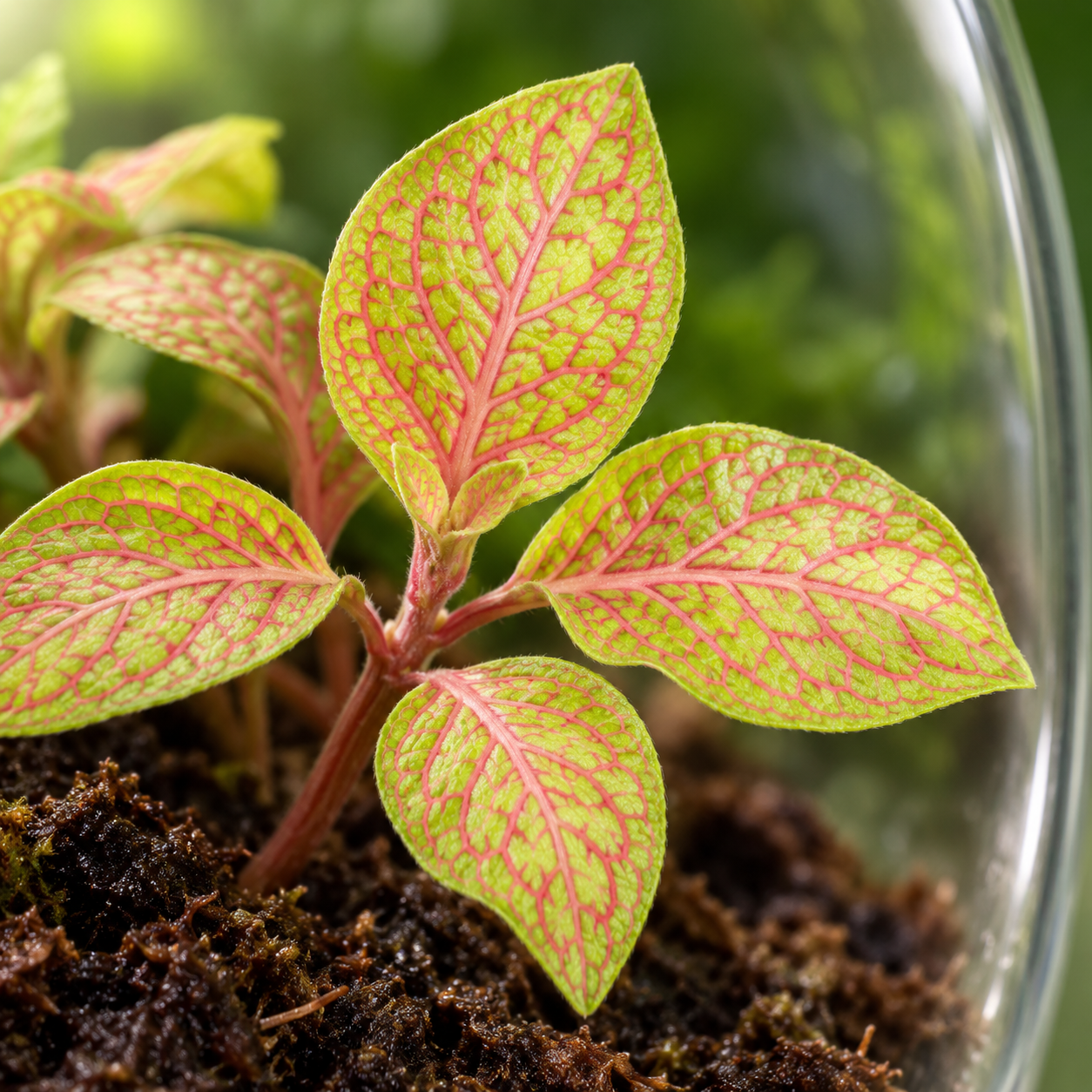
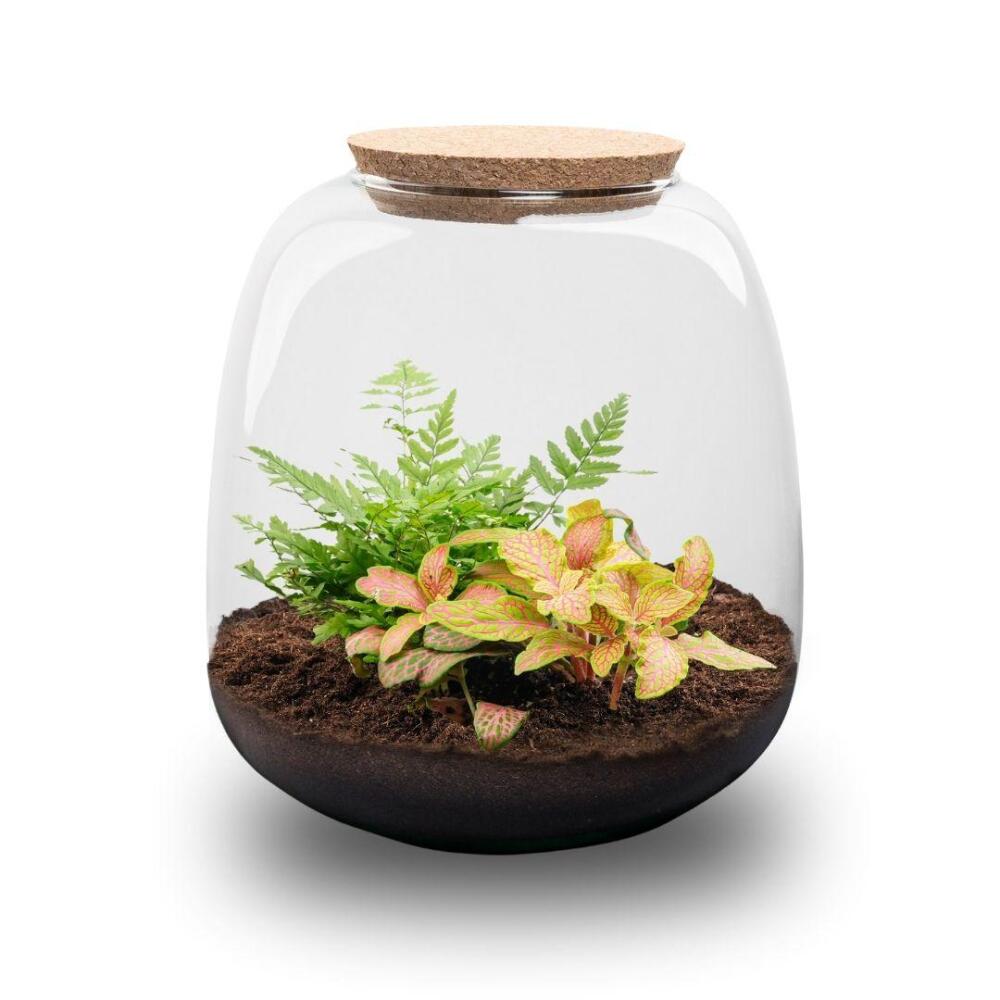
Up close, Ruby Lime immediately draws attention with its unusual colour combination. Its small oval leaves taper gently to a point; pink to reddish veins branch across yellow-green and lime-green surfaces. Some leaves look warmer, others fresher. In the original photograph, the fittonia sits low in front of a green fern. Its fine fronds give the broader leaf network a quiet background. The pattern is especially easy to appreciate when the glass stands on a bright, easily accessible shelf. A single small leaf has enough detail to make you pause as you pass. Neither flowers nor a large collection of plants alongside it are needed.
Ruby Lime is a named fittonia
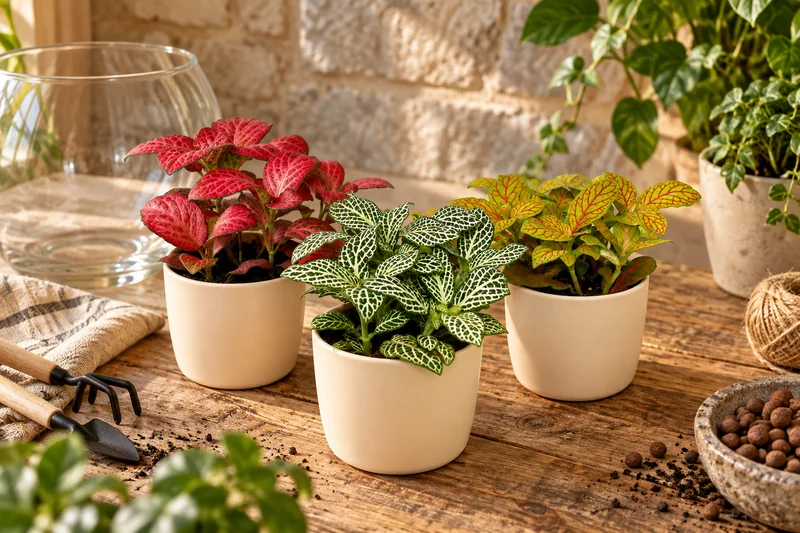
Fittonias belong to the acanthus family. Fittonia albivenis, the commonly cultivated species, comes from tropical regions of South America and produces low, creeping stems. The older name Fittonia verschaffeltii also appears in the trade. Ruby Lime identifies the selection offered here; the producer catalogue lists the same name with Zalm added. Its compact shape and pink markings are characteristic. Colour can look slightly different with leaf age and light. It is therefore neither a painted finish nor a care goal to be achieved by applying lots of fertiliser. The plant continues to grow and its stems can gradually occupy open areas of compost.
Planting the little glass garden yourself
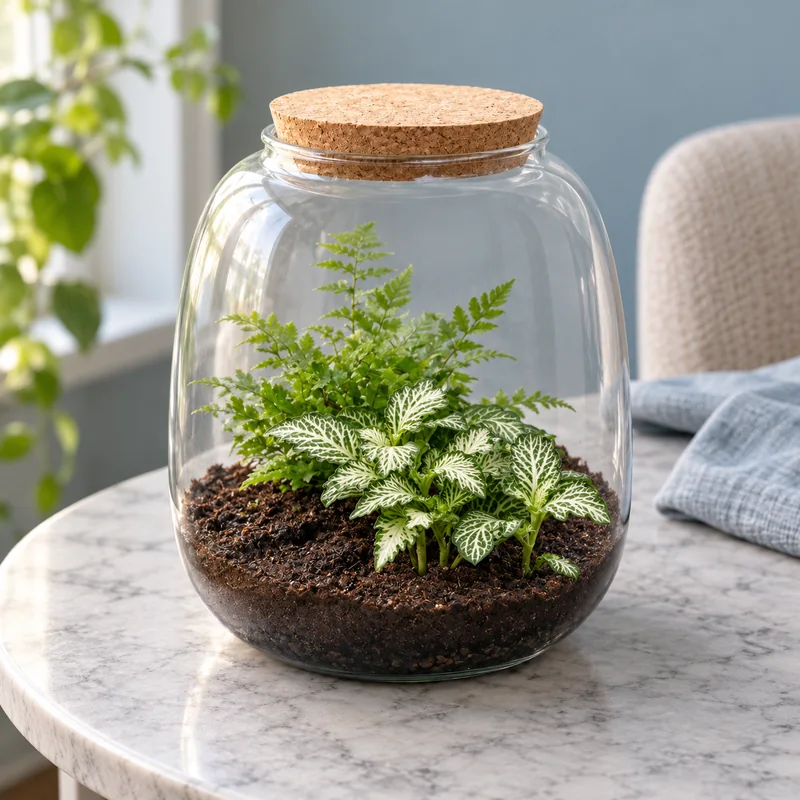
The offer described contains a DIY kit with a cork-lidded glass container, a Ruby Lime fittonia, a fern, hydroponic granules, activated charcoal, potting compost and instructions. The container is approximately twenty centimetres tall and nineteen centimetres wide. These dimensions describe the vessel; an exact delivery height is not stated for the individual plants. The original photograph shows an example of a planted arrangement. When unpacking, handle the glass and plants separately and carefully. Check the root balls before adding moisture. To plan the arrangement, it helps to position both plants provisionally first. The lower foliage remains visible at the front, while the fern has some room at the back for its fronds.
Gentle light protects the leaves and the glass garden
A bright position with indirect daylight suits the fittonia. The little glass container can work well in a quiet corner of a room near a window, provided enough light actually reaches it. A closed terrarium quickly heats up in direct sunshine. What matters is therefore not just how bright the position is, but also the path of the sun’s rays during the day. In summer, a suitable distance or screen protects it from hot sun through the window. Cold draughts during ventilation and a position immediately above a radiator are also unsuitable. Choose somewhere you can inspect the leaves, compost surface and lower layers without moving the container.
Top up sparingly and watch carefully
In the closed glass, water evaporates from the compost and leaves and condenses again on the cooler wall. Moisture therefore stays longer than in an open pot. Light, temporary misting can be part of this cycle. Large droplets, constantly wet leaf surfaces or water collecting at the bottom, however, call for an adjustment: open the lid temporarily and wait before watering again. If the compost has become noticeably drier, add only a little water, carefully. A lack of condensation alone does not prove that the root ball is dry. Check the compost too. The fittonia should not repeatedly collapse from drying out, but extra water stored in the glass does not protect it either.
Air for the compost and room for the stems
Follow the supplied instructions when arranging the layers and planting. Loose, humus-rich compost holds moisture without becoming a compacted wet mass. A lower layer of granules is not a drainage hole: water cannot leave the closed container by itself. Set the root balls so that stem bases and leaves do not disappear beneath extra compost. Later, overly long tips can be shortened neatly; remove the cut material from the glass afterwards. Creeping stems can form roots at their nodes. To try a cutting, watch a healthy section in its own small container with suitable moisture. An overcrowded arrangement can also be reorganised.
A little garden through the seasons
Fresh compost initially provides nutrients. Additional fertiliser is used sparingly in the small terrarium and only when there is an identifiable need; fast, dense growth does not make the limited space easier to care for. In winter, the glass remains bright and warm, while demand may decline with less light. Remove dead leaves promptly and inspect leaf undersides for unusual animals or deposits. If the foliage becomes limp, check moisture before reaching for the watering can. Soft stem bases in wet compost need a different response from a dry root ball. Healthy new growth is the best sign that a targeted improvement to the position or care has helped.
One plant, several views
Good to know
What does the offer described include?
A DIY bottle garden with a cork-lidded glass container, a Fittonia Ruby Lime, a fern, substrate materials and instructions. You put the arrangement together yourself.
Are the twenty centimetres the height of the plants?
No. That is the height of the glass container. No exact delivery height is stated for the plants included.
Why do some labels also say Fittonia verschaffeltii?
That is an older name for Fittonia albivenis. Ruby Lime, or Zalm Ruby Lime, names the selection offered.
Must the fittonia always look strongly pink?
The rose-red vein pattern belongs to this selection, but leaf age and light influence its appearance. A constant colour for every leaf is not promised.
Should I water the closed container every week?
No. Assess the compost, condensation and lower layers. In a suitable closed container, water is usually added only rarely and in small amounts.
What should I do about large droplets on the wall?
Open the lid temporarily or wipe away excess condensation. Do not add more water while the compost and glass are clearly too wet.
Which fern species is included?
The offer lists a fern without specifying its species. No additional fern identity or particular cultivar characteristic is therefore added here.
Can I also keep Ruby Lime in an open pot?
Yes, in loose compost with drainage, protected light and sufficiently humid air. In an open pot, the small root ball needs checking more often.
Sources and editorial note
- Exotenherz: offer and original photographs (03.10.2026)
- Danziger: producer catalogue, Ruby Lime on page 85 (03.10.2026)
- NC State: Fittonia albivenis, synonyms, growth habit and care (03.10.2026)
- RHS: bottle gardens, setup and moisture management (03.10.2026)
The shop offer, article number, GTIN, availability and original photographs were checked directly on 03.10.2026. Horticultural sources were read directly. Ruby Lime is a named selection in the Danziger producer catalogue, page 85. The kit described contains this fittonia and a fern of unspecified species; only the glass container has documented dimensions. The original gallery photograph is shown unchanged; AI-created images are identified as such.