This plant at Exotenherz
Check the shop offer for current availability, price and what is included.
Link to the offer in German. Check the shop for the current price, availability and delivery contents.
Your care table
| Topic | What to do | Why it helps |
|---|---|---|
| Light | Sheltered partial shade to shade outdoors. | Avoid dry hot midday sun. |
| Water | Supply the root ball evenly and never let it dry completely. | Still remove excess water. |
| Soil | Acidic, humus-rich and well-drained. | Choose a suitable ericaceous mix for lasting cultivation. |
| Fertiliser | When needed, sparingly, for acidic soils following product instructions. | Do not force slow growth with high nutrient applications. |
| Winter | Check moisture on frost-free days. | Evergreen foliage remains susceptible to frost drought. |
| Pruning | Selectively remove only dead or damaged shoots. | Regular hard pruning is not required. |
| Development | Give runners space in a permanent planting. | Fruit decoration is seasonal, not a permanent constant. |
| Use | Treat as an ornamental plant, not for snacking or remedies. | Conspicuous fruits may tempt children to taste them. |
Check the compost and pot weight. The care table explains how far the compost may dry.
Water only when needed. The water should reach the root ball without spilling over the rim.
Remove surplus water from the saucer or cachepot. Then return the plant to a suitable position.
A small woodland shrub with red ornaments
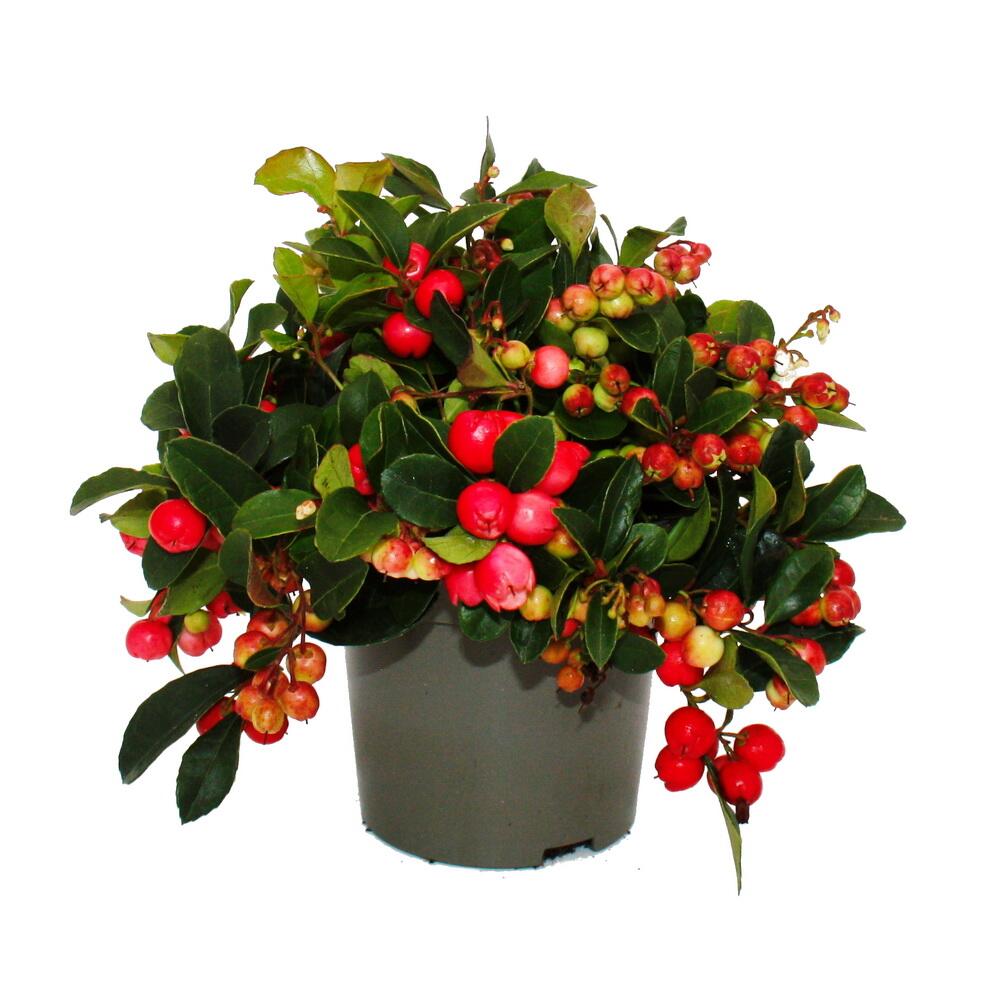
Gaultheria procumbens belongs to the heather family and originates in eastern North America. In open woodland settings it grows low and can join up through runners to form small carpets. Its firm glossy foliage is evergreen; reddish tones may develop during the cold season. Small pale flowers later give rise to its conspicuous red fruit decoration. Botanically, fleshy surrounding tissue contributes to the berry-like appearance, which explains its German name meaning false berry.
Autumn colour in a genuinely small size
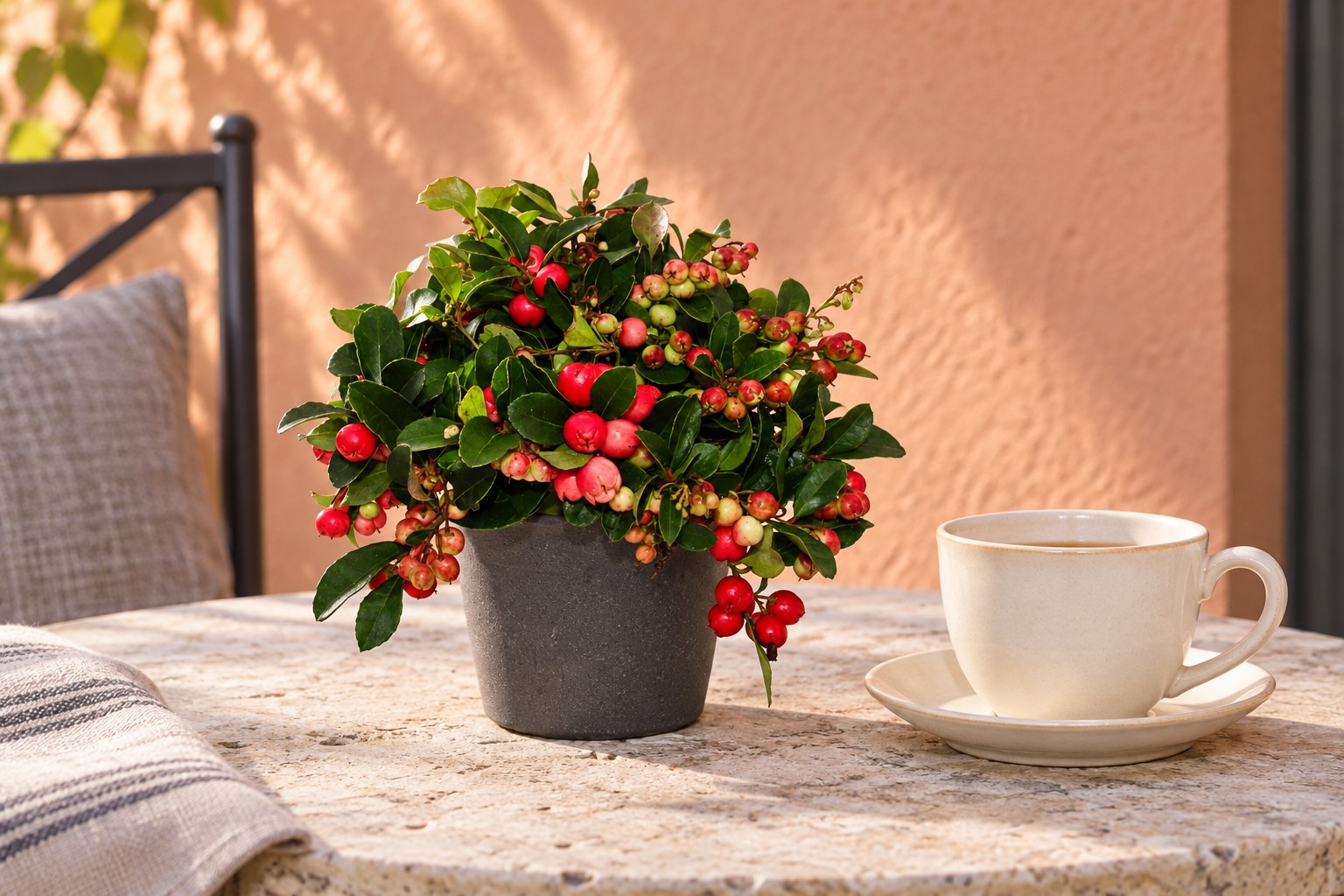
The offered plant is about 15 cm tall in an 11 cm pot. A cup beside the container illustrates its small delivery size in the scene. It can look attractive temporarily on a sheltered garden table; for the long term, a suitable outdoor position with acidic soil is appropriate. The fruits serve as decoration here and are not recommended for snacking. In a lasting planting, wintergreen can be combined with suitable other acid-soil plants without crowding it closely.
Choose partial shade and acidic humus-rich soil
A sheltered outdoor position in partial shade to shade suits its woodland character. Sun only makes sense with adequately moist roots that do not overheat; avoid full dry midday heat. Use acidic, humus-rich, well-drained soil for lasting cultivation. A suitable peat-free ericaceous mix can help in a container. Lime-rich soil and strongly unsuitable irrigation water make cultivation harder. Beneath a roof the plant is protected from much rain, but then needs all the more reliably controlled watering.
Moisture does not end with autumn
Do not allow the root ball to dry out completely. Check regularly, particularly after planting and during sunny or windy weather. Water slowly when needed and allow surplus to drain away. Continue checking on frost-free winter days. Evergreen leaves lose water outside summer too, while frozen roots cannot take up water. A sheltered position and a root ball supplied in good time help prevent frost drought. Constant wetness remains problematic, so check drainage holes and container saucers carefully.
Keep a small plant for the long term
Wintergreen grows slowly and needs no heavy fertiliser applications. For longer-term container growing, use a suitable fertiliser for acidic soils sparingly when needed, following product instructions. When roots fill the container, carefully move it to the next suitable size. Runners can develop if there is enough room. Regular hard pruning is not necessary; remove dead or damaged shoots selectively. The old fruit decoration eventually fades. This is part of the yearly cycle and does not automatically mean the whole plant must be replaced.
Observe fruits and leaf health carefully
Fruit number and colour depend on season and individual specimen. Young or non-fruiting plants can still be healthy. Check foliage for unusual spots, aphids or thrips and avoid water standing for extended periods. Distinguish reddish winter colour from dried, brittle leaves. Aromatic leaves and fruits are not a reason for homemade medicinal uses. This portrait concerns an ornamental plant. A safe position prevents small children from confusing the conspicuous fruits with edible berries.
One plant, several views

Good to know
Can I eat the red fruits?
The offered plant is treated here as ornamental. We recommend neither fruits nor leaves for eating or homemade medicinal preparations.
Why do leaves turn red in winter?
Reddish winter tones may be part of natural colouring. Dry brittle leaves and other damage should be assessed separately.
Does it need acidic soil in a balcony box too?
Yes, for lasting cultivation. A suitable humus-rich acidic mix and good drainage are advisable.
Does a lack of decorative fruits mean a care mistake?
Not necessarily. Age, season and flower development influence fruit set; healthy new growth matters too.
Sources and editorial note
Sources checked: 15 September 2026. Product information and delivery contents follow the linked shop offer. Care has been checked against the stated specialist sources and remains subject to plant condition, position and season.