This plant at Exotenherz
Check the shop offer for current availability, price and what is included.
Link to the offer in German. Check the shop for the current price, availability and delivery contents.
Your care table
| Topic | What to do | Why it helps |
|---|---|---|
| Light | Sunny to partly shaded outdoors. | Open bright positions support compact structure. |
| Water | Check the small root ball and water according to need. | Drought tolerance does not replace checks in a pot. |
| Compost | Airy and well-drained. | Constantly wet soil stresses roots. |
| Fertiliser | Sparingly; seasonal plantings generally need little. | The species copes with lean conditions. |
| Winter | Bright, cool and frost-free for lasting cultivation. | Silver branches alone do not prove hardiness. |
| Pruning | Lightly trim only young tips when needed. | Avoid hard pruning into older parts. |
| Health | Remove dead shoots and avoid crowded wet conditions. | Persistent moisture may encourage grey mould. |
| Arrangement | Combine with companions grown in similarly well-drained conditions. | Do not keep it permanently in wet ericaceous conditions. |
Check the compost and pot weight. The care table explains how far the compost may dry.
Water only when needed. The water should reach the root ball without spilling over the rim.
Remove surplus water from the saucer or cachepot. Then return the plant to a suitable position.
Silver branching rather than conspicuous flowers
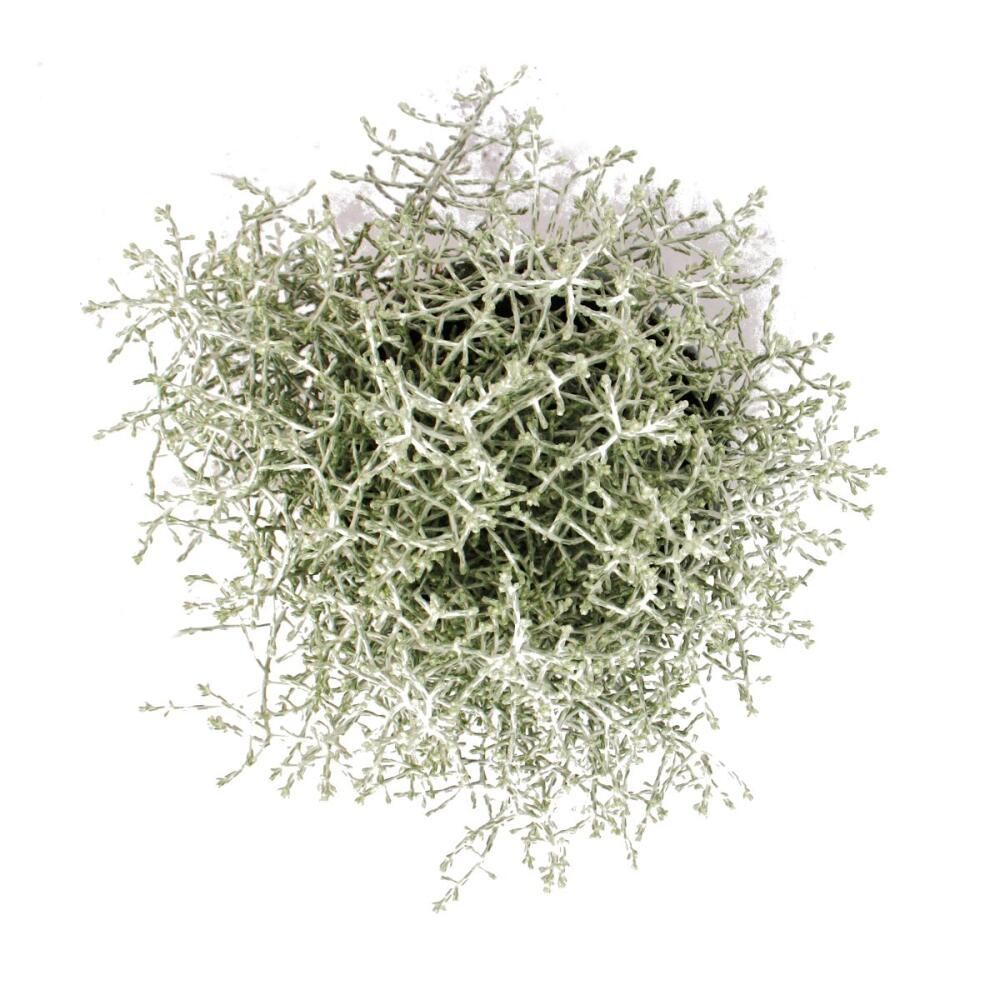
Leucophyta brownii is a small Australian shrub in the daisy family. It is still often sold under Calocephalus brownii. Fine hairs make its closely branching shoots look silvery. Small leaves pressed against the stems recede visually, creating the impression of an airy wire network. This structure works especially well beside larger leaves and strong colours. The plant may also form small pale to yellowish flower heads; for the autumn decoration offered here, however, the branch structure is the main feature.
A small companion with many possible combinations
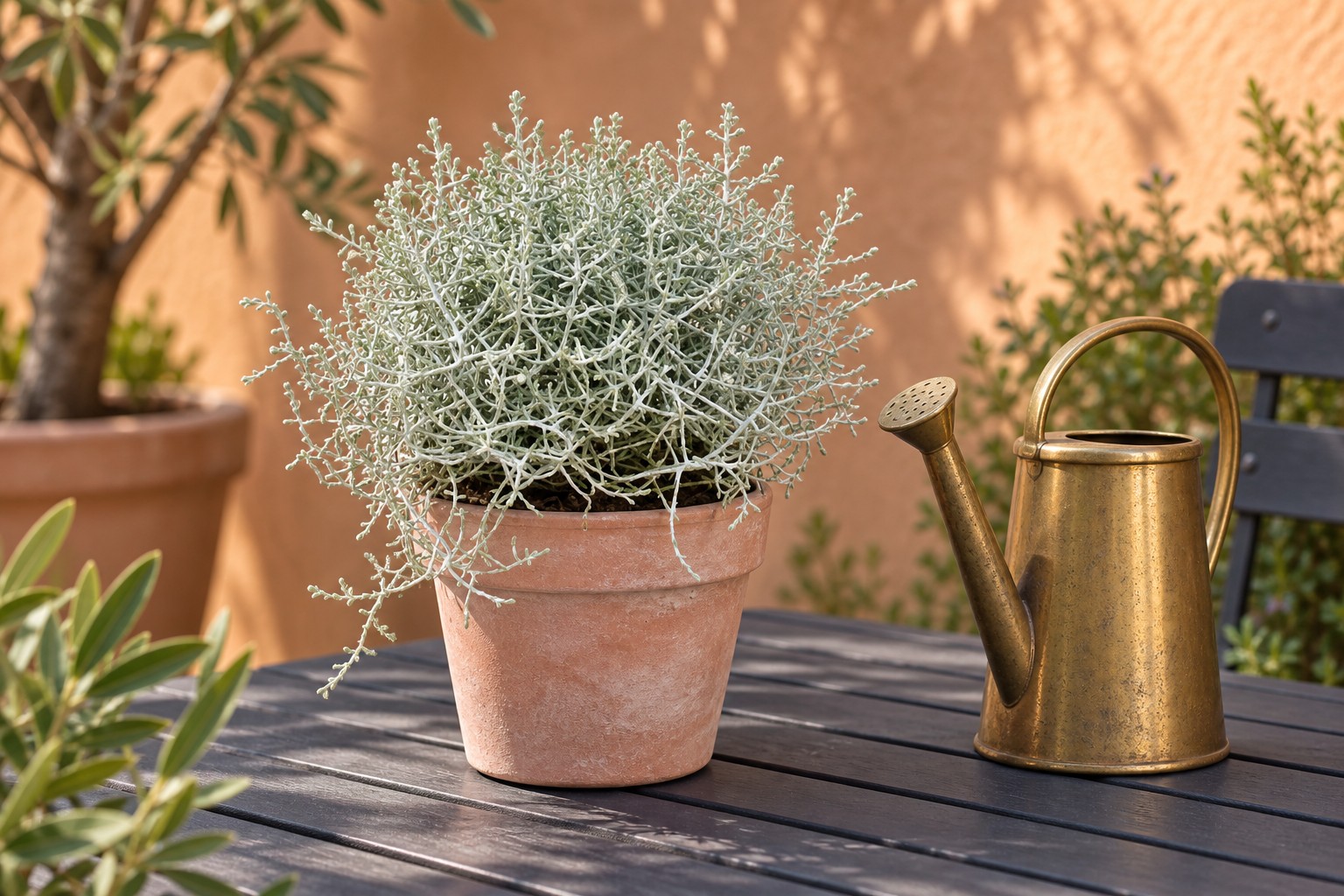
The shop offer describes a 12 cm pot and about 15–18 cm overall height. At this size cushion bush can be used on a garden table, in a bowl or at the edge of a balcony box. The AI scene shows one possible arrangement with an additional outer pot and decoration. Original images and shop details remain authoritative for the actual delivery form. In a combined planting, neighbours should have comparable watering needs. Permanently wet ericaceous conditions are less suitable for this Australian coastal plant than an airy, well-drained position.
Light and free-draining soil provide support
Choose a sunny to partly shaded outdoor position. Its silver appearance suits open bright places; compact growth is harder in dense deep shade. Soil should reliably drain excess water. A structurally stable mineral component can improve drainage in suitable container compost without prescribing a rigid mix. Check drainage holes too. The species copes well in nutrient-poor positions; heavy feeding is not a prerequisite for a dense small autumn plant.
Check the small root ball specifically
In its native habitat and after good establishment, cushion bush tolerates drier conditions. The small retail pot nevertheless dries quickly, especially in wind or under a roof. Check root-ball moisture before watering. If water is needed, apply slowly and evenly and let surplus drain away. The surface may dry a little between waterings; the entire root ball should not become hard and dry. A constantly filled outer pot is also unsuitable. This keeps water supply matched to the actual position.
Decoration in frost is not reliable overwintering
After cold nights branches may remain silver and decorative for a long time. That does not establish that the plant survives winter alive. In our climate cushion bush is not a reliably hardy permanent plant. To keep it, bring it to a bright, cool, frost-free position in good time. Water more cautiously there as demand falls, without letting the root ball dry completely. A warm dark living room is unsuitable for this purpose. In spring gradually reacclimatise it to outdoor light and weather.
Shape gently and observe changes
Young shoot tips can be trimmed lightly when needed to support the structure. Avoid hard pruning into older parts: cushion bush responds less reliably than many vigorous garden shrubs. Brown soft areas together with soil that stays wet indicate unsuitable conditions. Crowded, persistently damp plantings can also encourage grey mould. Carefully remove dead material and improve air movement and drainage. Fresh spring growth indicates successful overwintering better than the old silver colour.
One plant, several views

Good to know
Is cushion bush hardy?
Not reliably in our climate. For multi-year cultivation, overwinter it in good time in a bright, cool, frost-free position.
Why does the plant still look silver after frost?
The branch structure often retains its colour for a long time. This is not reliable proof that the tissue is still alive.
Do I need to feed cushion bush?
Only sparingly when longer-term cultivation requires it. A suitable bright position and good drainage matter more.
Can I prune it hard?
It is better to trim only young tips lightly. Hard cutting back is often poorly tolerated.
Sources and editorial note
Sources checked: 15 September 2026. Product information and delivery contents follow the linked shop offer. Care has been checked against the stated specialist sources and remains subject to plant condition, position and season.