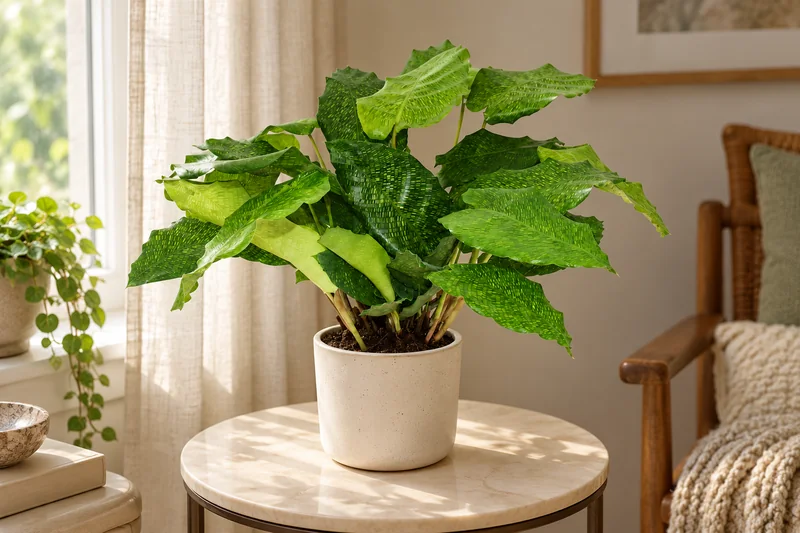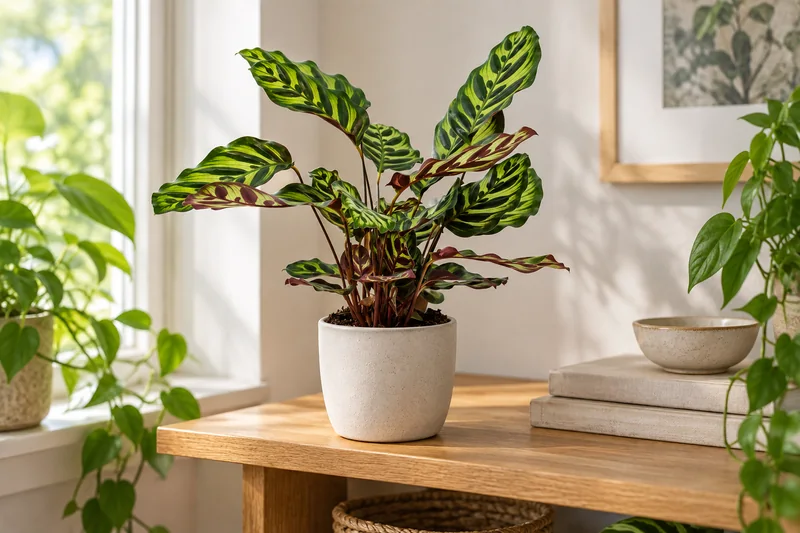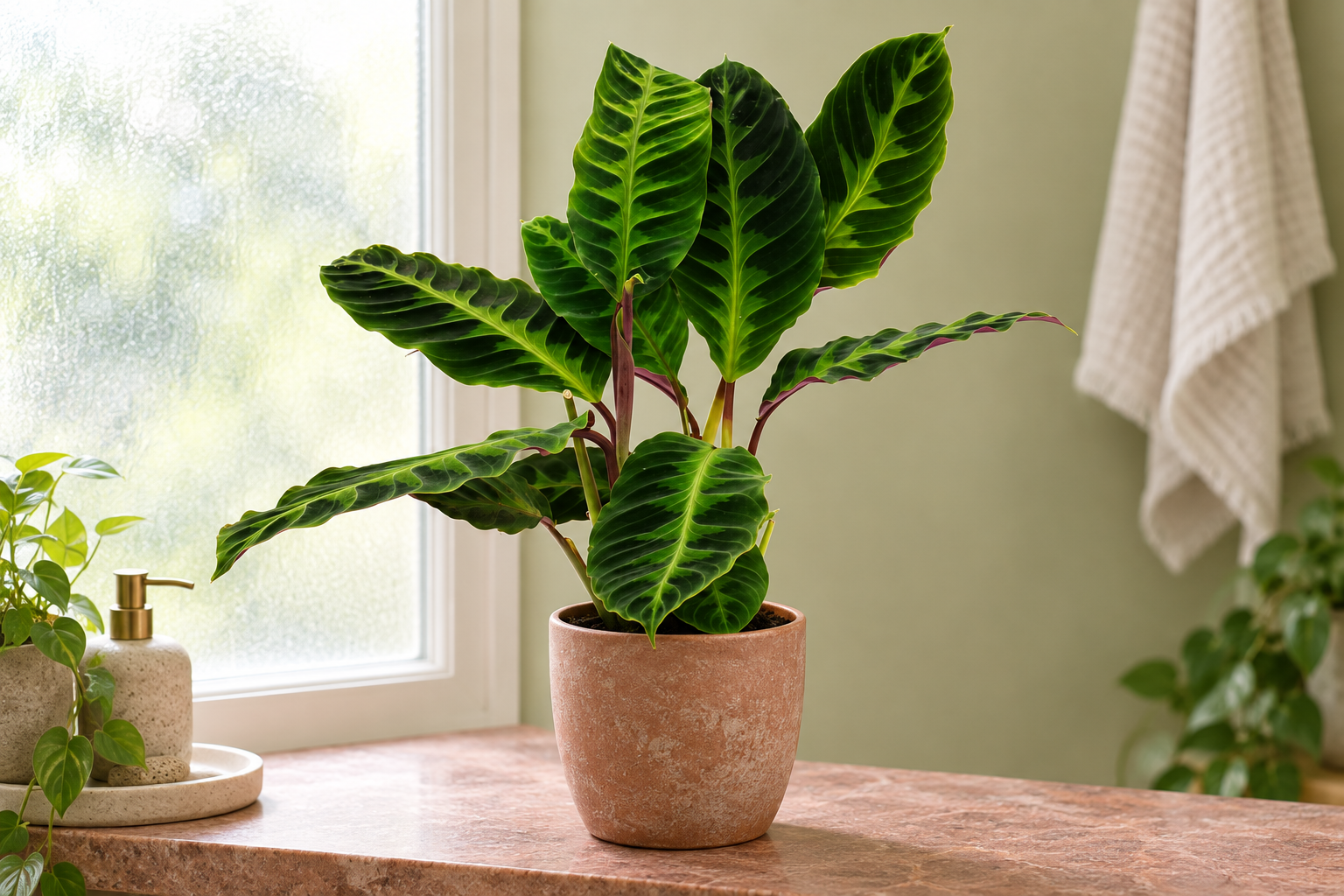
This plant at Exotenherz
Check the shop offer for current availability, price and what is included.
Check the selected shop offer for price, availability and delivery contents.
Your care table
| Topic | What to do | Why it helps |
|---|---|---|
| Position | Place brightly in indirect daylight sheltered from hot direct sun. | Patterned foliage needs light while strong sun may harm soft surfaces. |
| Watering | Check surface and pot weight; keep evenly moderately moist and let excess drain. | Rootball should neither dry completely nor lose aeration through constant standing water. |
| Water quality | Use suitable low-salt room-temperature water such as clean rainwater. | Sensitive edges may brown with unsuitable water ingredients. |
| Room climate | Provide even warmth, about 18–24 °C guidance, without cold drafts. | Tropical foliage perennial responds poorly to sudden temperature shifts and nearby dry heating. |
| Humidity | Improve very dry air and retain gentle air exchange. | Large soft leaves benefit from moister air; continually wet surfaces instead encourage spots. |
| Substrate | Choose humus-rich loose potting soil; with dense roots allow slightly more room during growth. | Soil should store water yet release excess moisture from a suitable pot. |
| Feeding | During visible growth supply moderately by suitable fertiliser label. | New leaves need food; high salt levels burden roots instead of improving pattern. |
| Division and leaf care | Properly divide strong clumps in spring; remove dust gently and dead leaves selectively. | Every division needs roots and several leaves; sensitive velvet foliage is not strongly scrubbed. |
Check the compost and pot weight. The care table explains how far the compost may dry.
Water only when needed. The water should reach the root ball without spilling over the rim.
Remove surplus water from the saucer or cachepot. Then return the plant to a suitable position.
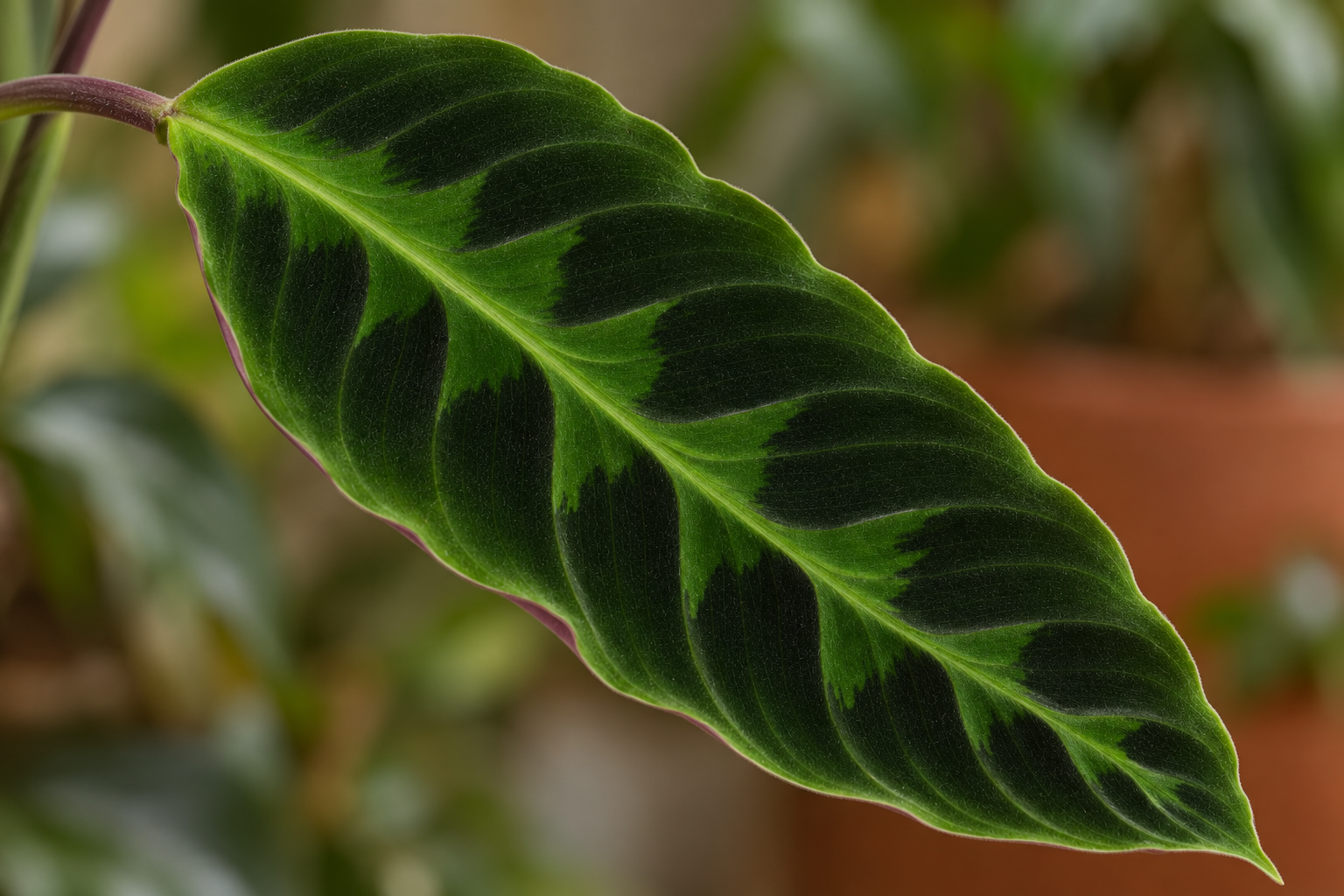
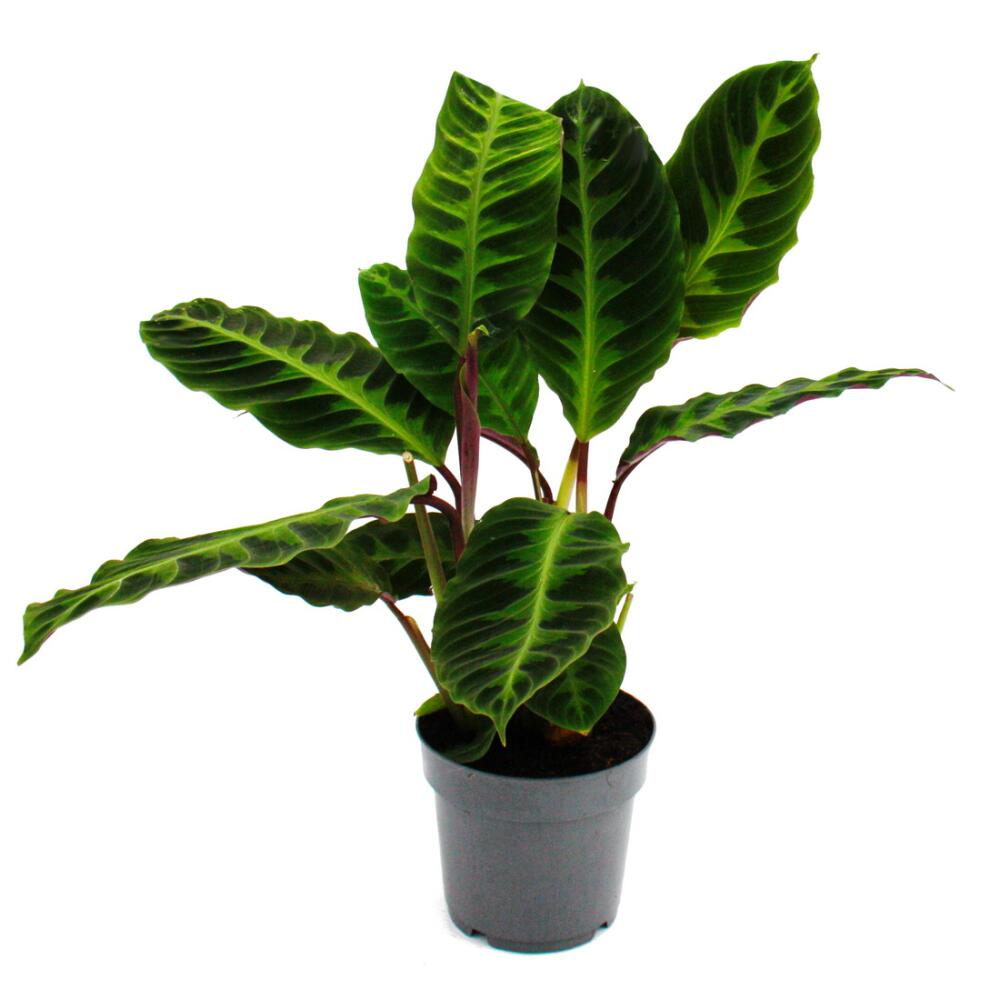
Green feathers on a soft leaf surface
A paler midrib runs through the velvet prayer plant’s dark-green elongated leaf. Pale-green lines and fields spread sideways with darker areas like broad feather branches between. Edges wave slightly; a turned leaf reveals purple reverse. Fine hairs give foliage soft velvety texture. Side daylight shows structure without stroking the leaf. Young clump on original carries leaves on stalks of differing lengths. This creates a lively somewhat open silhouette. Leave side room too: lower leaves should not hit a wall or towel at every movement.
Velvet prayer plant is now called Goeppertia
Shop uses familiar Calathea warscewiczii. Botanically species is now listed as Goeppertia warszewiczii; earlier Calathea picta also belongs to this plant. Different spellings therefore occur for the same velvet prayer plant. It belongs to Marantaceae and originates in Central America. Upright clump grows from rhizomes, underground shoots forming new leaves. Over years a well-kept plant can take much more room. About ninety to one hundred and twenty centimetres is horticultural guidance under favourable cultivation, not a fixed living-room final height. Dark-green feather pattern remains characteristic while individual leaf length and position change.
Unpack the young clump without pulling stalks
Current offer describes a fourteen-centimetre pot and around forty to fifty centimetres total height. Size refers to offered plant including pot. When unpacking hold container and release wrapping slowly between stalks. Do not bend individual leaves apart to reach centre faster. Then inspect soil moisture and free drainage. An adequately moist rootball needs no extra water reserve after transport. Initially choose a sheltered bright position where pot remains accessible. Larger repotting or division can wait until plant settles and grows again.
A bright bathroom position really needs daylight
Filtered bright light suits velvet prayer plant. A bathroom can suit through moister air if adequate daylight is present and plant stands clear of splashes and cleaning chemicals. Room label alone does not decide position. Shield leaves from hot sunny window glass; a too-dark place can encourage weak growth and less distinct markings. Even warmth around eighteen to twenty-four degrees is useful guidance. Avoid cold drafts when ventilating and direct heating warmth. Check rear leaves possibly close to a cold pane too. A quiet position is easier to assess than daily wandering through several rooms.
Rootball moisture and room humidity are two tasks
Feel surface and occasionally lift inner pot. Once upper layer has dried slightly supply rootball evenly moderately again. It should not repeatedly become entirely dry. Excess drains and is removed from decorative pot. Suitable low-salt room-temperature water such as clean rainwater helps sensitive margins. Air matters too: a warm room with very dry heated air may encourage brown tips despite moist soil. Suitable room design or humidifier helps more reliably than ever more watering. Gentle air exchange remains important. Continually wet leaves in still air are no good solution for desired humidity.
A strong clump can become several
Loose humus-rich soil should store moisture and allow enough air to roots. If densely rooted carefully move into slightly more space in spring or summer. A large supply of unused soil often stays wet unnecessarily long. A well-developed healthy clump can be divided in spring. Each piece receives roots and several leaves and is kept warm with reliable moderate moisture. Small delivery need not be split immediately. During visible growth restrained fertiliser by label supports fresh foliage. Pre-fertilised soil counts too. Individual fully dead leaves can be cleanly removed at base; velvet prayer plant usually needs no heavy overall cutback.
Leaf undersides offer further clues
Gently remove dust with a soft slightly damp cloth while supporting leaf beneath. Do not scrub velvety surface. During care examine undersides and stalk bases for animals, webbing or unusual deposits. Brown margins may relate to room air, water quality or disturbed root moisture and need a combined check. Already dead areas will not turn green; healthy new growth shows improvement better. In darker winter consumption often falls, so watering follows rootball. Flowers are possible indoors too and may appear cream, later more yellowish to pink. Offered plant is nevertheless described as a young foliage perennial; no particular flowering is assumed.
One plant, several views
Good to know
Are Calathea warscewiczii and Goeppertia warszewiczii the same velvet prayer plant?
Yes. Current Goeppertia name and familiar Calathea describe the same species here; Calathea picta is also a synonym.
What do typical leaves look like?
Elongated dark-green velvety leaves with pale-green feather pattern, wavy margins and purple undersides.
What delivery size is given?
Current offer gives 14 cm pot and about 40–50 cm total height. Later development may exceed it.
How big can the clump become?
About 90–120 cm guides favourable cultivation. Position, root space and development influence actual indoor size.
Can it grow in a bathroom?
Yes, with enough daylight, even warmth and sheltered place without splashes or cold draft.
What helps brown leaf tips?
Check rootball moisture, room air and water quality together. Extra watering alone fixes neither dry air nor unsuitable ingredients.
How is it propagated?
A strong healthy clump is properly divided. Each new section needs roots and several healthy leaves.
Are flowers necessary for a healthy specimen?
No. Foliage is lasting decoration. Later flowering is possible but not part of promised delivery development.
Sources and editorial note
- Exotenherz: offer and original images (03.10.2026)
- Kew POWO: Goeppertia warszewiczii, accepted name and synonyms (03.10.2026)
- RHS: Calathea warscewiczii, synonym and genus (03.10.2026)
- NC State: velvet prayer plant, leaf pattern, development and care (03.10.2026)
- RHS: prayer plants, pot cultivation and division (03.10.2026)
Shop offer, article number, GTIN, availability and originals directly checked on 03.10.2026. Specialist sources directly read. Kew POWO species wholly read via web.open03.10.2026; localKew403 not counted as full HTML. All earlier forms includingCalathea/Maranta picta, bullii and warscewiczii deduplicated against742 and central/isolated articles/assignments/variants, no matches. NC/RHS wholly read. Exact own gallery1 clean unchanged; clean2/3 also actually viewed. Delivery40–50cm versus later90–120cm guidance only. No unconfirmed cultivar added.