This plant at Exotenherz
Check the shop offer for current availability, price and what is included.
Check the selected shop offer for price, availability and delivery contents.
Your care table
| Topic | What to do | Why it helps |
|---|---|---|
| Position | Warm bright indirect daylight sheltered from cold drafts. | Suitable light supports more even development of the slender crown. |
| Watering | Let upper soil dry somewhat, then slowly supply rootball evenly. | Continually wet soil and severe drying can both accompany leaf loss. |
| Drainage | Let nursery pot drain and remove water from decorative pot. | Roots need air rather than a hidden reservoir. |
| Soil | Loose humus-rich, draining houseplant compost. | It should retain water without enclosing fine roots in air-poor conditions. |
| Feeding | During new growth feed moderately by label. | Existing fertilisation and slower winter growth alter extra requirements. |
| Repotting | When densely rooted, give slightly more room during growth. | Unnecessarily large soil volumes dry more slowly than a suitable pot. |
| Pruning | Precisely shorten overly long healthy shoots using clean tools and gloves. | Shape stays manageable; sap can irritate sensitive skin. |
| Checks | Remove dust gently; inspect undersides for scale, mealybugs and webbing. | Leaf bases and sheltered undersides often show pests before the view from above. |
| Winter | Keep bright and sheltered; supply less by actual rootball moisture. | Less light and growth frequently lower consumption. |
Check the compost and pot weight. The care table explains how far the compost may dry.
Water only when needed. The water should reach the root ball without spilling over the rim.
Remove surplus water from the saucer or cachepot. Then return the plant to a suitable position.
Pale fields between green leaf umbrellas
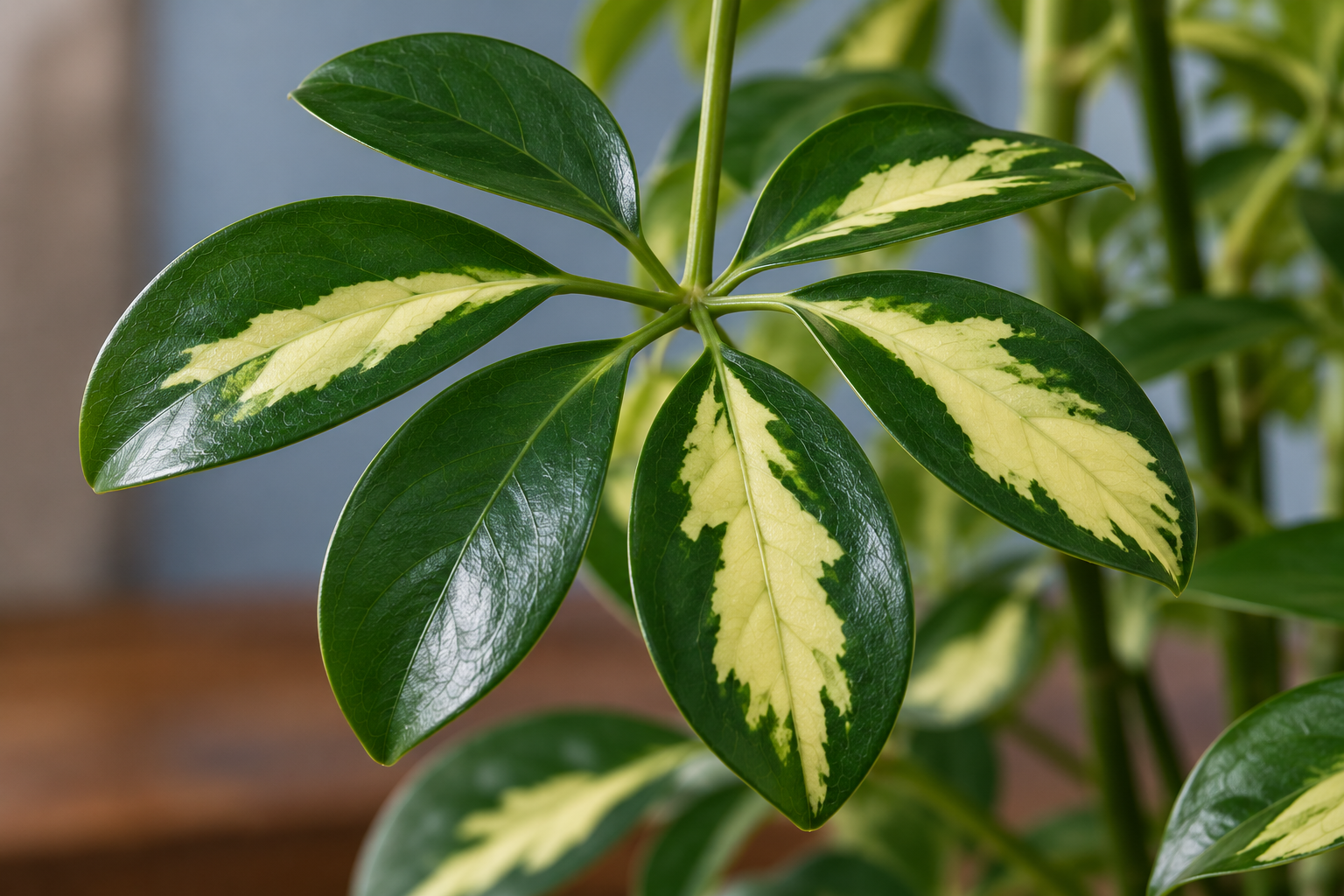
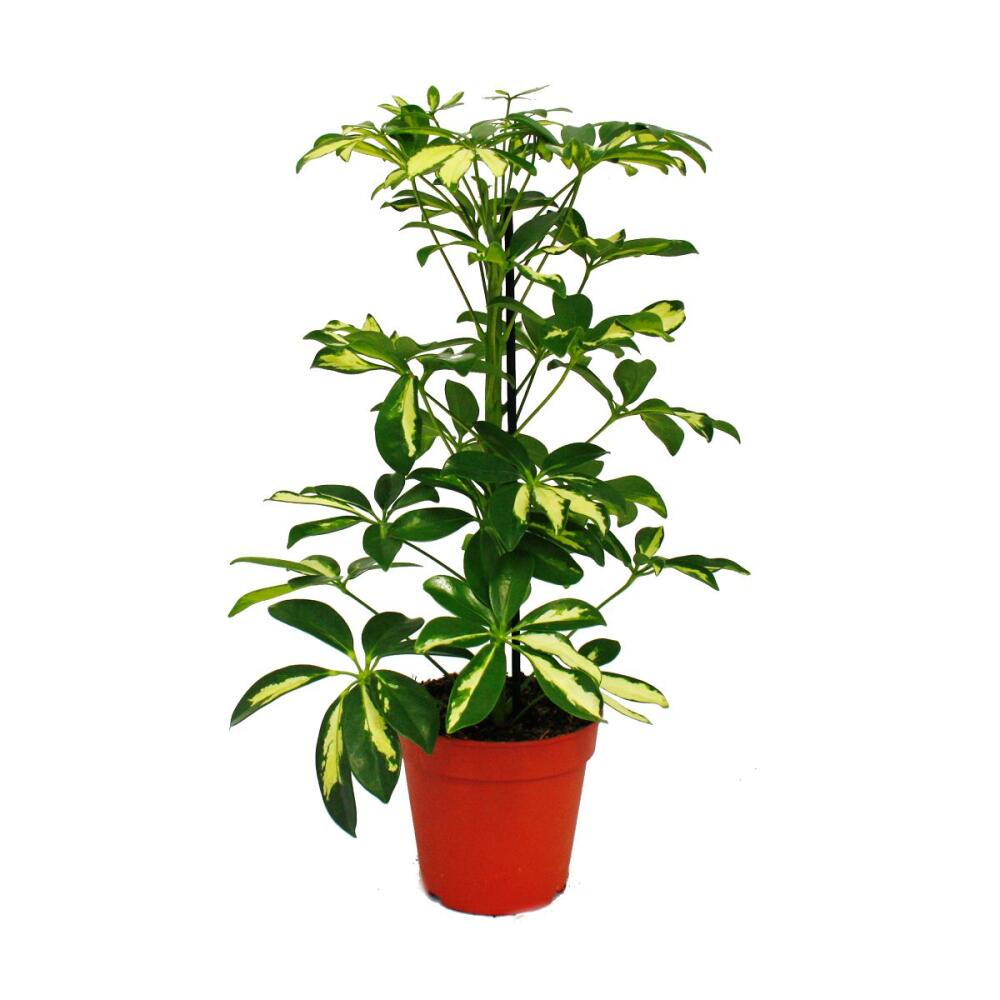
Pale markings change from leaflet to leaflet. A slender cream line follows one midrib while a larger pale area fans across the next. Entirely green leaflets stand between them. Original image also shows a gentle yellow tinge in some pale areas. Several oval leaflets meet at a long stalk's tip like spokes of a small umbrella. Smooth surfaces catch soft light without closing the whole crown. Its slender upright structure is easy to see from the side. A quiet wall behind the pot makes different leaf positions pleasant to read.
Two familiar genus names
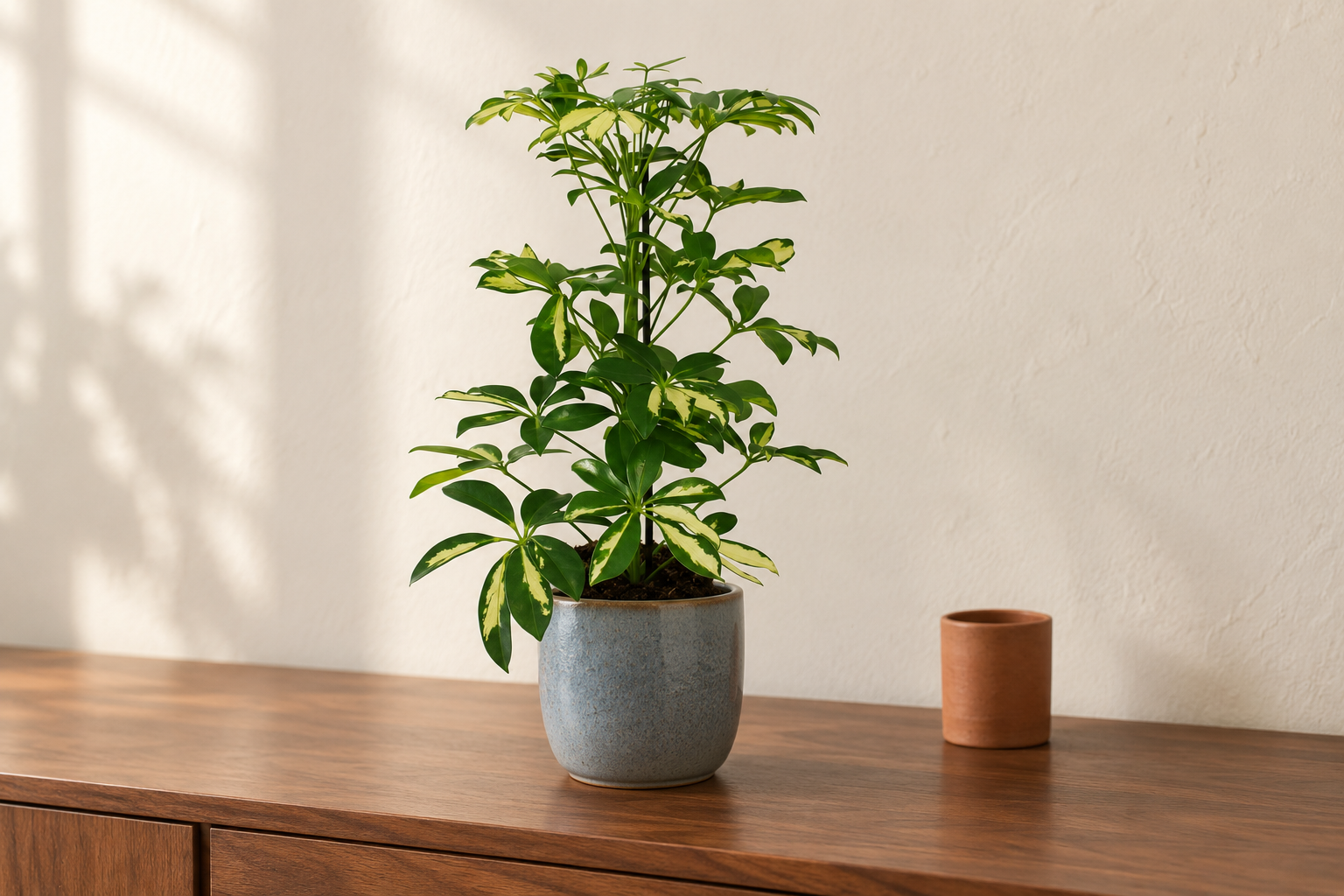
Schefflera arboricola is the older familiar name of the species now listed as Heptapleurum arboricola. It belongs to Araliaceae and comes from China and Taiwan. White-variegated form is offered for its green and pale foliage. Irregular variegation is no uniform coat across each leaf. Usually seven to nine leaflets share a stalk in this species, while young leaves may differ. Later a green shoot becomes a woody shrub. With suitable root space it can grow beyond young delivery size. A bright accessible position therefore accompanies further development too.
Preserve the young crown when unpacking
Selected individual offer specifies twelve-centimetre pot and about forty-five centimetres total height including container. Carry by pot and release wrapping from bottom upwards rather than pulling side umbrellas through a narrow opening. Feel soil and check drainage holes. Arrival does not automatically demand new compost or an immediate cut. Initially let it settle in its lasting position. Species may grow much larger indoors; light, branching and root space jointly determine later design. Young image describes a beginning, not a fixed final height.
Light for the entire crown
A warm bright position with indirect daylight supports upright structure. Foliage can suffer behind strongly sunlit glass; a light curtain or some distance softens hot exposure. More fertiliser cannot brighten a dark corner. Leave leaves free and soil accessible. If light mainly comes from one side, watch new growth and occasionally turn pot gently without constantly taking plant to entirely different places. Direct heated air and cold drafts are unfavourable. Move the small rootball out of airflow during winter ventilation. Stable conditions make fresh leaves easier to observe.
Let soil dry somewhat, then supply the rootball
Check upper soil and a little deeper when necessary. It may dry somewhat between waterings. Then water slowly evenly until moisture reaches rootball; excess drains and is removed. When roots stay wet, pale foliage colour adds little to diagnosis. Strong drying can also accompany leaf loss. A falling leaflet therefore calls for a moisture check, not an automatic extra portion. Occasionally lift pot: weight changes as soil dries. Requirements may rise in warm growth; in dimmer winter the same soil amount often stays moist longer.
Guide root space and branching with restraint
Loose humus-rich draining houseplant soil suits pot cultivation. A densely rooted ball gets a little more room during active growth. Very large soil volume around small roots stays wet unnecessarily. During new leaf and shoot formation feed moderately with suitable houseplant fertiliser by label; pre-fertilised soil counts too. Precisely shorten overlong healthy shoots with clean scissors without taking almost all foliage at once. Suitable stem cuttings or air layering are possible propagation routes. A recently arrived plant initially needs only sheltered position and properly supplied rootball.
Shine, undersides and winter care
Wipe smooth leaflets with a soft slightly damp cloth while supporting underneath. Twisting the entire stalk needlessly strains the delicate connection. Inspect undersides and stalk bases regularly for scale, cottony deposits or fine webs. With unusual foliage check light, moisture and pests together. Winter remains bright and sheltered; slower growth reduces water and feed. Flowers and fruit are rare in ordinary indoor cultivation. Plant is not for eating and belongs beyond chewing pets. Gloves are useful when cutting because sap can irritate sensitive skin.
One plant, several views
Good to know
Is Schefflera different from Heptapleurum here?
No. Schefflera arboricola is the older name of the same species now listed as Heptapleurum arboricola.
Are all leaflets identically white-variegated?
No. Original shows irregular pale areas and entirely green leaflets; pattern varies leaf to leaf.
What size is the individual offer?
12 cm pot with about 45 cm total height including container; the young plant can grow further.
Why do some leaflets fall?
Check root moisture, position and pests. Both overly wet and dry roots can accompany loss.
Can it stand directly against hot sunny glass?
Indirect daylight is a better starting point; strong direct heat can stress foliage.
Must it be repotted immediately after unpacking?
Not merely because it arrived. Check drainage, roots and position first; dense rooting determines later need.
Should I turn the whole crown when cleaning?
Support individual leaflets and wipe gently without twisting their common stalk.
May a pet chew leaves?
No. Keep umbrella plants out of reach; chewing foliage can cause discomfort.
Sources and editorial note
- Exotenherz: exact individual offer, SKU, GTIN, dimensions, stock and original (03.10.2026)
- NC State Extension: Heptapleurum arboricola, leaf structure, variegated forms, culture and handling (04.10.2026)
- RHS: Heptapleurum arboricola, species name, habit and culture (04.10.2026)
- RHS: variegated arboricola names, no automatic cultivar attribution to this offer (04.10.2026)
- Exotenherz: another directly evidenced individual12 cm/40–45 cm offer (03.10.2026)
Offer, article reference, GTIN, availability and originals checked in saved direct03.10.2026 retrieval. Whole specialist sources read directly. White-variegated trade form without invented cultivar; native originals compared with complete canonical Nora. Species spelling Schefflera arbicola supported as arboricola against NC/RHS. Two consistent individual offers; duo not offered because actual green+white montage. Unchanged03.10 shop HTML used; no shared files changed.