This plant at Exotenherz
Check the shop offer for current availability, price and what is included.
Product and delivery details are given in the individual offer.
Your care table
| Topic | What to do | Why it helps |
|---|---|---|
| Light | Filtered daylight instead of hot direct sun. | Dark foliage still needs a suitable light position. |
| Water | Keep lightly moist and check the root ball. | A tiny pot has little reserve. |
| Drainage | Allow to drain after watering. | Standing water does not remain in the outer pot. |
| Soil | Loose mixture for terrestrial orchids. | Moisture retention and air for roots are combined. |
| Temperature | Warm and protected from bursts of cold draught. | A foliage miniature is not a winter-hardy garden item. |
| Leaves | Do not polish or handle unnecessarily. | The velvety surface should remain undamaged. |
| Fertiliser | Feed cautiously during growth according to the label. | No extra feeding in response to every colour change. |
| Container | When space is needed, repot into a suitable, fairly shallow container. | The supply remains easy to monitor. |
Check the compost and pot weight. The care table explains how far the compost may dry.
Water only when needed. The water should reach the root ball without spilling over the rim.
Remove surplus water from the saucer or cachepot. Then return the plant to a suitable position.
The pink line highlights the dark leaf
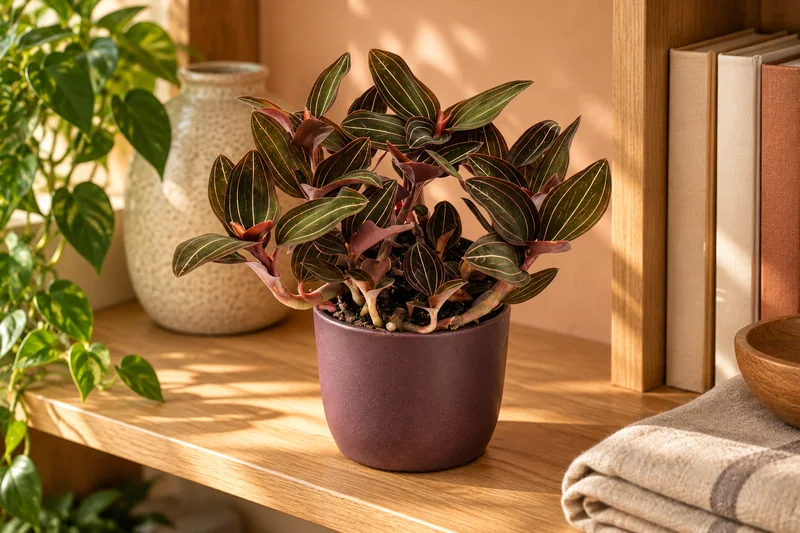
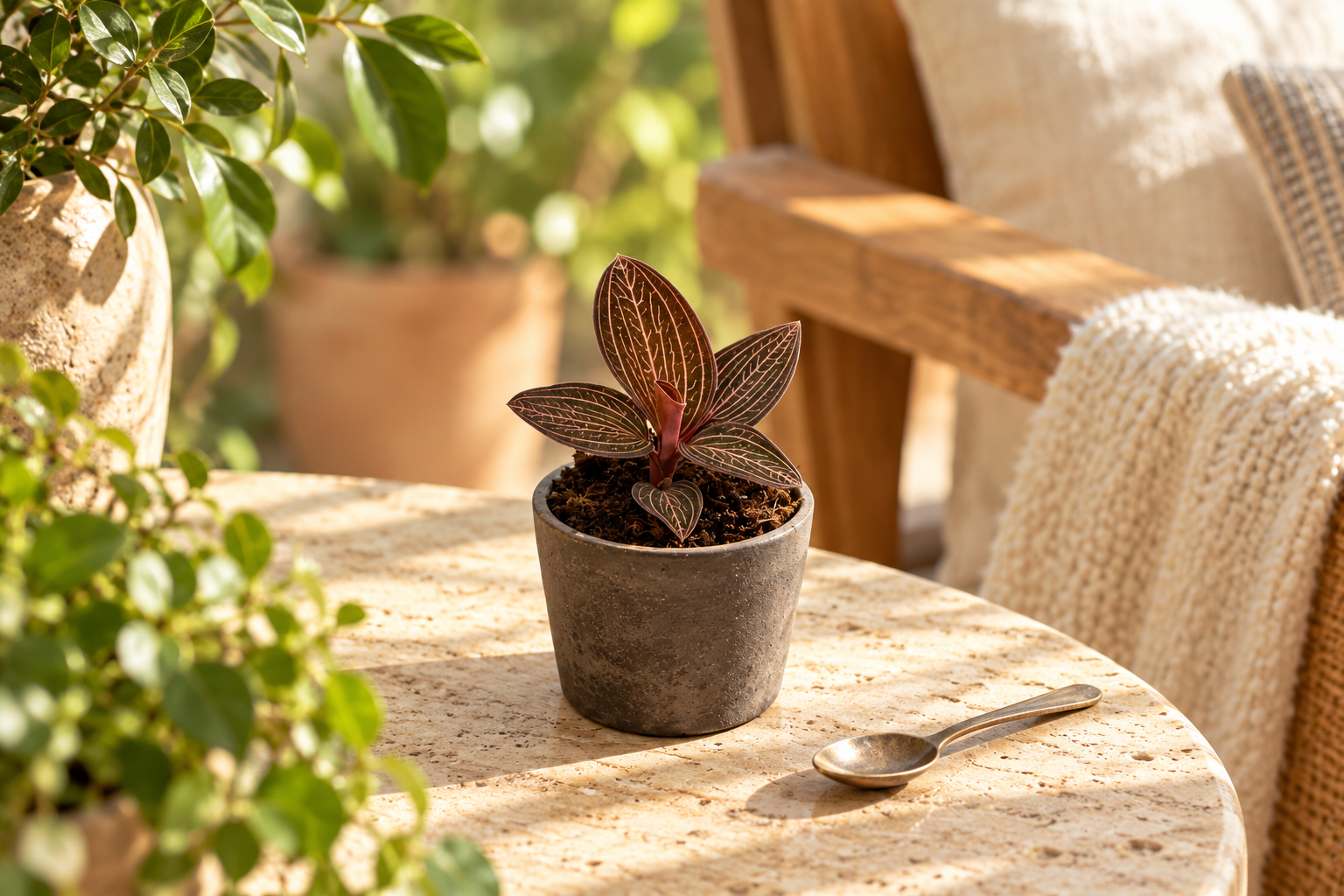
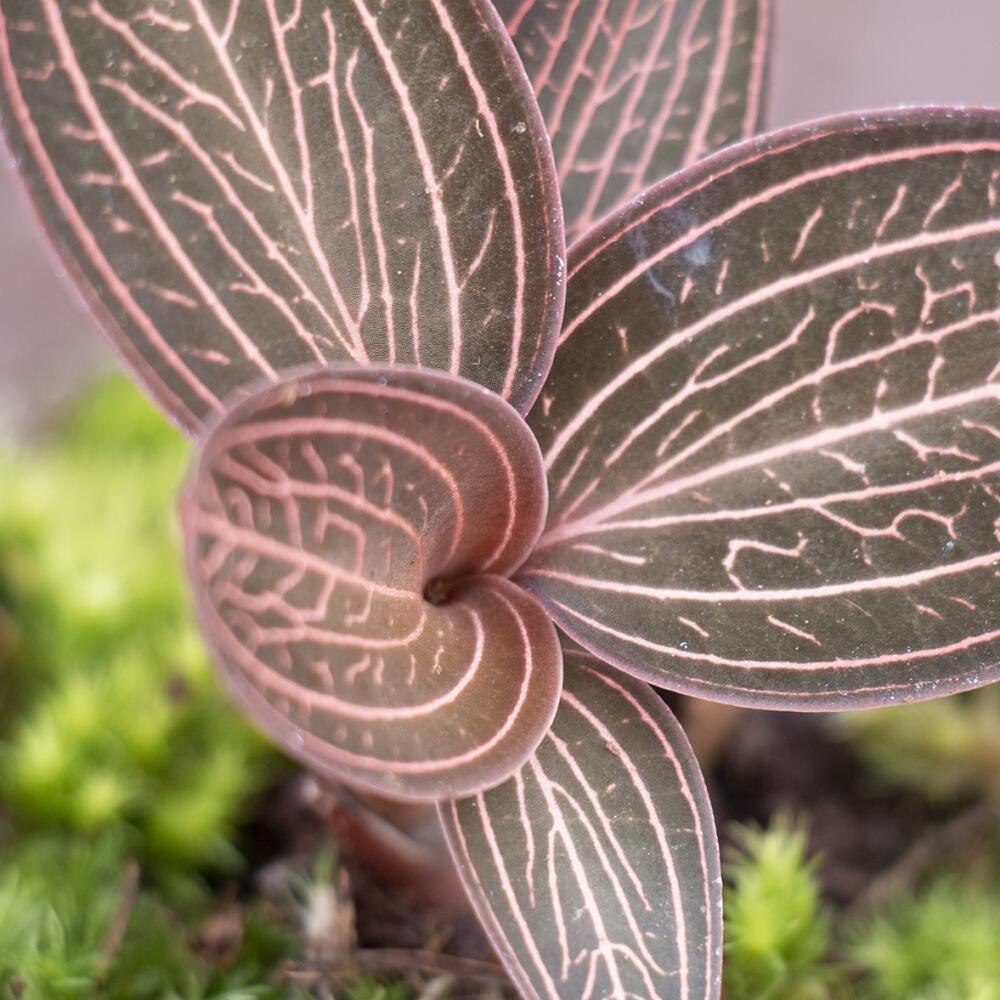
Ruby looks different from an ordinary green miniature plant. The oval, tapering leaves have a dark reddish-brown base colour. Pink and pale veins run across it like fine lines from the base outwards. The short shoots also show darker red tones. These markings are especially clear beside light materials. In the shop the selection is called Ludisia Ruby, or Rubin. The name explains the impression of its leaf colour; it does not turn the small foliage portrait into a promise of a red orchid flower.
Few leaves, plenty of personality
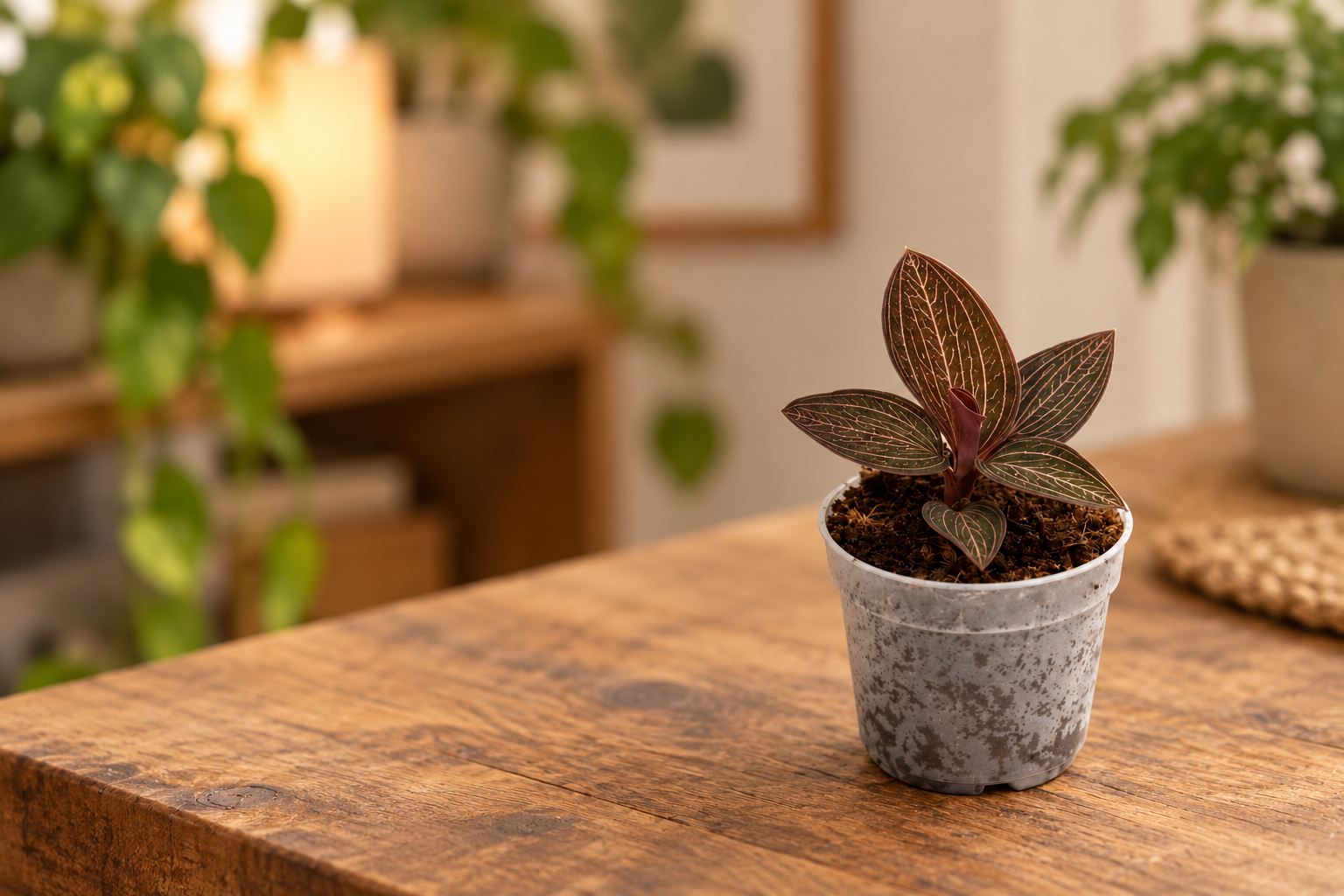
With a 6 cm pot and about seven to nine centimetres total height, Ruby is a genuine miniature. Just a few leaves form the visible portrait. When unpacking, hold the pot firmly and leave shoots and leaf stalks free. A light stone saucer or small clay outer pot can emphasise the dark foliage, but must remain accessible for checking water. The plant is not sunk deeply into it. Plan a place where the youngest tip has room to keep growing and is not touched every time someone passes.
Dark colour does not mean a dark position
The leaf colour does not say Ruby wants to stand in the shadow of a closed wall unit. Warm, filtered light suits terrestrial orchid cultivation; avoid strong direct sun. At a bright side area of a room, the dark foliage can still remain clearly visible. Observe a change of position rather than greatly changing several care steps at once. Let new leaves unfold first. Compare their shape and shoot condition with older leaves, without immediately treating every small colour variation as a deficiency.
The small pot has no large water reserve
A loose, moisture-retentive root zone helps Ruby through everyday life. Check regularly and keep lightly moist without letting the container stand in water. The top layer may dry a little; the root ball does not remain completely dry for prolonged periods. Water slowly and let excess drain away. With dark foliage, looking at the soil surface can be especially important: leaf colour alone does not show whether water is lacking. Consider pot weight, soil moisture and the latest conditions at the position together.
Care at the base rather than shine on the leaf
Do not polish the velvety surface with leaf-shine products. Avoid dirt by working carefully around the soil, and do not handle the few leaves unnecessarily. Feed cautiously during growth according to the label, using a fertiliser suitable for orchids. When repotting later, the actual root ball matters. A suitable shallow container makes monitoring easier. Check short shoots and leaf undersides; if an individual leaf becomes damaged, remove that part specifically instead of pulling at the whole young plant.
Accompany Ruby through the year
Warm indoor cultivation remains sensible in winter too. With less light, keep checking the root ball but do not water solely according to the summer rhythm. Ludisia can develop small pale flower stems. Ruby is described here as a specific foliage selection; neither flowering time nor a particular scent is guaranteed for the young delivery item. A close-up of pink veins and a whole-pot photograph fit the plant book well. Record the position and timing of new leaves. This reveals the small changes that often go unnoticed when passing every day.
One plant, several views

Good to know
Does Ruby get red flowers?
Ruby is the trade name of this dark foliage selection, not a promise of red flowers.
May it stand somewhere very dark?
Dark foliage also needs a bright, filtered position.
Can I polish the leaves to a shine?
Preserve the natural leaf surface; do not use leaf-shine products.
What does total height mean?
The roughly seven to nine centimetres refer to the plant including its pot.
Can it remain permanently wet?
No. Reliable light moisture also requires free drainage.
Sources and editorial note
- Exotenherz: offer and original photographs (03.10.2026)
- NC State Extension – terrestrial orchids, compost and air movement (03.10.2026)
- RHS – Ludisia, shallow containers and position (03.10.2026)
- American Orchid Society – Ludisia, moisture and flowering (03.10.2026)
Shop offer, article number, GTIN, availability and original images checked directly on 02.10.2026; specialist acceptance on 03.10.2026. Specialist sources read directly. Exact SKU, measurements, original images and orderability checked directly in the shop on 03.10.2026. Relevant specialist passages checked; shop name and botanical synonyms remain distinguishable. Currently not orderable: knowledge portrait without a purchase link, social drafts without sending approval. No Wawi, server or tool changes. Currently not orderable: knowledge portrait without a purchase link; social drafts are not authorised for sending.