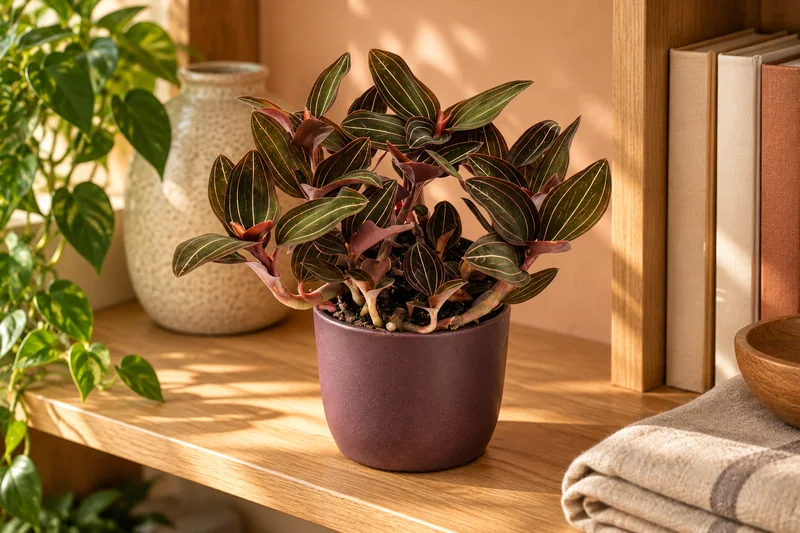
This plant at Exotenherz
Check the shop offer for current availability, price and what is included.
Product and delivery details are given in the individual offer.
Your care table
| Topic | What to do | Why it helps |
|---|---|---|
| Position | Warm with filtered daylight. | Fine markings need no hot direct sun. |
| Moisture | Lightly moist; check the surface. | The small root ball is not kept completely dry for long. |
| Watering | Apply to the soil, then allow to drain. | Wet foliage does not replace root supplies. |
| Growing medium | Loose and moisture-retentive for terrestrial orchids. | Air should reach the root zone. |
| Moss | Keep the root ball accessible despite a covering. | Green moss does not prove suitable soil moisture. |
| Feeding | Feed sparingly during growth according to the orchid fertiliser label. | The young plant does not need an automatic extra dose. |
| Repotting | Carefully move to a suitable container according to space needs. | Avoid unnecessary injury to the small root ball. |
| Winter | Protected indoors; observe water needs anew. | Less light changes consumption. |
Check the compost and pot weight. The care table explains how far the compost may dry.
Water only when needed. The water should reach the root ball without spilling over the rim.
Remove surplus water from the saucer or cachepot. Then return the plant to a suitable position.
Topaz thrives visually on a whole network of fine lines
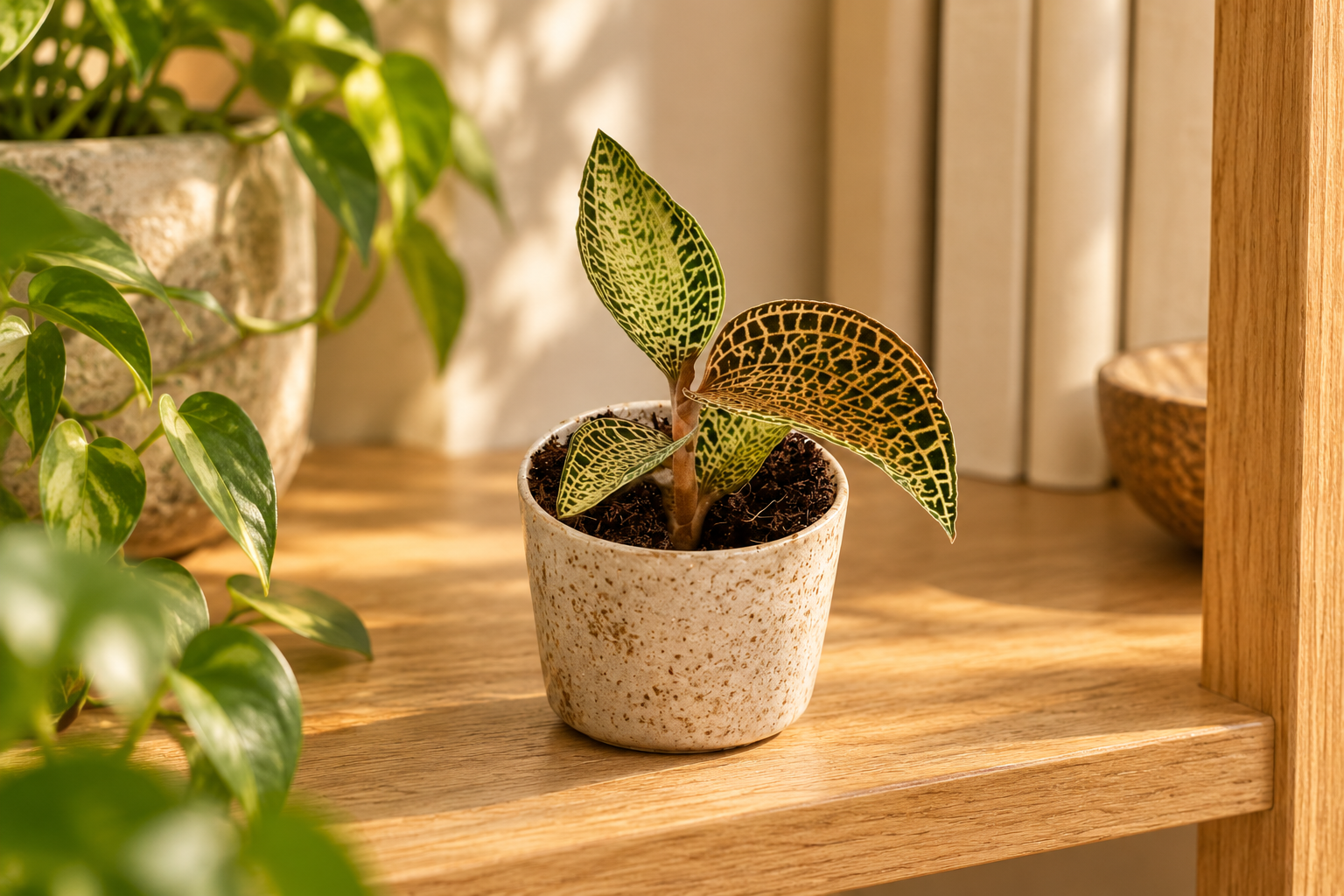
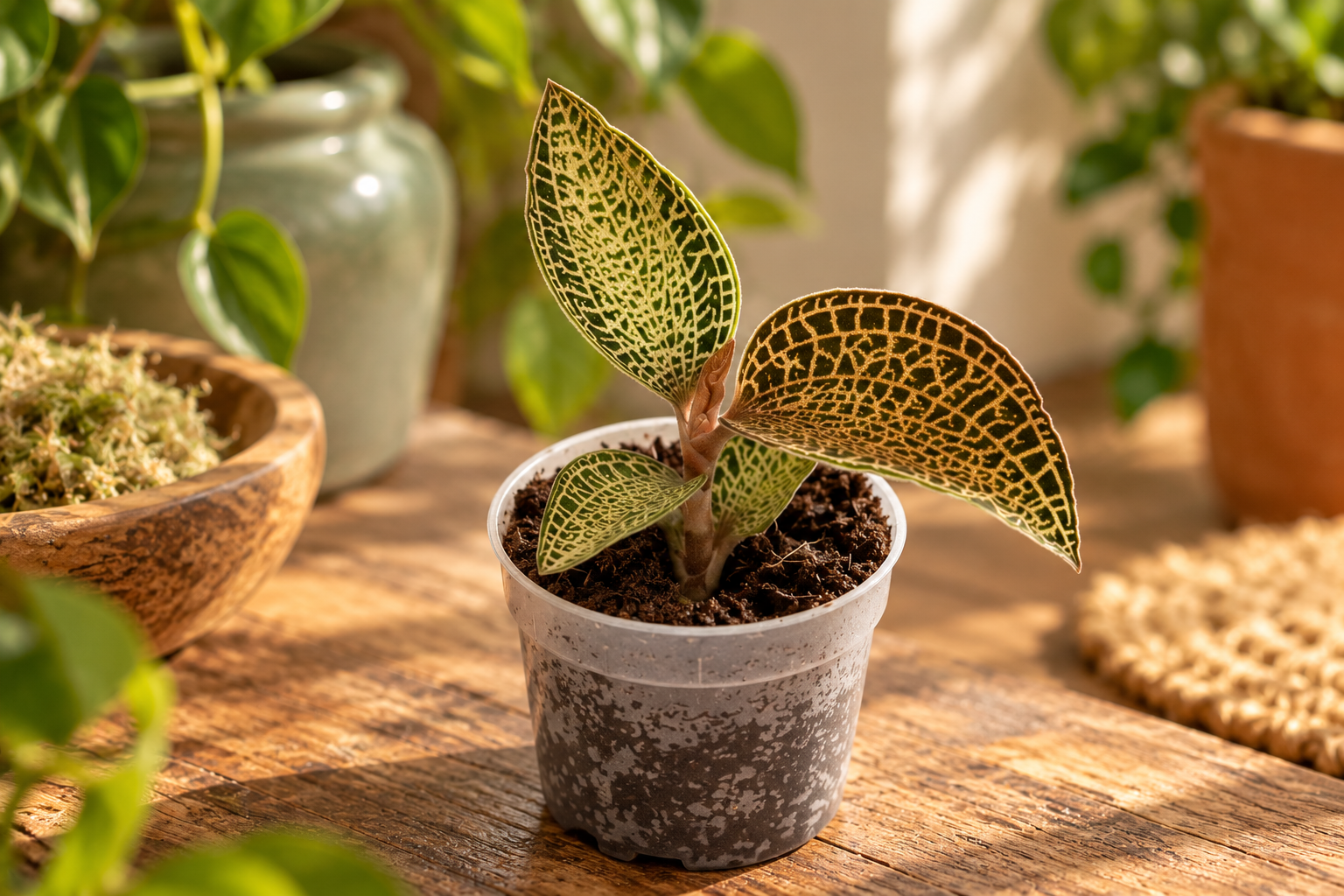
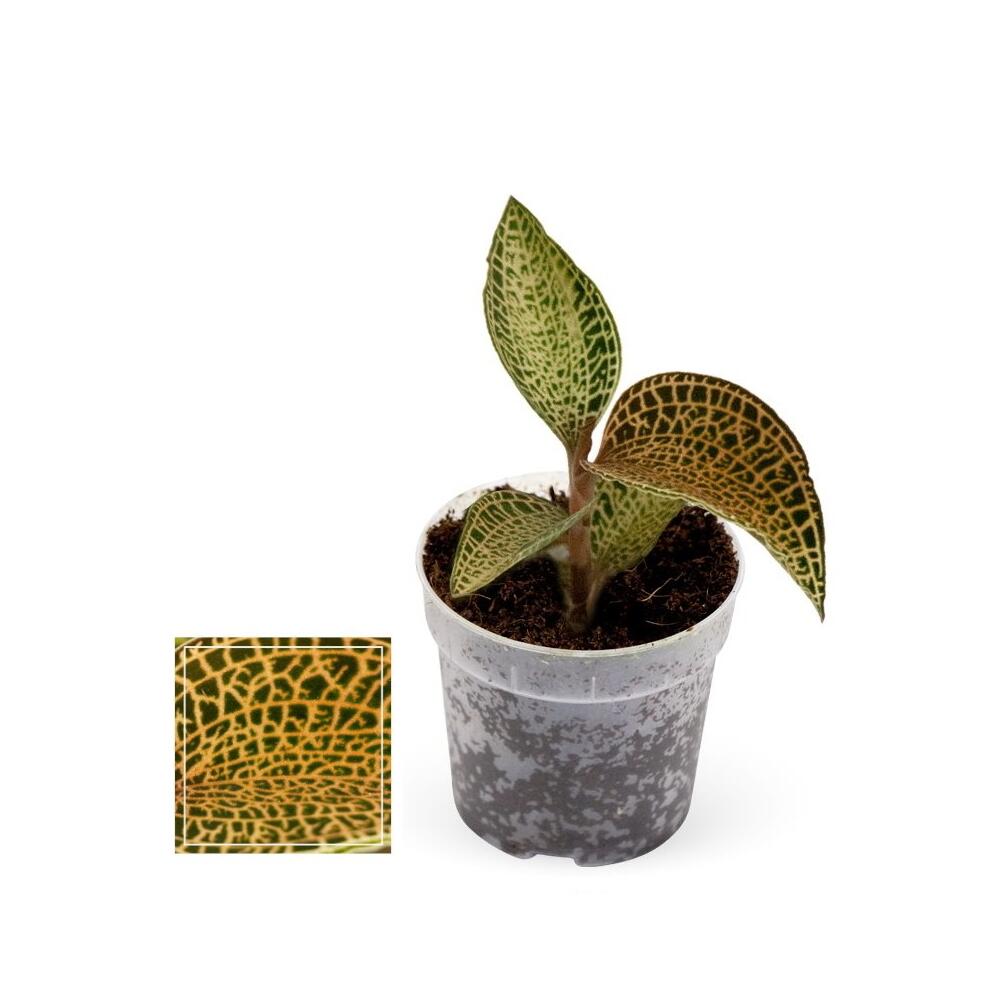
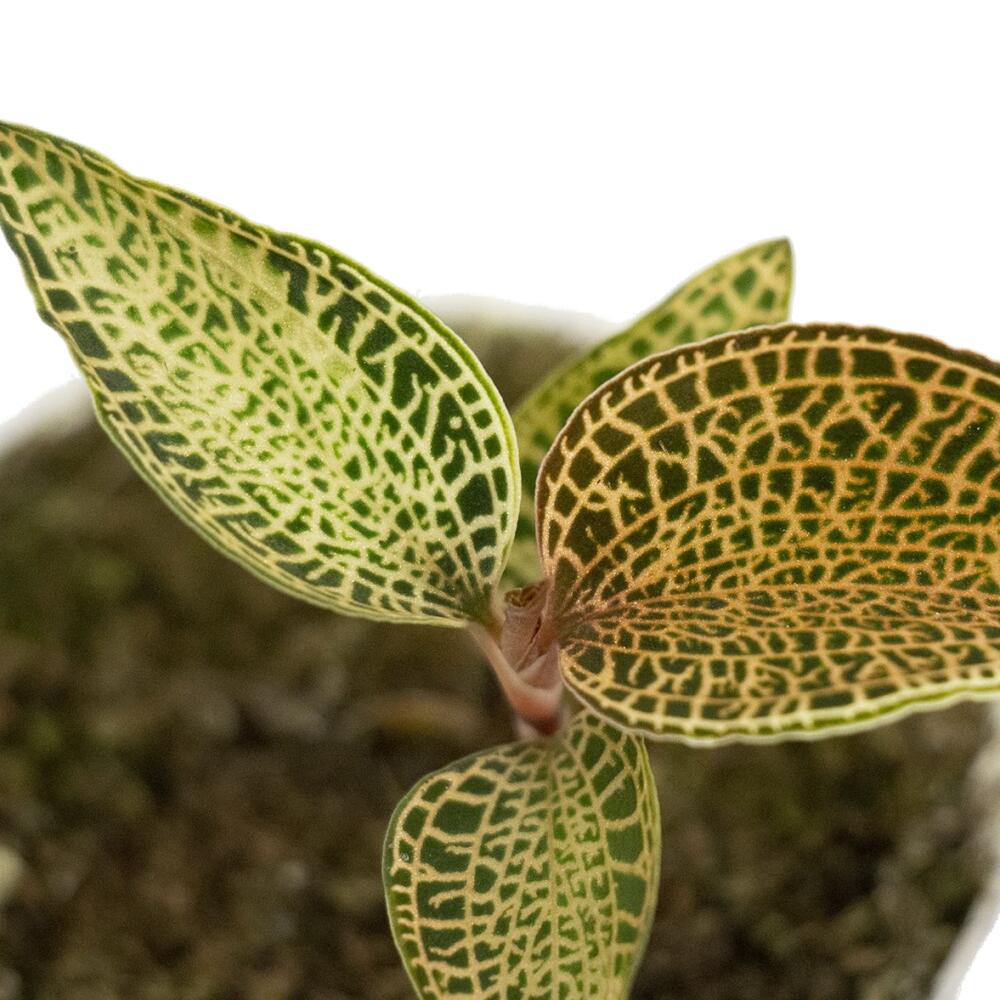
A dense pale vein network covers the pointed oval leaves. An olive-green to bronze background remains visible between the lines; darker undersides can be seen at some edges. This makes Topaz especially interesting close up. Its effect comes from the combination of leaf colour and fine markings, not large flowers. The offer names Ludisia Topaz. We retain this trade name. No unstated precise parent combination or additional species assignment is invented from the leaf pattern.
A small portrait needs a place of its own
The total height of roughly seven to nine centimetres includes the 6 cm pot. This is a young plant whose individual leaves already make up a large part of its crown. A small open shelf position can show it beautifully if filtered daylight reaches it. Clear, light book spines in the background allow the vein network to stand out without depriving the plant of air. Do not place larger pots directly in front. For each check, the small container must lift without pulling leaves or shoots.
The fine pattern needs no harsh lighting
A warm indoor position with bright, filtered light suits this terrestrial orchid selection’s care. Avoid hot direct sun. Make the leaf markings visible through a good viewing angle, not continual changes of position or an ever-stronger light source. As the youngest leaf grows, observe its unfolding and the short shoot beneath. A terrarium can offer a quiet environment if moisture and air movement are right. A small glass in direct sun, however, can heat strongly even when the room itself feels pleasantly temperate.
The soil remains the reliable starting point
Check compost and pot weight before watering. Keep the small root zone lightly moist and let excess water drain. The surface may dry a little; avoid prolonged complete drying. A pretty moss layer does not replace this look at the root ball. If it covers the soil, check carefully at a clear spot. Foliage is not soaked daily to compensate for missing root moisture. No reservoir remains in the outer pot to keep the lower root ball permanently wet.
Continue cultivating the young plant gently
An airy, moisture-retentive medium for terrestrial orchids and a suitable, fairly shallow container support manageable cultivation. Handle the young root ball carefully when repotting rather than tearing it apart. During active growth, feed sparingly according to a suitable orchid fertiliser label. Inspect leaf undersides and shoot bases. Remove individual damaged leaves specifically. Healthy leaf surfaces remain unpolished. Observe care steps one after another: a new position does not require a precautionary strong cutback and extra feeding simultaneously.
Record markings and development in the plant book
Topaz is continued as a warm perennial houseplant, not a frost-hardy border plant. The young item shows no guaranteed current flowering. Light and consumption may fall in winter; checking soil therefore remains more sensible than a fixed weekly calendar. Photograph a leaf front-on and the whole plant slightly from the side. The first view shows the pale network, the second the small shoot and actual size. Record when a new leaf opened. This makes the care history of this specific plant visible without deriving exact later dimensions from a trade name.
One plant, several views
Good to know
Is Topaz a flower colour?
It is the trade name of this foliage selection. The delivery image shows no flower.
Are the golden lines painted?
The original shows natural pale leaf-vein markings.
Must I use a terrarium?
Suitable glass cultivation is possible, as is an appropriate warm indoor position.
May the soil dry completely?
Prolonged complete drying is avoided with this small terrestrial orchid.
Is a precise later height established?
The offer establishes the young total height, not a precise final size for the trade selection.
Sources and editorial note
- Exotenherz: offer and original photographs (03.10.2026)
- NC State Extension – terrestrial orchids, compost and air movement (03.10.2026)
- RHS – Ludisia, shallow containers and position (03.10.2026)
- American Orchid Society – Ludisia, moisture and flowering (03.10.2026)
Shop offer, article number, GTIN, availability and original images checked directly on 02.10.2026; specialist acceptance on 03.10.2026. Specialist sources read directly. Exact SKU, measurements, original images and orderability checked directly in the shop on 03.10.2026. Relevant specialist passages checked; shop name and botanical synonyms remain distinguishable. Currently not orderable: knowledge portrait without a purchase link, social drafts without sending approval. No Wawi, server or tool changes. Currently not orderable: knowledge portrait without a purchase link; social drafts are not authorised for sending.