This plant at Exotenherz
Check the shop offer for current availability, price and what is included.
Product and delivery details are given in the individual offer.
Your care table
| Topic | What to do | Why it helps |
|---|---|---|
| Light | Place brightly with filtered daylight. | Strong hot sun can damage narrow foliage. |
| Warmth | Keep warm and sheltered from cold draughts. | These tropical rosettes are not hardy bedding plants. |
| Water | Supply each small root ball moderately and keep slightly moist. | Pots dry at different speeds; wet roots need more air. |
| Leaf tanks | Care for actual water-holding leaf tanks with soft water and renew it regularly. | Fresh water keeps the tank clean; not every loose crown is a reservoir. |
| Drainage | Remove excess water from outer containers. | Tank water and standing water around the root ball are different things. |
| Soil | Use an airy mix with appropriate bark components. | Roots with epiphytic characteristics like loose support. |
| Feeding | Feed sparingly during growth according to a suitable fertiliser label. | Small plants need no heavy reserve fertilising. |
| Offsets | After flowering, check the rosette base for new side shoots. | The mother rosette usually flowers once; offsets continue the plant. |
Check the compost and pot weight. The care table explains how far the compost may dry.
Water only when needed. The water should reach the root ball without spilling over the rim.
Remove surplus water from the saucer or cachepot. Then return the plant to a suitable position.
Three forms that complement each other
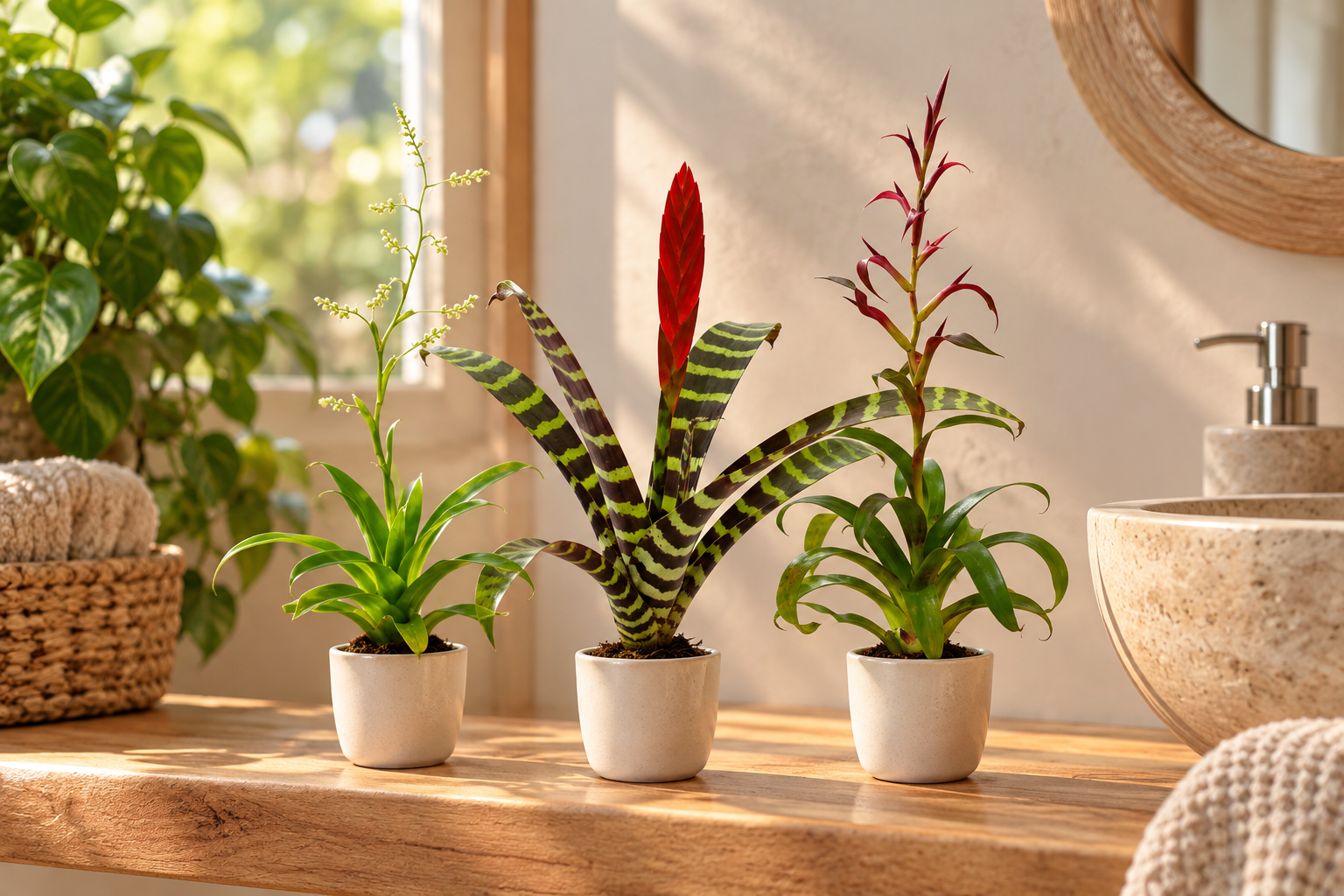
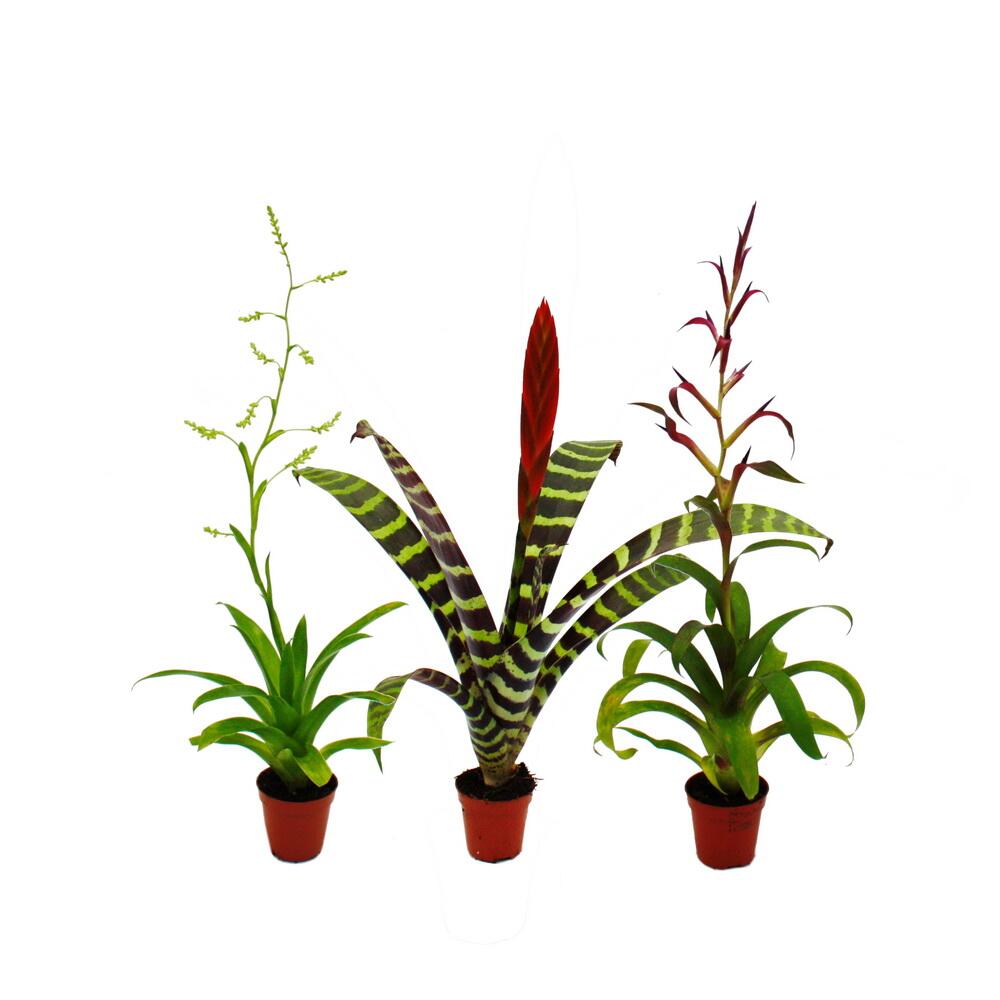
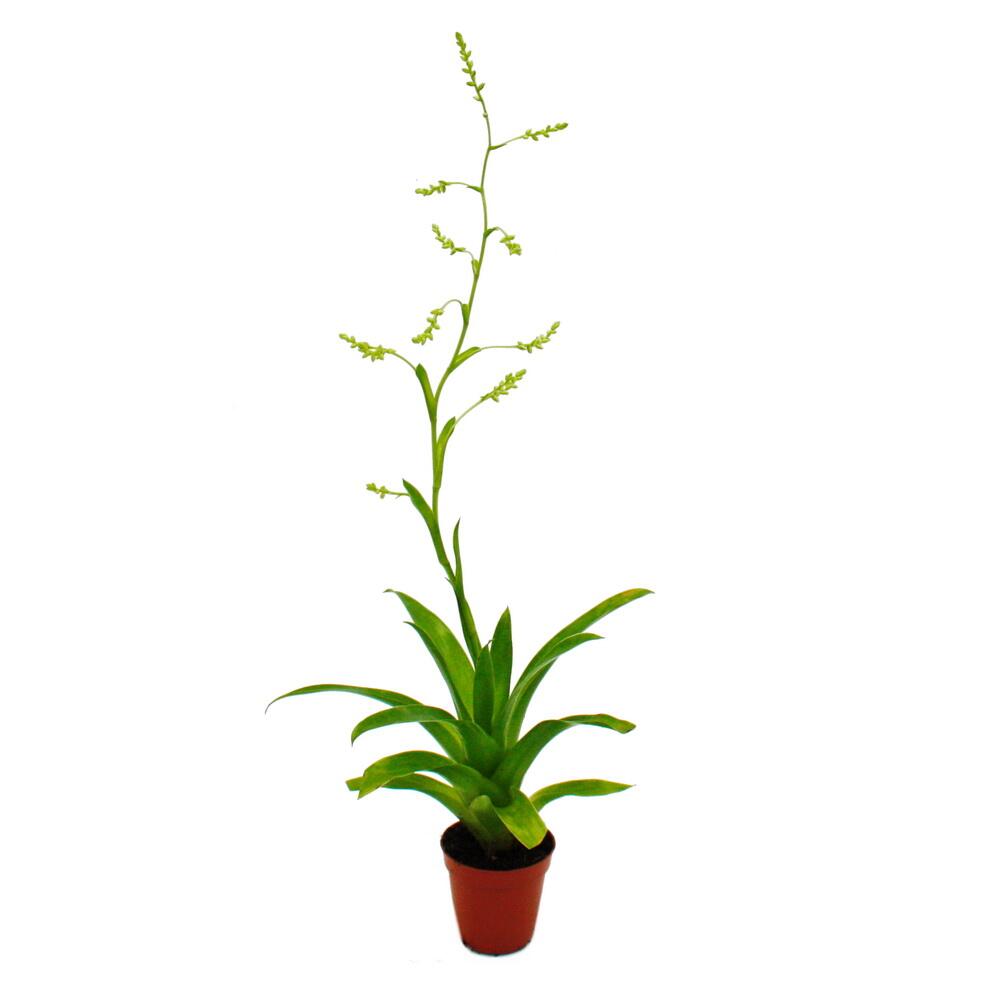
With this trio, it is worth looking from plant to plant. Vriesea splendens has banded foliage and the striking sword-shaped red inflorescence. Tillandsia leiboldiana adds a looser red branching form beside it. Catopsis morreniana looks almost drawn with its fine pale panicle. A bright shelf creates a little collection rather than three identical splashes of colour. A simple container makes the differences clear. The original photograph shows the offered forms. On closer inspection, we distinguish coloured bracts from the smaller true flowers between them.
The offered size stays manageable
The set contains three separate plants, each in a five-point-five-centimetre pot. Vriesea is stated at about twenty centimetres total height, Tillandsia and Catopsis about twenty-five. These measurements concern the supplied plants including their pots. They are not a fixed final adult size for each species. Decorative outer pots and scene furnishings are not included. After unpacking, all inner pots stay individually accessible. We can thus check each plant’s root ball and later watch their different development at the rosette base.
A bright warm spot even in the bathroom
A bathroom shelf may suit them if it receives real daylight. More humid room air helps but does not replace light. Avoid hot direct sun through glass and cold draughts during ventilation. We choose a position away from radiators where narrow leaves are not constantly brushed. The plants may display as a group but need air and a little distance. A deep dark recess would be unsuitable permanently. After moving, we focus on fresh foliage and buds rather than only existing colour.
Three small root balls and their leaf tanks
Check each pot before watering. Supply the airy mix moderately without leaving the root ball permanently wet in an outer container. Where the rosette forms a true water-holding tank, use soft clean water and renew it regularly. Not every loose leaf centre can be treated as a sealed container. Draining water must not submerge the inner pot. Tank care and root supply work together but are different tasks. Small pots especially may dry at different speeds. We therefore inspect every root ball individually even when all three were bought together.
Loosely rooted rather than deeply buried
An airy mix with appropriate bark components supports plants and allows water to drain. Do not bury the rosette centre deeper in soil. If a new pot size is later needed, a small step is sensible; a large reserve pot stays wet too long around few roots. During growth, feed sparingly following a suitable label. Strong food creates no extra sword colour. Clean a dirty tank rather than filling it with ever more additives. Firm leaves and a healthy rosette base indicate cultivation better than one striking bract tip.
The flower structure belongs to a life stage
An individual bromeliad rosette usually flowers once. Afterwards, the mother rosette may decline over a long period while offsets emerge at the sides. A finished-flowering plant is therefore not immediately discarded. Gently remove dry inflorescence remains and look at the base for young shoots. Separate offsets only when they are developed enough to make their own start. The three species may need different amounts of time. A fading red inflorescence does not automatically mean yesterday’s watering was wrong. First consider natural development together with actual root-ball condition.
Keep small differences in the care notebook
In winter, plants stay bright and frost-free in a warm interior. With less growth, reassess water use without losing sight of leaf tanks and room air. Old brown marks do not turn green again. New healthy growth and offsets help assess care. Look at leaf bases and undersides for unusual animals or soft areas. A short note for each plant maintains an overview. The trio thus shows not only three attractive flowering forms but also three individual ways a young rosette continues into a small collection.
One plant, several views
Good to know
Which plants are included?
Vriesea splendens, Tillandsia leiboldiana and Catopsis morreniana, each in its own 5.5 cm pot.
Are all three equally tall?
Delivery specifications state Vriesea at about 20 cm and the other two at about 25 cm total height.
Are the red parts petals?
The conspicuous coloured parts are mainly bracts; true flowers are smaller.
Can the trio go in a bathroom?
If there is enough filtered daylight and suitable warmth.
Must every leaf centre be full of water?
Care accordingly only for an actual water-holding tank. Do not treat all loose centres as reservoirs.
What remains after flowering?
The mother rosette may slowly decline and form offsets. Watch development and grow sufficiently large offsets on later.
Sources and editorial note
- Exotenherz: offer and original images (02/10/2026)
- RHS: bromeliad cultivation (02/10/2026)
- NC State Extension: bromeliads and leaf tanks (02/10/2026)
Shop offer, article number, GTIN, availability and original images checked directly on 02/10/2026. Specialist sources read directly. Species combination and individual heights taken directly from the offer; no universal tank or frost-hardiness promise.