This plant at Exotenherz
Check the shop offer for current availability, price and what is included.
Check the shop for the price, current availability and what is included.
Your care table
| Topic | What to do | Why it helps |
|---|---|---|
| Light | Bright with filtered light. | Pale leaf areas may burn in hot direct sun. |
| Water | Let the compost surface dry somewhat, then water thoroughly. | Variegation is no reason for constantly wet compost. |
| Drainage | Remove excess from the outer pot. | Roots need oxygen. |
| Compost | Loose, freely draining and structurally stable. | Even moisture should be combined with air in the root ball. |
| Temperature | Consistently warm, preferably from around 18 °C. | Avoid cold draughts and a wet cold pot base. |
| Feed | Moderately during growth according to the product. | High doses force neither markings nor leaf maturity. |
| Support | Provide suitable climbing support as growth increases. | The young delivery plant may need considerably more space later. |
| Foliage | Preserve healthy green leaf areas. | They contribute significantly to the plant’s nourishment. |
Check the compost and pot weight. The care table explains how far the compost may dry.
Water only when needed. The water should reach the root ball without spilling over the rim.
Remove surplus water from the saucer or cachepot. Then return the plant to a suitable position.
A starry pattern with individual leaf surfaces
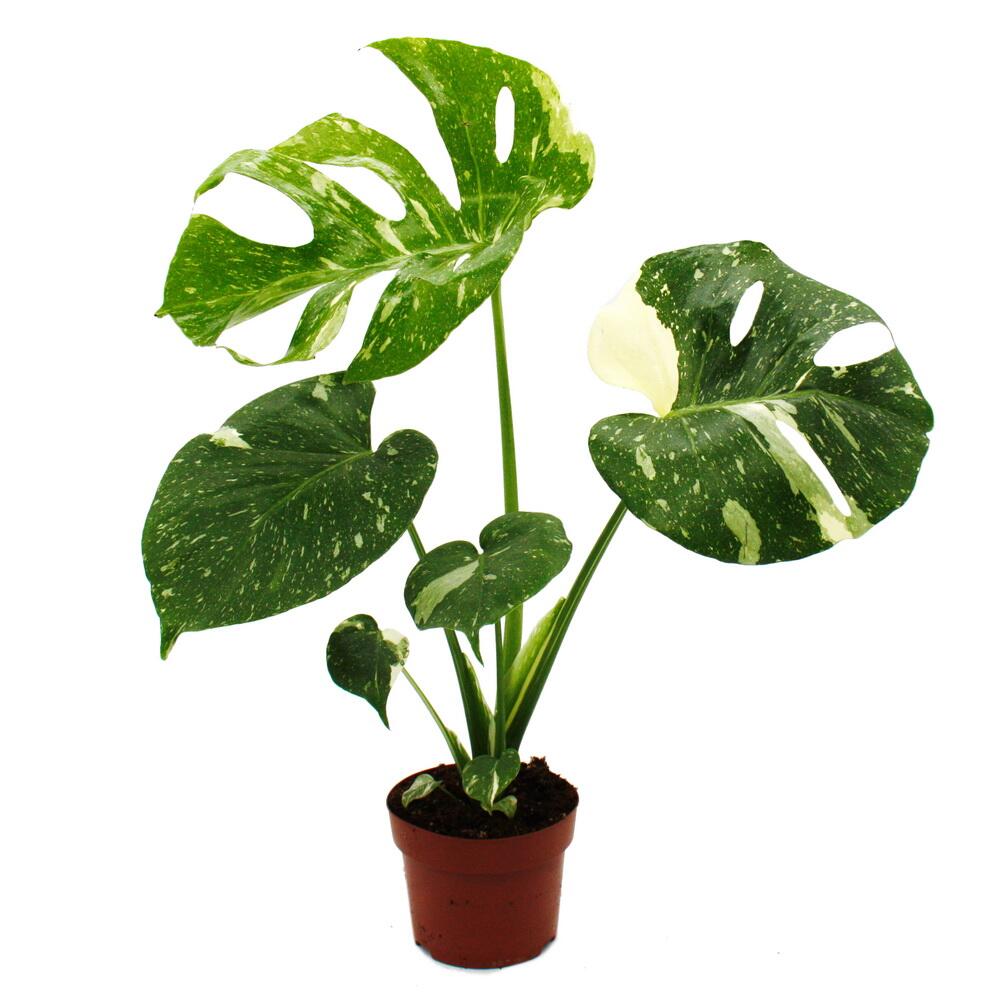
The RHS lists Thai Constellation as a cultivar of Monstera deliciosa. Cream speckles and larger pale areas stand alongside green tissue. The pattern is not identical on every leaf. The plant generally grows more slowly than the green species and may form more closely spaced leaves. Young leaves are often still heart-shaped and little divided; splits and windows may develop as it grows. These changes are part of growth. A portrait photograph with particularly strong markings does not guarantee that every leaf of a delivered young plant looks exactly that way.
Read delivery size transparently
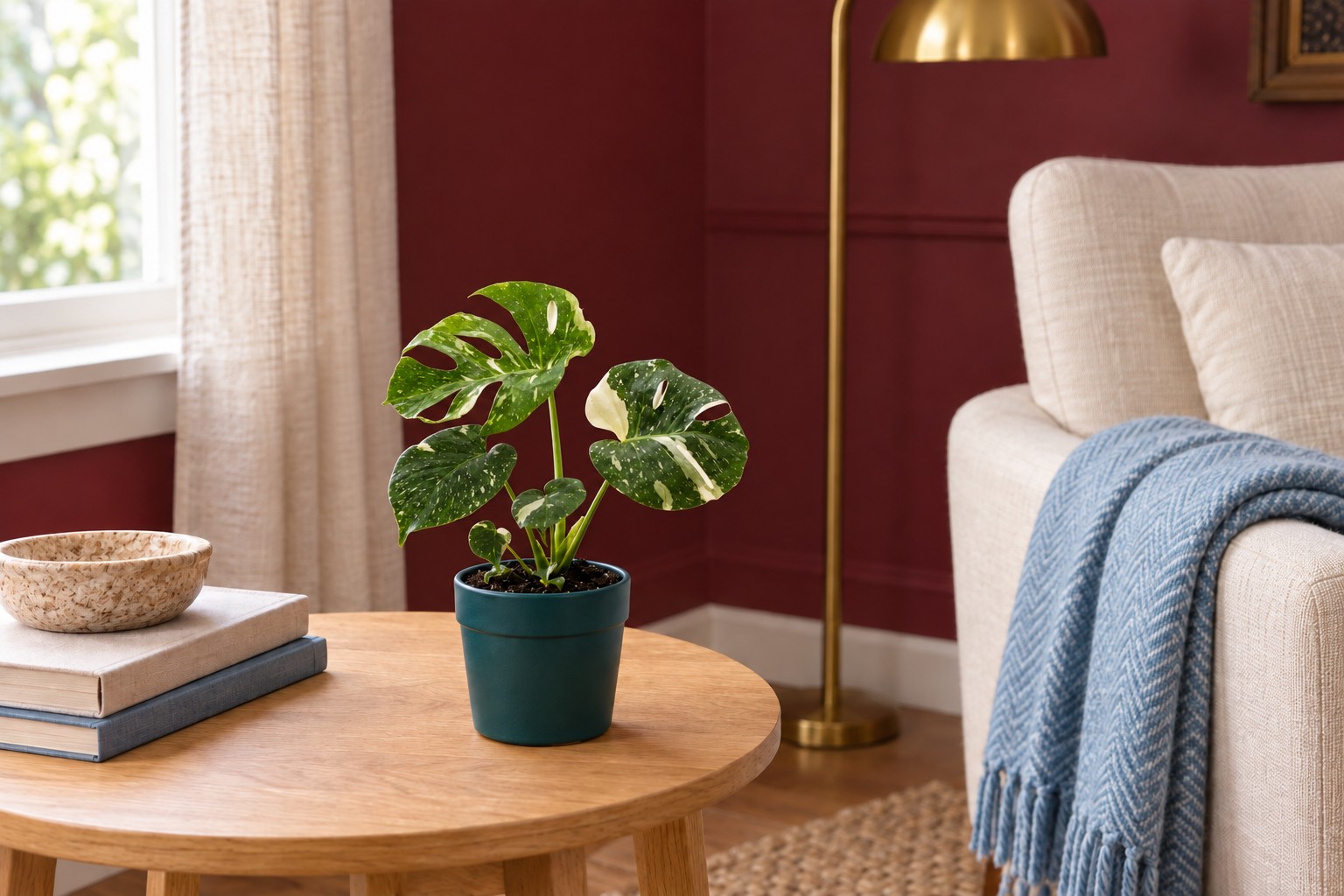
The offer is a 12 cm pot. Shop height figures differ: the short description says around 30 to 35 cm, while the detailed text says around 35 to 40 cm overall height. If a precise measurement matters, clarify the current figure before buying. It remains a young plant, not a large mature Monstera. This compact starting size is reflected in the indoor scene. Nevertheless, plan long-term room for larger leaves and suitable climbing support rather than treating the initial small position as its final size.
Protect pale leaf areas from overload
A bright position with filtered light supports the plant. Hot direct sun may damage pale areas especially. After shipping or a darker position, gradually introduce more light. Permanent darkness is not a solution either: green areas need light to supply the plant. Consistent warmth from around 18 °C suits it better than a cold draughty winter spot. Consider humidity and air movement together. A very dry heating corner makes care harder, but constantly wet leaves in stagnant air are unwanted too.
Water according to roots rather than markings
Use a loose structurally stable mix and a pot with drainage holes. Let the surface dry somewhat before watering again, then supply the root ball thoroughly and allow complete drainage. Do not water more often preventively just because a leaf has pale areas. A small pot may still stay wet inside for a long time when light and warmth are lacking. Check root-ball weight and moisture too. In winter, adjust intervals to reduced use. Remove any water remaining in the outer pot so sensitive roots do not remain without air.
Preserve healthy green areas and supported growth
Do not discard healthy foliage in pursuit of as much white as possible. Green areas contribute to the plant’s supply, while very pale areas contribute less. During active growth, feed with suitable foliage fertiliser according to the product, without forcing faster maturity through high doses. Offer support in good time and guide shoots loosely. Repot when the root ball is sufficiently rooted, only moderately larger. Carefully damp-wipe mature leaves when cleaning and leave tender new shoots untouched. Aerial roots may be guided into suitable support or towards compost without forcibly bending them.
Assess changes and keep expectations realistic
A young leaf with few holes is not a defect. Brown pale areas, however, may be associated with sun exposure, root problems or unsuitable humidity, among other causes. Check all conditions before taking action. Regular inspection of leaf undersides helps detect pests early. Vegetative propagation needs a healthy stem piece with a node; reliable true-to-type Thai Constellation cannot be guaranteed from seed. The plant is ornamental, not food or an investment asset. Irritating substances require a position out of reach of small children and nibbling pets.
One plant, several views

Good to know
Why does my young Thai still have few leaf holes?
Young leaves are often mostly entire. Typical stronger division develops with growth and suitable cultivation.
What height is delivered?
The shop gives differing overall heights of around 30 to 35 and 35 to 40 cm in a 12 cm pot. For a fixed space, clarify the current delivery figure before buying.
Does every leaf keep the same pattern?
No. Speckles and larger pale areas are individually distributed. One pattern is not guaranteed for every new leaf.
Can I grow a true-to-type Thai from seed?
That cannot be reliably guaranteed. To preserve a particular form, propagate vegetatively using suitable healthy material with a node.
Sources and editorial note
- Product and delivery contents: Exotenherz
- Royal Horticultural Society: plant and care information
- NC State Extension: plant profile
Sources checked: 15 September 2026. Product information and the contents of delivery follow the linked shop offer. Care advice was checked against the cited specialist sources and should still be adapted to the plant’s condition, position and season.