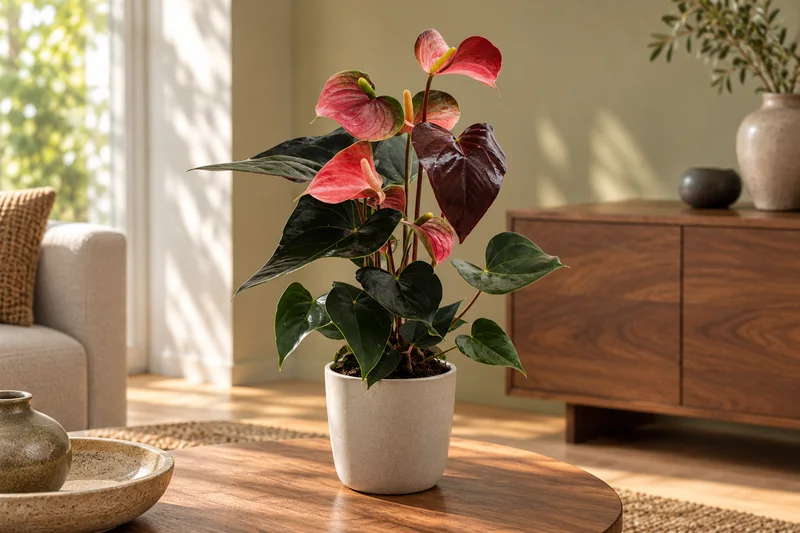
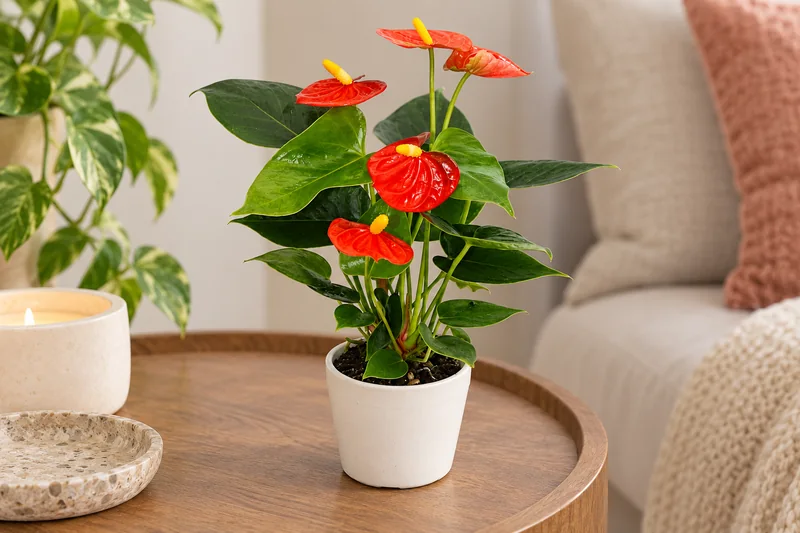
This plant at Exotenherz
Check the shop offer for current availability, price and what is included.
Product and delivery details are given in the individual offer.
Your care table
| Topic | What to do | Why it helps |
|---|---|---|
| Location | Place bright to sunny near a window and acclimatise slowly to direct sun. | Light supports a firm rosette; after transport, hot window sun can stress foliage. |
| Watering | With slightly dried surface, check the root ball and water evenly as needed. | Roots need moisture and air; constantly wet soil encourages rot. |
| Drainage | Let the nursery pot drain fully and remove water from the decorative pot. | A hidden water level keeps the small root space unnecessarily wet. |
| Room climate | Keep warm without cold draughts; shop guidance is around 18–22 °C. | The tropical selection grows more reliably in a sheltered warm room than during cold nights. |
| Soil | Use loose free-draining substrate for terrestrial bromeliads. | The plant roots in soil and needs no permanently filled leaf funnel. |
| Feeding | Feed moderately according to a suitable fertiliser label during visible growth. | Pre-fertilised soil and slower winter growth reduce extra demand. |
| Repotting | When roots are dense, pot slightly larger with drainage holes and unchanged depth. | A suitable pot gives roots space without too much persistently moist soil. |
| Leaf care | Remove dust with a soft damp cloth; handle toothed edges carefully. | Clean surfaces are easier to inspect and firm edges may scratch. |
| Daughter rosettes | Let healthy side shoots grow; separate only well-developed offsets carefully. | After flowering and fruiting the mother changes, while offspring can continue the plant. |
Check the compost and pot weight. The care table explains how far the compost may dry.
Water only when needed. The water should reach the root ball without spilling over the rim.
Remove surplus water from the saucer or cachepot. Then return the plant to a suitable position.
A little pineapple carries a second leaf crown
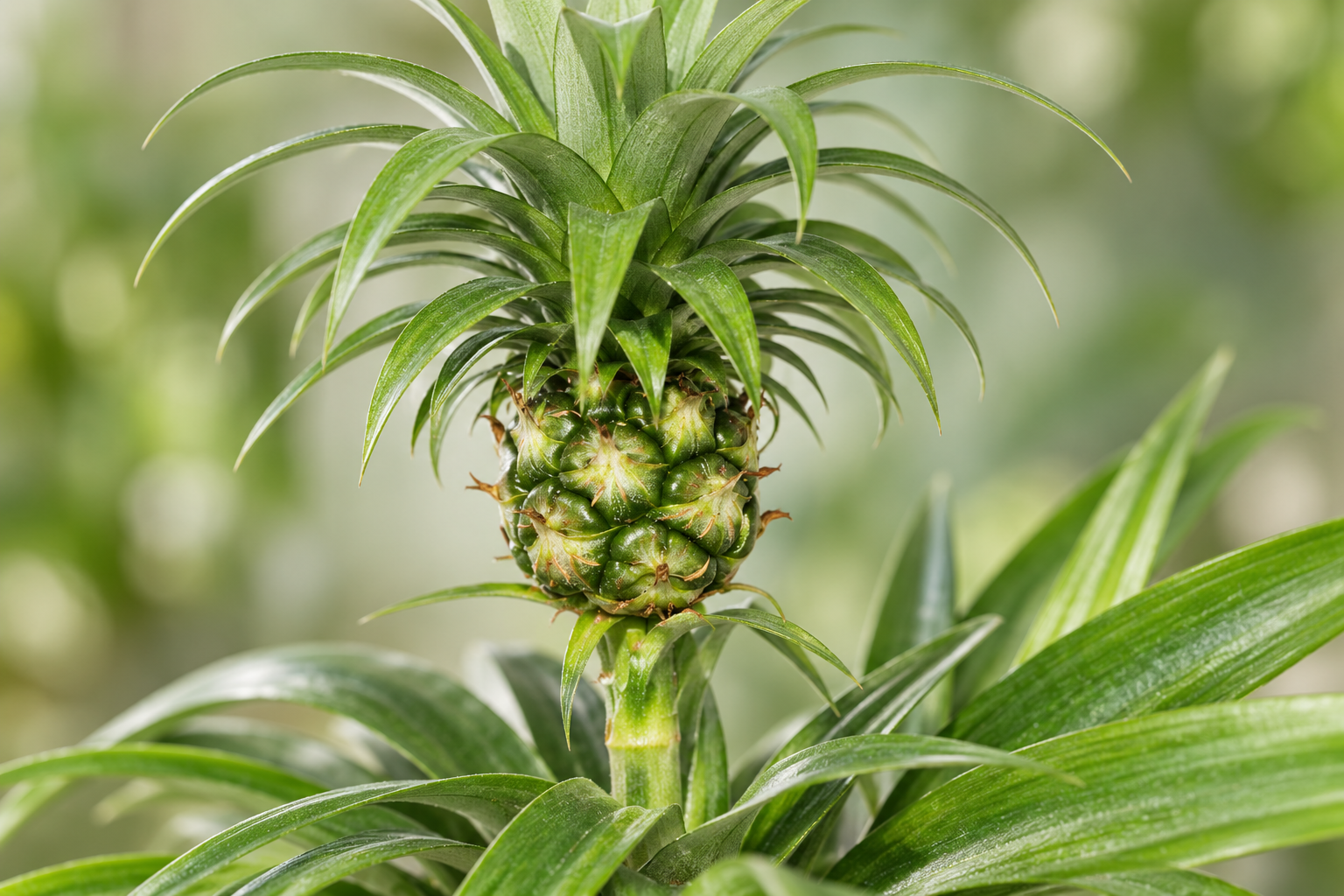
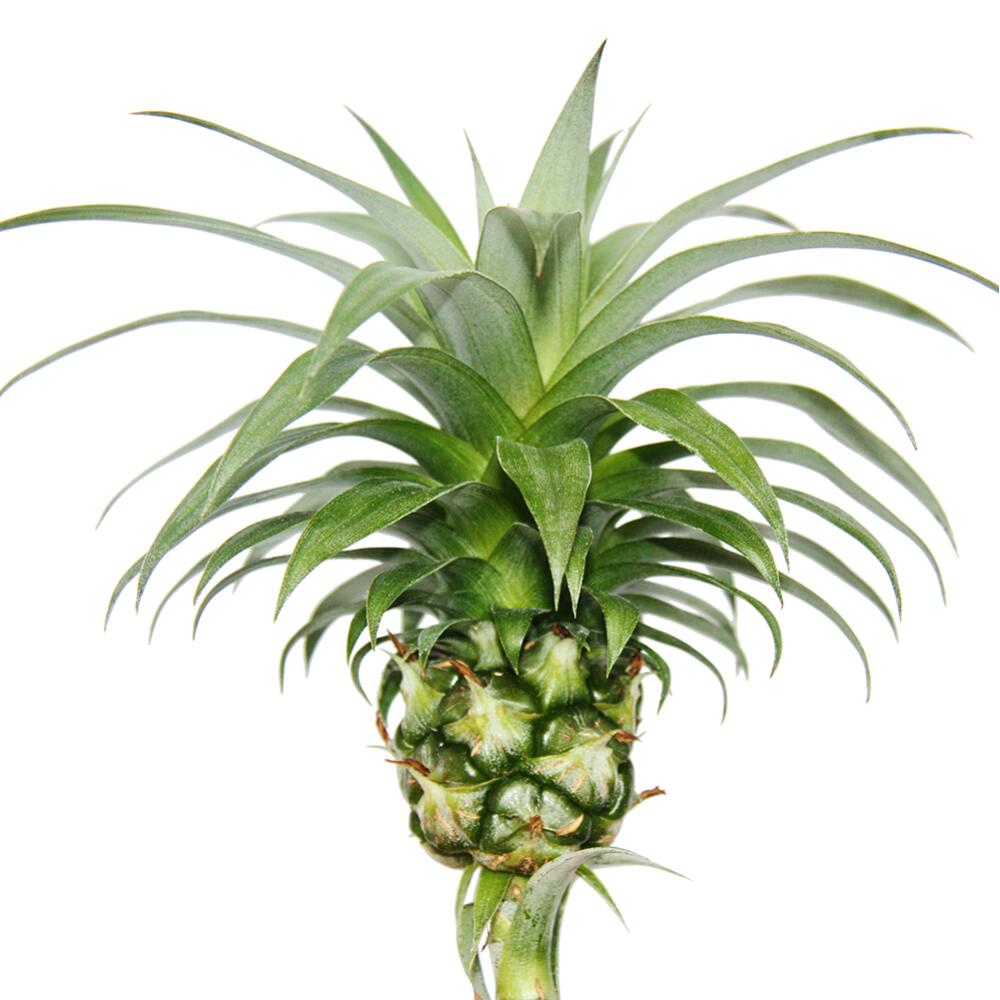
The ornamental pineapple shows two green levels. Below, long leathery leaves open into a spreading rosette. Above, on an already-fruiting plant, the little pineapple sits on its own stem crowned with narrower leaves. In the clean original detail, many fields in its green skin are clearly visible. They are not random scale markings but belong to the multiple-fruit structure. Champaca is therefore as interesting close up as it is as a whole plant. A quiet background leaves tips and little crown clear. The decorative pot should be stable while the broader rosette can spread outward freely.
Champaca is a compact terrestrial bromeliad
Ananas comosus belongs to the bromeliad family. Champaca is a named compact selection of the species, also offered simply as Ananas Champaca. Unlike many tree-growing bromeliads, it develops a root ball in soil. Its supply therefore follows substrate, not a leaf funnel always filled with water. RHS gives a later size class of roughly ten to fifty centimetres in height and width. This helps choose a place but is not a fixed ceiling for every specimen. Long leaves also need sideways space; a tight niche suits less than a bright accessible plant position.
Delivery size and illustrated fruit are different things
The current individual offer gives a ten-centimetre nursery pot and roughly twenty to twenty-five centimetres total height. Originals show an already-fruiting stage; the composed scene also follows that fruit appearance. This does not promise fruit or the same height in every delivery. Hold the nursery pot when unpacking rather than pulling crown or fruit stem. Remove packaging carefully between firm leaves then check root-ball moisture. The offered plant is ornamental. Its fruit is considered decoration here, not a promised indoor harvest. Decorative pot and furnishings are design examples.
A bright warm place lets the rosette grow
Choose a well-lit position near a window. It tolerates sun but should acclimatise gradually after shipping or a darker place. A light curtain can soften very hot summer sun behind glass. At the suggested warm room position around eighteen to twenty-two degrees, protect against cold draughts. Ventilation must not blow cold air through the rosette. Place the pot so window panels cannot trap leaves. Adequate light matters in winter too. Extra water cannot compensate for a decorative place in a dark room’s centre; suitable brightness is missing first.
Water belongs in the well-aerated root ball
Check top soil and weight of the little nursery pot. When the surface has dried slightly and the root ball needs water, pour slowly until evenly supplied. Excess must then drain freely. Permanently saturated soil is as unfavourable as a completely dry root ball ignored for a long time. Consumption changes with light, warmth and development: an active bright summer position often needs more attention than slow winter growth. A rigid watering day therefore helps little. Do not routinely fill the centre as a reservoir. Terrestrial pineapple is supplied through roots; remove hidden water in the outer pot after watering.
Little extra pot space and moderate nutrients
While roots have enough space, the nursery pot can stay. With dense rooting, choose slightly larger with drainage holes and loose free-draining bromeliad substrate. Do not bury the rosette base deeper. During new leaf growth, suitable moderate feeding according to the label supports supply; fresh pre-fertilised soil counts too. Allow for slower growth in dimmer winter. Remove dust gently, supporting firm leaves rather than bending them sideways. Be careful with finely toothed edges. Also inspect protected leaf bases: little scales or white cottony deposits deserve closer checks before increasing water or fertiliser.
After fruiting, the story continues sideways
The pineapple’s multiple fruit develops from many small flowers. Violet tubular flowers precede later fruit and are not simultaneously visible on every plant. A mother rosette goes through this development once and can then gradually decline. Side daughter rosettes allow continuation; let them strengthen before potting a well-developed offset separately. One ageing outer leaf therefore does not automatically mean a care problem. If the base softens and roots remain wet for a long time, check moisture. New rosettes need time and good culture. Rapid flowering again or a particular number of little pineapples is not promised for the houseplant.
One plant, several views
Good to know
What is Champaca?
A named compact selection of Ananas comosus offered as an ornamental pineapple with green rosette and characteristic fruit.
What size is the current delivery?
The offer gives a 10-cm pot and about 20–25 cm total height. The illustrated already-fruiting state is not promised for every specimen.
Is it a bromeliad with a water funnel?
It belongs to bromeliads but grows in soil. Supply roots as needed without routinely filling the centre as a reservoir.
How large may it grow later?
RHS size class is about 10–50 cm high and wide. This guides the compact selection, not a guaranteed final size.
When should I water again?
With slightly dried surface, check roots and pot weight, then water as needed. Excess must drain; a fixed weekly rhythm does not suit every environment.
Is the fruit shown promised as a harvest?
No. This shop offer is ornamental; the portrait describes fruit as decoration, without food or harvest promises.
Why does an old rosette decline?
After flowering and fruiting the mother may gradually age. Healthy daughter rosettes continue sideways; a soft wet base is separately checked for care problems.
Must I immediately take a large pot?
No. With crowded roots, pot only slightly larger using free-draining substrate. An oversized pot easily stays moist too long.
Sources and editorial note
- Exotenherz: offer and original photographs (03.10.2026)
- RHS: Champaca, rosette, flowering and compact size class (03.10.2026)
- RHS: AGM list, Ananas comosus Champaca (03.10.2026)
- NC State Extension: Ananas comosus, composite fruit and daughter rosettes (03.10.2026)
- RHS: bromeliads, terrestrial pineapple and indoor care (03.10.2026)
- UF/IFAS: pineapple, roots, compost and culture development (03.10.2026)
Offer, item number, GTIN, availability and originals checked directly on03.10.2026. Specialist sources read directly. Today’s directly read SKU26102013474,pot10cm/total height20–25cm. RHS AGM assigns Champaca to Ananas comosus. Clean originals1/2 actually viewed; public original2 byte-identical. Already-fruiting image stage distinguished from current delivery size. Different shop/RHS edibility statements documented internally: no blanket cultivar toxicity/inedibility claim; offered ornamental plant without food promise. No shared file changed.