This plant at Exotenherz
Check the shop offer for current availability, price and what is included.
Product and delivery details are given in the individual offer.
Your care table
| Topic | What to do | Why it helps |
|---|---|---|
| Light | Place in very bright light and acclimatise gradually after relocation. | Sudden strong sun can damage even succulent foliage. |
| Water | Water again only after substantial drying. | Fleshy leaves store water. |
| Drainage | Let water drain away completely. | Persistent wetness threatens roots and stem bases. |
| Compost | Use very free-draining growing medium with mineral ingredients. | The mixture should not stay wet for long. |
| Fertiliser | Dose sparingly during growth. | This small plant needs no intensive feeding. |
| Repotting | Move to a slightly larger container only as needed. | Too much fresh compost delays drying. |
| Care | Handle leaves carefully and remove dry parts. | Even thicker leaves can break off. |
| Winter | Keep bright and check the need before every watering. | Less light usually means less water consumption. |
Check the compost and pot weight. The care table explains how far the compost may dry.
Water only when needed. The water should reach the root ball without spilling over the rim.
Remove surplus water from the saucer or cachepot. Then return the plant to a suitable position.
Seeing red without needing flowers
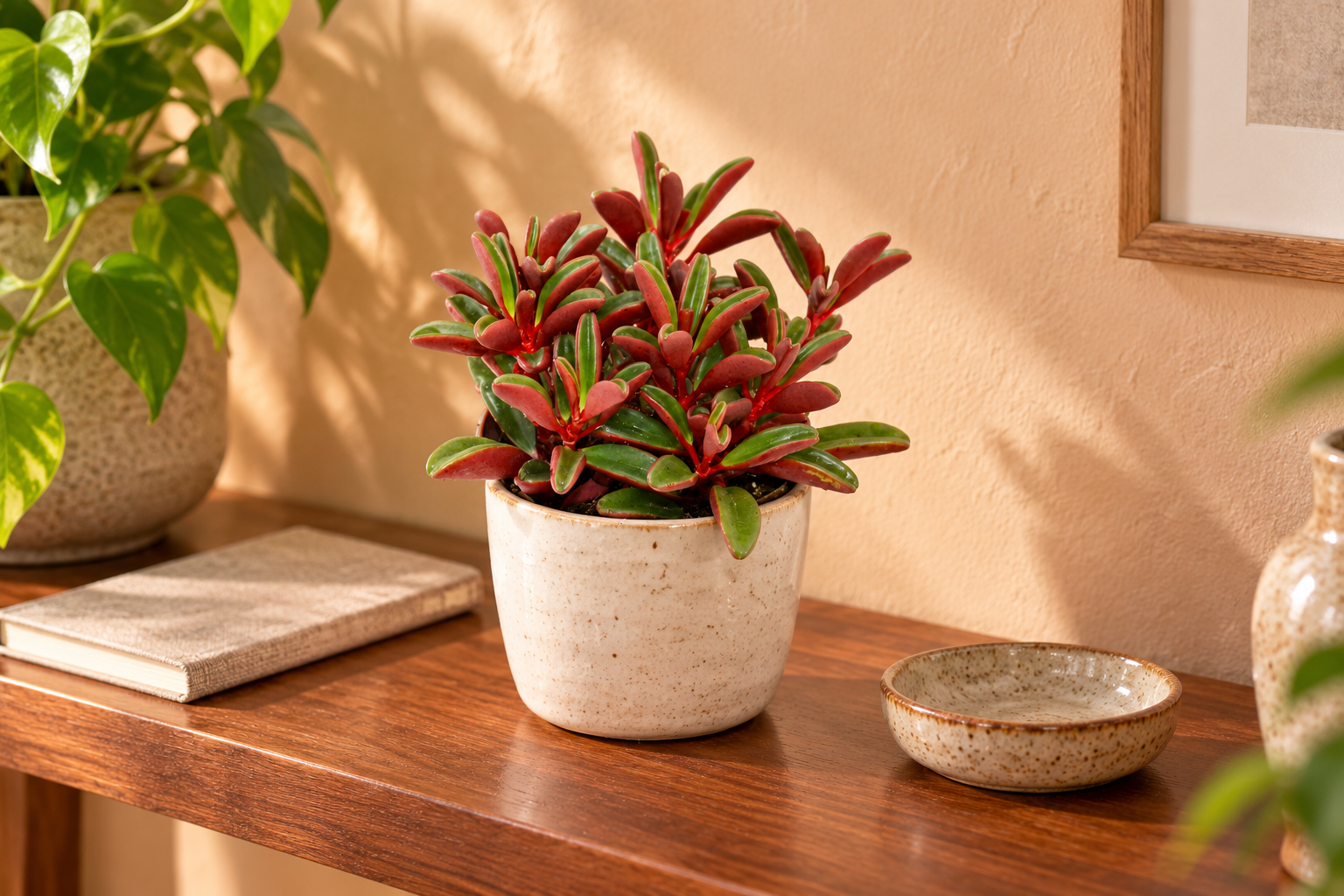
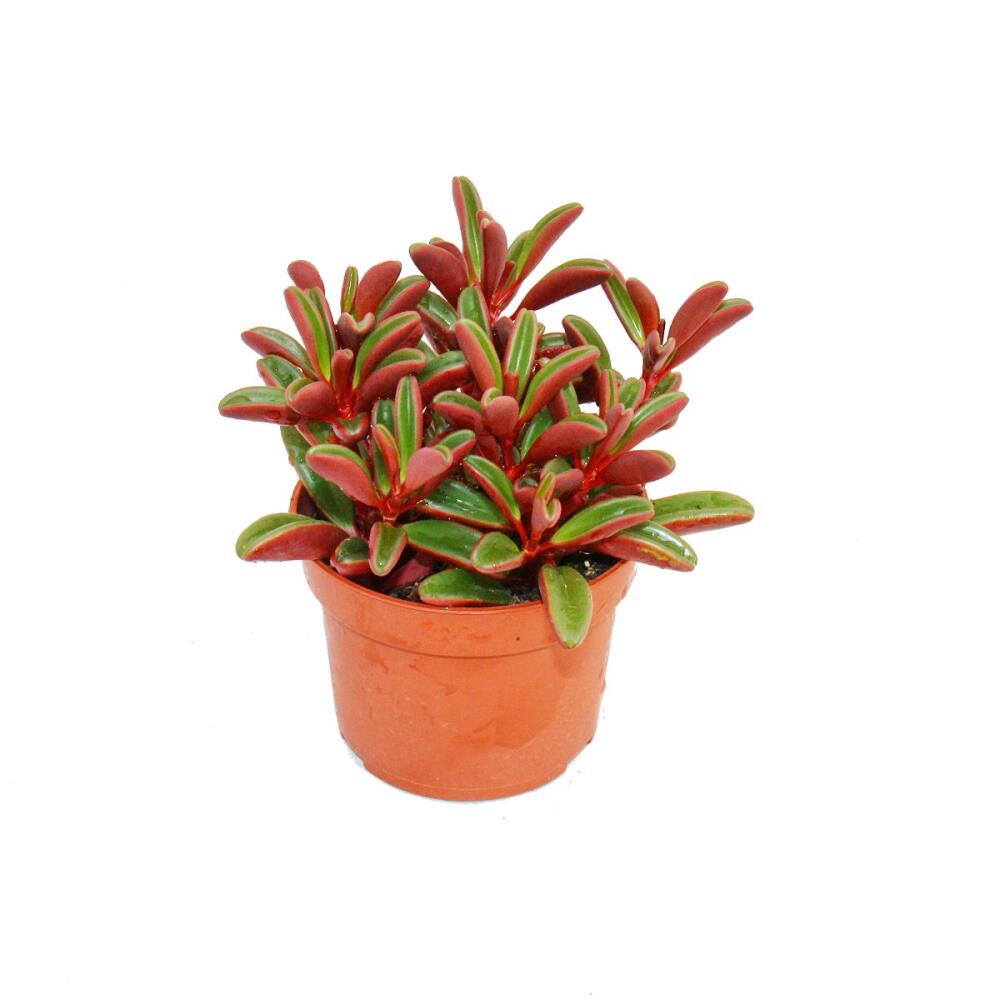
Peperomia graveolens brings an unusual colour combination through its leaves alone. A narrow green area lies on top, with a wine-red leaf back glowing underneath. The fleshy leaves sit on reddish stems and resemble little boats in shape. When light falls from the side, the green upper surface becomes particularly clear. On a simple, pale shelf, the plant remains easy to see despite its small format. The shop specifies a ten-and-a-half-centimetre pot and around fifteen to eighteen centimetres in height. A decorative outer pot complements that size without turning it into large-scale room greenery.
A peperomia with succulent leaves
Not every peperomia is treated alike. Graveolens has distinctly fleshy foliage and belongs among the forms for which a very free-draining rootball and restrained watering are particularly important. I do not automatically place it with tropical foliage plants that are kept constantly moist. A small container is easy to pick up and check for weight. As it gradually becomes lighter after watering, its behaviour becomes familiar. The dry surface is not the only factor. Sufficient moisture may remain beneath it, particularly when the plant is in dense growing medium.
A bright spot for clear colours
This compact plant deserves a very bright position. After transport or relocation, it is gradually accustomed to stronger sunshine. An early morning ray differs from a hot south-facing window in midsummer. I observe new leaves and the temperature at the position before increasing sun exposure further. In the dark interior of a shelf, growth easily loses its compact effect. The scene therefore shows an open, bright compartment rather than a deep, enclosed niche. In winter, light and distance from cold glass remain important. Red foliage is a characteristic of the plant, not a reason to try to force colour with extra fertiliser.
Make a point of letting water drain
During watering, the rootball receives water and excess is then allowed to drain. The nursery pot does not remain in a puddle inside the outer pot. Before watering again, the compost may dry substantially. However, I do not deliberately wait for badly collapsed or damaged leaves in order to pass a supposed drought test. The course depends on brightness, warmth, pot and growing medium. A small plant may dry faster in a bright, warm place than in autumn. A blanket once-a-week rule is therefore not reliable for every room and season.
A mixture with good drainage
Free-draining succulent compost or a suitable loose mixture with mineral ingredients provides an appropriate setting for the roots. What matters is how it behaves in your container: water should be absorbed but then move away again, allowing the rootball to dry. A pot without a hole is not automatically made safe by a handful of gravel at the bottom. At later repotting, I choose only a slightly larger container. The small root volume first needs to explore the fresh compost. Checking the need is more useful than planning a much larger pot every spring simply because the plant has grown another year older.
New shoots and restrained feeding
During visible growth, a suitable fertiliser can be supplied very sparingly. The precise dosage follows the product; freshly fertilised compost initially needs no extra application. Long, thin shoots are first considered alongside the available light. More fertiliser alone does not brighten a dark position. If individual shoots are shortened for design reasons, clean tools are used. The fleshy leaves are not indestructible and break off easily when handled carelessly. I therefore lift the plant by its pot rather than an accessible group of leaves, even if that initially seems convenient.
Take soft areas seriously
A soft, dark stem base and permanently wet compost demand attention. The rootball is then checked first rather than giving still more water out of concern. Wrinkled leaves may suggest water shortage in dry soil, but can also occur with damaged, wet roots. The surroundings determine the next step. Individual old leaves are removed cleanly without unnecessarily injuring healthy stems. In peperomias, flower spikes are more of a subtle extra detail than the main attraction. The living-room scene highlights leaf colours; the gallery retains the unchanged shop photograph for comparison of growth and starting size.
One plant, several views
Good to know
Is the red underside normal?
Yes. The wine-red underside is part of this peperomia’s typical foliage.
Is it a cactus?
No. It is a succulent peperomia from the pepper family.
Can it be placed in sun?
A very bright position suits it; acclimatise slowly to stronger direct sun.
Why does the stem become soft?
Also check persistent wetness or root damage rather than automatically continuing to water.
Must it be repotted into a large pot?
No. Only as required, and into a slightly larger container.
Are flowers the main attraction?
No. The colourful, fleshy leaves shape its appearance.
How can I check the price and availability of Peperomia graveolens?
The linked shop offer provides price and availability information. Check that page before placing an order.
Sources and editorial note
- Exotenherz: offer and original photographs (01.10.2026)
- RHS: Peperomia graveolens (01.10.2026)
- RHS: graveolens form and succulent cultivation (01.10.2026)
- RHS: caring for peperomias (01.10.2026)
Shop offer, SKU, GTIN and availability checked live on 01.10.2026. Original photograph unchanged. Independently researched gardening texts and an individually reviewed scene. Ruby Glow is only a supplementary cultivation reference, not a promised variety name for the shop article.