This plant at Exotenherz
Check the shop offer for current availability, price and what is included.
Product and delivery details are given in the individual offer.
Your care table
| Topic | What to do | Why it helps |
|---|---|---|
| Unpacking | Lift tufts from below without pulling tips out. | Fine repeated branches may catch on the box edge. |
| Position | Choose a bright, visible arrangement that is rarely touched. | Light is general lichen context; it does not prove viability of these pieces. |
| Support | Arrange on a clean accessible surface; lay tufts loosely. | Heavy stones and hard pressure hide or strain structure. |
| Moisture | Observe moisture from neighbouring plants and the base. | No permanently wet cultivation regime is documented for this unidentified box. |
| Water boundary | Adopt neither standing water nor a fixed daily spraying routine. | Rules for green moss or Sphagnum do not automatically apply to lichen material. |
| Air | Prefer an open arrangement; do not create an unverified constantly wet glass setup. | A closed moist environment is no confirmed cultivation basis for these goods. |
| Nutrients | Do not use potted-plant liquid fertiliser as a care aid. | No suitable feeding plan is documented for this unidentified trade material. |
| Cleaning | Gently remove loose remains without brushing or vigorous washing. | Gentle handling retains fine branch outlines. |
| Checks | After moving, look at pressure marks, moisture and the base. | Observing existing pieces replaces an unsupported growth or lifespan promise. |
Check the compost and pot weight. The care table explains how far the compost may dry.
Water only when needed. The water should reach the root ball without spilling over the rim.
Remove surplus water from the saucer or cachepot. Then return the plant to a suitable position.
A pale network of small branches
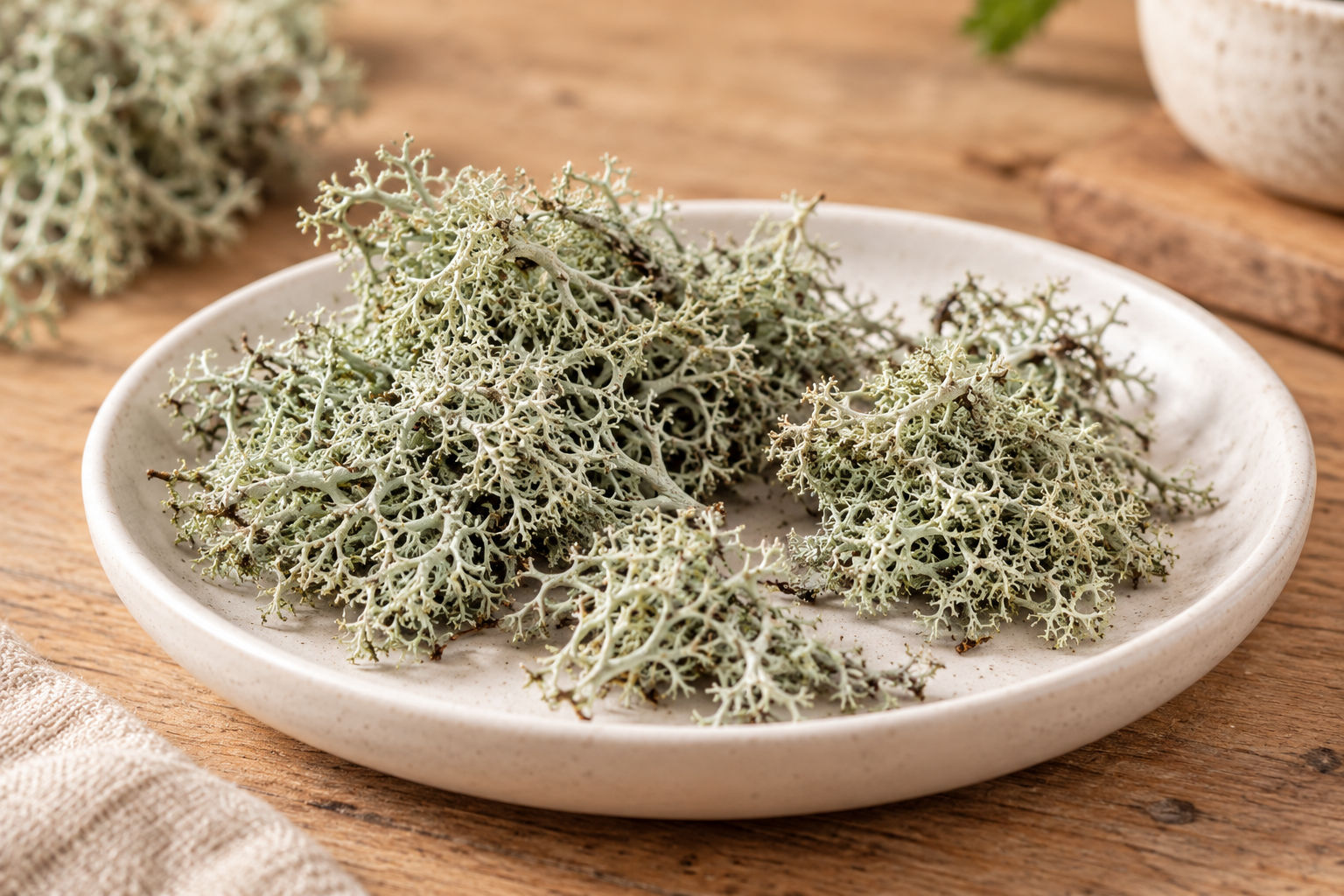
The open structure is the first striking feature of this material. Many thin pale grey to grey-green branches fork repeatedly into irregular small tufts. Darker sections and fine natural associated remains are visible between them. The shop gallery shows neither broad green leaves nor the densely leafy shoots of neighbouring moss offers. A shallow pale container reveals shadows between branches, with outlines allowed to trail loosely at the sides. For arrangement, simply place individual pieces gently together. The AI images show such a small display on a pale worktable. Bowl and accessories make an example frame and are not extra contents of the offered material box.
Distinguish reindeer lichen, Silbermoos and Islandmoos
The offer uses several names: Silbermoos, Rentierflechte and Islandmoos, plus a Cladonia designation. These words do not stand here for one reliably shared wild species. The portrait cautiously treats reindeer-lichen trade material. Lichens are not true mosses; generally their body forms through a fungus living with a photosynthetic partner. Even similar-looking branching reindeer lichens may need further features for exact identification. Expert sources also associate Islandmoos with another taxon. The names therefore do not become a species list for the box. The visible repeatedly branched material of the shop offer remains central. Classification explains its difference from green moss without pretending a microscopically or chemically confirmed delivery species.
Read packaging and arrange pieces carefully
The shop description calls the material fresh and untreated and recommends it for decoration. This is no proven promise of viability or continued indoor growth. The approximately twenty by twelve by twelve centimetres describe the outer box. The accompanying approximately thirty cubic centimetres remains unconfirmed as fill volume and is not converted into another quantity. For display, look at pieces actually present. Open packaging so fine branches do not snag at the edge. Lift a tuft from below where possible instead of pulling it by one tip. Shape, thickness and natural associated elements may vary; no number of equally sized decorative balls is assumed.
Understand light and air as their own conditions
General lichen biology differs from potted-plant care. Lichens absorb water from their environment; during dryness their metabolism may become inactive. Light matters to the photosynthetic partner in viable lichens. These relationships establish neither the condition of this box nor successful indoor cultivation. For a small decorative display, choose a bright, visible place where material is not constantly handled or squashed. An airy open arrangement makes condition easier to inspect. Do not place pieces uncritically into a tightly closed, permanently wet bottle garden. A moist display for green moss supplies no immediate cultivation rule for lichen pieces not identified to species.
Do not transfer moss watering to the pale tufts
This offer has no ordinary root ball to water. Nor does the portrait recommend standing water, a constantly moist green moss surface or a fixed daily spray routine. The shop’s lichen description specifically contains no promise that keeping moist preserves a green colour. Instead examine arrangement, contact with the base and any moisture from neighbouring plants. When a neighbouring plant is watered, lichen pieces must not disappear beneath it as an uncontrolled water reservoir. If water lies in a bowl, check the setup and keep it away from the decorative arrangement. Dry-looking material cannot reliably be revived by a burst of water. A surface change calls for observation, not a confirmed statement about viability or growth.
Retain fine structure without feeding or propagation trials
Place tufts loosely on a clean accessible support. They need not cover a complete area and should not be pressed between heavy stones. Gently remove loose associated remains if this can be done without pulling branches. Aggressive brushing, washing or repeated dismantling does not improve a natural-material display. This box has no documented indoor feeding plan; potted-plant liquid fertiliser is not used as a care aid. General lichen biology describes slow development and different reproductive routes. This does not mean that broken pieces from the box reliably establish in glass. Anyone wishing to build actual cultivation first needs a suitably identified species and reliable information on the starting material’s condition.
Accompany an open small display in daily life
Pale branches look particularly attractive when new pieces are not continually laid on top. After moving, check whether an edge presses against glass, wood or neighbouring plants. When cleaning the area, lift the bowl calmly rather than wiping over the material. Investigate unusual moisture or smell in the base rather than supplying a general moss rule afterwards. Without reliable species identification, neither an indoor plant’s frost-free overwintering value nor a fixed lifespan is adopted. The portrait shows decorative lichen material and its careful handling. It is a different display from a moist Sphagnum bowl or a layer of dense Kugelmoos cushions. The actual branching structure remains the starting point, not an expectation of a later closed landscape.
One plant, several views


Good to know
Is reindeer lichen true moss?
No. The offer lists lichen material under several trade names. Lichens differ biologically from true mosses.
Is a particular Cladonia species confirmed?
No. The shop goods remain an unidentified reindeer-lichen trade group. The name alone confirms neither a Cladonia nor a Cetraria species.
What does fresh and untreated mean?
This is the shop’s material description. It does not promise that every piece is viable or will continue growing in an indoor display.
Must tufts stay constantly moist?
No such rule is adopted for this material. No standing water or permanently wet closed glass; observe moisture from neighbouring plants and the base.
Can water definitely make dry material grow again?
This cannot be promised for the box. General lichen biology explains responses to dryness but proves no regeneration of these pieces.
How large is the offered box?
Approximately 20 × 12 × 12 cm is outer packaging. It describes neither tuft height nor piece count; approximately 30 cm³ remains unconfirmed as fill volume.
How do I remove individual pieces?
Support from underneath and lift slowly. Do not pull a single tip or press branching tufts into uniform balls.
Sources and editorial note
- Exotenherz: exact material box and own gallery (05.10.2026)
- BLS: identification limits for reindeer lichens (05.10.2026)
- BLS: general lichen biology (05.10.2026)
- BLS: lichen morphology (05.10.2026)
- USFS: Iceland moss as a different taxonomic classification (05.10.2026)
- RHS: mosses and lichens, general classification (05.10.2026)
Shop offer, original images and expert sources checked on 05.10.2026. Current availability in the shop.