This plant at Exotenherz
Check the shop offer for current availability, price and what is included.
Check the shop for the current price, availability and offer contents.
Your care table
| Topic | What to do | Why it helps |
|---|---|---|
| Light | Keep very bright and sunny; acclimatise slowly after transport. | Light supports firm pitchers and their colouring. |
| Water | Use rainwater, distilled water or suitable reverse-osmosis water. | Minerals from hard water may accumulate in the sensitive root environment. |
| Summer | Keep compost moist; monitor shallow standing water during growth. | The pitcher plant comes from cultivation of wet, nutrient-poor positions. |
| Compost | Choose unfertilised acidic carnivorous-plant compost. | Ordinary pre-fed potting compost does not suit this cultivation. |
| Fertiliser | Do not add ordinary plant or slow-release fertiliser. | The plant uses captured small animals as an extra nutrient source. |
| Repotting | Check root space and rhizome before strong spring growth. | A living growing point must not disappear deep beneath compost. |
| Winter | Rest bright and cool, keep the root ball moist and protect from severe frost. | Small pots and hybrids not precisely documented need cautious winter care. |
| Pruning | Remove only dead pitchers cleanly, retaining green parts. | Ageing traps belong to the annual cycle and do not automatically signal disease. |
Use clean rainwater or suitable distilled water. An ordinary jug filter does not reliably remove dissolved salts.
Put a little water in the saucer. The base of the pot stands in water; the compost surface and centre of the plant remain well above it.
Keep the root ball moist and the saucer clean. Light, temperature and the species-specific winter care in the table determine its needs.
A pale hood full of small lines
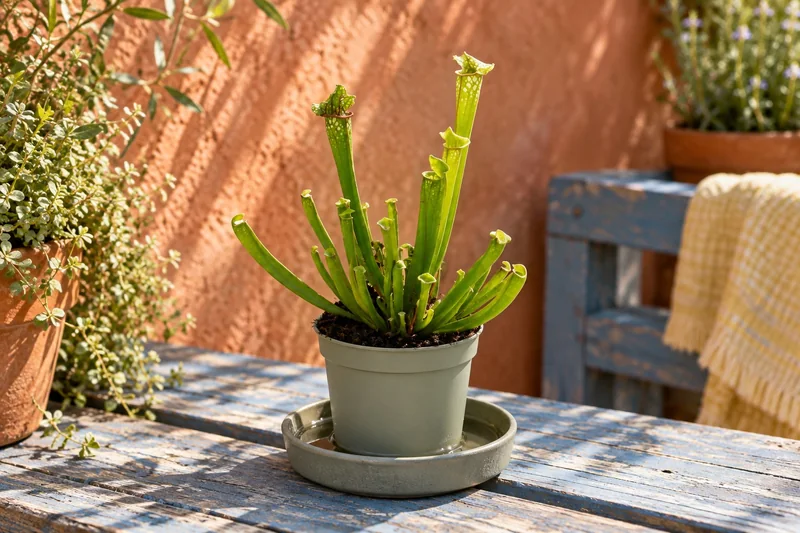
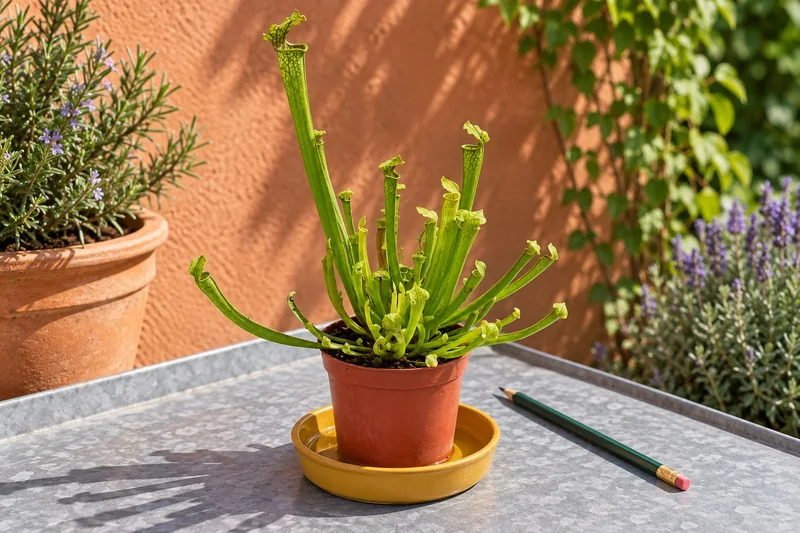
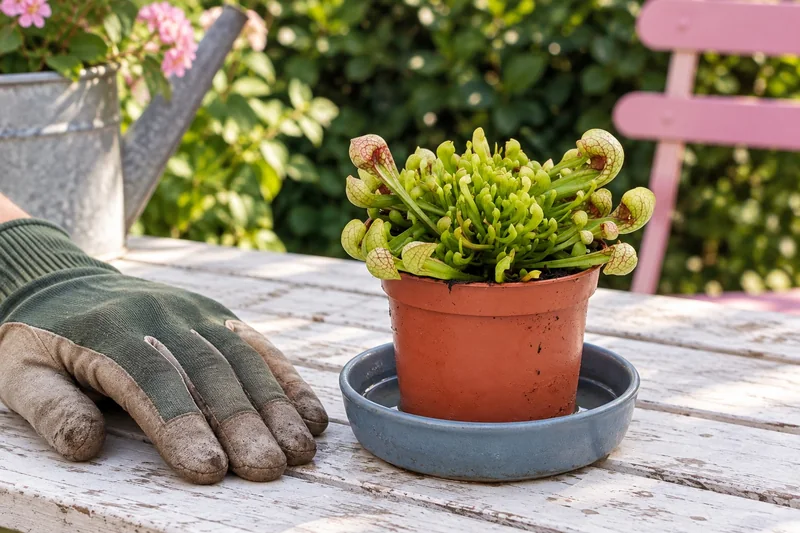
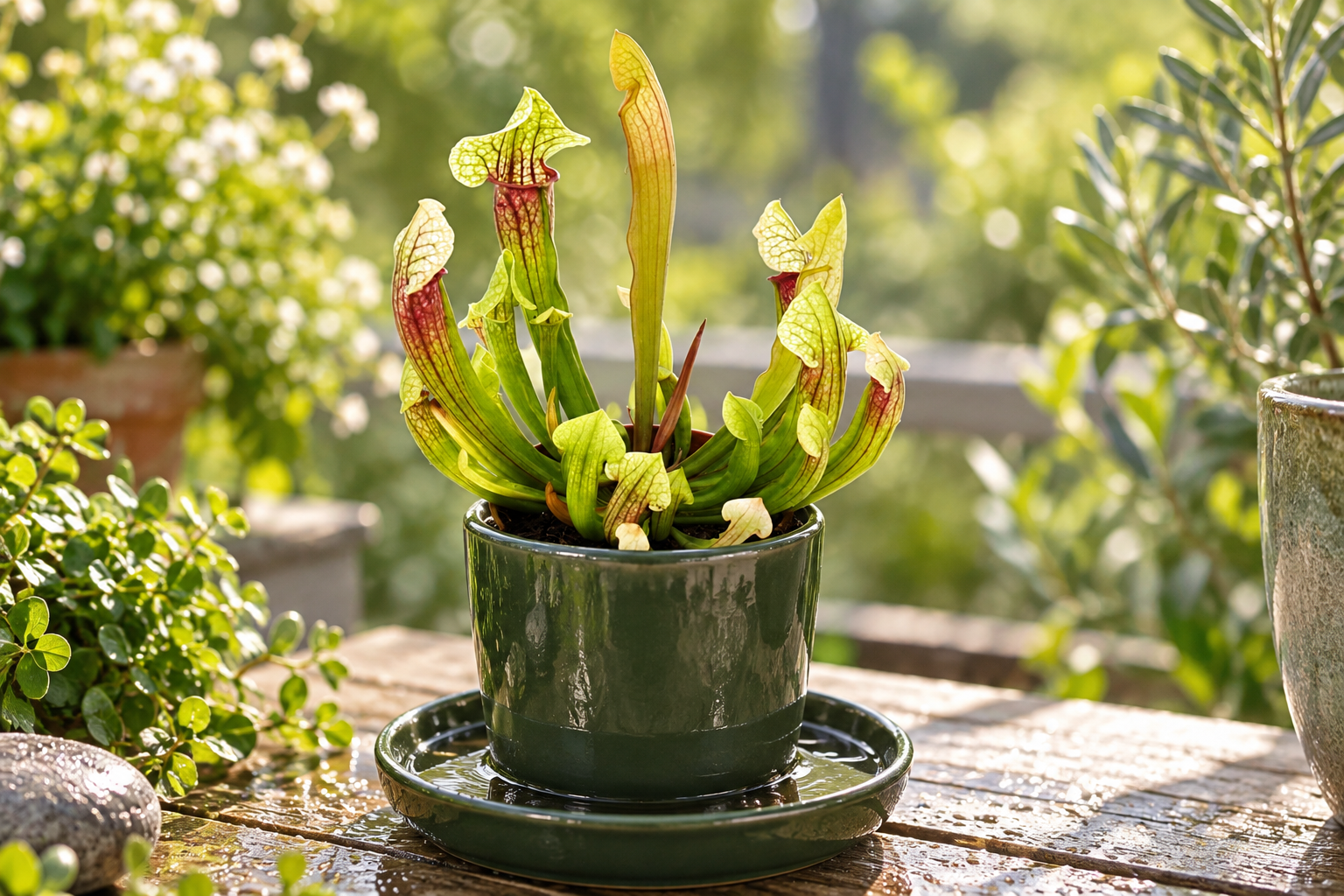
Eva is a plant where a second look almost always reveals something new. Above the green to yellow-green pitchers sit pale hoods with red lines and darker areas at the entrance. Some pitchers stand upright, others lean sideways. This small irregularity makes the young plant lively. The markings are easy to observe on a sheltered balcony table. The hoods are not flowers but parts of the trapping leaves. Their openings remain open; they do not snap shut on touch like a Venus flytrap.
A small pot, a special cultivation
The shop lists Eva as a Sarracenia hybrid in a 9-cm pot. A precise delivery height is not guaranteed there and is not calculated from the photograph. The original shows the current form with pitchers at different developmental stages. Colour and length of later leaves may change under other cultivation conditions. For us this development belongs to the plant’s appeal. The photograph guides growth form, not a fixed inventory of all pitchers. A decorative container may complement it beautifully, but must allow its water care and must not conceal the living centre.
The suitable spot lies in the light
Eva needs a very bright sunny position protected from strong wind. An open terrace or suitable balcony gives the trapping leaves more light than a shelf deep inside a living room. Increase sunshine gradually after transport and protect the small pot from extreme heating. Hoods should stand free, not pressed against glass or a hot wall. We like looking sideways through the plant to discover new pitchers at the base. A permanently warm dark living-room position does not fulfil its annual cycle, even if initially attractive as decoration.
Water is part of the care decision
Provide rainwater, distilled water or suitable reverse-osmosis water for Eva. Mineral-rich tap water is not a good lasting foundation. During growth the compost stays moist; a shallow water level in the saucer helps supply the small root ball. Still check the reserve regularly, particularly on warm windy days. A short shower does not guarantee enough water remains in the container. Use a clean plastic or glazed saucer. Actual moisture around the roots is what matters. The surface is not kept dry merely because many other potted plants may dry between watering.
Traps do not replace a spot with good conditions
The pitchers can passively capture small animals and gain extra nutrients from them. They need neither pieces of meat nor ordinary flowering-plant fertiliser for this. Not every open trap must be filled by hand. The enjoyment lies in observing this special leaf design undisturbed. Even a successful trap does not replace light or suitable water quality. Eva is therefore not presented as a guaranteed insect destroyer. If a small plant grows weakly, first check position and root conditions. Extra food or heavy feeding cannot simply compensate for poor cultivation.
A suitable root ball stays nutrient-poor
Use unfertilised acidic carnivorous-plant compost when repotting. Ordinary potting compost with fertiliser and lime does not belong in this pot. The best time usually lies before strong spring growth. Handle the rhizome and new growing points gently and leave them at their previous suitable height. Not every small plant needs dividing immediately on arrival. We first give it time to get to know its new position. A clean pot with enough root space makes later care easier; an unnecessarily large decorative container alone does not create better cultivation.
The resting phase belongs to Eva
Growth decreases in autumn and older pitchers may turn brown. In the right context this is part of cool winter rest. Keep the plant bright and cool rather than returning it permanently to a warm living room. The root ball stays moist without having to force the summer water level unchanged. Protect small containers from prolonged severe frost and drying wind. Remove only dead pitchers and retain green leaf parts. When new tips appear from the base in spring, the next stage begins. This change makes Eva a plant you get to know through the seasons.
One plant, several views
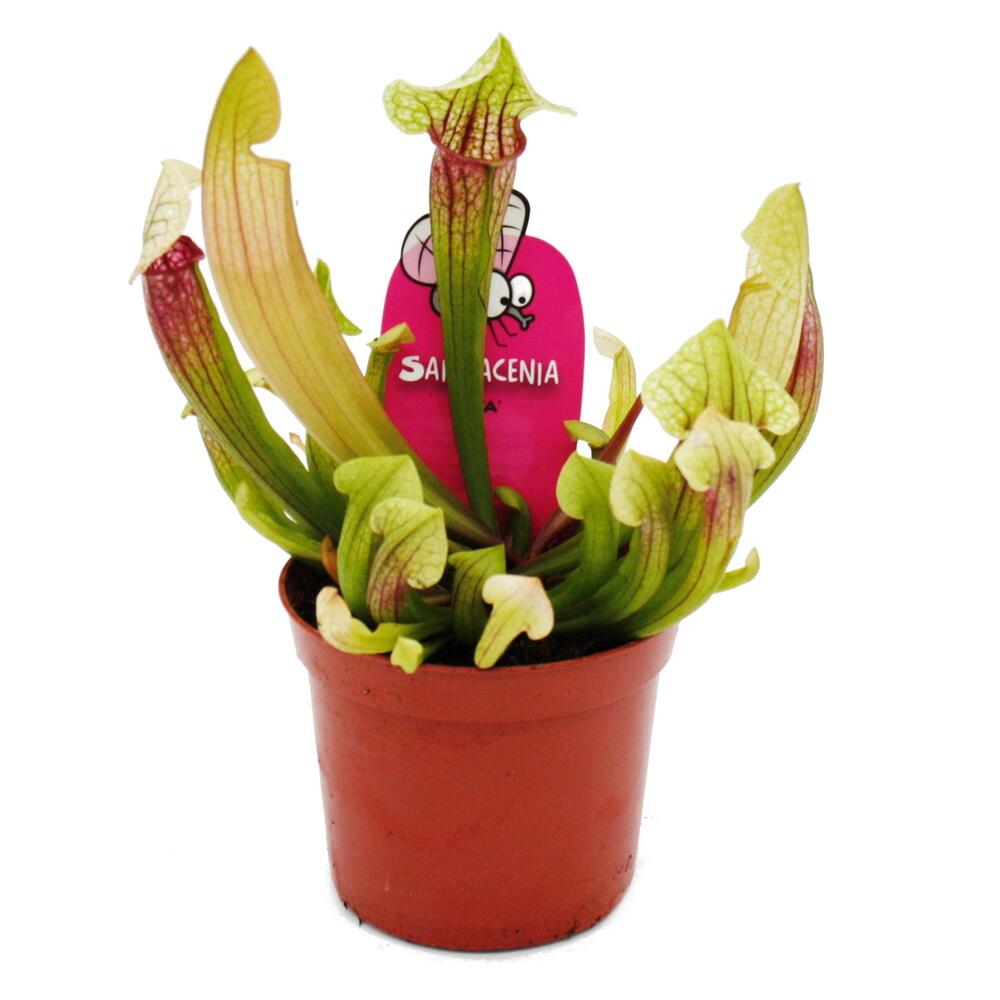
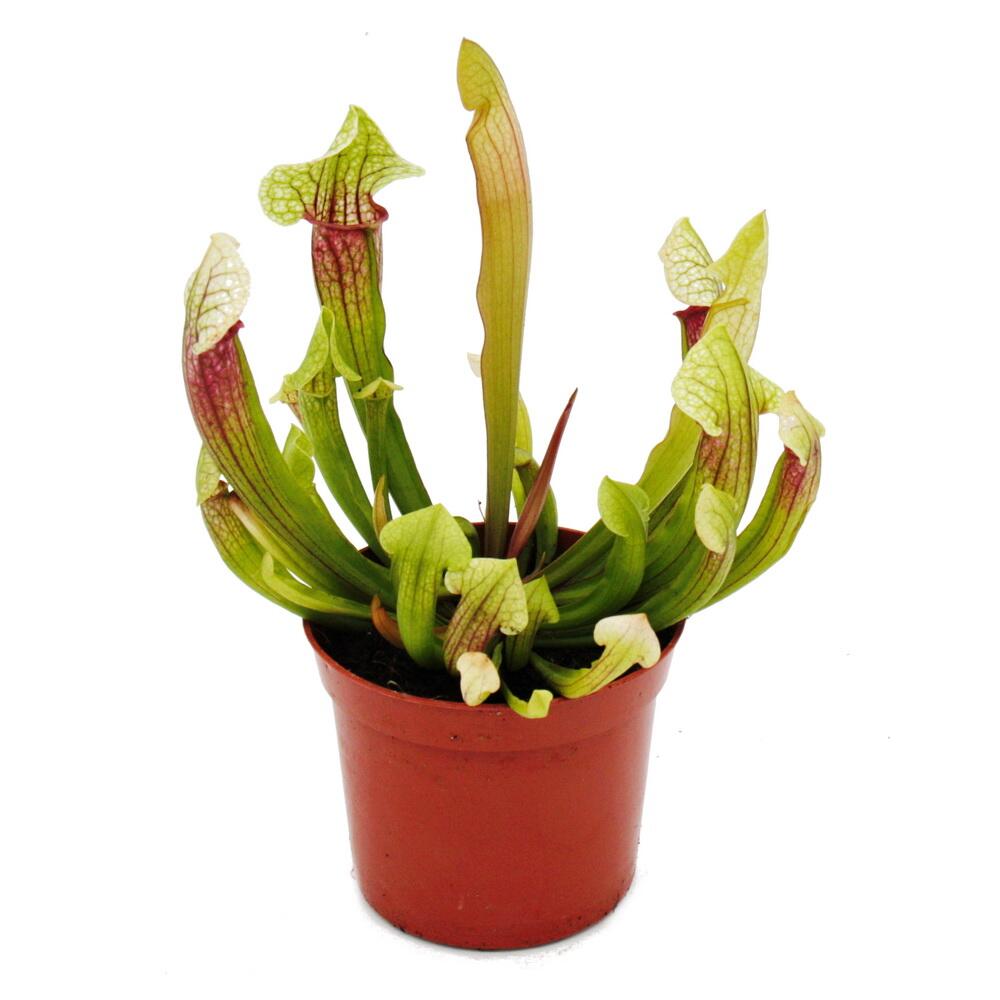
Good to know
Are the pale hoods flowers?
No. They belong to the trapping leaves. Flowers develop as separate organs and are not guaranteed at delivery.
How tall is the delivered plant?
The shop gives a 9-cm pot but no fixed delivery height. The original photograph shows the offered growth form.
What water is suitable?
Rainwater, distilled water or suitable reverse-osmosis water. Avoid mineral-rich tap water for continued use.
Should I use ordinary potting compost?
No. Choose unfertilised acidic carnivorous-plant compost.
Must I feed Eva meat?
No. Do not put pieces of meat or usual fertiliser into pitchers or compost.
Why do pitchers turn brown in autumn?
Old traps may die during cool winter rest. Consider moisture, rhizome and new growing points as well.
Sources and editorial note
- Exotenherz: offer and original photographs (02.10.2026)
- RHS: Sarracenia (02.10.2026)
- RHS: growing carnivorous plants (02.10.2026)
- UC Davis Botanical Conservatory: their own Sarracenia cultivation (02.10.2026)
- Sarracenia Northwest: experience from their own nursery cultivation (02.10.2026)
Shop offer, product number, GTIN, availability and original images checked directly on 02.10.2026. Specialist sources read directly. No invented delivery height or blanket frost threshold for the hybrid. Pitcher leaves and flowers distinguished; winter rest and low-mineral water accounted for.