This plant at Exotenherz
Check the shop offer for current availability, price and what is included.
Check the shop for the current price, availability and offer contents.
Your care table
| Topic | What to do | Why it helps |
|---|---|---|
| Position | Provide bright indirect daylight with protection from hot midday sun. | Its forest origins explain filtered light and a higher water requirement. |
| Watering | During growth and with buds, water thoroughly after slight drying. | The rootball should not remain completely dry for long; constantly wet compost also damages roots. |
| Drainage | Let the inner pot drain well and remove water from the outer pot or saucer. | Moisture stored in the rootball needs air around the roots, not a standing water reserve. |
| Rest phases | Keep cooler and provide less water before bud formation and after flowering. | Slower consumption requires longer watering intervals without completely drying out the rootball. |
| Bud formation | In autumn, provide bright days, uninterrupted longer nights and about 12–15 °C. | Day length and temperature influence the next flowers; constant light can disrupt them. |
| Compost and repotting | Choose an airy humus-rich mixture and only move slightly up in pot size after flowering when roots are cramped. | A large container with a lot of wet compost does not help a still-small root system. |
| Feeding | Support active spring and summer shoots modestly according to a suitable fertiliser label. | New stem segments need nutrients; suspend supplementary feeding during rest periods. |
| Pruning and cuttings | If needed, remove individual whole segments at their joints in spring. | Targeted shortening encourages branching; healthy pieces can root after brief drying. |
| Checks | Inspect shoot bases, branches and the rootball carefully when shoots are limp. | Shrivelling may result from dry roots or damaged wet roots; do not automatically water again. |
Check the compost and pot weight. The care table explains how far the compost may dry.
Water only when needed. The water should reach the root ball without spilling over the rim.
Remove surplus water from the saucer or cachepot. Then return the plant to a suitable position.
Flowers start at the green shoot tips
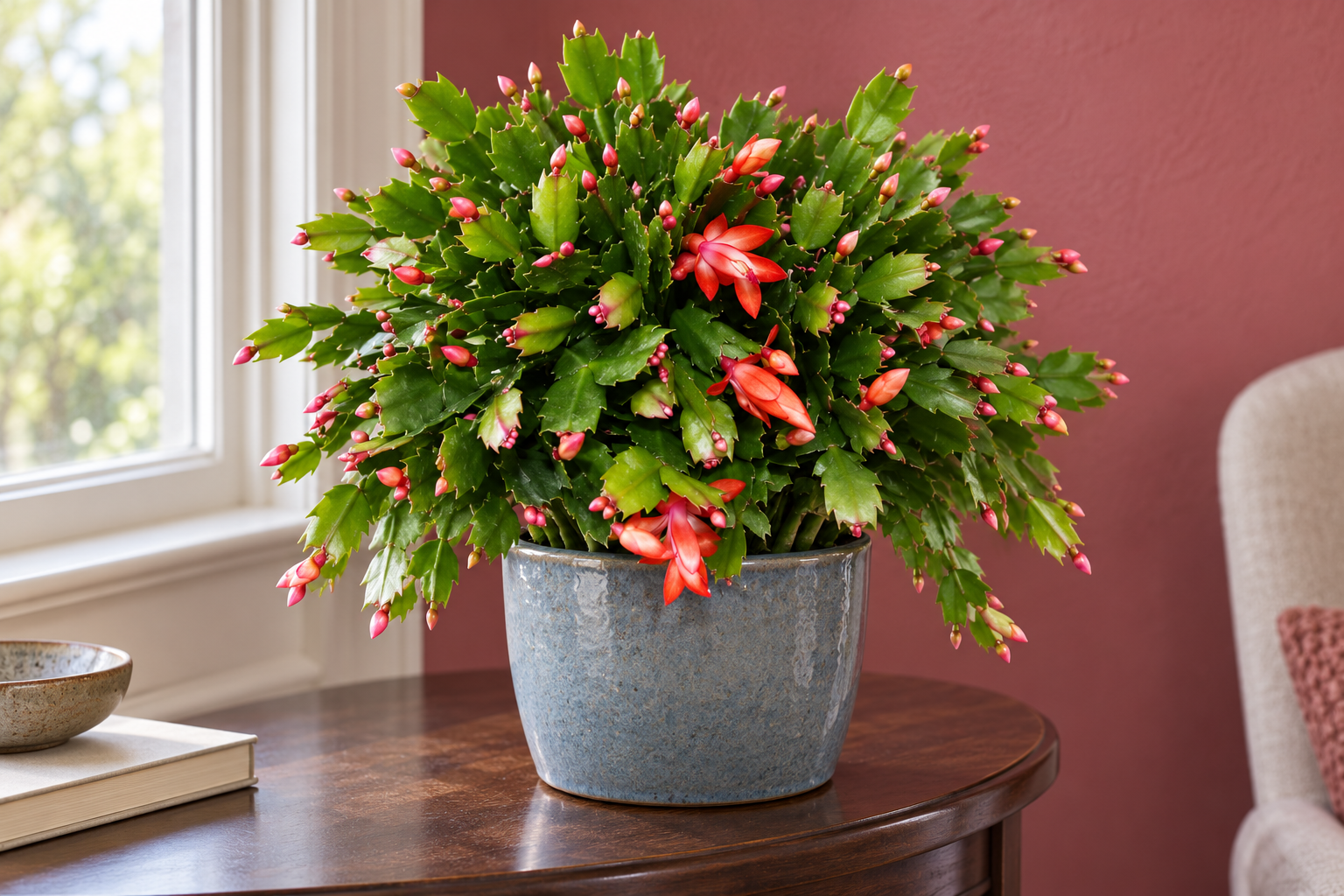
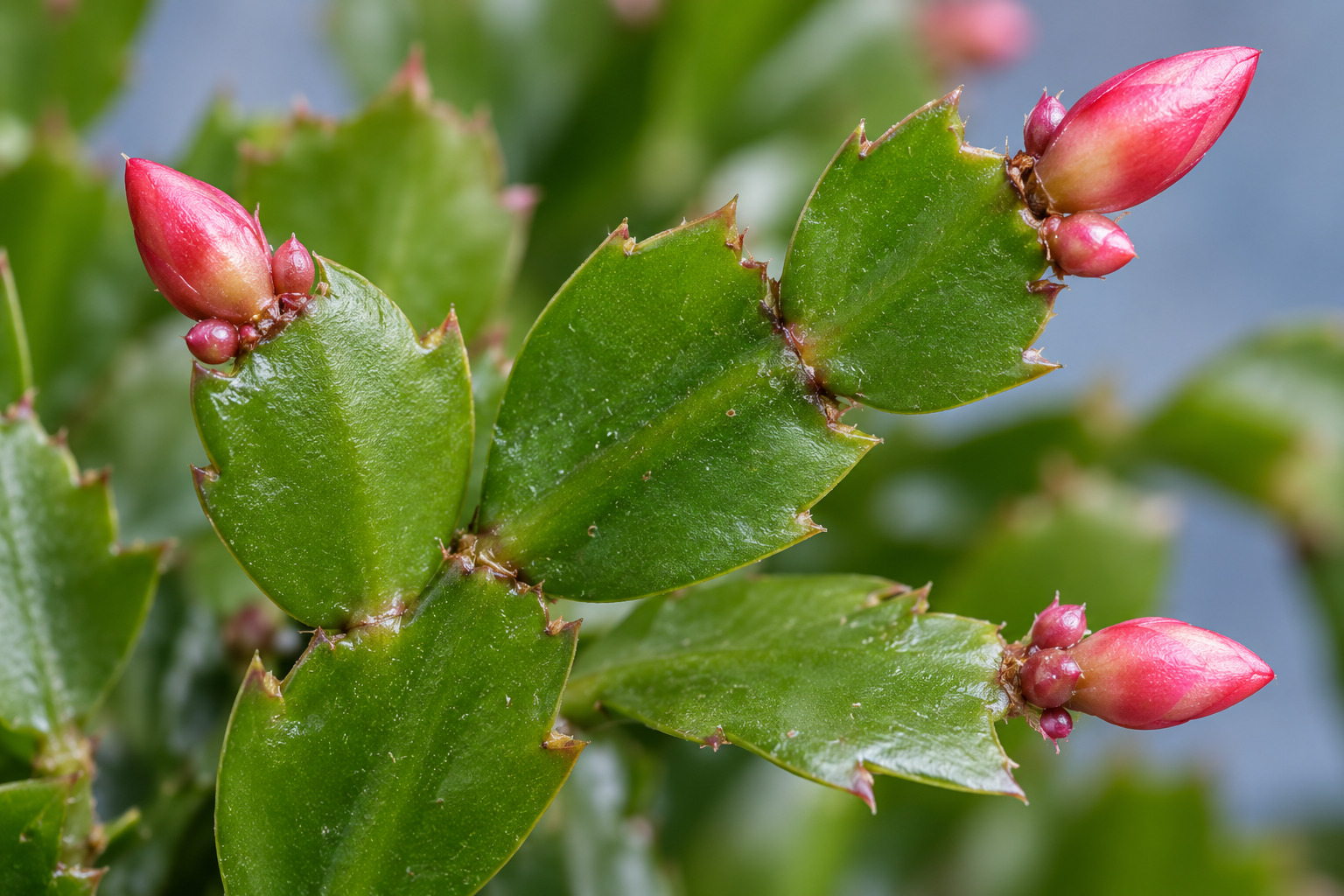
The structure of a Christmas cactus is particularly clear when you follow a branch to its tip. Flat fleshy green segments sit one behind another like short links in a chain. In the original red-form photograph their edges are clearly toothed, with small pink buds at the ends. Some open into red to coral-red-looking flowers with pale areas in the centre. The dense green growth remains interesting between flowering periods. The apparent leaves are stem segments that capture light and store water. As branches lengthen, the initially compact clump increasingly hangs over the container rim. Leave these ends free so they do not constantly brush against curtains or furniture edges.
A forest cactus with different commercial forms
Schlumbergera belongs to the cactus family. Its natural parent species come from moist forest areas in south-eastern Brazil, where they grow as epiphytes among other habitats. This explains why strong sun and lengthy dry periods are not suitable standard care. Christmas cactus includes forms with distinctly toothed segments and others with softer edges. Specialist books discuss Schlumbergera truncata and the cross Schlumbergera × buckleyi, for example. This offer explicitly names Schlumbergera hybrids without specifying a cultivar. Its red, pink or white option describes flower colour. The common name is also no promise that the plant will flower precisely over the holidays.
Delivery size and a quiet start
Each colour offer states a 17 cm pot and approximately 25–35 cm total height. This describes the plant including its container, not its later maximum spread. When unpacking, support the pot and carefully free packaging from shoot tips. Do not use existing buds as handles. Then check compost and drainage: a rootball that is still moist does not immediately need more water. The original shows buds and some open flowers, but their number and stage may differ at delivery. A simple stable position helps more than frequent moving. The styled outer pot and furnishings in the scene are examples of use.
Light by day, a real night in autumn
A bright position with filtered daylight is suitable. Avoid hot midday sun behind glass; a dark table far from a window is equally unsuitable. In summer, after acclimatisation, a sheltered shaded outdoor position is possible while the weather remains warm. Bring it inside in time before cool nights. Longer uninterrupted nights and cooler conditions around 12–15 °C help autumn bud formation. A lamp directly beside the plant until late at night can disrupt this rhythm. Keep the position bright during the day; permanently putting it in a dark cupboard is not a cultivation method. Avoid cold draughts and large temperature swings even when buds are already present.
Support the rootball through flowering phases
Check moisture regularly during growth and bud formation. Once the upper compost has dried slightly and the pot feels noticeably lighter, water slowly and thoroughly. Allow the water to drain completely afterwards. Fleshy segments justify neither constant wetness nor a root system dried out for weeks. Before bud formation and after flowering, the plant receives a quieter, cooler phase with less water. The upper compost may then dry more, without the whole rootball staying dry for long. A fixed weekly schedule poorly reflects these changes. If buds drop, consider moisture, recent moves and warmth together rather than increasing water as a precaution.
Encourage roots and new branches gently
An open humus-rich mixture with coarse aerating ingredients and clear drainage holes combines moisture retention with ventilation. Repotting becomes useful when the rootball densely fills its existing space or the compost structure declines. After flowering, as growth begins, provide only a reasonable increase in space. In spring and summer, modest suitable feeding supports new shoots; account for rest phases and pre-fertilised compost. Individual long shoots can be shortened at a joint if needed. Healthy tips of a few segments can serve as cuttings after their cut surface dries briefly. Kept bright and warm with careful moisture, they gradually develop into independent plants.
Observe stem signals and the next flowers
Limp or wrinkled segments are a reason to inspect the rootball first. Dry roots require a different response from brown soft roots in wet compost. Hot sun can also discolour green surfaces. Occasionally inspect branches for cottony clusters or new firmly attached deposits. A healthy base becoming firmer and browner with age is not automatically diseased; soft wet areas, however, deserve careful investigation. Green shoots remain after flowering. Suitable light and new branching create further possible flowering sites. Whether and when they open depends on the seasonal rhythm and the plant’s condition. You can support its development without having to recreate every photograph.
One plant, several views

Good to know
Are the flat green parts leaves?
They are fleshy stem segments. They capture light and form new shoots or flowers at their ends.
Will I receive a particular named cultivar?
The checked offers specify Schlumbergera hybrids and the selected flower colour, but no separate cultivar name.
Which flower colours are offered?
The specific child offers state red, pink and white. Choose the colour in the relevant offer.
Will Christmas cactus definitely flower at Christmas?
No. Late autumn and winter are typical flowering seasons; selection, night length, temperature and cultivation affect the actual course.
Why do buds fall after moving it?
Strong changes in light, temperature or moisture can promote shedding. Choose a stable bright place and inspect the rootball.
Should I keep it as dry as a desert cactus?
No. During growth and bud development, water reliably after slight drying. Let excess drain away.
Why are there few flowers despite green shoots?
Check autumn conditions. Constantly warm nights and artificial evening light can interfere with bud formation. More fertiliser does not replace this rhythm.
Can I propagate individual stem segments?
Detach healthy pieces of a few segments at a joint, let the wound dry briefly and insert them in airy compost. Water carefully until rooted.
Sources and editorial note
- Exotenherz: offer and original images (03.10.2026)
- RHS: Christmas cacti, full cultivation and rest phases (03.10.2026)
- NC State Extension: Schlumbergera, forest origins and stem morphology (03.10.2026)
- Iowa State Extension: hybrid forms, bud rhythm and propagation (03.10.2026)
- UMN Extension: seasonal care and distinction of typical problems (03.10.2026)
Shop offer, article number, GTIN, availability and original images directly checked on 03.10.2026. Specialist sources directly read. A distinct unnamed hybrid group, not a new cultivar created from flower colour. Current direct Root retrieval at 20:47 UTC: selected parent and child pages read in full; four sources directly read, UMN HTML returned 403 but its complete web content was read. RHS does not require complete rootball drying; the differing absolute Iowa drying recommendation is not adopted. No wild species identified from a photograph. Clean unchanged gallery 3 of the red child offer, other galleries individually checked in full; delivered flower count not guaranteed.