This plant at Exotenherz
Check the shop offer for current availability, price and what is included.
Product and delivery details are given in the individual offer.
Your care table
| Topic | What to do | Why it helps |
|---|---|---|
| Light | Position brightly with filtered daylight. | A dark position more readily makes shoots loose and bare. |
| Water | Allow topsoil to dry slightly and check the root ball. | Fleshy shoots need supplied roots without persistent wetness. |
| Watering | Direct water between shoots onto the compost. | Dense foliage should not stay constantly wet. |
| Drainage | Remove excess and let the nursery pot drain. | Wet shoot bases and roots can rot. |
| Compost | Use loose houseplant compost in a pot with drainage holes. | It holds moisture without compacting the root zone. |
| Pruning | Shorten overly long healthy shoot tips above a node. | Small corrections encourage branching and a denser shape. |
| Feed | Supply moderately during growth according to the label. | Weak winter growth needs fewer nutrients. |
| Inspection | Inspect undersides and leaf bases too. | Fine webs, scales or cotton-like deposits are easier to notice early. |
Check the compost and pot weight. The care table explains how far the compost may dry.
Water only when needed. The water should reach the root ball without spilling over the rim.
Remove surplus water from the saucer or cachepot. Then return the plant to a suitable position.
Violet that changes with the viewing angle
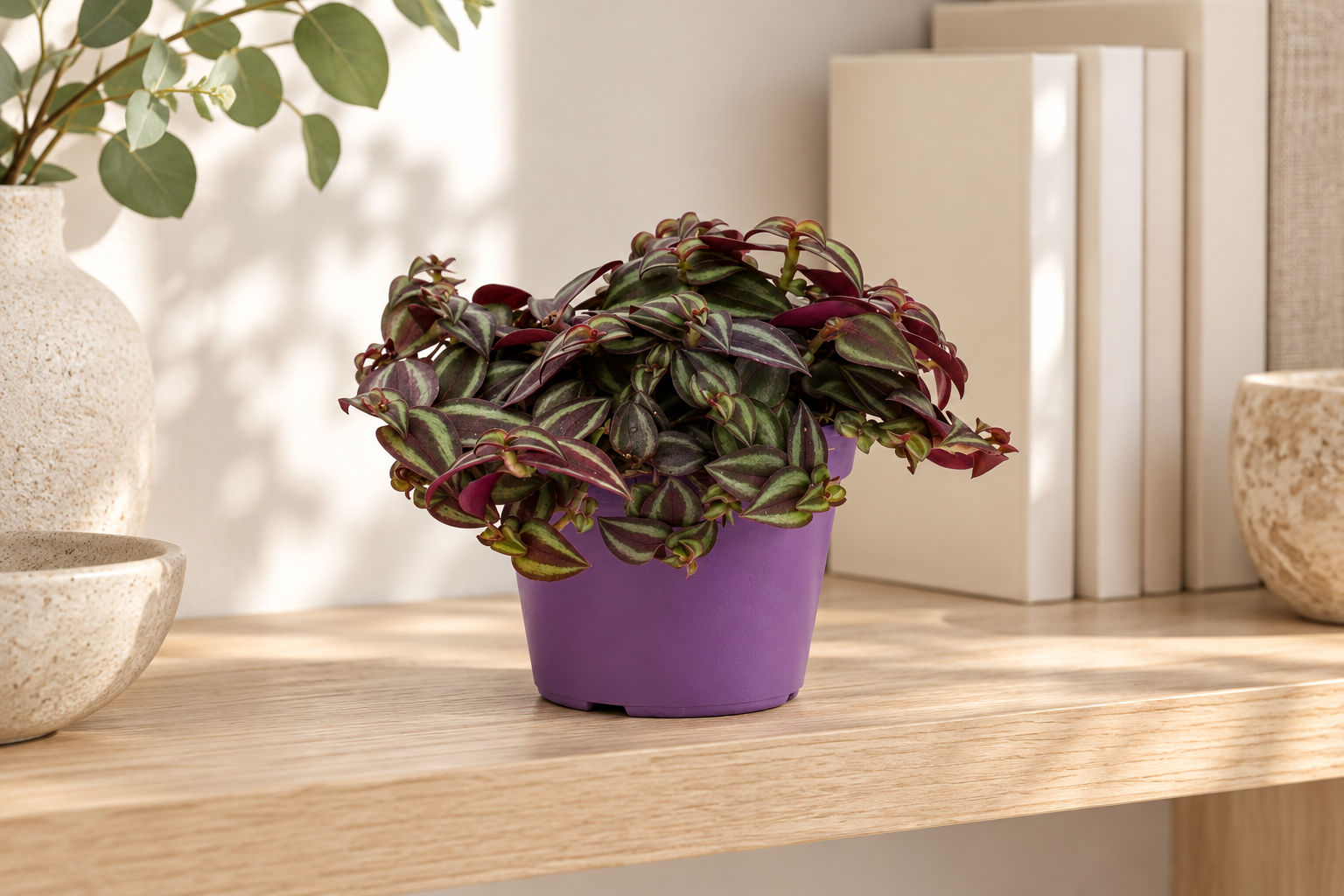
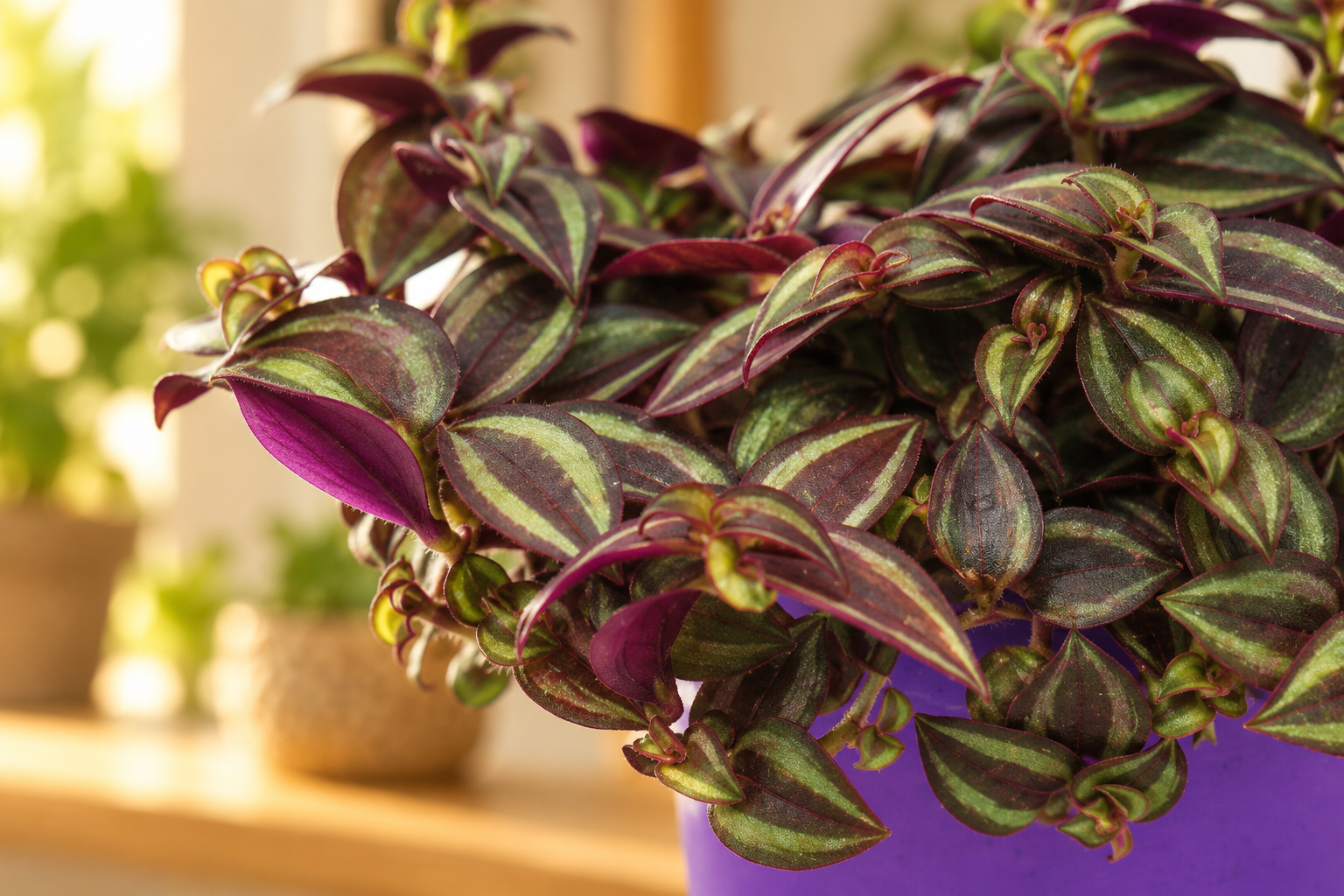
The young low crown carries dark violet leaves with lengthwise stripes appearing greenish to silvery. Turn leaves slightly and their violet undersides come into view. Purple Passion is this selection’s shop name. A study of the Tradescantia collection assigns this trade name to cultivar Tradescantia zebrina ‘Burgundy’. Both names help find it again; visible stripes distinguish it from uniformly violet tradescantia. On a pale open shelf, its colour looks especially attractive beside quiet materials. The crown remains the focus instead of disappearing among numerous decorations.
A low beginning with moving shoots
In its 12-cm pot, the delivered plant measures roughly 12 to 15 cm total height including the container. The low measurement does not indicate a permanently short shoot length. Shoots can hang over the edge as growth continues. Leave space at the shelf front without pushing the pot far enough forward to risk tipping. Support the pot while unpacking and free the soft shoots from the wrapper. Existing compost and a suitable position suffice initially; immediate substantial cutting or a much larger container are unnecessary.
The shelf needs a bright open position
Filtered daylight supports dense structure. A compartment near a suitable light source can work; deep in the room or beneath a closely overlying shelf, the same plant still looks decorative but receives less light. Long gaps between leaves and bare lower sections invite a look at the position. Increase strong sun exposure gently after shipping. A light curtain helps with hot sunshine behind glass. Compare new leaves in similar light rather than answering every changing colour impression with more fertiliser.
Supply evenly beneath the crown
You can feel the topsoil between two shoots. When it has dried slightly, check root-ball weight and moisture too. Water slowly directly onto the compost until the root zone is supplied, then let excess drain. Constantly wetting dense leaves is not a better water supply. Dry and waterlogged roots can both cause limp growth. Do not water wet compost further as a precaution. Warm days, new shoots and a thickening crown alter demand; a fixed appointment overlooks this development.
Small cuts preserve graceful movement
If individual shoots grow too long, shorten healthy tips above a node. The remaining crown can keep growing. This lets you observe and gently influence the plant’s direction. Healthy shoot sections with nodes suit cutting experiments in a small suitable container; rooted plants can later fill bare areas. Remove dead leaves from the dense base. Wear gloves when cutting and avoid sap contact, as it can irritate sensitive skin. Clean tools and an accessible workplace make these small care tasks simpler.
Match compost and pot to the root ball
Loose houseplant compost in a pot with drainage holes provides a sufficient foundation. If roots densely fill the ball and it dries very quickly despite careful watering, a little extra pot space is useful. A greatly enlarged container instead holds an unnecessary reserve of moist compost. Feed during active growth according to the label, allowing for nutrients in fresh compost. Do not force every care task at once. Resolve an identifiable difficulty first and inspect new shoots; this makes it easier to judge which change really helped.
A violet crown also has a winter routine
Keep frost-free and as bright as possible. With reduced growth, water demand often drops; dry heated air can still dry the small pot faster. Check both before watering. Look beneath leaves for pests and clear dead foliage from the bases. Small three-part flowers are possible but not a reliable indoor expectation. The foliage plant is not intended for eating and belongs somewhere inaccessible to nibbling pets. A photograph of the young crown in the plant book later shows how its low beginning became longer moving shoots.
One plant, several views

Good to know
Is Purple Passion uniformly violet?
The checked selection shows violet surfaces with greenish-silvery lengthwise stripes. It belongs to the zebrina type.
What does Burgundy mean?
A directly checked cultivar study lists Purple Passion as the trade name of Tradescantia zebrina Burgundy. The shop name remains visible in the portrait.
Does the plant stay 12 to 15 cm tall?
This is the young delivery’s total height. Shoots grow further later and can hang down.
How do I water beneath dense foliage?
Check topsoil in a clear gap and water slowly directly onto the compost. Let excess drain.
Why do shoots become bare below?
Ageing and insufficient light can contribute. Check the position and selectively use healthy tips for rejuvenation.
May I prune it?
Yes. Shorten overly long healthy tips above a node. Gloves protect against irritating sap.
Sources and editorial note
- Exotenherz: offer and original photographs (03.10.2026)
- NC State Extension – Tradescantia zebrina (03.10.2026)
- Avery Rowe – RHS Coke Trust: study of Tradescantia varieties, page 8 (03.10.2026)
- RHS – light, pots and ongoing houseplant care (03.10.2026)
- Iowa State University – caring for houseplants (03.10.2026)
Shop offer, article number, GTIN, availability and original images checked directly on 02.10.2026; specialist acceptance 03.10.2026. Specialist sources read directly. Current offer and original checked directly on 03.10.2026. NC State read in full; RHS/Iowa houseplant care read directly. Avery Rowe’s report (RHS Coke Trust) saved locally and page 8 read directly with pypdf: Purple Passion as the trade name of cultivar Burgundy. Original photograph morphology matches the striped zebrina type; not equated with Tradescantia pallida Purple Pixie. Delivery size 12–15 cm including pot, without a promised later shoot length. Compared with the complete published tradescantia-zebrina-guide and tillandsia-ionantha-guide.