This plant at Exotenherz
Check the shop offer for current availability, price and what is included.
Check the shop for the current price, availability and offer contents.
Your care table
| Topic | What to do | Why it helps |
|---|---|---|
| Light | Bright with filtered sun, protected from hot midday heat. | The low plant needs light down to the compost surface. |
| Water quality | Use suitable low-mineral water. | Mineral-rich watering burdens the sensitive culture. |
| Moisture | Keep compost evenly wet; check controlled tray watering. | The fine carpet must not dry out completely. |
| Compost | Use a suitable unfertilised carnivorous-plant mix. | Ordinary pre-fertilised potting soil does not suit this culture. |
| Food | No routine houseplant fertiliser applications. | Nutrient-poor cultivation is not replaced by heavy feeding. |
| Air | Bright warm conditions with some air movement. | A dark closed jar can favour algae and mould. |
| Flowers | Handle delicate stalks gently. | Flowers are possible, not a guaranteed delivery component. |
| Winter | Keep frost-free and continue checking water level. | Even quieter growth does not allow prolonged drying. |
Use clean rainwater or suitable distilled water. An ordinary jug filter does not reliably remove dissolved salts.
Put a little water in the saucer. The base of the pot stands in water; the compost surface and centre of the plant remain well above it.
Keep the root ball moist and the saucer clean. Light, temperature and the species-specific winter care in the table determine its needs.
These flowers deserve a closer look
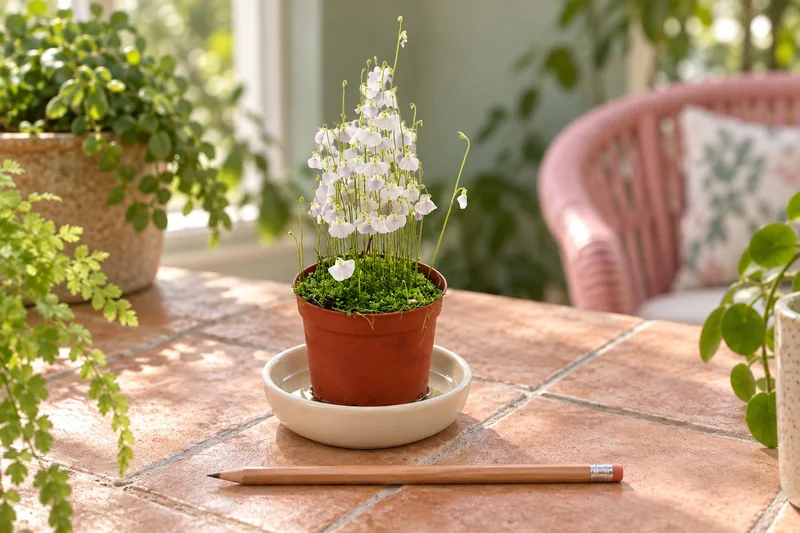
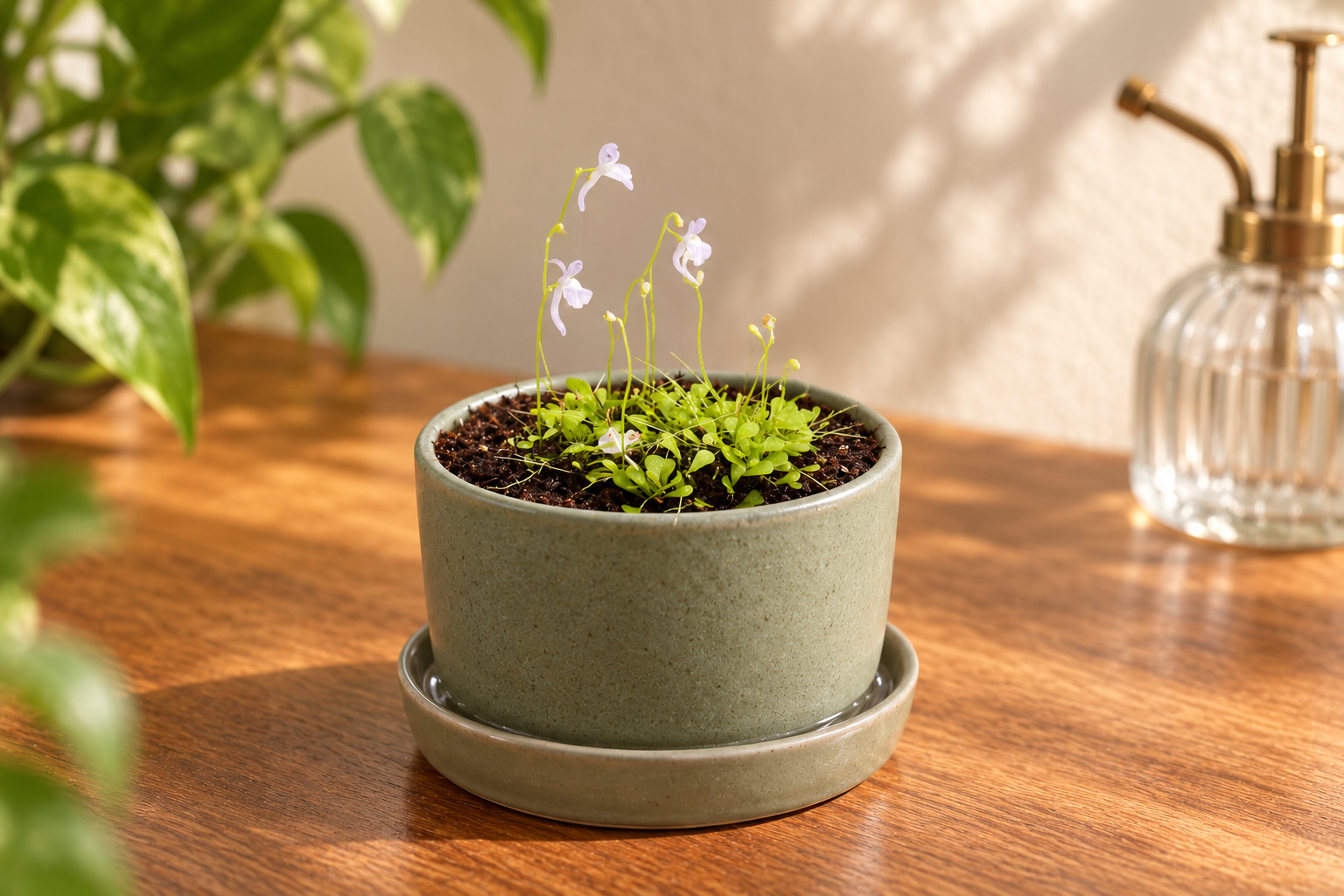
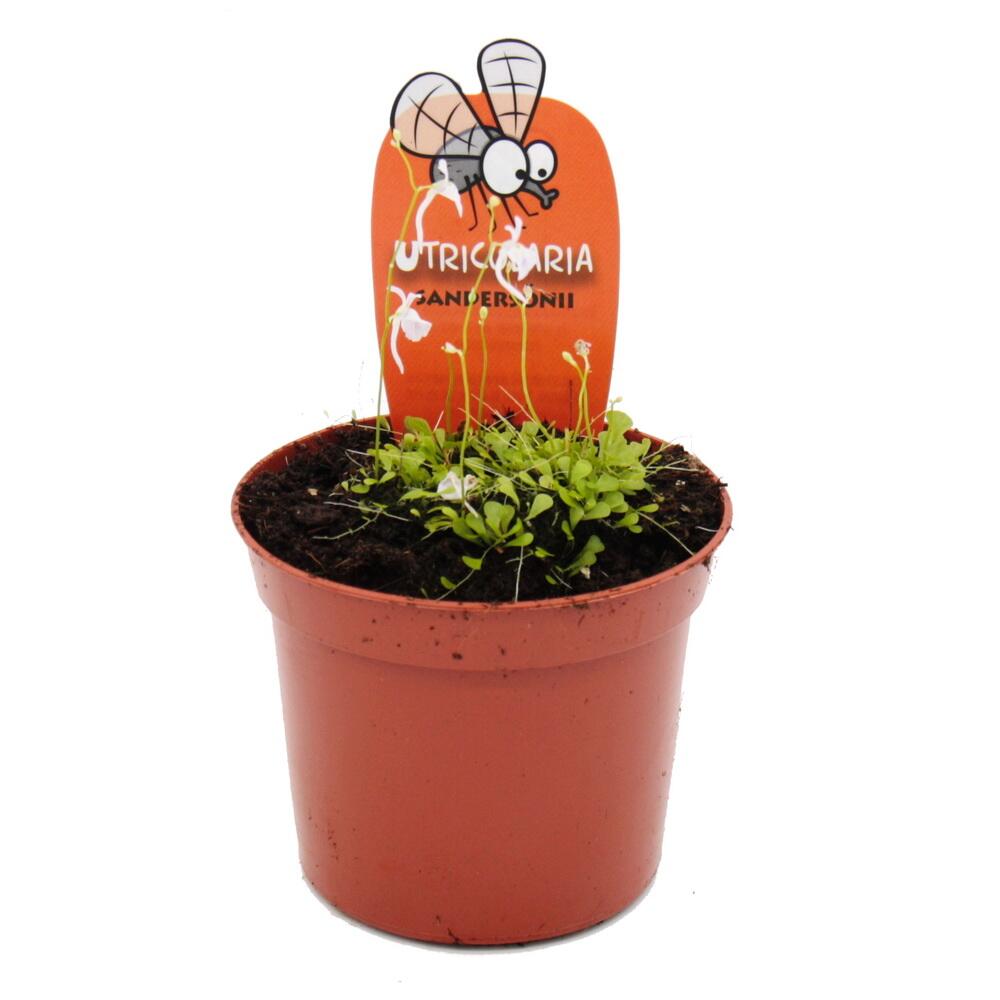
Utricularia sandersonii is a plant for small discoveries. Delicate flower stalks stand above a low green carpet; its little white to pale-lilac flowers resemble bunny faces in shape. I like placing the pot in a bright spot where one can comfortably lean over it. From a distance the fine detail would easily be lost. The offer states a nine-centimetre pot. No particular flower count or height is inferred from that. The scene uses the small starting plant and shows possible flowers, while the unchanged shop image beside it preserves the actual offer presentation.
A bladderwort without a large pool
The genus name easily creates a mistaken image. This species is grown terrestrially on moist compost rather than treated as a permanently submerged aquarium plant. Its tiny bladder traps are hidden in or around the underground network. They catch very small organisms; this is no promise to remove visible flies from a room. At the surface we mainly see small green foliage and flowers. I do not dig up the carpet to show the traps. The plant stays an interconnected small culture and needs its moist nutrient-poor base.
Water quality belongs to the essential care
Low-mineral water matters for this carnivore. Suitable clean rainwater, reverse-osmosis water or distilled water may be used. Ordinary mineral-rich tap water does not become suitable irrigation simply because it is pleasant to drink. I keep a separate little container ready so it is not accidentally watered with all the other houseplants. Rainwater’s origin and cleanliness are considered. A decorative bottle in the scene remains just a design idea. Actual water quality matters, not how attractive the watering can or how small the container looks.
The carpet must not stay dry for long
Compost stays evenly wet. Controlled tray watering can help make moisture easy to manage. The water level is still checked rather than forgotten for days. The small plant is treated neither like a drought-tolerant succulent nor permanently kept completely underwater. I watch how quickly water is used at my own position. A warm bright room changes that pattern. The small leaf surfaces do not always reveal a dry pot clearly at an early stage. Checking compost and tray therefore counts more than asking whether the fine flowers still look pretty.
Soil is deliberately kept nutrient-poor
A suitable unfertilised carnivorous-plant mix forms the base. Ordinary pre-fertilised potting soil is not used. Nor does the plant routinely receive the fertiliser used for a neighbouring ficus. I do not try to feed the hidden traps pieces of meat or captured large insects either. Such additions can dirty the small culture without fitting its lifestyle sensibly. When a pot change is necessary, the existing network is handled gently. Division is possible in a well-developed planting, but not merely to count particularly many flower stalks in a small pot.
Light must reach the low surface
A bright warm position with filtered light makes it easy to observe the green carpet and flower development. Hot direct midday sun behind glass is avoided. The plant does not stand in the shade of a large neighbouring pot even if the two look lovely together on the table. A terrarium can be designed suitably, but needs enough light and air movement. A dark tightly closed jar is no automatic improvement. I keep the surface clean and gently remove dead flower stalks without pulling healthy foliage. Sensitive fine stalks tolerate rough handling considerably less well than the nursery pot.
Water remains under observation in winter too
The plant is kept frost-free. A warm bright interior makes for calmer cultivation than a cold balcony where a small water tray can quickly chill. Flowers may develop repeatedly in suitable conditions; no fixed monthly calendar is promised. With algae, mould or declining growth, water quality, air movement and light are checked rather than heavy feeding applied. Care knowledge thereby stays aligned to its special lifestyle. The scene shows a small collector’s spot with a decorative container. It turns the offered carnivore neither into a large flowering perennial nor into reliable household pest control.
One plant, several views
Good to know
Is it an aquarium plant ?
This species is grown terrestrially on wet compost, not permanently completely submerged.
Does it catch flies in the room ?
Its tiny hidden traps catch very small organisms; control of visible houseflies is not promised.
Which water suits it ?
Suitable low-mineral rainwater, reverse-osmosis or distilled water.
May it receive ordinary potting soil ?
Use no standard pre-fertilised soil; choose a suitable nutrient-poor carnivorous-plant mix.
Is it fed like a ficus ?
No. No routine heavy applications of houseplant fertiliser.
Must the pot dry out ?
No. The small carpet is kept evenly wet and tray water is checked.
Are bunny flowers always present ?
Flowers are possible, but number, timing and delivery condition are not promised.
Sources and editorial note
- Exotenherz: offer and original images (01.10.2026)
- Sarracenia Northwest: Utricularia sandersonii and cultivation (01.10.2026)
- New England Carnivorous Plant Society: terrestrial utricularias (01.10.2026)
Shop offer, SKU, GTIN and availability checked live on 01.10.2026. Original photograph unchanged. Our own researched gardening texts and individually accepted scene. Terrestrial carnivorous-plant cultivation. No promise of housefly control, no ordinary houseplant feeding.