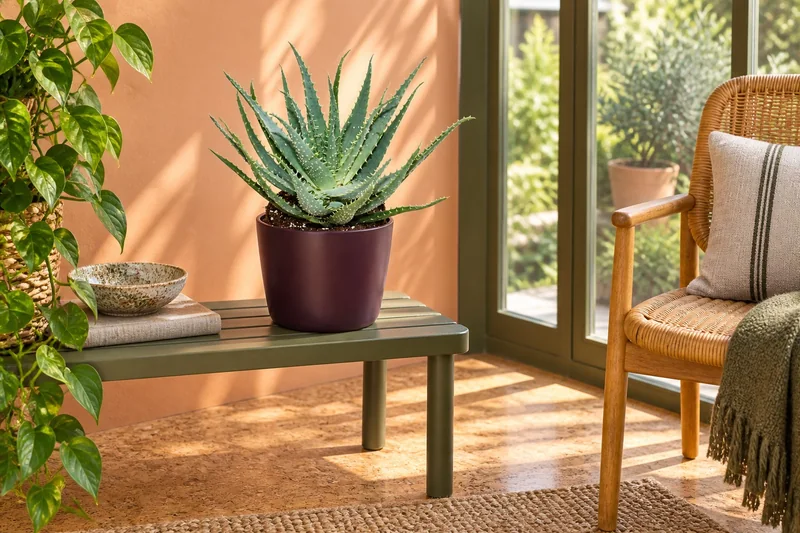
This plant at Exotenherz
Check the shop offer for current availability, price and what is included.
Check the shop for the price, current availability and what is included.
Your care table
| Topic | What to do | Why it helps |
|---|---|---|
| Light | Very bright; acclimatise slowly to sun | The narrow rosettes need enough energy |
| Water | Let the compost dry well between waterings | Fleshy leaves store moisture |
| Hanging pot | Reach it safely for watering and let it drain afterwards | Water must not remain hidden in an outer container |
| Compost | Use a free-draining succulent mix | Air in the root zone helps prevent constant wetness |
| Winter | Keep bright and frost-free; cooler conditions around 10–15 °C are possible | Water considerably less when growth slows |
| Fertiliser | Feed moderately during growth according to the label | A small plant does not need large reserve applications |
| Propagation | Carefully divide healthy rooted daughter rosettes | Their own roots make establishment easier |
| Use | Do not use as food or skin gel | This portrait describes an ornamental aloe |
Check the compost and pot weight. The care table explains how far the compost may dry.
Water only when needed. The water should reach the root ball without spilling over the rim.
Remove surplus water from the saucer or cachepot. Then return the plant to a suitable position.
The spider-like form comes from narrow leaves
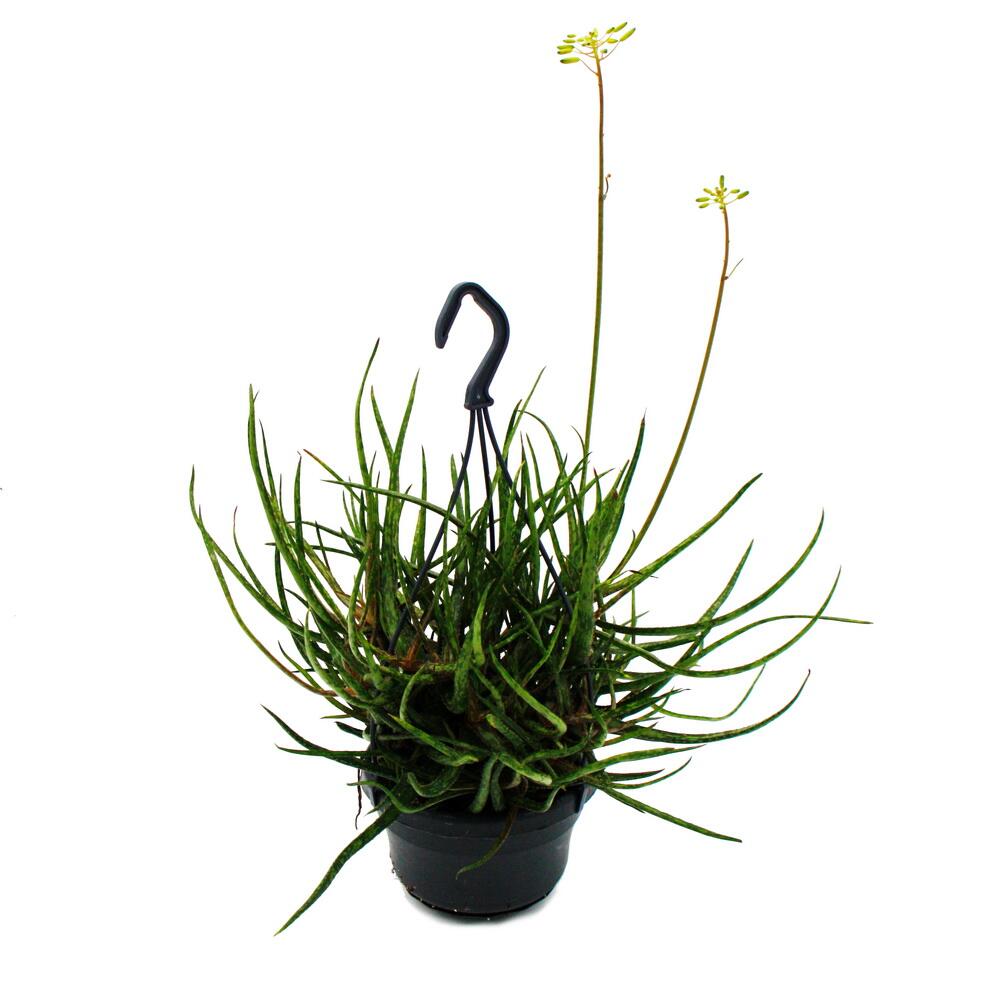
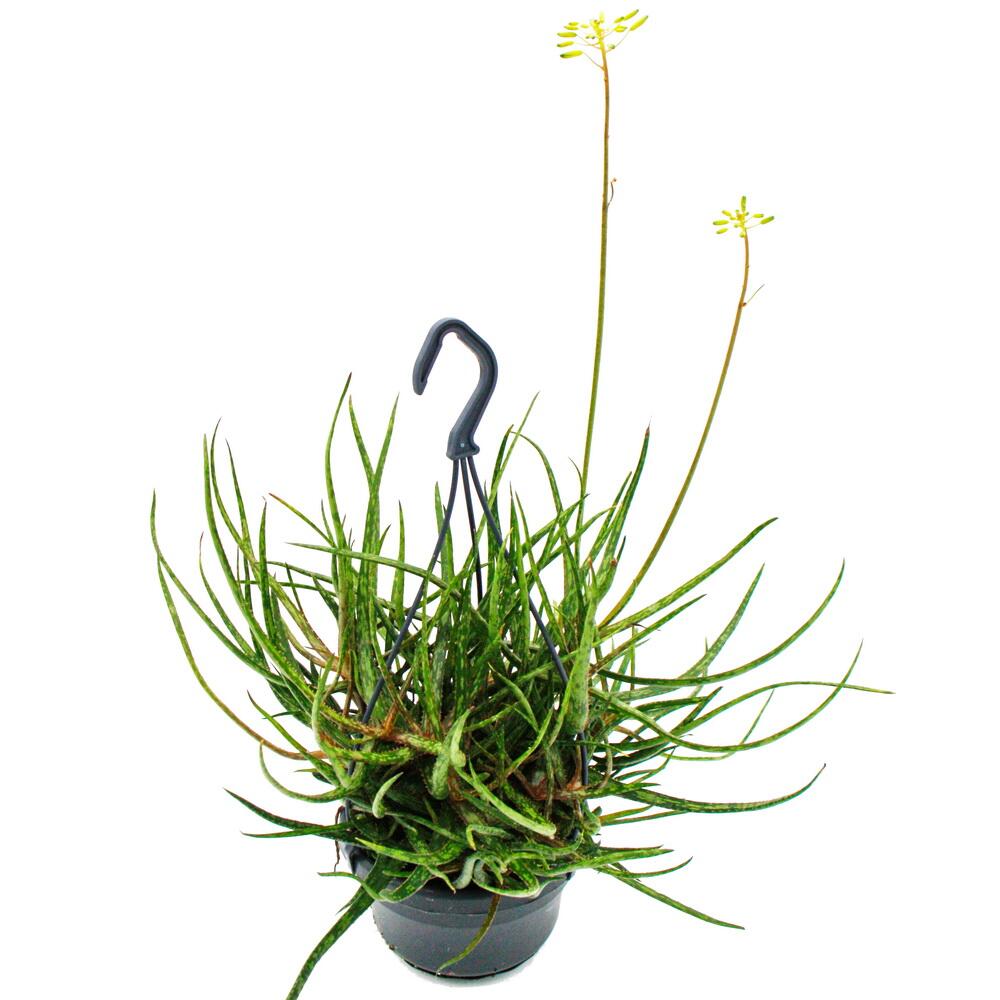
Long narrow leaves sit in small rosettes, bearing pale spots and fine teeth along their edges. Numerous daughter rosettes create a lively, almost shaggy clump. The name spider aloe describes this impression; it does not mean that the plant attracts spiders. Aloe bakeri comes from Madagascar. The different South African origin stated in the shop text is therefore not adopted. Botanically it belongs to the asphodel family and differs clearly from a large broad-leaved Aloe vera.
A small hanging pot, usually delivered without flowers
The offer states a 14 cm hanging pot and approximately 20 to 25 cm overall height. Hanging supports and long flower stems are not useful guides to the size of the green clump. The supplier notes that delivery is usually without flowers. Our new scene therefore shows only the foliage plant. The hanging pot needs a weight-bearing fixing and should remain easy to reach for checking and watering. Free space around the rim prevents narrow leaves from constantly being bent by passers-by.
Bright cultivation rather than a dark indoor corner
Good daylight and sunshine after gradual acclimatisation support strong growth. After transport, do not immediately hang it beside the hottest south-facing pane. With insufficient light, stems and leaves can weaken and stretch more. A sunny outdoor position in mild summer weather is possible after acclimatisation, provided rain does not remain in the container. Bring it indoors before cold wet autumn weather. A bright frost-free place suits winter; cooler cultivation around 10 to 15 °C calls for particularly restrained watering.
Water must drain from a hanging pot too
Check moisture before watering and let the compost dry well between applications. If necessary, safely take down the hanging pot for watering and supply the root zone evenly. Afterwards, drain fully. A closed decorative outer basket must not collect water unnoticed. Small containers dry faster on warm sunny days than in winter, so do not use an unchanging weekly amount. Avoid constantly wet rosette centres. Soft dark leaf bases are a reason to check the roots rather than immediately watering again.
Divide rosettes and keep compost airy
Free-draining succulent compost and a container with drainage suit cultivation. Support the clump underneath when repotting; narrow leaves are not carrying handles. Healthy daughter rosettes with their own roots can be gently separated. Let injured areas dry first before creating consistently damp conditions. Choose only a moderately larger hanging pot so surplus compost does not stay wet for long. Feed moderately according to the label during active spring and summer growth. Accompany resting periods with less water rather than forced extra feeding.
Flowers as a bonus and health as the measure
In suitable conditions, slender flower stems with tubular flowers can appear. They are an attractive bonus, not a reliable annual date for every houseplant. Carefully remove the stem once flowering has completely finished. Inspect dense rosettes for mealybugs and dry old leaf remains. Occasionally removing dead material improves visibility without thinning healthy leaves. This aloe is ornamental, not a source of homemade medicinal gel or food. Treat leaf tips and small marginal teeth with care, particularly when taking down the hanging pot.
One plant, several views
Good to know
Does spider aloe attract spiders?
The name refers to its narrow leaves. No special attraction of spiders is inferred from it.
Is it delivered with tall flower stems?
The shop states that delivery is usually without flowers. The scene accordingly shows only the foliage plant.
Is Aloe bakeri from South Africa?
The species is native to Madagascar.
Can I use it like Aloe vera for gel?
This offer is grown as an ornamental plant and is not recommended for producing skin gel or food.
Sources and editorial note
- Product and delivery contents: Exotenherz
- Royal Horticultural Society: plant and care information
- Royal Horticultural Society: plant and care information
Sources checked: 15 September 2026. Product information and the contents of delivery follow the linked shop offer. Care advice was checked against the cited specialist sources and should still be adapted to the plant’s condition, position and season.