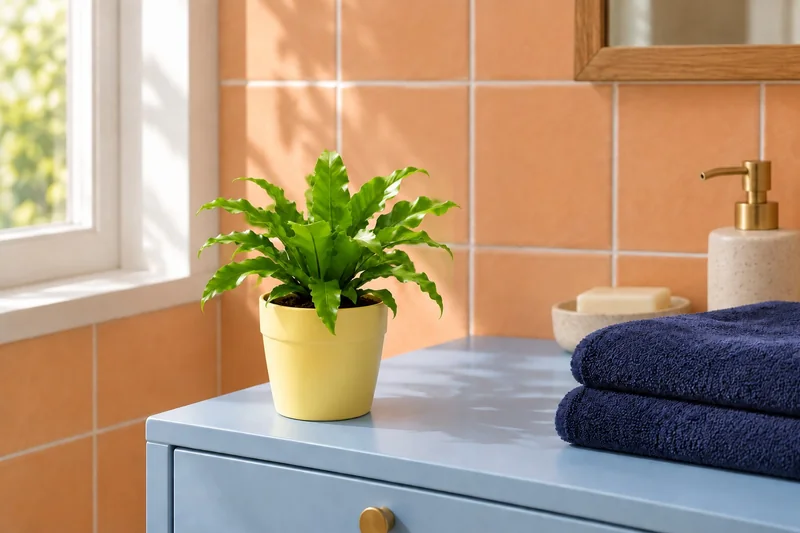
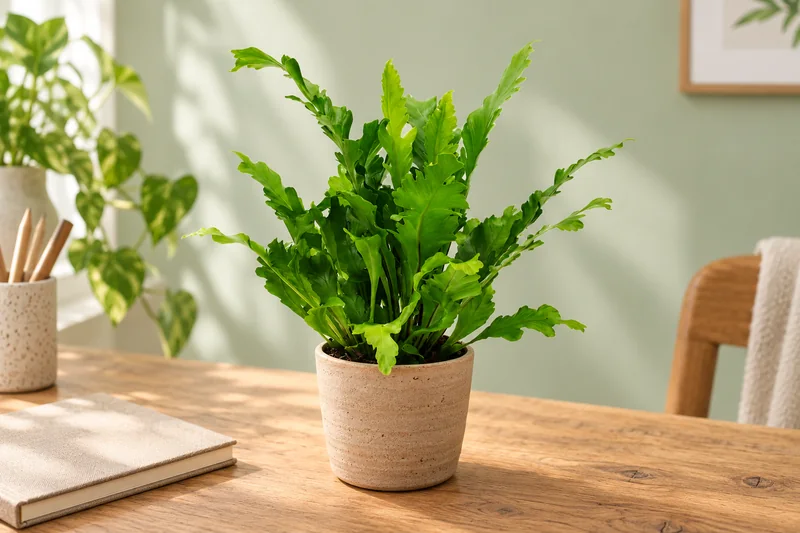
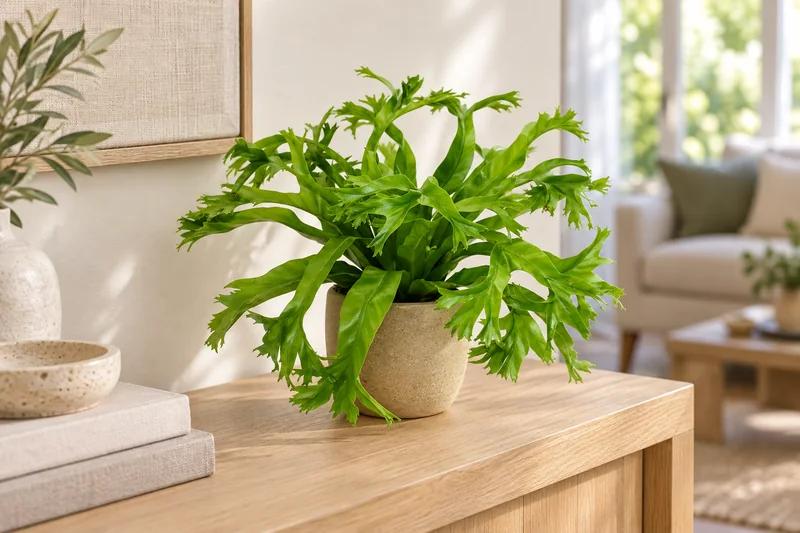
This plant at Exotenherz
Check the shop offer for current availability, price and what is included.
Check the shop for the current price, availability and offer contents.
Your care table
| Topic | What to do | Why it helps |
|---|---|---|
| Shelf position | Choose an open bright compartment with clearance around frond tips. | Foliage needs daylight and space, not just an attractive surface. |
| Moisture | Keep the root ball slightly moist and check its condition regularly. | A completely dry pot stresses the fern. |
| Watering | Water the soil slowly at the rosette’s edge. | Closely packed young tips remain protected. |
| Drainage | Remove excess water from the cachepot. | Higher air humidity does not require wet roots. |
| Room climate | Move away from radiators and cold airflow. | Frilled leaf ends have many sensitive edges. |
| Soil | Use a humus-rich porous mix with free drainage. | An airy root ball is easier to monitor. |
| Nutrients | Feed moderately according to the label during growth. | Consider fresh compost and small pot size when deciding quantity. |
| Care | Remove dead fronds and do not pull open young fans. | New leaves develop their shape themselves. |
Check the compost and pot weight. The care table explains how far the compost may dry.
Water only when needed. The water should reach the root ball without spilling over the rim.
Remove surplus water from the saucer or cachepot. Then return the plant to a suitable position.
Frilled fans rather than fine feathered leaves
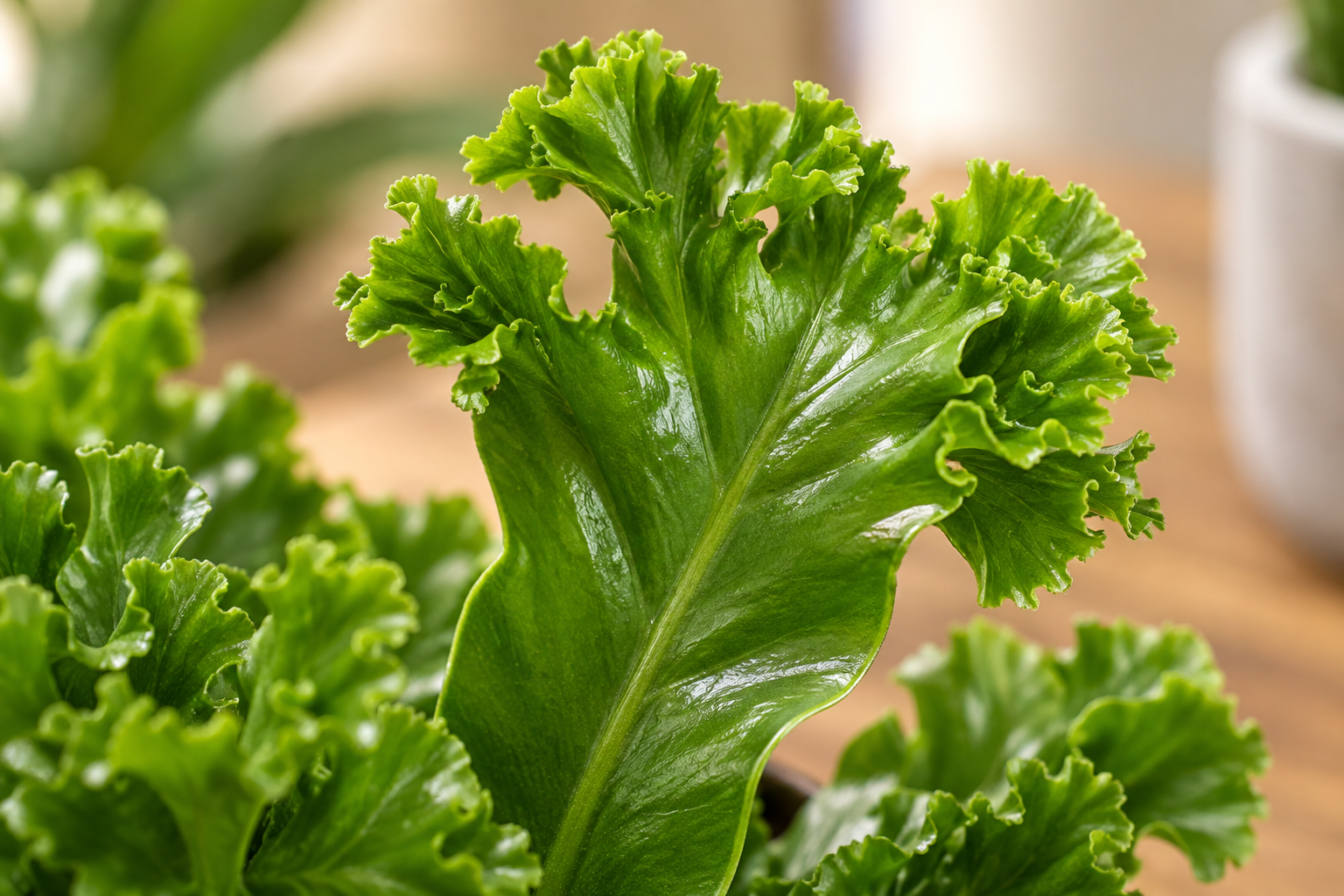
In Leslie, each frond begins as a broader green surface and ends in a frilled fan-shaped tip. The foliage forms a small dense rosette that looks almost round from above. Original images show the difference between the leaf centre and the more divided end very well. A bright open bookshelf gives this structure a calm background. Leave space beside and above it so the tips do not rub against book edges or boards. A single small fern is enough as a subject. Its many green folds need no extra decoration to look interesting.
A young plant with room to develop
Leslie is offered in a 12 cm pot at about 20 to 30 cm overall height including the pot. RHS lists Asplenium antiquum 'Leslie' as a compact form with a possible later height around 60 cm. This describes a developed plant under suitable conditions, not delivery height. The fern remains perennial and evergreen while its cultivation suits it. Flower colours and flowering months do not belong in this portrait: ferns form spores. Attractive frilled tips are frond tissue, not a flower head. In a young rosette, healthy new foliage comes first.
Light reaching the open shelf compartment
A shelf suits the plant if indirect daylight actually reaches the leaf surfaces. On a rear shelf far from a window, conditions may be worse than the bright room initially suggests. Hot direct sun, however, stresses fronds. Choose a sheltered warm position a little away from heating. Leslie likes a less dry environment, but not a narrow permanently wet compartment. Avoid cold currents when airing the room. Turning it slightly to look at it differs from repeatedly moving it between entirely different light and temperature conditions.
Reach the soil beneath the frilled foliage
The dense rosette may conceal the soil. Check gently at a clear spot and notice the weight of the pot. The top layer may begin drying slightly; the whole root ball should not repeatedly dry out. Water slowly onto soil at the edge until roots are supplied, and let excess drain. Check a narrow-rimmed cachepot afterwards. The centre of the rosette is not a funnel for a permanent water reserve. If leaves appear limp despite wet soil, first examine the root situation and drainage.
Repot without gripping the fans
Loose humus-rich fern compost stores moisture and lets water drain. When roots clearly fill their space during active growth, carefully provide a little more room. Support the root ball from below and do not grip the dense leaf tuft. Retain the original planting depth. An oversized new pot contains much unrooted soil that may stay moist for a long time. Use fertiliser sparingly according to the label when new fronds develop. Consider fresh pre-fertilised compost. A strong nutrient dose does not make frilled tips more reliable or beautiful; good roots and suitable light support development.
Each new leaf needs time
Rolled young fronds appear in the centre and open gradually. Do not pull their future fans apart with your fingers. Sensitive tissue may tear. Clean older dusty surfaces carefully without rubbing hard at folded edges. Remove completely dead fronds with clean tools and retain healthy green growth. Regular spore-bearing structures on a mature underside differ from irregular detachable deposits. For propagation, a single young rosette is not simply torn apart. Watching its leaf development is already an enjoyable part of fern care.
Winter care in the actual position
Leslie continues to be kept warm and frost-free indoors in winter. Soil may dry more slowly with little new growth; a shelf above warm heating may simultaneously have very dry air. Brown frilled edges therefore call for looking at the root ball and air, not merely a larger watering vessel. Also check undersides and leaf bases for changes. Treat a problem only after identifying it, and do not test strong sprays indiscriminately on sensitive fern foliage. A securely placed pot prevents the rosette tipping when a book is removed. Its position can be attractive and practical at the same time.
One plant, several views
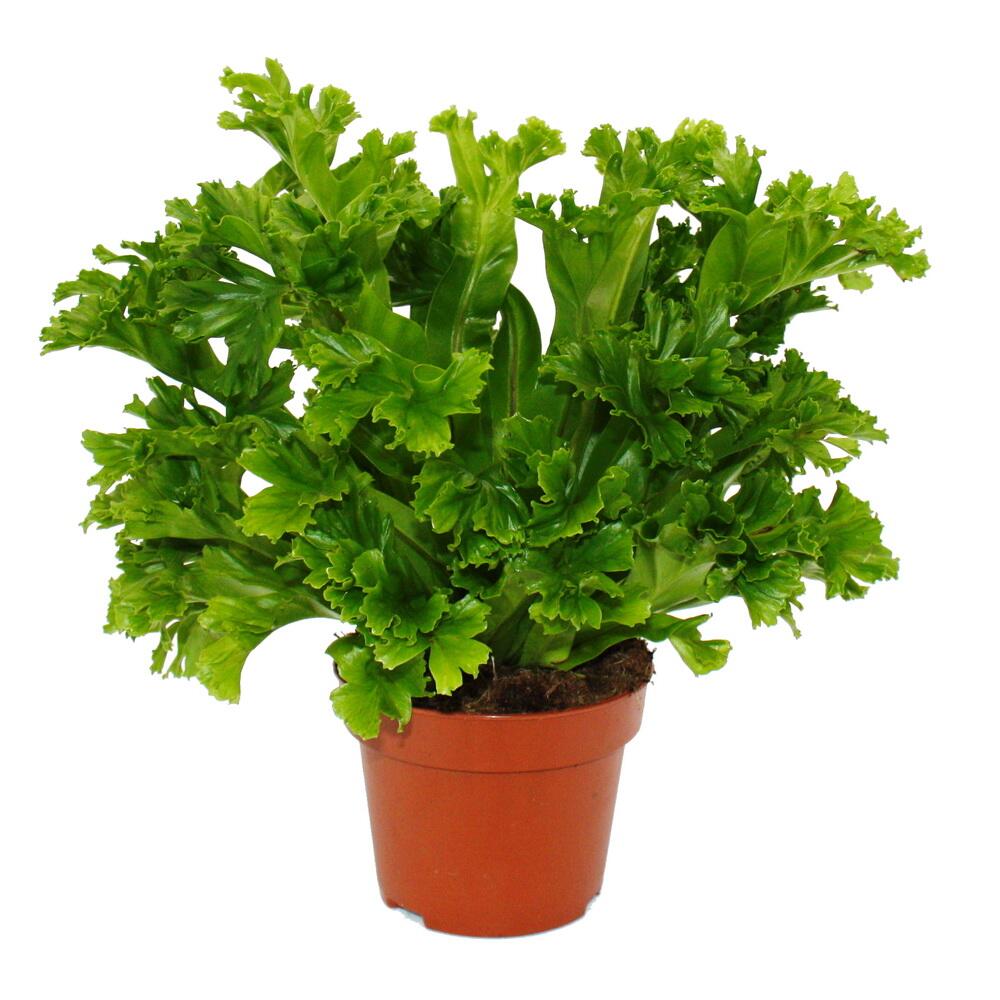
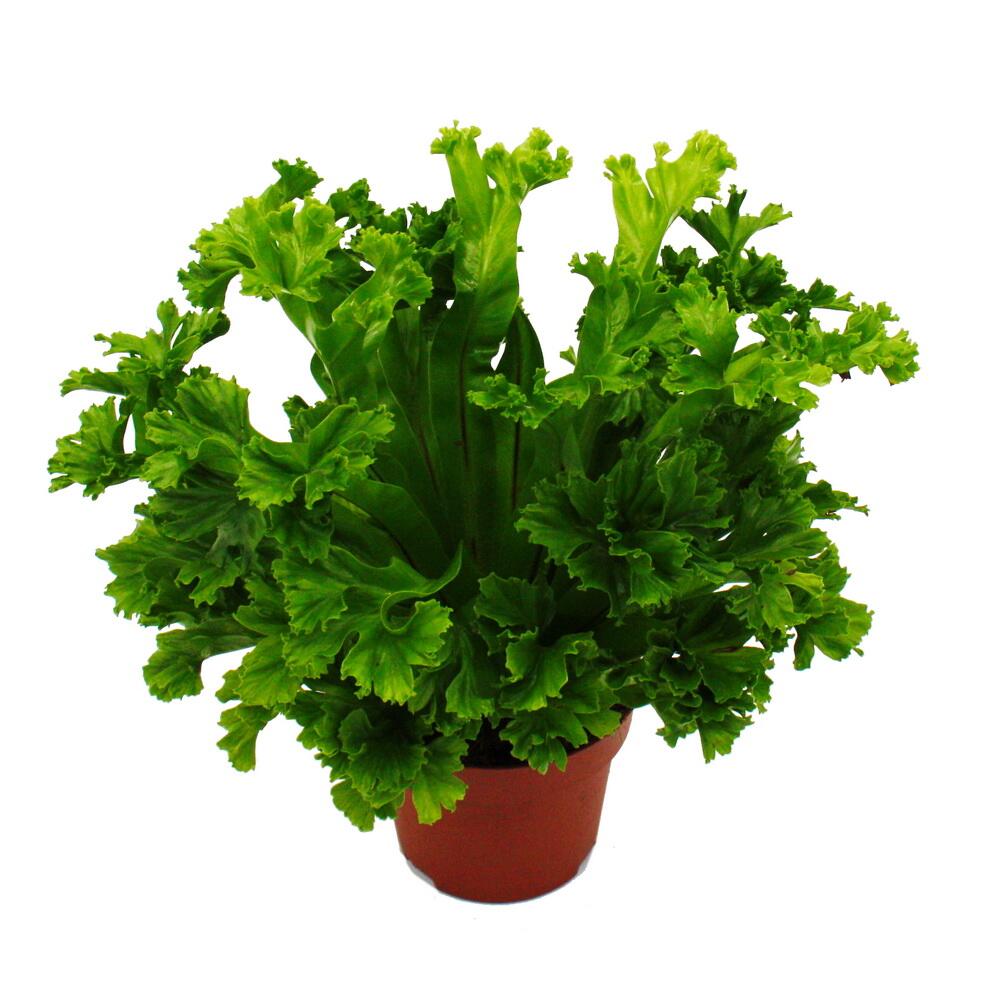
Good to know
Are the frilled tips normal?
Yes. Fan-shaped ruffled frond ends characterise Leslie. Brown dead edges, however, are not part of the desired leaf appearance.
Does it stay 25 cm tall?
That is its approximate young delivery size. Under suitable conditions, Leslie may later develop considerably further.
Can it go on a bookshelf?
A bright open compartment with indirect daylight and enough clearance is suitable. A dark narrow compartment is not.
Why not water into the centre?
Young growth sits there. Water is directed onto soil and excess drained away.
Can I simply divide it?
Do not tear apart a single young rosette. A suitable propagation method depends on its stage of development.
What helps brown tips?
First check root-ball moisture, heating air and fertilising. Already brown tissue does not turn green again; continuing healthy development matters.
Sources and editorial note
- Exotenherz: offer and original images (02.10.2026)
- RHS: Asplenium antiquum Leslie, growth and cultivation (02.10.2026) (02.10.2026)
- NC State Extension: bird’s-nest fern, rosette growth and indoor cultivation (02.10.2026) (02.10.2026)
- UF/IFAS: bird’s-nest ferns, fronds and spores (02.10.2026) (02.10.2026)
- RHS: potted ferns, watering and leaf care (02.10.2026) (02.10.2026)
Shop offer, product number, GTIN, availability and originals checked directly on 02.10.2026. Specialist sources read directly. Leslie confirmed through RHS cultivar profile and original images; later size explicitly separated from delivery height.