This plant at Exotenherz
Check the shop offer for current availability, price and what is included.
Product and delivery details are given in the individual offer.
Your care table
| Topic | What to do | Why it helps |
|---|---|---|
| Arrival | Check root ball, fruiting branches and short supports; carry by the container. | Fruits add weight to delicate branches. |
| Position | Choose warm, sunny and sheltered conditions; introduce stronger sun gradually. | Light and frost-free conditions support further fruit development. |
| Repotting | Provide more root space and open drainage holes for summer cultivation. | The small delivery pot has limited water and nutrient reserves. |
| Support | Loosely support fruit-bearing branches if necessary. | Even a compact bush can tip under the weight of fruit. |
| Watering | Check moisture regularly and water slowly in the root zone when needed. | Even supply reduces strong moisture fluctuations. |
| Feeding | During fruit development, dose tomato fertiliser according to its label. | Too much nitrogen can encourage foliage rather than further fruits. |
| Pruning | Leave healthy bush sideshoots; selectively remove damaged parts. | Cherry Tomato Red does not need sideshooting like a cordon tomato. |
| Harvest | Carefully pick individual fully red fruits and wash them. | Ripening stages differ; leaves and stems are not a kitchen harvest. |
| Season’s end | Act before frost and let healthy unripe fruits ripen indoors if appropriate. | A summer tomato crop does not guarantee year-round production. |
For young plants, feel the soil directly at the root ball. The surface and deeper soil may have different moisture levels.
Water thoroughly after planting; later, water according to the soil, weather and establishment rather than a fixed calendar.
Avoid standing water. For plants in containers, also check that water runs out of the drainage hole.
A compact bush with small round tomatoes
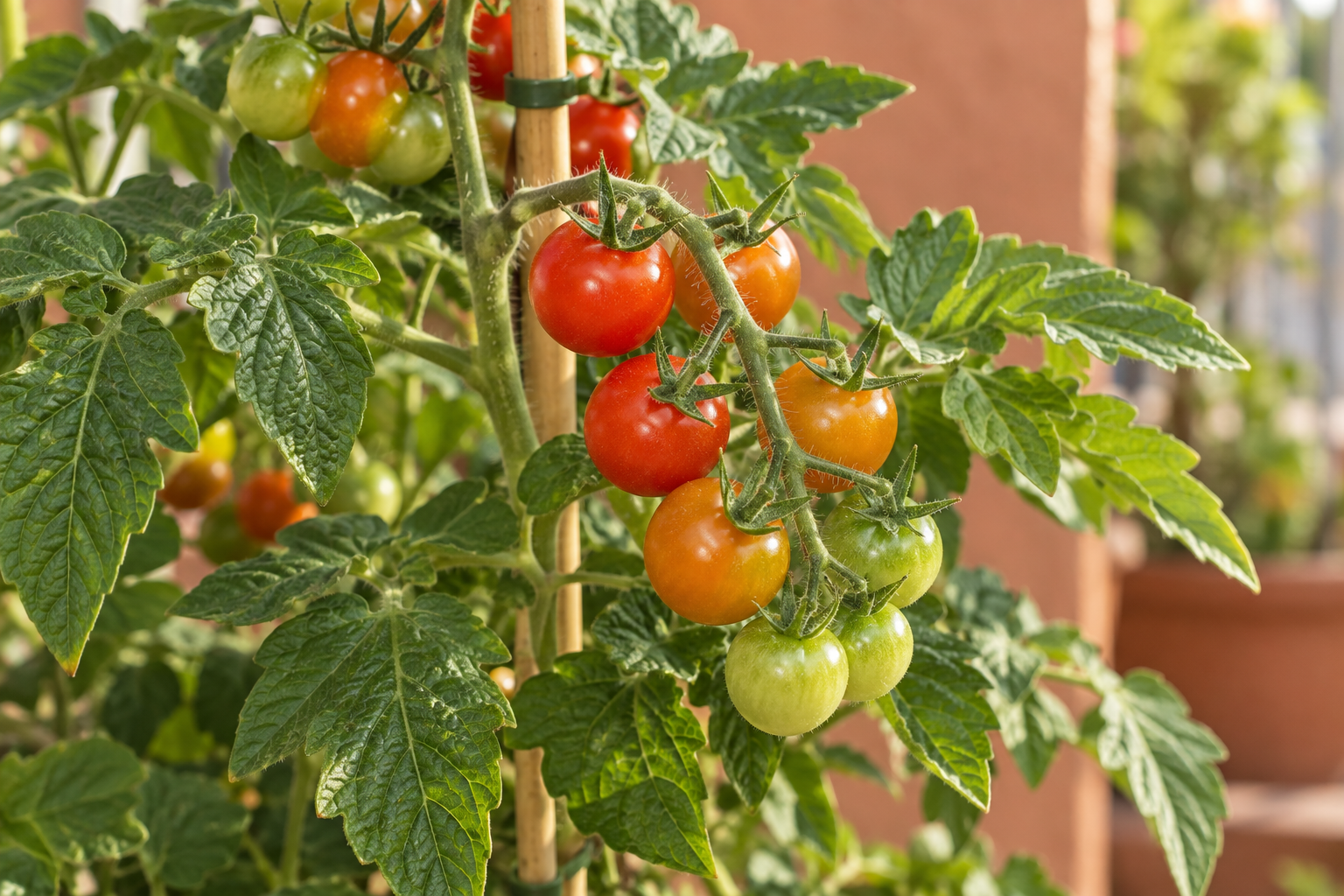
Cherry Tomato Red has small round fruits hanging among strong green leaves. Green, orange and red stages can be visible together; the commercial selection is described as producing red ripe cherry tomatoes. The leaves are divided, their leaflets look slightly crinkled and have toothed edges. Fine hairs cover the green shoots. Botanically it is Solanum lycopersicum, a tomato in the nightshade family. Cherry Tomato Red here identifies the producer’s named compact commercial selection, without assigning it an additional undocumented cultivar name. It grows as a bush tomato with limited tip growth. Its sideshoots are retained for this structure. The small red fruits invite picking when ripe; a constantly full red truss is not a permanent condition.
The offered plant already carries fruits
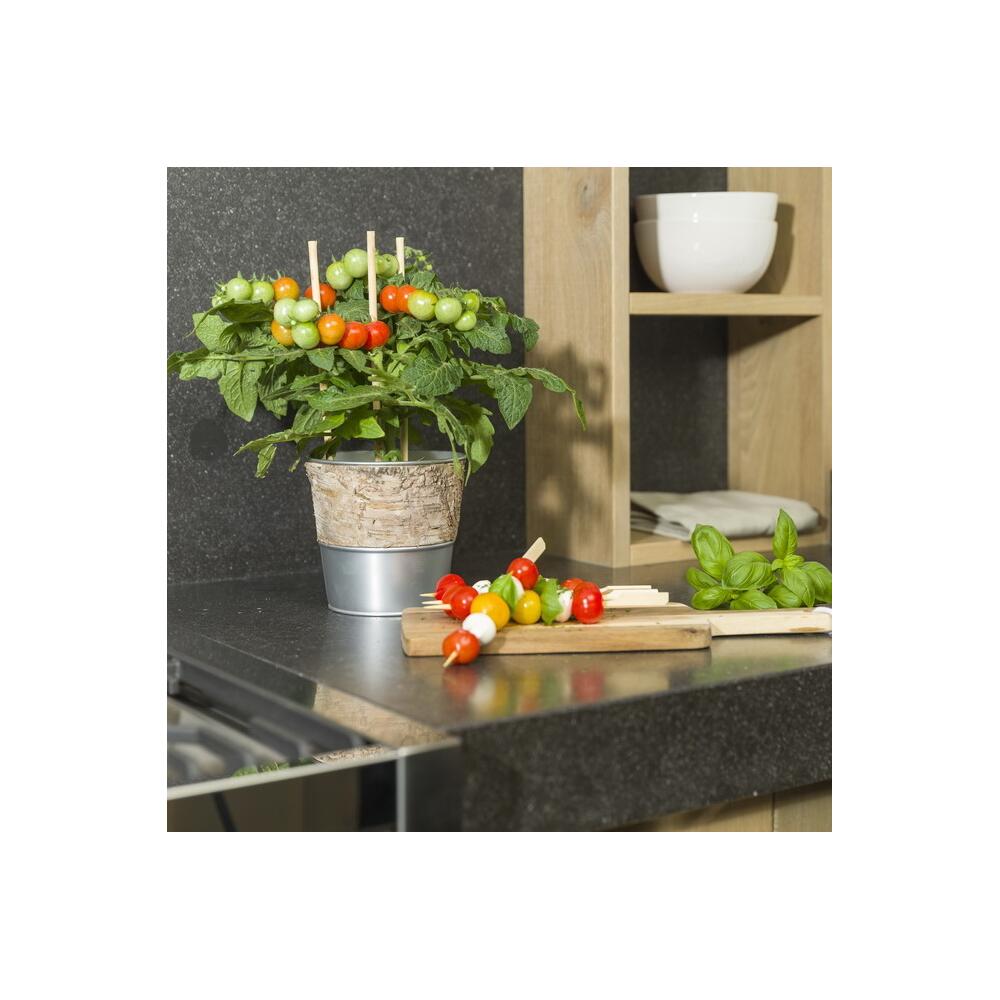
The offer states one plant with fruits in a 14 cm pot and approximately 45 cm plant height. This is described as plant height, not total height including the container. Fruit number and ripening stages can differ. On arrival, first inspect the root ball, branches and supports. Slowly moisten a dry small pot; afterwards remove water from the outer pot. Carry the plant by its container so heavy fruiting branches are not put under pulling strain. This compact bush is not a tall cordon tomato. Its later shape depends on supply and cultivation; the offered measurement does not imply a guaranteed mature height. The clean kitchen original shows a decorative situation. Longer-term growth needs a bright warm cultivation position, not just any dark worktop.
Choose light, warmth and wind protection together
A sunny sheltered balcony, a warm garden position or a well-ventilated greenhouse are suitable. Gradually introduce a previously sheltered plant to stronger sun and outdoor air. Permanently shaded foliage provides poorer conditions for further development. At the same time, do not let the small pot dry out between hot paving slabs. The tomato is frost-sensitive. It goes outside only when there is no further frost risk and temperatures remain reliably warm. One mild afternoon is not enough. As nights cool, the plant needs a sheltered transitional position. Under glass, consider ventilation and heat build-up; foliage and fruit should experience neither cold wind nor persistently stuffy humid air between closely packed pots.
Give more root space for the rest of the season
The 14 cm pot is a compact starting size. For further summer cultivation, a larger container with free drainage and fresh suitable compost helps. For bush tomatoes, approximately 30–45 cm container diameter is general guidance; one plant receives its own root space. Before repotting, moisten the root ball and support fruiting branches. Tomatoes can form additional roots on a buried lower stem. Remove lower leaves that would otherwise end up underground and do not bury fruiting branches. When planting in the garden, approximately 45–60 cm spacing is general tomato guidance, adapted to the actual bush. Allow air and access for care and picking. An existing short support remains useful when fruits pull individual branches down.
Even moisture matters more than a watering calendar
Check the soil and pot weight before watering. In warm balcony air, a small fruiting root ball can dry quickly, while cooler days demand less water. When necessary, water slowly in the root zone until the soil is moistened and excess water drains freely. Sudden changes between strong drying and large amounts of water encourage fruit splitting. Dark sunken areas at the fruit end can also relate to disrupted water supply. Keep moisture as reliable as possible without standing the pot in water. For growing fruits, dose a suitable tomato fertiliser according to its label. Excessively nitrogen-heavy feeding can encourage plenty of foliage at the expense of fruit development. More fertiliser replaces neither light nor a properly functioning root ball.
Retain bush shoots and pick individual ripe fruits
This self-limiting bush selection does not require sideshooting. Do not remove its healthy sideshoots using a routine for tall cordon tomatoes: these carry more leaves and developing fruits. Cleanly remove damaged parts if necessary and loosely support heavy branches. Small yellow star-shaped flowers appear during summer cultivation; successful fruit set develops into fruits. Development and ripening depend on light, warmth and supply, not water alone. Carefully pick individual fully red fruits without tearing off the entire truss. Even an already fruiting delivery needs time to develop further green fruits. Washed ripe tomatoes belong in the kitchen; leaves and stems stay on the plant or are excluded during maintenance pruning.
Watch the season and bring it to a timely close
Here, tomatoes are usually grown as frost-sensitive summer crops. As days shorten and nights become cooler, ripening slows. Neither year-round harvest nor complete ripening of every new fruit set can be promised. Before frost, suitable healthy unripe fruits can be brought indoors to finish ripening; discard rotten or badly damaged fruits. With yellow leaves, first check root-ball moisture, light and root condition. Spots and rapidly wilting shoots need closer inspection rather than simply more fertiliser. Clean containers and supports for the next season and plan fresh cultivation conditions. In a garden bed, changing the growing position in relation to other nightshade crops helps. This small current plant remains a seasonally cared-for bush tomato, not a permanently self-supplying harvest arrangement.
One plant, several views
Good to know
Should I remove the sideshoots?
The offered Cherry Tomato Red is a bush tomato with limited tip growth. Retain healthy sideshoots; it is not sideshot using a cordon tomato routine.
Does 45 cm include the pot?
The offer explicitly describes this value as plant height. No additional total height including the container is inferred.
Can it keep fruiting on a dark kitchen worktop?
A decorative original scene does not show a permanent growing position. Further development needs enough light and warmth; a sunny sheltered outdoor position is suitable in the frost-free season.
Why do some tomatoes split?
Strong moisture fluctuations can encourage fruit splitting. Check the root ball reliably and supply water evenly, without constant water in the outer pot.
Can I certainly ripen every new truss?
Ripening depends on light, warmth, time and supply. Especially towards the end of the season, complete ripening of all set fruits is not guaranteed.
Is the 14 cm pot ideal for the whole season?
It is the offered starting size. More root space and free drainage ease further summer cultivation and increase water reserves.
What needs doing before the first frosty nights?
Protect the plant and harvest in time. Suitable healthy unripe fruits can be brought indoors to finish ripening; the tomato is not a frost-hardy winter crop.
Sources and editorial note
- Exotenherz: delivery offer and original photographs
- Pick & Joy: Cherry Tomato Red producer profile
- RHS: complete tomato care guide
- NC State Extension: botanical tomato profile
The fruiting delivery form and its further seasonal cultivation are described separately. Check availability in the shop.