This plant at Exotenherz
Check the shop offer for current availability, price and what is included.
Product and delivery details are given in the individual offer.
Your care table
| Topic | What to do | Why it helps |
|---|---|---|
| Light | Keep bright in filtered daylight without hot midday sun. | The different leaf colours need a suitable light position. |
| Water | Water each root ball thoroughly after slight surface drying. | Three pots in the same position may dry at different speeds. |
| Drainage | Let inner pots drain and empty outer pots. | Constant wetness can damage roots. |
| Soil | Use a loose, permeable houseplant mixture. | Air and available moisture support new roots. |
| Training | Let shoots hang freely or guide them on a suitable support. | Philodendrons can be grown trailing or climbing. |
| Pruning | Shorten long shoots selectively during growth and wear gloves. | Nodes are the starting point for new growth; sap may irritate. |
| Nutrition | Feed sparingly according to the label when fresh leaves form. | More food cannot replace a brighter position. |
| Winter | Keep warm, adequately bright and without cold draughts. | Adjust watering to need during reduced growth. |
Check the compost and pot weight. The care table explains how far the compost may dry.
Water only when needed. The water should reach the root ball without spilling over the rim.
Remove surplus water from the saucer or cachepot. Then return the plant to a suitable position.
Three greens with related leaf shapes
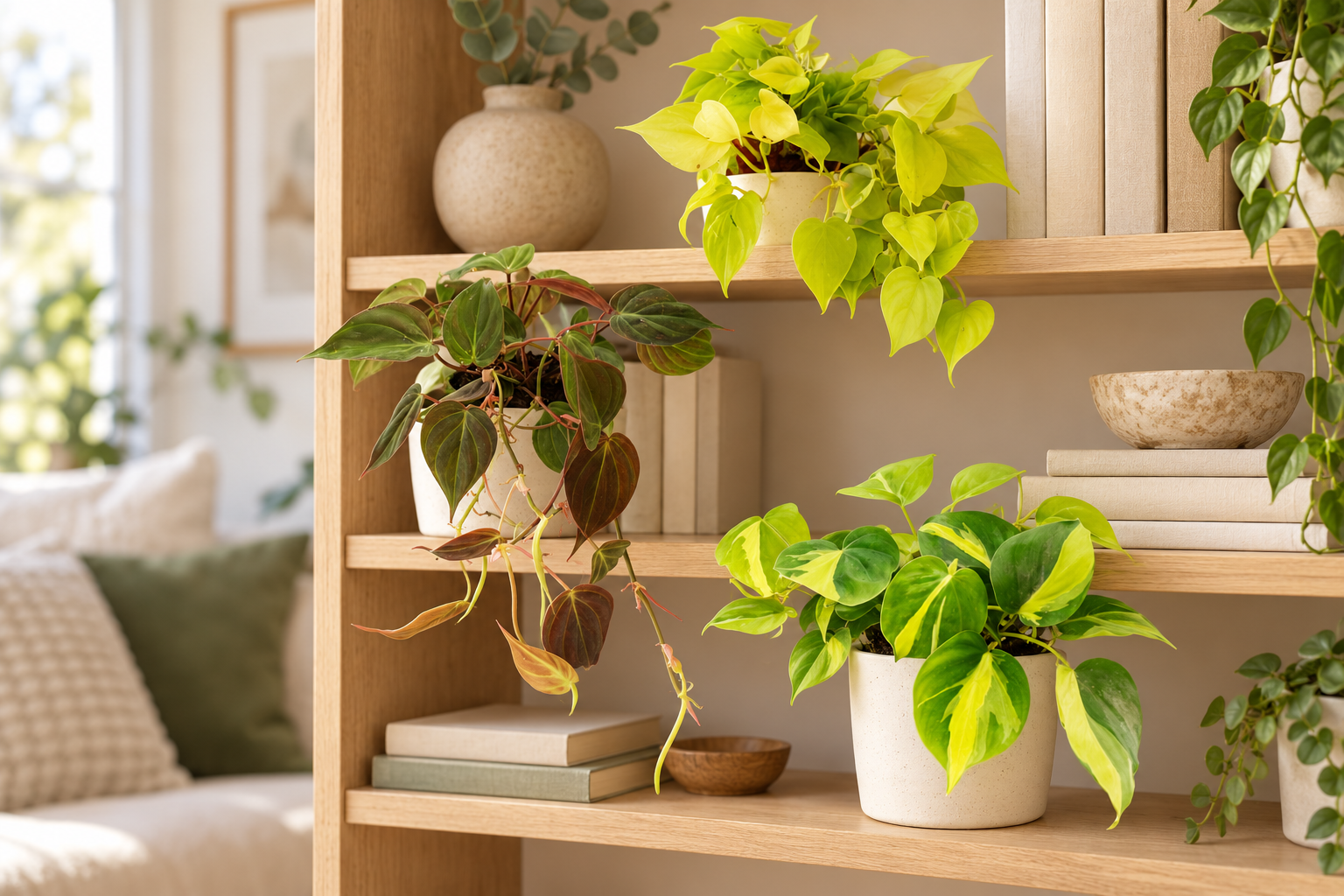
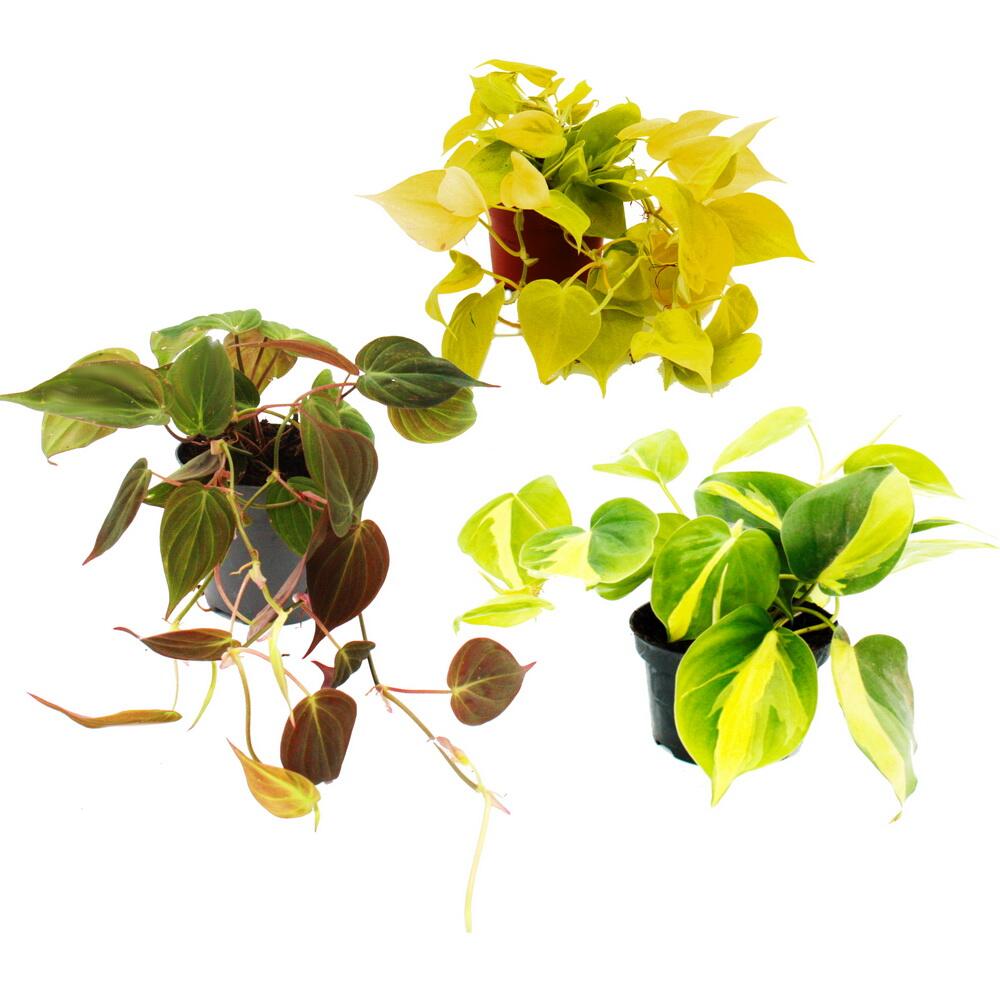
The direct comparison attracts us to this trio. Micans shows velvety-looking dark foliage with bronze tones. Lime adds pale lime-green leaves. Brasil carries green-yellow areas whose distribution can change between leaves. All three develop heart-shaped leaf outlines along slender shoots. On a bright shelf this creates movement without a row of large specimen plants. Leave some air between containers and free paths for shoots. A calm background reveals the differences more clearly than a collection of colourful objects where leaf tips constantly disappear.
The offer consists of three individual plants
Micans, scandens Lime and scandens Brasil are delivered, each in a 12 cm pot. No fixed total height is stated. These trailing forms’ shop names also occur today within the Philodendron hederaceum group. We use the offered trade names so the plants stay easy to identify. These are three separate root balls, not a pre-planted shared container. The scene’s decorative outer pots and shelf are not included. You can display the trio together or place individual pots in suitable spots. Even side by side, every plant needs its own moisture check.
A shelf position should suit the light
Bright filtered daylight supports fresh leaves and an attractive structure. A bookcase suits them if it receives enough light and does not stand deep in a dark recess. Shield strong midday sun behind glass cautiously. The paler areas of Lime and Brasil are no reason to expose the pot to maximum heat. New shoots help assessment: if gaps grow long and foliage becomes smaller, check the position. One darker or yellower leaf is not automatically a care mistake in variegated forms. Overall development matters more than an isolated colour.
Shoots may hang or climb
Without support the slender shoots grow over the rim. A suitable climbing support lets them be guided upwards. Choose the direction according to available space and keep young tips away from sharp edges. Aerial roots at nodes belong to the growth habit and do not need removing. If a shoot becomes too long, shorten selectively during good growth with clean tools. Wear gloves because sap may irritate. Healthy sections with a suitable node can be used for a cutting experiment. A single cut leaf without a stem node does not replace such a cutting.
Every root ball gets suitable water
Before watering, feel the upper soil and lift the pots. When the surface has dried slightly, water slowly and thoroughly. Then let it drain and empty outer pots. Micans may stand beside Lime and still show a different need, for example because leaf mass or light differs. A shared watering day may therefore be a check, not an automatic equal amount of water. If one root ball stays wet for a long time, consider light, temperature and mixture. Repeated complete dryness is not the goal either. With limp foliage, check roots first rather than adding water based only on appearance.
Develop root space and nutrition calmly
A loose, well-draining houseplant mixture keeps moisture available and allows air into the root ball. With crowded roots, later move to a suitably larger size. The plants do not have to be put together in a giant pot immediately after purchase. Much unused soil makes drying harder and hides differences between root balls. During new leaf growth, feed moderately according to the label and allow for fresh pre-fertilised soil. Keep warm and adequately bright in winter. If growth slows, the group generally needs less water and food but still attention to each individual pot.
Attractive foliage belongs in a safe place
Philodendron parts are not for eating. Keep trailing tips out of reach of small children and animals; a high shelf helps only if long shoots do not hang back into their reach. Check leaf undersides and nodes too. Assess yellow foliage together with root-ball moisture, light and possible pests. Do not polish velvety micans vigorously to make it shiny. Its surface belongs to its character. These differences make the trio attractive: three related plants whose new leaves unfold individually in a well-chosen place.
One plant, several views
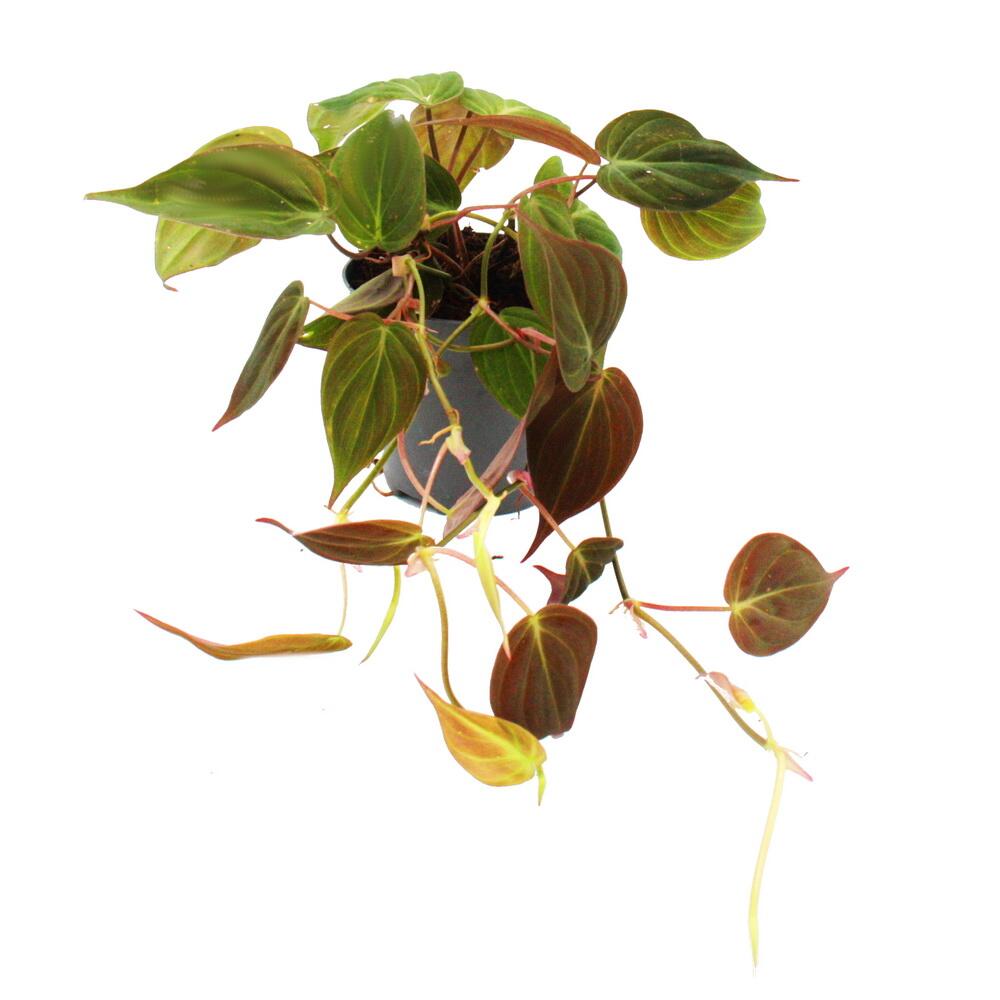
Good to know
What does the trio contain?
One each of micans, scandens Lime and scandens Brasil in 12 cm pots.
Is a fixed delivery height stated?
No. The three pot sizes are confirmed in the offer but no fixed total height.
Must the plants climb?
No. They may hang over a container rim or grow on a suitable support.
Can I plant them together immediately?
Separate root balls initially make individual moisture checks easier. A shared container needs enough space and good drainage.
How do I propagate a long shoot?
A healthy stem section needs a suitable node. Work with clean tools and gloves.
Are they suitable for animals to nibble?
No. Do not eat plant parts and position out of reach of children and animals.
Sources and editorial note
- Exotenherz: offer and original images (02/10/2026)
- NC State Extension: Philodendron hederaceum and commercial forms (02/10/2026)
- RHS: growing philodendrons (02/10/2026)
Shop offer, article number, GTIN, availability and original images checked directly on 02/10/2026. Specialist sources read directly. Three separate 12 cm pots. No unconfirmed delivery height or three independent botanical species claimed. Leaf colours and safety information supported.