This plant at Exotenherz
Check the shop offer for current availability, price and what is included.
Check the selected shop offer for price, availability and delivery contents.
Your care table
| Topic | What to do | Why it helps |
|---|---|---|
| Light | Place very brightly and acclimatise gently to sunshine. | Pale plant parts are not abruptly exposed to hot sun. |
| Water | Let the rootball dry considerably between waterings. | Succulent shoots store water. |
| Drainage | Remove all excess. | Waterlogging stresses roots and shoot bases. |
| Compost | Well drained with suitable mineral components. | Compost should be able to dry again after watering. |
| Nutrition | Feed sparingly during active growth. | Strong doses do not reliably produce prettier colouring. |
| Pot | Increase only modestly when required. | Too much moist compost increases the risk of wet roots. |
| Handling | Use gloves; do not cut unnecessarily. | Escaping latex may irritate skin and eyes. |
| Winter | Keep bright and frost-free, reducing watering considerably. | Reduced activity changes consumption. |
Check the compost and pot weight. The care table explains how far the compost may dry.
Water only when needed. The water should reach the root ball without spilling over the rim.
Remove surplus water from the saucer or cachepot. Then return the plant to a suitable position.
Pale columns with a surprising colour
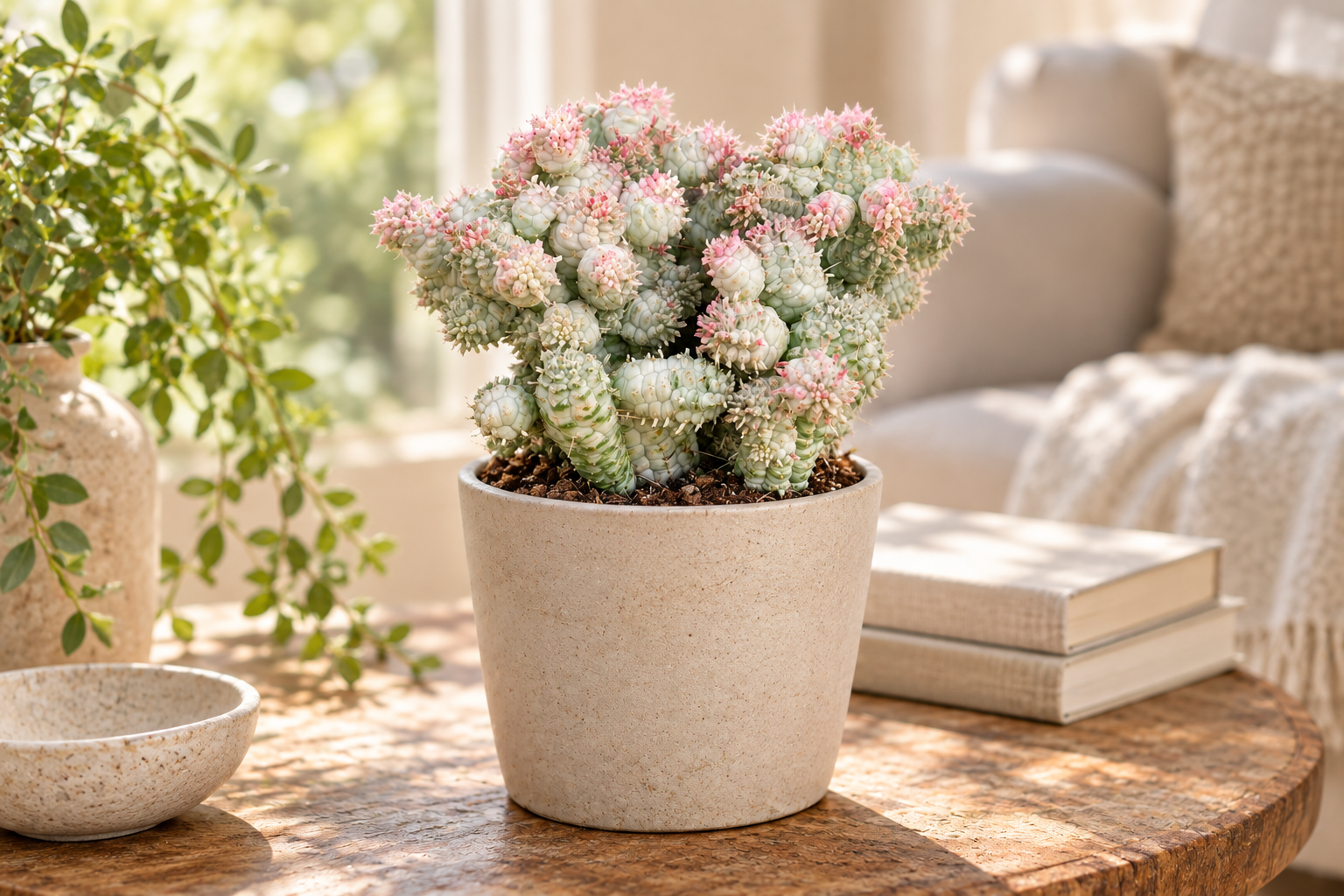
This euphorbia builds small branching columns with a surface of clearly visible tubercles. In the variegated form, creamy pale and greenish areas alternate while young parts may look pink. I like the quiet contrast on bright wooden furniture with a simple sand-coloured cover. The offer states approximately thirty centimetres of overall height and a fourteen-centimetre pot. The scene stays with this delivered size and shows the branching form of the original photograph. A larger older specimen with many extra columns would be a different developmental stage. Colour and branching remain individual in a living plant even when its basic shape is easily recognisable.
A spurge rather than a cactus
Euphorbia mammillaris belongs to the spurge family. The columnar succulent form may recall cacti but is classified differently botanically. The Variegata variety has pale areas that create its special impression. Pink parts are not automatically flowers, and this portrait promises no particular floral display. Firm healthy shoots and a well-supplied root area are decisive. I do not treat the plant like an object that must stay unchanged without light or water. It continues to grow under suitable conditions while branching changes. Its latex is also an important difference to consider in all handling.
Plenty of light with gentle adjustment
A very bright position supports typical development. Direct sunshine is introduced gradually rather than moving the plant straight from protected cultivation into hot radiation behind glass. Pale areas deserve particular attention. A deep, dark position is less suitable long term, even if the colour remains decorative there. I check the position throughout the day and watch for strong pot heating. A new pink shade alone is no certain measure of perfect care. The whole plant remains decisive: firm shoots, a suitable rootball and no newly developing dried or soft damaged areas.
Drying belongs to water balance
Between waterings, the rootball may dry considerably. Once the compost has dried accordingly and the plant is actively growing, it is moistened evenly. Excess drains and does not remain in an outer cover. Moisture stored in shoots does not mean unlimited abstinence from water, but it also does not make daily little sips sensible. I inspect the actual pot and keep its size in mind. A sunny, warm position changes consumption while a darker, cooler week reduces it. If shoots turn soft, roots and rootball are examined first; extra watering is not automatically the right reaction.
Well-drained compost keeps care manageable
Suitable succulent compost with mineral components prevents the growing medium staying heavy and wet for long. A container with clear drainage holes is part of this. If the rootball makes good use of the pot, repotting into a modestly larger container can take place during a suitable growing phase. I hold the plant at appropriate stable areas and avoid unnecessary damage. An oversized pot stores water that existing roots cannot absorb quickly. Restrained nutrition according to product dosage suffices during active growth. Pale markings are not improved by a stronger dose; good cultivation remains more important than hoping for particularly intense colours from an additional treatment.
Latex makes careful handling necessary
When repotting or carrying out unavoidable work, I protect hands and eyes. Damaged euphorbias may release irritating latex. I therefore do not cut a shoot out of curiosity or break a branch simply to make the form more even. Tools and working surfaces are handled carefully afterwards, and plant parts remain inaccessible to children and pets. Even short spines or firm tips deserve attention. Normal care generally needs no pruning. Dust and unusual areas are examined carefully. A secure position where nobody knocks over the plant in passing is worth more for this particular little column group than repeated shape corrections.
Bright and with less water through winter
In winter, the plant stays frost-free and as bright as possible. With reduced activity, watering is cut considerably without judging every situation by a rigid number of weeks. A cold, wet rootball is particularly avoided. I occasionally inspect bases and roots for unusual changes and keep the cover free of remaining water. Pink accents may change with light and development. Not every colour difference from the photograph is therefore a flaw. With calm cultivation, the pale branching euphorbia can retain its character and continue growing without its special appearance becoming a complicated daily care task.
One plant, several views

Good to know
Is the plant a cactus?
No. It is a succulent member of the spurge family in the genus Euphorbia.
Are pink areas flowers?
Not automatically. Young or differently lit areas may look pink; flowering is not promised.
How large is the delivered plant?
Approximately 30 cm in a 14 cm pot. Later development may differ.
When should I water?
When the rootball has dried considerably. Moisten, allow drainage and remove remaining water.
May it receive full sunshine?
Acclimatise slowly to direct sun and check pale plant parts for new damage.
What matters when repotting?
Well-drained compost, drainage holes, a modest pot increase and protection from damage and latex.
Why do I need gloves?
Latex can irritate. Protect skin and eyes and keep plant parts away from children and pets.
Sources and editorial note
- Exotenherz: offer and original photographs (01.10.2026)
- RHS: Euphorbia mammillaris Variegata (01.10.2026)
- LLIFLE: Euphorbia mammillaris f. variegata cultivation (01.10.2026)
Shop offer, SKU, GTIN and availability checked live on 01.10.2026. Original photograph unchanged. Independently researched gardening texts and an individually reviewed scene. Botanical spelling mammillaris; the public original is the unlabelled second shop photograph.