This plant at Exotenherz
Check the shop offer for current availability, price and what is included.
Check the selected shop offer for price, availability and delivery contents.
Your care table
| Topic | What to do | Why it helps |
|---|---|---|
| Light | Very bright; increase stronger direct sun gradually. | Compact leaf pairs need light; abrupt post-transport changes can stress surfaces. |
| Watering | Supply moderately during growth after substrate has dried well. | Fleshy leaves store water while constantly damp soil stresses roots. |
| Drainage | Water the soil, drain freely and then empty the saucer. | Even a small pot should not remain standing in leftover water. |
| Substrate | Draining cactus substrate with mineral components and a perforated pot. | Air in the root ball and reliable drying matter more than decorative gravel alone. |
| Feeding | Restrained liquid feeding in active growth, about once or twice at half strength. | The small cushion needs measured nutrition; food does not replace light. |
| Winter | Bright and frost-free, nearly dry without feed during resting growth. | Little growth and consumption leave moist root balls wet particularly long. |
| Repotting | Only when needed, slightly more root room and base at previous level. | Excess unrooted soil dries slowly; deeply buried cushions stay moist at the base. |
| Checking | Look for soft spots or cotton-like deposits between leaf pairs and at the root collar. | Natural warts stay firm; new deposits and translucent tissue require closer checks. |
Check the compost and pot weight. The care table explains how far the compost may dry.
Water only when needed. The water should reach the root ball without spilling over the rim.
Remove surplus water from the saucer or cachepot. Then return the plant to a suitable position.
Tiger jaws with an almost tactile surface
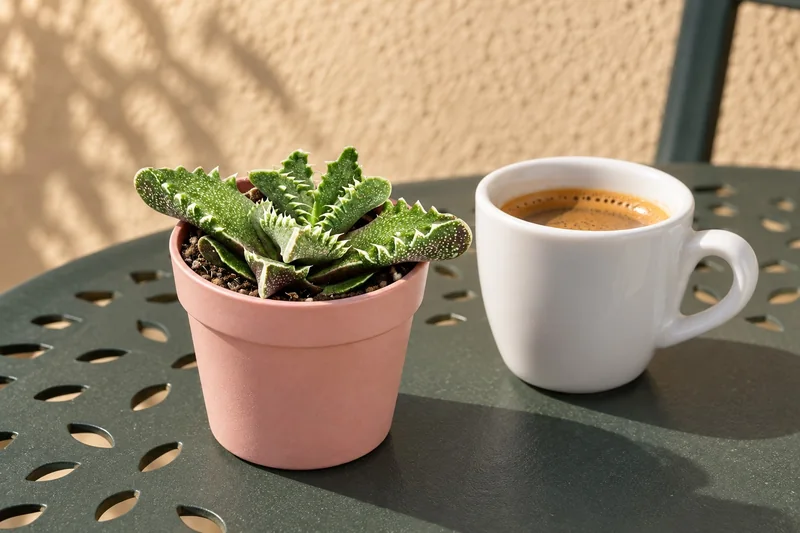
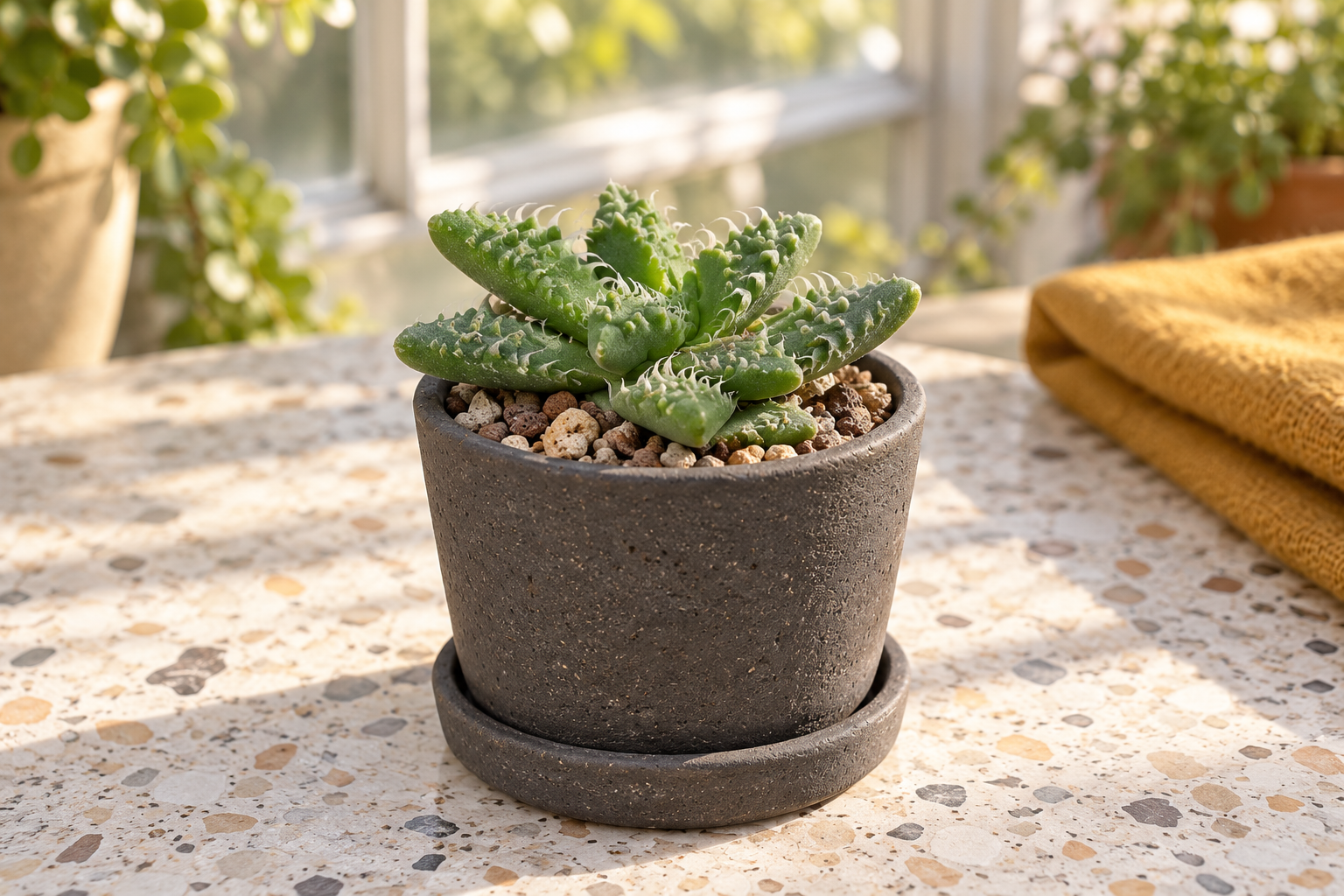
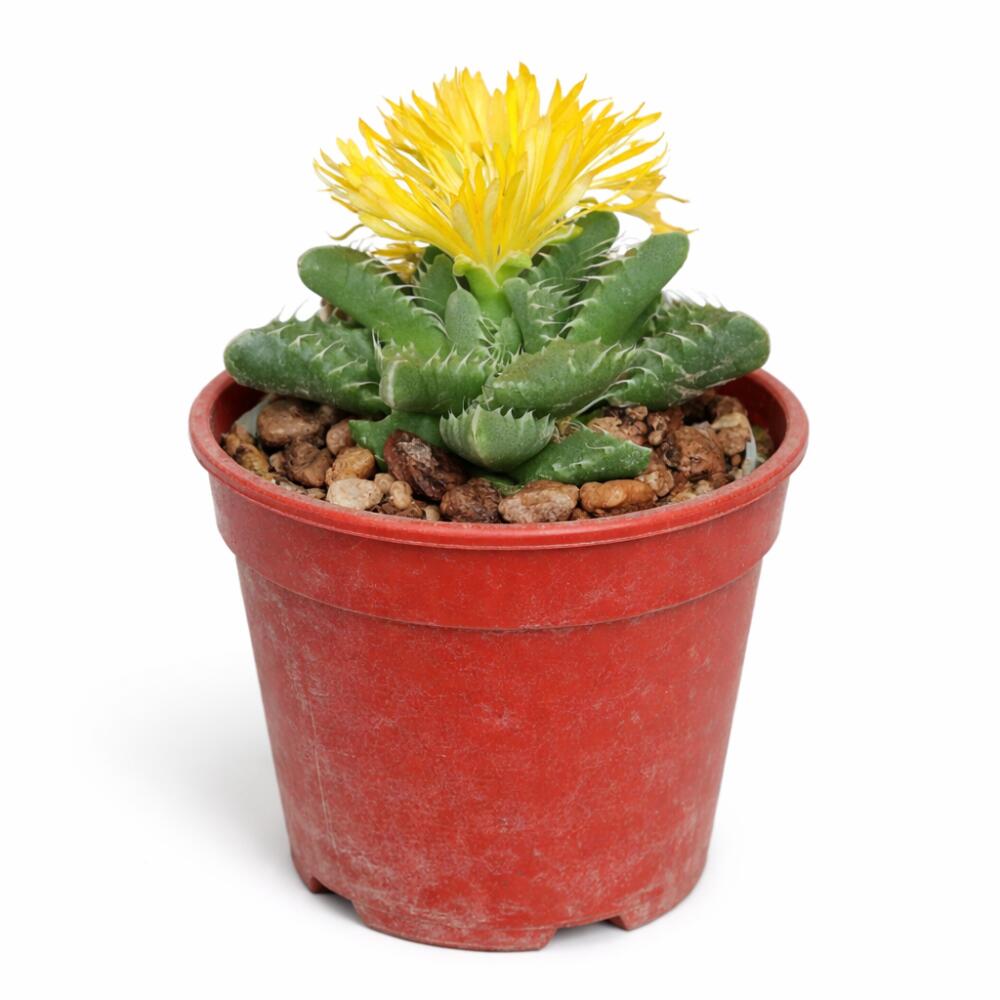
The leaf surface already tells a story on this little succulent. Green leaves are thick, wedge-shaped and arranged in pairs. Irregular pale elevations sit on their broader faces: real little warts casting tiny shadows in sideways light. Whitish soft-looking extensions stand along the margins, some with curved tips. New growth emerges between older pairs. This differs from a smooth rosette with stiff cactus spines. Position tiger jaws so you can view it sideways too, where the structure is particularly clear. Move it by the pot without repeatedly touching delicate edges.
The offered plant and its botanical name
Our own shop offer names Faucaria tuberculosa in a 6.5 cm pot with 15 cm overall height. This means the offered version including its pot; no later height of the low foliage cushion follows. The clean original shows a single plant with a yellow flower, but flowering is no fixed promise for every delivery. Botanically Faucaria tuberculosa is an accepted South African species in the ice-plant family. The also-used name Faucaria felina subsp. tuberculosa denotes the same plant. After unpacking, check growing pot and soil first. A still-moist root ball needs no preventive watering. Remove loose packing remnants without pulling firmly between leaf pairs.
Light does not turn the cushion into a dark-shelf plant
Faucaria tuberculosa requires a very bright position. Direct sun belongs to its culture but should be increased gradually after shipping or a previously protected position. Begin with plenty of brightness and mild sun before longer periods by hot glass. Watch leaf surfaces: new pale dry marks following a sudden move are reason to reduce intensity initially. A bright conservatory or sunny room away from hot airflow suits it. A rain-sheltered outdoor position is possible in warm summer too. This use ends before frost; a sunny balcony does not replace frost-free winter quarters. A permanently dark niche is unsuitable despite its small footprint.
The root ball may dry between waterings
Leaves store water reserves, yet the root zone should still be supplied during growth. Feel accessible soil and check pot weight rather than only decorative gravel. Only after substrate has dried well, apply a moderate amount to soil. Water must drain freely below; empty the saucer afterwards. Frequent little sips without checks easily keep the root collar permanently damp and make root-ball condition hard to assess. A fixed weekly rhythm fits poorly too: light, warmth and pot material affect drying. If leaves soften, check soil first. Dry soil with slightly reduced firmness needs a different response from glassy soft tissue over a wet root ball.
Drainage begins below the visible gravel
A few attractive surface stones do not drain heavy soil staying wet underneath. Choose airy cactus substrate with mineral components and a container with an open drainage hole. The small nursery pot may stay as long as the plant grows healthily and drainage works. When later repotting, give only slightly more room without sinking the base deeper. Hold the cushion by its pot or root ball, without pulling individual leaves. Restrained nutrition suffices for active growth: liquid feed once or twice at half concentration offers useful guidance. Account for fresh pre-fertilised soil. Suspend feeding during dormant winter; extra food does not compensate for missing light.
Yellow flowers belong to a possible later phase
With suitable culture, yellow flowers may appear in late summer and autumn. Many narrow petals open mainly on sunny days, so a closed bloom under dull light is no reason for extra water. The warty foliage cushion remains the attraction without flowers. Gently remove fading blooms without damaging the centre. Regular shaping cuts are unnecessary, and white marginal extensions are not cut off. Seeds or shoot cuttings are propagation options. For a newly arrived small plant, however, its own healthy growth comes first. Repeatedly splitting the cushion is no essential care step and does not accelerate settling in.
Reduce winter care and read changes
In the low-light season tiger jaws remains bright and frost-free. During resting growth keep the substrate nearly dry. That means occasional checks rather than ignoring a warm small pot completely for months. With increasing light and visible growth, carefully adjust supply again. Inspect gaps between leaves and the root collar for cotton-like deposits; root mealybugs can also be relevant in a suspicious root ball. Raised pale warts, by contrast, are natural and are not scraped off. With new soft dark areas, consider drainage, root-ball moisture and temperature together. Observing these differences gives more precise care than the general label “little water”.
One plant, several views

Good to know
How can I recognise Faucaria tuberculosa?
Typical fleshy wedge leaves carry distinct raised pale warts above and soft white marginal extensions. The elevations are not just flat dotted markings.
Is Faucaria felina subsp. tuberculosa another plant?
No. This botanical name is listed as a synonym of Faucaria tuberculosa, describing the same species.
Is 15 cm an adult cushion’s height?
No. The shop measurement is overall height of the offered version including its 6.5 cm pot. The succulent cushion grows low.
Are tiger jaws always supplied flowering?
Flowering delivery is not promised. The original shows a yellow bloom as an example; the species may flower in late summer and autumn with suitable culture.
Should I water equally in winter and during growth?
No. During resting growth in bright frost-free quarters, substrate remains nearly dry. Check roots and plant before supplying water.
Are pale warts and white deposits the same?
Firm raised leaf warts belong to the species. New cotton-like deposits between leaves or at the root collar, however, call for pest checks.
Sources and editorial note
- Exotenherz: full own offer and unchanged original gallery
- Kew Plants of the World Online: accepted Faucaria tuberculosa and synonyms (fully read 4 October 2026)
- RHS: Faucaria tuberculosa, leaf warts, habit, flowering and complete growing guidance (read 4 October 2026)
Sources compared on 4 October 2026. Own full shop offer and clean original gallery read and viewed. Offer measurements describe the offered young plant, not a later final size.