This plant at Exotenherz
Check the shop offer for current availability, price and what is included.
Product and delivery details are given in the individual offer.
Your care table
| Topic | What to do | Why it helps |
|---|---|---|
| Arrival | Unpack gently, do not use the trunk as a handle and check root-ball moisture. | The few soft leaf fans and slender trunk need careful handling. |
| Outdoor position | Choose sun and gradually increase stronger sunlight after protected cultivation. | Ginkgo is an outdoor tree with seasonal leaf fall. |
| Soil | Provide well-drained soil and clear drainage holes. | Water may supply the roots but must not remain permanently in the container. |
| Water | Keep the young root ball slightly moist; check surface and pot weight before watering. | Surface drying does not mean that the entire root ball should dry out. |
| Repotting | Once roots fill the root ball, use a moderately larger container and plant at the previous level. | Extra wet soil without roots in it does not help the small tree. |
| Nutrients | During active growth, feed moderately if needed according to a suitable fertiliser label. | Consider fresh pre-fertilised soil; feed does not solve wetness or light problems. |
| Pruning | Initially retain healthy young shoots; assess damaged parts selectively. | The species profile requires no regular pruning; frequent cutting does not create a dwarf clone. |
| Autumn | Observe yellowing and leaf fall as part of the annual cycle and adjust watering to lower demand. | A bare ginkgo in winter is not automatically dead. |
| Winter | Place the small pot under protection, retain free drainage and check on frost-free days. | The small root ball is more exposed than an established garden tree. |
For young plants, feel the soil directly at the root ball. The surface and deeper soil may have different moisture levels.
Water thoroughly after planting; later, water according to the soil, weather and establishment rather than a fixed calendar.
Avoid standing water. For plants in containers, also check that water runs out of the drainage hole.
Leaf veins open a green fan
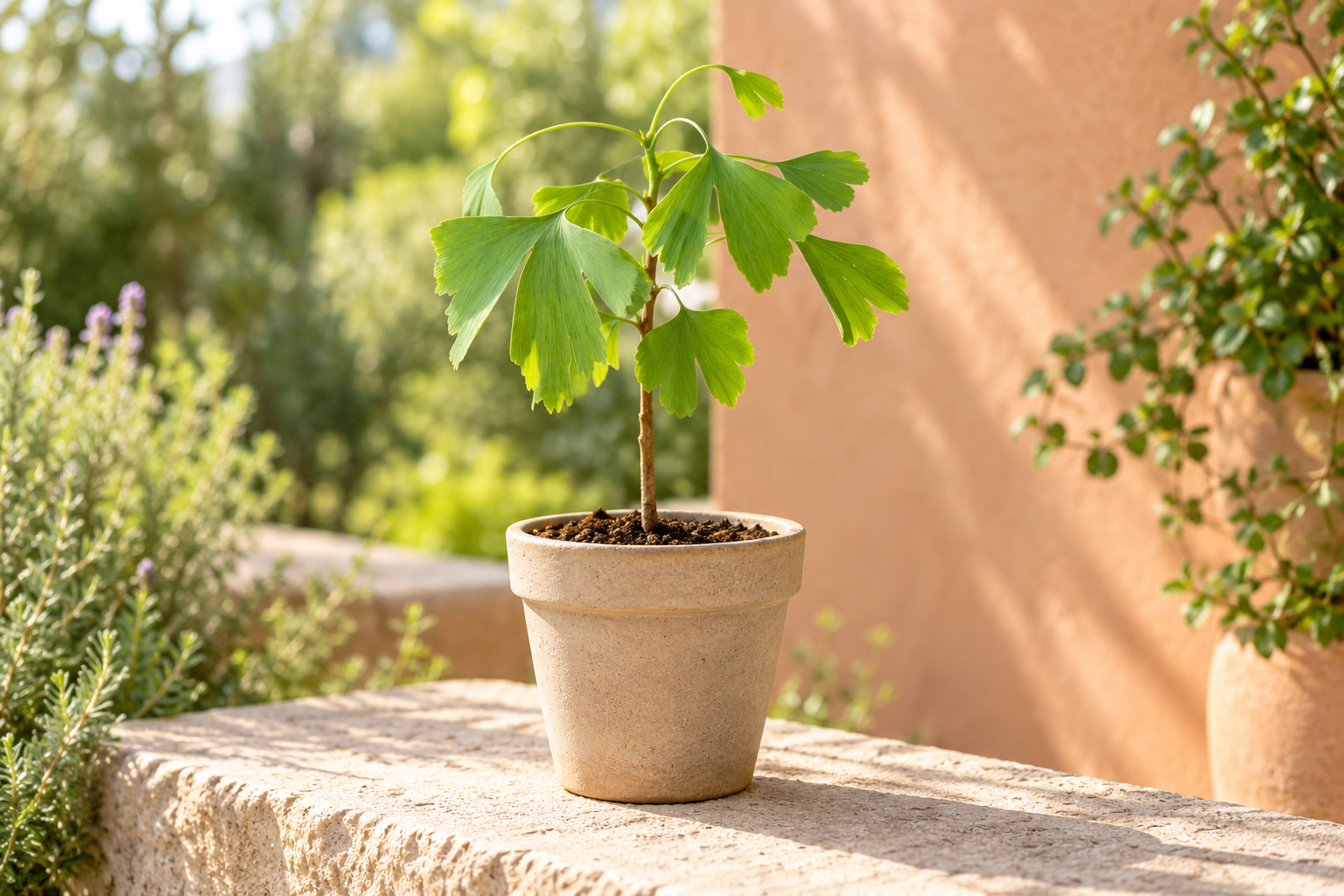
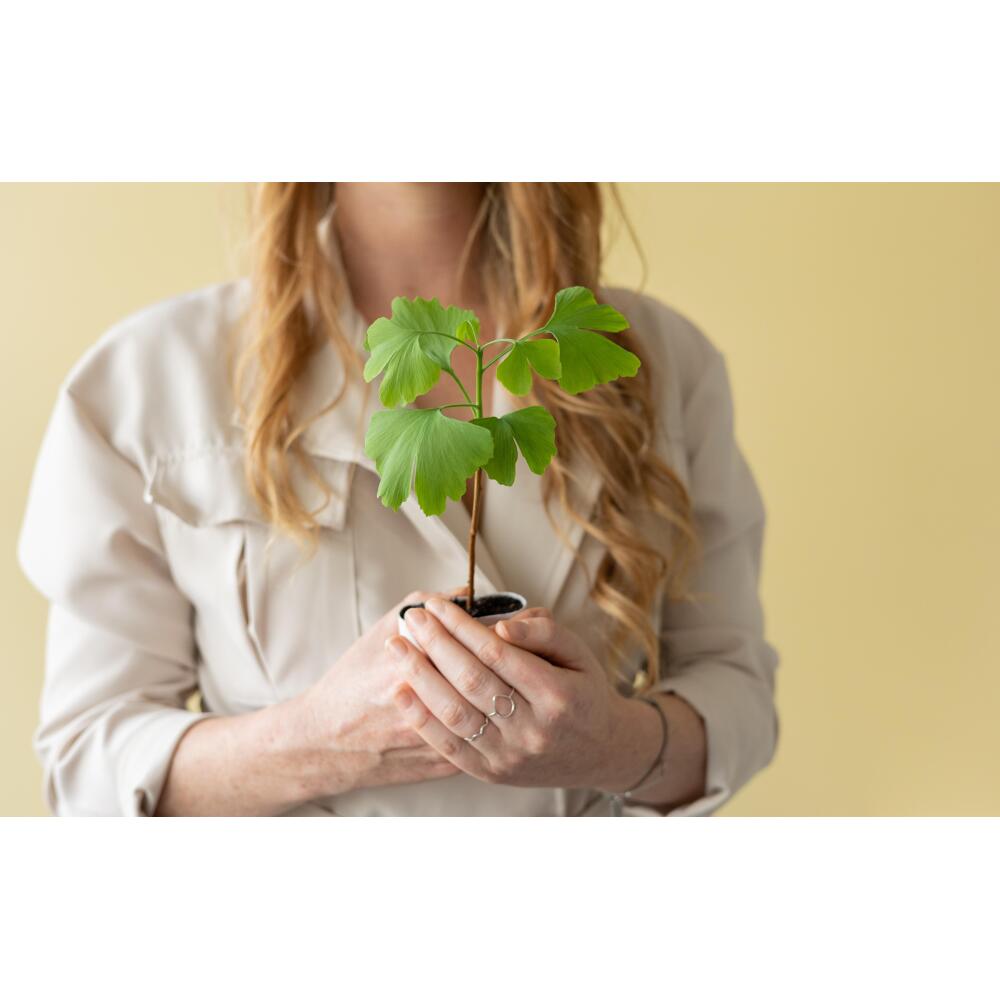
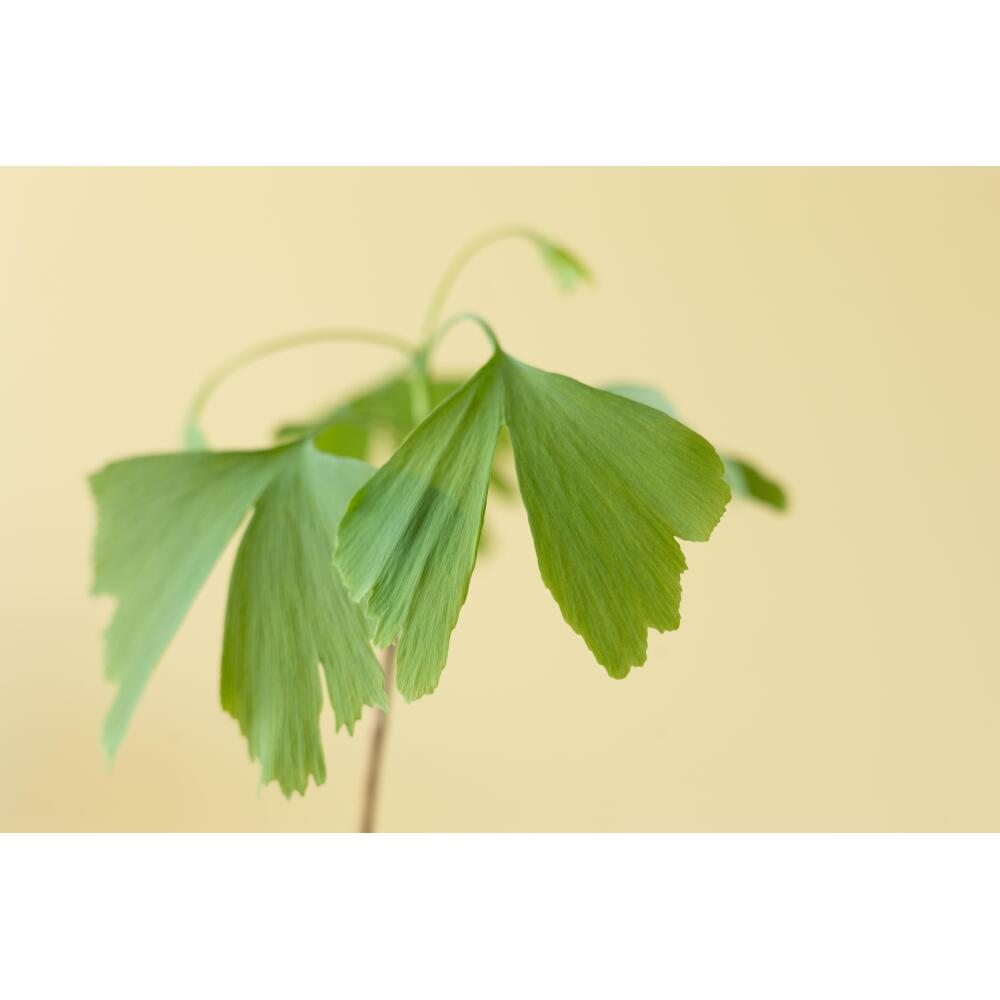
On a young ginkgo, your eyes almost naturally rest on the leaves. A long, slender stalk supports a broad blade whose veins fan out from the base and divide repeatedly. Many leaves have a central notch, appearing as two adjacent fan halves; others are less deeply divided. This natural variation belongs to the leaf pattern. The fine, slightly wavy outer edge lacks pointed maple lobes. The clean shop views also show a thin upright trunk and a few short shoots. Almost every leaf can still be followed individually. Ginkgo biloba belongs to the Ginkgoaceae family and is deciduous. The names fan-leaved tree and temple tree refer to the same species. The young plant tells its story mainly through foliage and growth, not large garden flowers. In autumn this picture changes: the fans can turn clear yellow before falling and leaving the trunk to enter winter dormancy.
Approximately 30 cm is the beginning, not mature size
This specific gift offer states a 15 cm pot and approximately 30 cm total height. Total height here includes plant and pot; a separate height above the soil is not given. The photographs illustrate a young plant but do not allow precise pot measurement. The offer names no permanently small cultivar. Plan for a young species tree that will keep developing. The RHS species profile describes Ginkgo biloba as initially rather conical and later more irregular, with a possible height up to about 25 m. This guidance concerns a long-grown tree in a suitable position. It says nothing about its height after a year in a container. The RHS later spread of 4–8 m is also a long-term planning figure. The small gift form is an attractive start, not a promise of a permanently small tabletop plant. A container may accompany the tree initially; its later development needs deliberate garden planning.
Find sun and suitable root space outdoors
A sunny outdoor position and good drainage are shared cultivation features in the expert profiles. After transport, initially choose a bright sheltered place and gradually increase stronger direct sun if the plant was previously protected. A small pot beside a hot wall needs different moisture checks from a tree in open ground. A warm indoor windowsill cannot permanently replace an outdoor position with its annual cycle. Mild frost-free conditions suit garden planting when the soil is workable and not waterlogged. Moisten the root ball beforehand and plant at roughly its previous level; settle soil gently and water slowly. The original root ball must receive water even if neighbouring soil looks moist. Before planting, check for sufficient long-term space for crown and roots. A narrow balcony or small bed corner does not automatically become a suitable permanent position for a large tree because its delivery size is small.
Slight moisture without a wet centre
For the young potted ginkgo, watering decisions begin with the soil. Check the surface and, when needed, pot weight rather than waiting for a fixed weekday. The upper layer may dry slightly; the entire small root ball should not regularly become dry during growth. As it becomes lighter and drier, moisten slowly and let excess drain completely. A saucer or outer pot must then hold no permanent water reserve around the roots. If the root ball remains heavy and wet, first check drainage and existing moisture. Rain may have supplied water outdoors, but beneath a roof it often does not reach the pot. Wind increases demand too. Better drought tolerance in an older, well-established garden tree does not mean that a young potted tree needs little attention. Wilted or yellow leaves alone prove neither dryness nor wetness: consider soil, position, season and progression together. Consumption falls after autumn leaf drop; less water still means continued checking.
Repot for the root ball, not the trunk
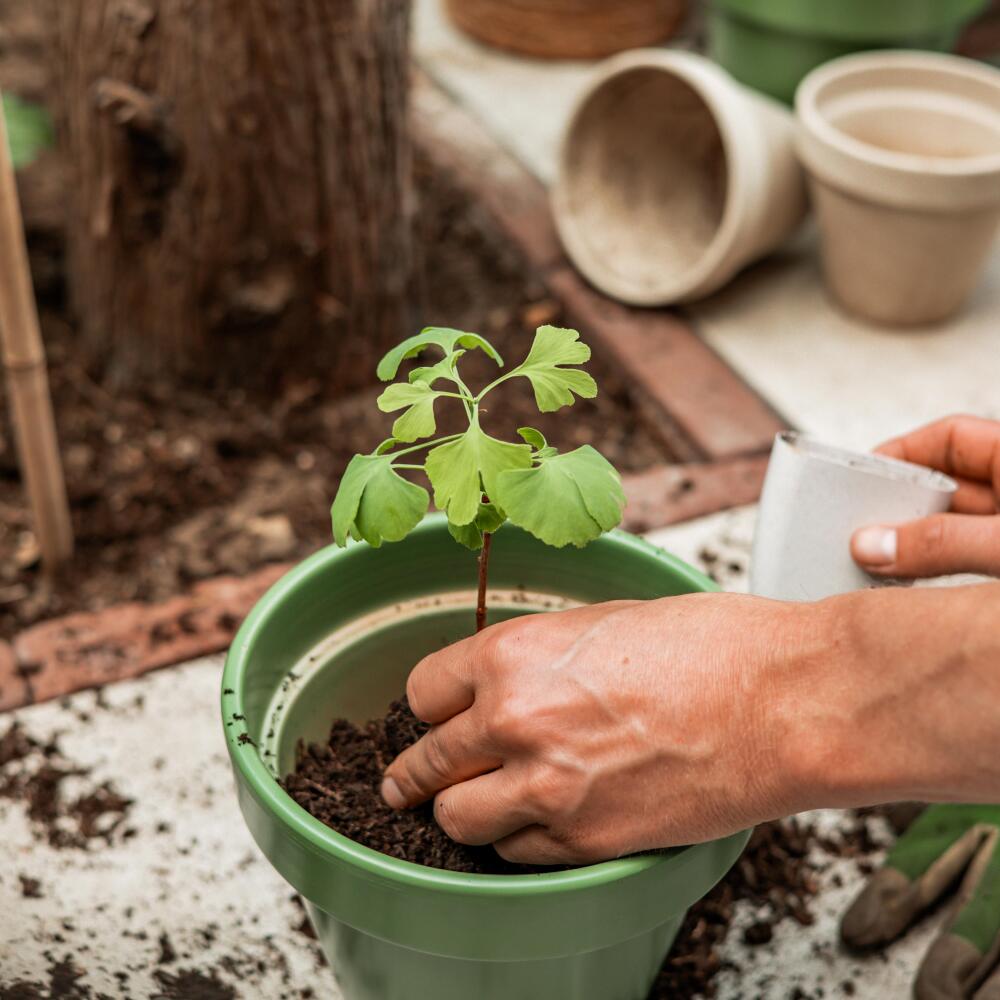
Root space chiefly shows whether a larger container is needed. If roots densely fill the ball or it dries very quickly despite suitable care, a moderately larger pot makes sense as development continues. A very large volume of soil staying wet around a few young roots would be unsuitable. Use well-drained soil, clear drainage holes and approximately retain the previous planting depth. Release the old pot gently; the slender trunk is not a pulling handle. After planting, water slowly and check for water collecting below. During active growth, moderate feeding according to a suitable label may be appropriate. Account for fresh pre-fertilised soil and observe the plant instead of transferring the shop schedule unchanged to every container. Stronger feeding does not help in winter dormancy. According to the RHS, ginkgo needs no regular pruning. Initially retain healthy young shoots; repeated cutting does not turn the tree into a named dwarf form.
Autumn yellow and a protected small winter root ball
Green fans turning yellow and then falling in autumn are part of ginkgo’s normal annual cycle. Note the timing and observe whether the change fits the weather. Premature colour in midsummer with unsuitable root-ball moisture warrants a different check from even autumn yellow. The young tree should experience dormancy; a permanently heated room is no suitable substitute. Root zones in small pots remain more exposed than those in garden soil. Place the container under protection in winter, retain free drainage and, in strongly exposed conditions, protect the pot from rapid freezing without wrapping it watertight. Protection must allow water to drain. Check moisture on frost-free days because even a leafless root ball can dry out. No general sub-zero guarantee is transferred from species hardiness to the delivery container. In spring, wait for new shoots before deciding which parts are actually damaged.
A gift becomes long-term tree planning
A ginkgo changes its space requirements slowly but permanently. Anyone starting it in a container should decide in good time where the tree can later go. A pot does not automatically promise bonsai or miniature culture. Plan in the garden according to the possible later crown and local space; the expert spread figure is guidance, not a rigid boundary distance. Buildings and neighbouring plants matter too. Male and female ginkgo trees are separate; no sex is given for this young shop selection. Female trees may later form seeds with a fleshy, unpleasant-smelling covering. Botanically these are not ordinary fruits. Do not eat seeds; wear gloves when handling seeds and their covering. Initially, foliage, trunk and roots are central to young-tree care. The RHS lists few typical pest problems, but still observe changes. A dated photograph with root-ball condition and position in the plant book helps distinguish the normal annual cycle from care problems.
One plant, several views

Good to know
Can the small ginkgo stay permanently on a desk?
For permanent cultivation it needs a suitable outdoor position and the natural annual cycle. A brief indoor gift display does not replace sun, further root space and winter dormancy.
What does approximately 30 cm total height mean?
The shop measurement includes plant and pot. The pot is stated as 15 cm; the offer gives no separate height above the soil surface. Photographs cannot replace measurements.
Does this ginkgo stay small by itself?
No dwarf cultivar is named. Treat it as a young species tree and plan long-term development; the RHS species profile gives up to about 25 m for older trees.
Must the whole root ball dry before each watering?
No. The surface may dry slightly, but the young root ball should remain slightly moist during growth. Excess water must drain freely.
Is a bare ginkgo in winter dead?
Not automatically. Ginkgo biloba is deciduous. Check season, root-ball condition and subsequent new shoots together.
Does the small pot need winter protection?
The species is an outdoor tree, but the small root ball is more exposed. Keep sheltered, maintain free drainage and check moisture on frost-free days; no fixed temperature guarantee for the container.
Is the offer a male tree?
Its sex is unstated. Young leaf shape does not prove it; later seed formation or a particular cultivar identity are not promised.
Sources and editorial note
- Exotenherz: specific Ginkgo offer, delivery measurements and original images
- RHS: Ginkgo biloba, habit, annual cycle and garden cultivation
- NC State: Ginkgo biloba, leaf features, position and reproduction
Shop offer, original photographs and RHS and NC State profiles compared on 5 October 2026. Delivery dimensions and later tree development described separately. Check availability in the shop.