This plant at Exotenherz
Check the shop offer for current availability, price and what is included.
Check the shop for the current price, availability and offer contents.
Your care table
| Topic | What to do | Why it helps |
|---|---|---|
| Position | Choose bright with plenty of indirect light. Try stronger sun gradually. | It needs light; avoid a sudden move into very strong sunshine. |
| Watering time | Wait until substrate has dried well. Consider surface, internal moisture and weight together. | A dry surface says little about moisture deeper inside. |
| Water application | Water soil and drain all surplus. Empty saucer or outer pot afterwards. | Free drainage prevents roots remaining in water after watering. |
| Container | Use clear drainage holes; a closed outer pot is only a cover. | Decoration cannot replace drainage of the actual growing pot. |
| Substrate | Use draining succulent soil allowing water out and air to roots. | Dense soil wet for a long time hinders intended drying. |
| Repotting | Repot when roots fill the container or soil loses loose structure. Choose suitable root space. | An unnecessarily large pot may hold more wet soil than the little plant uses. |
| Slower growth | Check moisture more often and allow longer drying before watering; keep bright and frost-free. | Need follows real conditions rather than a rigid monthly schedule. |
| Feeding | During active growth, use suitable succulent feed sparingly as directed. | More feed fixes neither poor light nor wet roots. |
| Leaf surface | Gently remove loose dust with a soft brush; do not rub or reshape tips. | Flattened ends belong to the plant and need no shaping cuts. |
| Checking | Watch for new cottony nests between leaves and at the base; also examine light, soil and roots. | Mealybugs may occur; succulent changes also have different causes. |
Check the compost and pot weight. The care table explains how far the compost may dry.
Water only when needed. The water should reach the root ball without spilling over the rim.
Remove surplus water from the saucer or cachepot. Then return the plant to a suitable position.
A fan worth viewing from every side
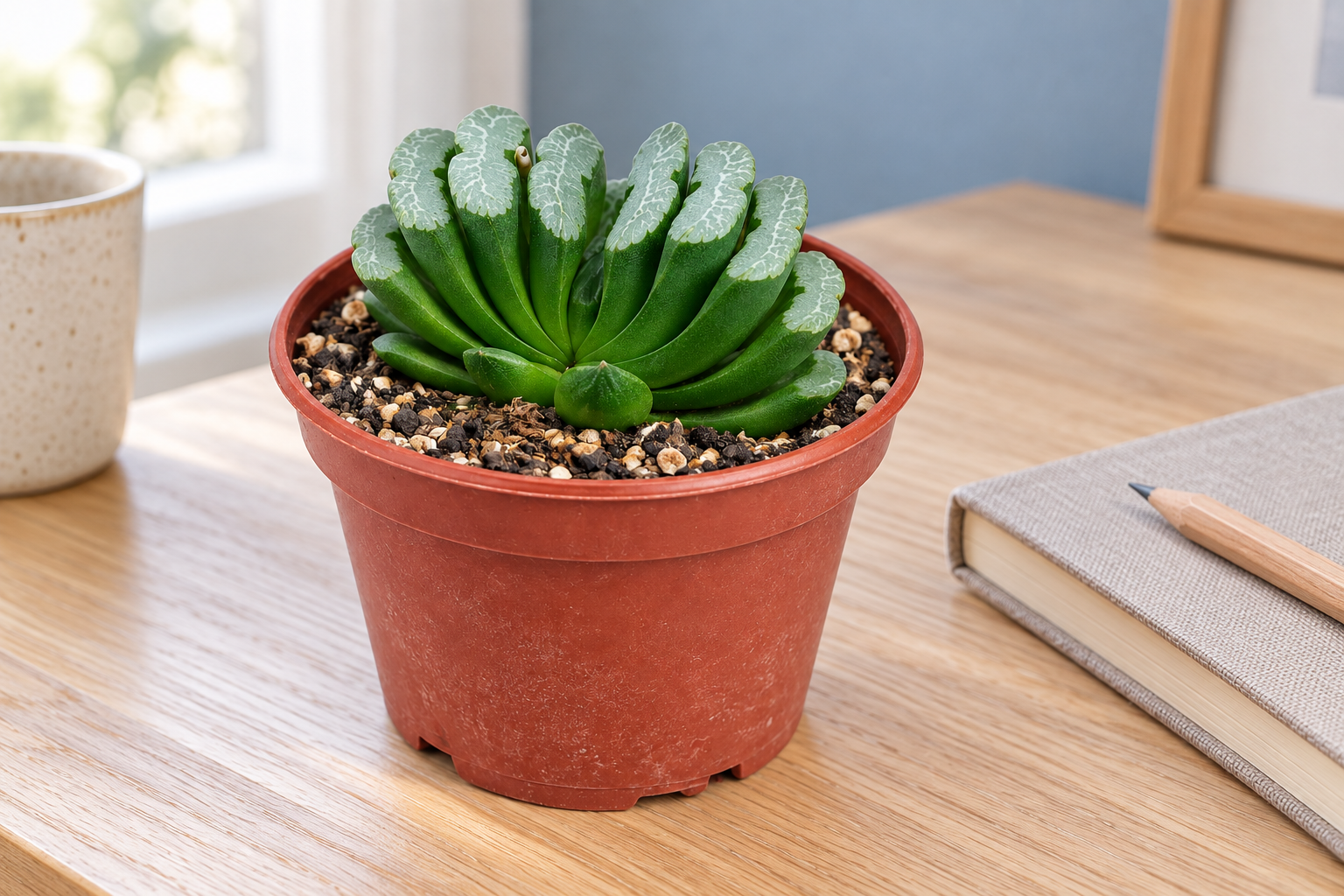
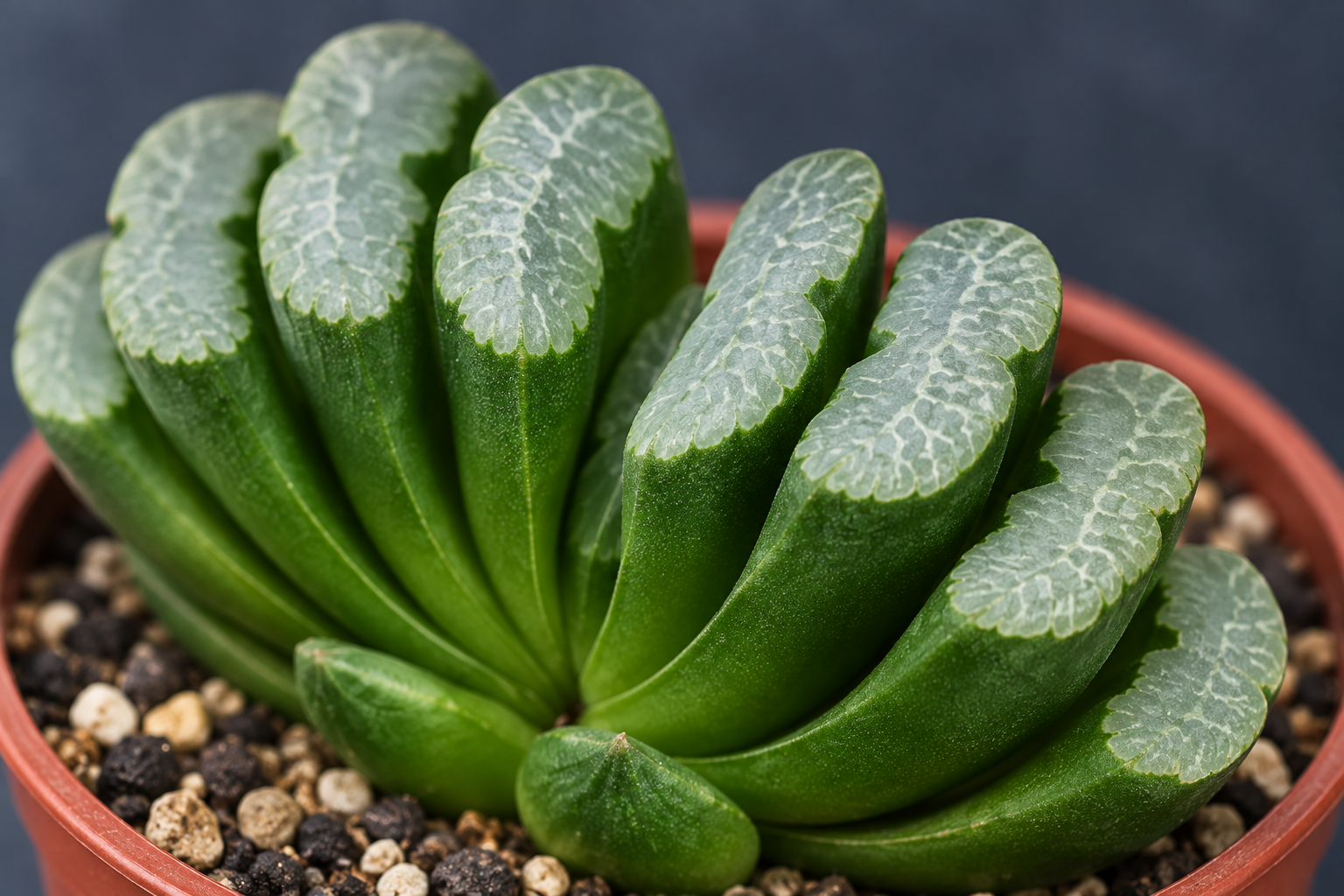
Haworthia truncata attracts through leaf shape rather than long shoots. Green fleshy leaves stand in two rows and end strikingly flat. The associated shop photograph shows a fine net-like pattern on the paler tips. Green sides alternating with pale end surfaces make the little fan interesting. When unpacking, hold the container or gently support the root ball instead of pulling leaf ends. Choose a place where close viewing and watering remain easy.
Understanding Haworthia truncata
The species’ botanical name is Haworthia truncata, with Schönland cited as author. It belongs to Asphodelaceae and comes from South Africa’s southwestern Cape. It is a perennial succulent. Very fleshy leaves arranged in two rows with flattened ends also feature in the botanical description. No cultivar or variety is fixed here. The associated specimen shows the actual arrangement; individual plants need not be identical copies. Origin describes the species and is not a guide to unprotected garden cultivation.
Much light with a gentle move towards sun
A bright place with plenty of indirect daylight is a good starting point. Desk or shelf can work if sufficient light really arrives; proximity to a window matters more than the room name. Introduce stronger sun gently while observing. An immediate move from shelter into intense sun is unnecessary. If leaves become notably pale or growth form changes, review light and conditions. Keep the place accessible for checking leaf bases and soil.
Water according to the root ball, not the weekday
Let substrate dry well before watering again. A dry surface alone may not suffice: moisture can remain deeper. Test at an accessible point and compare pot weight to assess the root ball. When needed, water soil and let surplus drain fully. Leave no water in saucer or closed outer pot afterwards. Water soil rather than regularly showering the fan. Sparing watering does not mean keeping the plant completely dry permanently; drying, light and growth guide the next decision.
Draining soil and appropriate root space
Desired drying starts with soil and container. Free-draining succulent soil with mineral structure lets water escape and keeps air around roots. Clear drainage holes are essential. A decorative closed cover can enclose the pot but needs checking and emptying after watering. Repot if roots fill the space or soil loses its loose structure. An oversized pot adds moist soil around a little root ball. Support by the root ball when moving; fleshy leaves are not handles.
Slow growth needs an adjusted routine
Our offer describes Haworthia truncata as slow-growing. Observe changes over time rather than expect new leaves daily. During active development, use suitable succulent feed sparingly as directed. If growth is less visible and soil stays moist longer, needed watering intervals lengthen. Keep bright and frost-free. This fixes neither resting months nor an exact temperature. The individual plant’s signs matter; extra water or feed cannot force healthy growth.
Preserve leaf patterns and examine changes
Flat ends and pale markings are part of the visible appearance. Do not rub or trim them into shape. Remove loose dust gently with a soft brush if needed. Look between leaves and at the base: new cottony nests warrant closer inspection for mealybugs. Soft or discoloured tissue, strong shrivelling or altered growth are not definite diagnoses. Consider moisture, roots and light together. Not every change needs more water; with soil wet for a long time that would be the wrong first response.
A small plant with easy-to-follow care
An accessible place simplifies care. Briefly check bases and soil before watering, drainage afterwards and development occasionally. While learning drying, note watering dates and changes in pot weight. This helps observe your own place rather than establishing rigid rules for all seasons. Haworthia truncata is already interesting in its green fan and pale tips. It needs no promised flowers or rapid size increase to reward close viewing.
One plant, several views
Good to know
Why do the leaf ends look cut off?
Flattened ends are characteristic of Haworthia truncata. Do not recut or reshape them.
Must it have full sun?
Bright with plenty of indirect daylight is a good start. Try stronger sun gently instead of suddenly moving into intense sunshine.
How can I tell when to water?
Substrate should have dried well. Check an accessible point inside the root ball and pot weight as well as surface. A fixed weekday does not replace checks.
Must I repot straight after purchase?
Not necessarily. Root space, soil structure and drainage decide. Repot when needed without creating unnecessary extra wet soil.
Are pale tips a sign of pests?
The regular pale pattern is visible on the associated plant and is not removed. Check new cottony nests at bases separately. Appearance alone cannot replace close inspection.
How often should I water in winter?
No fixed calendar here. With less growth and slower drying, water later. Keep bright and frost-free.
Does the fan need shaping?
No. Preserve flat leaf ends; gently remove loose dust with a soft brush if needed.
Does little water mean little attention?
Applications may be sparing but light and root space still need attention. Brief checks of soil, leaf bases and free drainage help follow actual need.
Sources and editorial note
- Exotenherz: our offer and associated shop photograph (checked 6 October 2026)
- Royal Botanic Gardens, Kew: Haworthia truncata, name and origin (6 October 2026)
- Royal Horticultural Society: Haworthia truncata, species description (6 October 2026)
- Royal Horticultural Society: Haworthia, general genus cultivation (6 October 2026)
- Royal Horticultural Society: cacti and succulents as houseplants (6 October 2026)
Our offer and associated photograph checked on 6 October 2026. Care follows light, drying and actual growth.